
Submission by Marks Barfield Architects.
Being a good ancestor
Practice
1. Do you have a clearly stated purpose aligned with the planetary emergency? We’re looking for a bold ambition here, and a culture which recognises the need for long-term thinking.
Collectively, we developed a vision to “Become a regenerative design practice, aligned with the planetary emergency where projects are designed, constructed and operated within ecological boundaries, maximising social justice and biodiversity outcomes”. A regenerative design roadmap was workshopped with a plan for 1-year, 2-year and 5-year actions, including advocacy, knowledge-sharing and fostering circular economy principles. We refocused on retrofit and reuse, adopted the donor-recipient model, and are developing a project entirely from reclaimed materials. Our plan is reviewed annually, as a team.
Over the past year, we have focused on advocacy for regulatory change through Architects Declare, including the London Eye takeover for the Circular Revolution campaign, and participation in a range of industry events. Our work also includes the West Somerset Lagoon, a speculative tidal energy project that would represent the UK’s largest renewable energy scheme, capable of powering over two million homes for more than 120 years.
2. Do you have a clearly stated purpose aligned with the planetary emergency? We’re looking for a bold ambition here, and a culture which recognises the need for long-term thinking.
MBA, founded by a husband and wife partnership, is rooted in family spirit: nurturing employees, eschewing strict hierarchies, and based on mutual trust, respect, with a culture promoting a good life/work balance.
The directors have written a vision document articulating the values and ethos of the practice: architectural excellence, social and environmental commitment, collaboration, and integrity. These values are completely aligned with regenerative principles and intended as a guide for MBA into the future.
MBA has a Share Incentivisation Plan (SIP) as a way of sharing ownership. Currently 89.5% is owned by the founding director and 10.5% by a Share Incentivisation Plan Trust. The intention is to increase the share ownership with those who contribute to the practice’s success. Discussions of possible succession avenues are ongoing among directors and employees. The transition will ensure continuity of purpose and stewardship, while enabling wider employee participation, voice, and agency in practice direction.
3. Do you share research and knowledge for the benefit of society and the wider world?
The practice promotes knowledge-sharing and transparency to benefit society and the environment. This includes research into reuse through voluntary initiatives and Circular Economy consulting, alongside pro-bono POE on several projects. We regularly collaborate across the industry on CE strategies, such as publishing case studies of lessons learnt on reuse driven projects.
Contributions to industry research includes the Measuring Mass Timber Research Project with DRMM, the QoL Foundation and Edinburgh Napier University, assessing the performance of the Cambridge Central Mosque. We have participated in the Build Zero material flow studies with ReLondon, material passport research with ORMS and UOL, aided the FIS reuse pilot, and publications on material reuse and regenerative design.
To help drive sector wide change we regularly speak at industry events including Futurebuild and Footprint, collaborate with organisations such as Reusefully and Material Index, and participate in advocacy groups including ACAN, Architects Declare, the CDT and The Edge.
Project
1. Do you advocate for long-term thinking at the outset of work? Do you initiate work with long-term thinking and challenge clients? Also, can the organisation demonstrate that this approach has worked?
We developed our own regenerative framework for the MDDT to track throughout all stages of the project, starting with a client workshop to establish their deep, long-lens purpose. We interrogate the need for building and prioritise efficiency at inception, forensically looking at the site’s systems at all scales. As masterplanners for a UK government project we questioned the proposed demolition, calculated the carbon and suggested saving buildings which were resultantly reused.
Our approach is informed by “seven-generation thinking”, exemplified by the West Somerset Tidal Lagoon, designed to provide renewable energy for over 200 years, and social regeneration.
We consistently apply circular economy principles to extend material life. On an office fit-out, material reuse saved 577 tonnes CO2e and £1.65m through effective collaboration.
We explore shorter, adaptable design lives, including a deconstructable pop-up venue for Touretteshero that reuses materials to test and tease out real inclusive design for theatre and play.
2. Does your work take account of the future climate and the need for resilience?
We approach every project through the lens of the climate emergency, designing for adaptability and resilience. Scenario planning tests how our office designs might evolve, with structural strategies that maximise open spans and reduce fixed elements. For an office building in India, we’ve worked with engineers to project future climate data—shaping a façade of stone fins that block direct sun while maintaining daylight. We view buildings as material banks, establishing a host–donor model with an in-house -circular economy. Early material audits identify reuse opportunities and inform strategies for disassembly. A developing project with Touretteshero looks to build a deconstructable pop-up venue to test ideas for a more permanent relaxed venue; the aim is to then reuse the pop-up in the final design. A recent project with the charity Oasisplay is designed entirely from reclaimed materials—demonstrating our commitment to resource-conscious, demountable design that adapts to changing environmental and social needs.
3. Does the majority of your work go beyond mitigating negatives and towards optimising positives?
We are signed up to the RIBA 2030 Challenge and committed to going further: working under a just and regenerative mindset, exceeding current carbon targets. We aim to benefit the environment, community, and future generations while respecting planetary boundaries. At our behest the London Eye donates 1% of turnover to the local community in perpetuity- amounting to £15 million.
We seek to go beyond ‘the redline boundary’ to enhance biodiversity and generate renewable energy. With the Touretteshero project, we are working iteratively to promote regenerative principles and question Part M for a more inclusive society. On the Isle of Wight Rewilding School, we are exploring ways to rewild a swath of the countryside and create a centre for learning to uplift the local and wider community. At the Leyton Cricket ground, we are using the grade II listed project to test and challenge the cross section between heritage and sustainability.
Co-evolving with nature
Practice
1. Do you use biophilia within your premises and/or do you regularly gather in natural settings?
Our studio, based in a repurposed 19th-century warehouse, integrates biophilic principles to support wellbeing and productivity. Skylights provide even daylighting, and planting is curated throughout the space—including a living green wall, stairwell creepers, and individual desk plants—managed by our office manager. These features are part of a broader approach to regenerative workplace design, supported by our evolving material library, which features natural fibres, bio-based materials, and reclaimed timber. Our ongoing refurbishment includes a terrazzo kitchen surface made from recycled woodchip—sourced via our reuse network. Our layout supports calm focus and natural cues for rest, supported by passive ventilation and views to the sky. Our staff culture reinforces this: we have lunchtime picnics in our local park and host offsite annual trips in natural environments. Together, these spatial and cultural practices bring biophilia into daily life—embedding nature as a collaborator in both our space and thinking.
2. Can you share examples of where you have considered nature in decision making?
Nature actively informs both our practice culture and decision-making. We have adopted a decentralised, collaborative structure inspired by biomimicry, with teams operating interdependently to encourage resilience and adaptability. Seasonal rhythms also influence our approach to workload and wellbeing, recognising that people’s capacity changes throughout the year.
Recent workshops exploring local ecologies led to regular staff walks to the Oasis Nature Garden and Clapham Common, alongside annual support for Friends of Clapham Common and its biodiversity initiatives. We also engage with wider regenerative design networks, including IStructE workshops focused on nature-led approaches to collaboration and client engagement.
Our office environment reflects these values through biophilic design principles including planting, natural light and passive ventilation, alongside a zero-waste policy and preference for low-impact materials. We view nature not as a backdrop, but as a co-designer that shapes our systems, culture and approach to regenerative practice.
3. Are you supporting nature locally and nationally?
We support nature locally and nationally through design, advocacy and long-term stewardship. In Clapham Old Town, we completed an urban piazza that reversed the balance of road to pavement, introducing 80 trees. Being actively involved in Clapham BID and Friends of Clapham Common we are currently lobbying for further greening of Clapham High Street through tree planting. We support Larkhall Park; including assistance with grant funding applications, advocacy for biodiversity enhancement, and improvements to play spaces and community events. We are supporting Oasisplay, a local youth charity, by delivering a new forest school building. Nationally, we support rewilding initiatives such as the Isle of Wight School for Rewilding and the West Somerset Lagoon in the Bristol Channel. Through our involvement in the AD Steering Group, we are advocating changes in legislation to tackle the biodiversity crisis, for example the AD Building Blocks manifesto; launched in parliament in March 2024.
Project
1. Can you demonstrate work that strives to match the performance of a mature ecosystem?
We consider projects through a regenerative framework, understanding them as small parts of wider systems; of not only a physical ecosystem but also metaphysical. This informs interventions that seek to enhance ecological function rather than reduce harm, with BNG adopted as a minimum baseline where applicable. For our Croydon High School project, we brought rewilding and greening to the fore, planting 52 new trees on the site achieving the BNG and promoting the school’s green fingered groups looking after bees and wildflower meadows. Other projects include a large mosque which is designed as a ‘grove of trees’ with sculptural tree-like columns. As part of enhancing the curb appeal and increasing biodiversity we created a community garden using native plants and creating aquatic habitats. The School of Rewilding aims not only to enhance existing biodiversity, but to bring new and forgotten species to the site such as Elk and Beavers.
2. Are you working on material stewardship?
We consider projects through a regenerative framework, understanding them as small parts of wider systems; of not only a physical ecosystem but also metaphysical. This informs interventions that seek to enhance ecological function rather than reduce harm, with BNG adopted as a minimum baseline where applicable. For our Croydon High School project, we brought rewilding and greening to the fore, planting 52 new trees on the site achieving the BNG and promoting the school’s green fingered groups looking after bees and wildflower meadows. Other projects include a large mosque which is designed as a ‘grove of trees’ with sculptural tree-like columns. As part of enhancing the curb appeal and increasing biodiversity we created a community garden using native plants and creating aquatic habitats. The School of Rewilding aims not only to enhance existing biodiversity, but to bring new and forgotten species to the site such as Elk and Beavers.
3. Does the majority of your work demonstrate the use of biologically-inspired approaches such as Bioregionalism, Biophilia or Biomimicry?
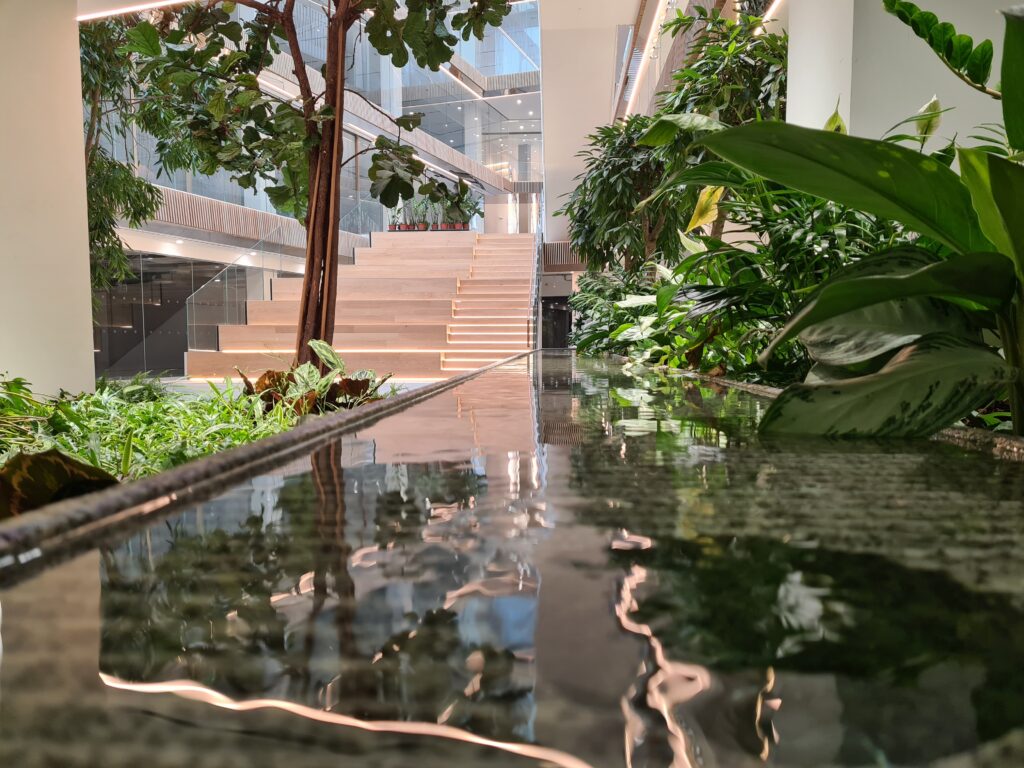
Our approach to structural efficiency and expression draws inspiration from biological systems, informed by biomimicry, biophilic design and ecosystems thinking. Projects include the competition-winning Bridge of the Future, a bridge inspired by the structural logic of a dinosaur spine; Kew Walkway, based on tree structures and the Fibonacci spiral; and the Cambridge Central Mosque’s timber tree-like columns that use passive principles to ventilate and illuminate the space like a forest canopy. We are designing a building with a hexagonal plan, using the structural efficiency of nature—beehives, carbon molecules and snowflakes—to reduce material use and minimise embodied carbon. Across projects we map local materials at early design stages to inform proposals, reducing carbon and supporting local economies. Biophilic principles are embedded throughout, for example in a mixed-use office building the atrium acts as a ‘forest floor’, incorporating a rill, mature trees and layered planting to enhance wellbeing and connection to nature.
Creating a just space for people
Practice
1. Do you have a progressive EDI policy and can you evidence many forms of diversity, which are welcomed and acknowledged, within your company/organisation?
We embrace and celebrate diversity in many forms, with staff from a range of ethnic, cultural, and professional backgrounds. We maintain gender balance and value different perspectives across ages and experiences. Our recruitment process is designed to be bias-free. Staff receive regular EDI training, and our flexible working policies support those with caregiving or other needs. Our commitment extends beyond the practice: we deliver pro bono work for underserved communities and offer work experience to inspire young people from underrepresented backgrounds. We are also taking steps to make our workplace more inclusive. Recent improvements include an accessibility audit (inspired by work with a wheelchair-using client) and the creation of a dedicated prayer space. Through these efforts, we aim to build an open, supportive, and progressive culture where equality, diversity, and inclusion are truly embedded and help drive our innovation.
2. Do you operate a no overtime culture, meet the living wage consistently, and stipulate a fair salary ratio between staff of all levels?
The practice operates a no overtime culture where working beyond our business hours of 37.5 hours per week is discouraged, and we consider the work-life balance and the overall wellbeing of the staff to be enormously important to the efficiency and productivity of the work that we do. Clear policies are in place outlining the conditions under which overtime is allowed to achieve project and competition deadlines, how it should be managed, and when it can be compensated with time off in lieu.
We carry out thorough annual industry-wide salary benchmarking, resulting in the provision of good, fair, and gender-equal pay (from the inception of the practice). We determine a fair salary ratio between the staff of all levels by balancing equity, market standards, and the specific roles and responsibilities within the company; also ensuring that an intern, and our cleaner, are paid above the London Living wage.
3. Do you support charities, community groups, social enterprises, action groups and others through pro-bono work, charitable giving or in-kind donations?
Since inception in 1989, the practice has been embedded in the local community, carrying out pro-bono and cost-only work for charities and good causes. We have worked on a variety of projects for Oasisplay in Stockwell, providing pro-bono services to submit planning applications and sourcing, deconstructing and re-building a Walter Segal building on the South Bank. We have also carried out several small-scale refurbishment projects for Clapham Omnibus Theatre.
Our involvement with the London Eye saw our community activity widen to incorporate the Southbank where we embedded our most notable charitable initiative which ensures that 1% of ticket sales go to the local community in perpetuity amounting to £15 million so far.
Prior to achieving some funding on the Relaxed Venue Project, we have worked pro-bono with the disabled arts charity Touretteshero for several years, supporting them in projects like the Tate Bodies in Motion and Oasis cycle hub.
4. Do you use an ethical framework to assess opportunities and/or supply chain partners and is them team consulted on these decisions?
The practice has taken a principled ethical position regarding taking work or tendering projects in certain countries where Governments or ruling regimes are known to oppress free speech and or carry out political oppression. We have turned down opportunities in countries (in the Middle East) if we could not see that the clients shared our ethos on climate emergency and social justice. We carefully consider the practical implications of carrying out work in countries where the extreme locational distance would require extensive air travel.
We have also taken a principled position within our industry by questioning the M&S Oxford St development. Our founding director spoke at the public enquiry in defence of retaining the existing building. We subsequently submitted a proposal for the RIBA Re-Store competition, for which we were shortlisted.
Project
1. Does your work demonstrate deep engagement with local stakeholders and end users?
Our projects demonstrate deep engagement with local stakeholders and end users, moving beyond consultation to embrace co-design. We understand co-design as extracting local intelligence and embedded knowledge for the benefit of the project. In Leyton, for the refurbishment of an historic cricket pavilion, we developed youth workshops with Matt+Fiona and J&L Gibbons. Local young people (paid for their time) contributed ideas through these creative sessions using collage and model making. For Touretteshero (centre for Disabled and Neurodivergent Arts) we held dreaming and scheming workshops that combined lived experience with regenerative design principles, shaping a shared vision. A live scribe visually captured the conversations, helping record and reflect ideas creatively. We also build long-term relationships: 19 years after completing a community art gallery, we’ve returned to support maintenance and improvements. Through sustained and inclusive engagement, we create designs that reflect community needs, encourage ownership, and embed value well beyond project delivery.
2. Does your work create connected and resilient communities which positively contribute to neighbourhoods and allow equality of access?
We approach each project individually, responding to the site and its community. Rather than applying a singular style, our work is shaped by local context. The London Eye generated significant economic opportunity, with 1% of ticket sales reinvested into local initiatives like Jubilee Gardens. Footfall on the South Bank tripled the year it opened and since has significantly boosted the local economy, generating over £143 million in Gross Value Added annually to London and supporting over 200 on-site jobs.
We embed social value throughout our processes: in Leyton, young people participated in workshops to co-design the Cricket Pavilion, fostering a sense of authorship and pride. With Touretteshero, we are developing a relaxed venue – an inclusive, accessible centre for Disabled and Neurodivergent Arts – which aims to shift public perception around disability. In all cases, we aim to create connected, resilient places that leave a lasting, positive legacy within their neighbourhoods.
3. Does the majority of your work promote equity in society, and consider all people, not only building inhabitants
Our design process places people at its heart, engaging communities from the outset to ensure we address demographic, social, and cultural needs. We carefully specify responsibly sourced materials, prioritising locality to support regional economies and reduce emissions. We consider the ethical implications, including supplier due diligence and Modern Slavery training; visiting stone quarries in Delhi to ensure safe working conditions with no child labour. Politically, we took a stand, not using Russian plywood in response to the Ukraine war. We believe our time can offer the greatest social value. At Leyton Cricket Pavilion we pledged to run eight workshops across local schools, mentor three young people throughout the construction, and three additional workshops to involve youth directly. Designing a relaxed venue for Touretteshero, we aim to radically change societal perceptions and norms throughout the project and its process, reviving the idea of public luxury, promoting equity and inclusivity throughout society.