
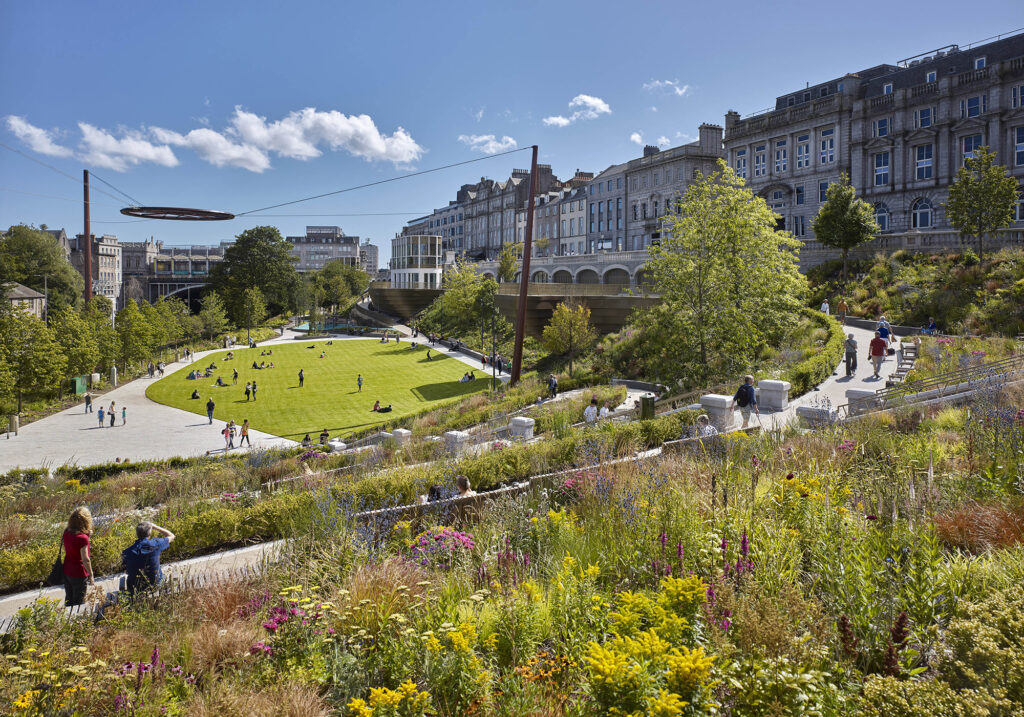
Submission by LDA Design.
Being a good ancestor
Practice
1. Do you have a clearly stated purpose aligned with the planetary emergency? We’re looking for a bold ambition here, and a culture which recognises the need for long-term thinking.
We are a collective of placemakers aiming to shape the world for the better. We are proud to be 100% employee owned. We champion change that raises the quality of life without hurting the planet.
We start at the end, by imagining ambitious outcomes for every project. We make a bold case for change and design for a world where nature is regenerating, and where people believe in the possibility of a brighter, fairer future.
We listen, in a world that often doesn’t. By asking the question, ‘what’s the change you want to see?’, we can find the bigger wins and build consensus, aligning clients and communities around a shared purpose and vision. Our outcomes-led approach is grounded in the UN Sustainable Development Goals and Doughnut Economics.
We are aiming for Net Zero by 2050 and are on course to reduce our carbon emissions by 42% by 2030.
2. Do you have a clearly stated purpose aligned with the planetary emergency? We’re looking for a bold ambition here, and a culture which recognises the need for long-term thinking.
Transitioning to 100% employee ownership in 2021 changed how we work, ensuring our employee-owner voice is strong across our governance and decision making.
Our Employee Involvement Group (EIG), made up of representatives from each of our studios, is at the heart of our governance structure. EIG members sit on our governance groups, including Trust, Board and Operations. Our governance is designed to be open and transparent, supporting our ‘One Business’ culture. The Trust serves as a critical friend, has an independent Chair, and protects our long-term interests.
We are two years into a three-year business plan shaped by our employee owners. Through it, we have developed an outcomes-led approach to projects and greater resilience. We have launched a creative ideas lab and strengthened our approach to EDI through new policy, training and an inclusive language guide. Under ‘growth with purpose’, employee owners can now pitch ideas directly to our Board.
3. Do you share research and knowledge for the benefit of society and the wider world?
Our culture is built around advocacy. Our employee owners are driven by social and environmental concerns and a desire to create positive change. We partner with others to help move thinking on. This summer, we are working with Tranquil City to reveal the impacts on wellbeing of our radical redesign of Strand in Westminster.
We share knowledge through workshops, articles, research, talks, tours and design review, in the UK and internationally. We actively support industry organisations, including the TCPA, RTPI, NLA, The Developer and Landscape Institute. We sponsored the 2025 TCPA conference and spoke about the purpose of planning. This was also the subject of our article for The Planner, co-authored with the Quality of Life Foundation.
We present on good design for major infrastructure and on high street recovery, including for Design for Wales. We contribute to industry publications including the Landscape Institute’s Journal, IEMA’s Outlook and Building Design.
Project
1. Do you advocate for long-term thinking at the outset of work? Do you initiate work with long-term thinking and challenge clients? Also, can the organisation demonstrate that this approach has worked?
Circular and responsible use of resources is one of the seven outcomes which govern our projects from the outset. We listen to, and work closely with, local communities to ensure current and future needs are met, adopting meanwhile strategies to test viability and encourage engagement and ownership. We also select high-quality, sustainable (local, where possible), hard-wearing, long-lasting materials. With our Outcomes Framework we can champion the environment and challenge.
Reuse is at heart of our public realm work. For Woolwich Town Centre, which completed last year, our strategy to revitalise the town’s main square and high street included retaining and recycling as much material on site as possible. Existing paving was lifted, crushed and repurposed as substrate with 60% of all paving reused. Granite blocks lifted from the square became seating on the high street and stepping stones in a new pavilion garden. The design has been welcomed by residents.
2. Does your work take account of the future climate and the need for resilience?
Our projects strengthen climate resilience, from major infrastructure that looks to create wider environmental benefits through to public realm where biodiversity and green space are maximised, enhancing urban cooling, tackling air pollution and improving surface water management by integrating SuDS and rain gardens. Our projects include renewable energy and new reservoirs.
We make multifunctional, nature-based solutions the norm for placemaking. Our Outcomes Framework includes climate stability and resilience and thriving nature and ecosystems. These guide our work ensuring we meet community needs within planetary boundaries.
Our masterplan vision for a new community in East Cullompton, Devon, minimises potential carbon emission sources and increases the benefits of nature, including supporting pollinators to improving soil health; natural water management; and carbon storage. This influenced spatial decisions, such as avoiding soil disturbance in areas of high-carbon storage and creating new areas of woodland and wetland where they can deliver the greatest benefits.
3. Does the majority of your work go beyond mitigating negatives and towards optimising positives?
Our Outcomes Framework takes projects beyond outputs and mitigation towards maximising benefits for people and planet. It is built on our values and aspirations for sustainable development and was shaped by discussions of what ‘shaping the world for the better’ means to us today. It sets clear direction and hardwires into the process monitoring, evaluation and continual improvement. Our outcomes are:
- Equitable & inclusive communities
- Memorable & inspiring places
- Climate stability & resilience
- Prosperous & distributive economy
- Healthy lives & wellbeing for all
- Circular & responsible use of resources
- Thriving nature & ecosystems
In Southsea, a project to protect 10,000 homes and 700 businesses from flooding could have focused on building a new concrete sea wall. Instead, we worked with the project team to ensure that it delivers on placemaking ambitions, transforming the seafront to offer a dramatically better experience for residents and visitors, with high-quality, social public spaces, which celebrate heritage and feature generous marine planting.
Co-evolving with nature
Practice
1. Do you use biophilia within your premises and/or do you regularly gather in natural settings?
Close contact with nature is known to reduce stress, improve mood, and cognitive function. Biophilic design makes for healthier, happier places, and we advocate for this approach, including at major international healthcare forums, as we promote the role place has in preventative healthcare. Naturally, biophilia shapes our workspaces too.
We invest in our working environments, and all of our studios are airy, comfortable, welcoming, rich with plants and with good levels of natural light. They feature a mix of spaces to accommodate different types of working – from long benches for collaborative design to spaces for quiet conversation or focused work. Lunchtimes are communal, and studio activities include nature walks.
Every employee owner has a volunteering day to use annually in support of causes important to them. Many involve nature restoration. Last year, this amounted to 269 hours of volunteer time covering 22 events, including restoring deadwood hedgerows at Brockell Park.
2. Can you share examples of where you have considered nature in decision making?
We are committed to making the case for change that gives nature a clear voice and a seat at the table. Our Outcomes Framework is built on wanting to deliver sustainable development. It provides the basis for early project discussions with clients, communities and stakeholders, making climate; nature and thriving biodiverse ecosystems; and responsible use of resources central. We believe landscape holds the solution for many of today’s challenges. We have been working with Homes England to position sustainability, wellbeing and the environment at the heart of their placemaking.
We recognise seasonal changes impact individuals differently. We have strengthened our flexible working policy and removed core hours. This provides increased flexibility, so that employee owners can adapt their working day to reflect seasonal differences i.e. finish earlier to enjoy summer evenings or start later on dark winter mornings. Hybrid working allows for greater individual control over the working week.
3. Are you supporting nature locally and nationally?
- We support multi-species design and are advocates for the rewilding of our cities. LDA Design Director, Sophie Thompson, has been commissioned by RIBA to author, ‘Wilding the City’, (published in 2027).
- We are ‘grey to green’ pioneers, with award-winning projects like Strand and West End Project turning car-dominated city streets into biodiverse green spaces.
- For our work on Stratford Cross, a new residential development in east London, we are introducing a ‘wild urbanism’ to public gardens.
- We have worked to influence proposed changes to the planning system, arguing that solving housing need cannot be at the expense of the living world. We want to see wellbeing positioned at the heart of housebuilding and have taken this message to national forums.
- We support community initiatives focused on stewardship, planting and education. For the Great Big Green Week, the Glasgow studio ran a workshop on the water cycle for Garnetbank Primary.
Project
1. Can you demonstrate work that strives to match the performance of a mature ecosystem?
We champion biodiversity gain that exceeds mandatory standards, with projects regularly securing high net gain, like the proposed Kitland Solar Farm in Somerset at 94%.
Creating HS2’s Colne Valley Viaduct presented an opportunity to establish a large-scale, interconnected mosaic of dynamic, nature-rich habitats across floodplains and valley slopes, and in both protected and degraded environments, scoring a BNG of 80%.
Central is the restoration of rare, high-value habitats such as chalk grasslands, scrub, and wood pasture. Most of the excavated material from the Chilterns Tunnel, along with large volumes of temporary construction aggregates, has been reused forming the foundation for new chalk grasslands and dry valleys. Ecological interventions include hibernacula, basking banks, otter holts and ephemeral ponds. Innovative soil preparation methods and sustainable land and water management practices are rooted in rewilding. This will support the long-term success of new ecosystems, prevent soil carbon loss, and ensure enduring ecological value.
2. Are you working on material stewardship?
Our action list for reducing carbon on, for exampe, public realm projects includes:
- Introducing more than 50% soft landscape
- Planting hardwood trees rather than softwood. Softwoods grow quickly but absorb less CO2
- Using local materials, wherever possible. In Castlegate, Aberdeen, we are using indigenous stone
- Using surfaces like resin bonded/bound gravel, which carry a lower carbon impact
- ntroducing generous areas of no-mow lawn and wildflowers – good for pollinators. Lawns are high maintenance and this carries a carbon impact
- Integrating SuDS and natural water bodies, wherever possible. Rain gardens and wetlands absorb more carbon
- Specifying recycled aluminium, which is lower carbon than steel
- Maximising the use of sustainable FSC, PEFC or recycled timber
- Keeping construction waste onsite. For Stratford Waterfront at East Bank, 80% of waste by weight was diverted from landfill. For our work on a new reservoir in Lincolnshire, all excavated materials will be used on site.
3. Does the majority of your work demonstrate the use of biologically-inspired approaches such as Bioregionalism, Biophilia or Biomimicry?
Biophilia is a lodestar for our design work and Director, Scott Carroll, addresses major national and international health forums on the power of biophilic design to change health outcomes and shape places that transform wellbeing and support preventative healthcare.
Our work with Great Ormond Street Hospital (GOSH) to create London’s first healthy hospital street is award winning. The hospital is situated on a heavily trafficked street, meaning air quality data exceeds the WHO recommended levels for NO2 and PM2.5 – both of which cause respiratory illnesses and decreased lung function amongst children.
The project is being shaped by biophilic design principles, ensuring Great Ormond Street becomes a better environment for patients and their families, staff and the wider community. Building on widely used healthy streets metrics, we have developed a holistic Healthy Hospital Streets Wheel to assess and score sites, design proposals and completed projects, leading to healthier places and placemaking.
Creating a just space for people
Practice
1. Do you have a progressive EDI policy and can you evidence many forms of diversity, which are welcomed and acknowledged, within your company/organisation?
- We have focused on strengthening our EDI policy this year, and produced an inclusive language guide with training to support roll out. We are piloting a cultural intelligence workshop to develop training materials.
- Our EDI policy supports diversity across gender, ethnicity, disability, caring responsibilities, life stage, health and socio‑economic background. This is reflected in how we work and our workplace practices.
- Our inclusive approach is embedded within our design process, particularly through community engagement, accessible communication and a focus on social value and climate justice. We use inclusive language and accessible formats in our reports, drawings and consultations and adapt communication to suit different needs.
- Flexibility in the workplace, including with hours, benefits everyone, including those with caring responsibilities, health conditions or differing life circumstances.
- 59% of our employee owners identify as female and 50% of our studio leads identify as female. We are more diverse than our industry.
2. Do you operate a no overtime culture, meet the living wage consistently, and stipulate a fair salary ratio between staff of all levels?
- Wellbeing sits at the heart of our three-year plan, which includes an efficiency focus to reduce time pressures. Flex enables time to be claimed back. Removing core hours provides greater individual flexibility.
- We are a Living Wage Employer. Our salary bands provide transparency and reflect levels of experience. They reward fairly people who prefer to move laterally.
- The ratio between the lowest and highest earning person in LDA Design is 7:1. We balance fair pay, internal equity and market competitiveness. We review salaries and aim for them to be in the top quartile of the market. We are commissioning an external benchmarking exercise to ensure we meet this aim.
- We are a 2026 Dezeen Top 20 Company for supporting flexible working, mentoring and wellbeing.
- We are London Mayor Good Work Standard accredited, This reflects the benefits we offer, our focus on mental health and wellbeing and our strong employee-owner voice.
3. Do you support charities, community groups, social enterprises, action groups and others through pro-bono work, charitable giving or in-kind donations?
We want to have a positive impact on the communities where we live and work and support a variety of charitable causes, from collecting for food banks to fundraising. Last year, we gave 54 talks including in schools and universities; volunteered for 269 hours and provided 86 weeks’ work experience. Forty-one employee owners volunteered for 22 activities:
- We sponsor and provide training with PLACED Academy, a free-to-access built-environment programme supporting young people aged 11-25 across the North West
- In Cambridge, we gave talks on water management and hosted a free screening of ‘Pure Clean Water’, a film about the environmental impacts of over-extraction from aquifers
- For Homes England, we took part in four school events on multi-species design and green careers
- Our annual bursary of £2,000 and four week’s paid work experience is awarded to three students studying in the UK
- Our volunteering includes creating or restoring wildlife habitats
4. Do you use an ethical framework to assess opportunities and/or supply chain partners and is them team consulted on these decisions?
Our ethical decision-making framework encourages meaningful conversations and transparency about the work we take on. In February 2025, we introduced an Ethics and Business Integrity Policy.
Our ethical framework gives our employee owners a way of questioning processes. A traffic-light approach means the reasons behind decisions are clear, showing where constraints and challenges outweigh potential gains. Non-negotiables include, “go to work safe, come home safe”. We currently use the list of Human Rights Priority Countries compiled by the FCDO. The 31 countries on the list include Russia, Saudi Arabia and the Democratic Republic of Congo.
An evolution of our framework is being explored to encourage discussions around where funding for projects originates and broader ethical matters.
We apply similar ethics to our supply chain and finances. We are planning to extend this screening to include fossil fuel investment.
Project
1. Does your work demonstrate deep engagement with local stakeholders and end users?
Listening helps us to understand local needs and then work to meet them. By listening, we can build consensus around change in a world that is increasingly polarised and we can harness local knowledge and lived experiences, key to identifying the challenges and the solutions. It’s these conversations that shape the best outcomes.
Aberdeen’s Castlegate was once a popular city square but its public realm had degraded, making it somewhere to pass through. We brought local businesses and community groups together to understand the challenges the area faces and the opportunities. A Place Audit revealed that improved accessibility, actions to aid nature recovery and supporting greater climate resilience were top local priorities. People wanted to see social improvements too. From these conversations, a community events programme is being developed to provide year-round activity alongside a physical transformation, which will reposition the square as a local social and economic hub.
2. Does your work create connected and resilient communities which positively contribute to neighbourhoods and allow equality of access?
Woolwich’s Beresford Square has hosted the town’s market for 400 years. Powis Street is its main shopping thoroughfare. Woolwich is in one of the UK’s most deprived boroughs and the town has faced challenges, which further strained tired public realm. Residents wanted the Square to feel safer, be greener. They felt the market was too dominant.
Our redesign includes reprofiling the Square’s sloping terrain making it more accessible. Reverting the market to its original linear form allows for community events. There are now beautiful gardens, generous seating and a family-friendly water feature. New lighting makes the Square inviting after dusk. A toilet block has been replaced by a smart red-brick pavilion with an independent café, toilets and garden. The Square is 30% greener. Restoration of the Grade II Royal Arsenal Gatehouse opens it up for the first time in 25 years, establishing a desire line to the Elizabeth Line station.
3. Does the majority of your work promote equity in society, and consider all people, not only building inhabitants
Our projects are guided by principles that promote equity and inclusivity, not only for the immediate users of a space but for the broader community and all individuals affected throughout the lifecycle of our projects. We strive to design landscapes, streets and spaces that are accessible, welcoming and beneficial to people of all ages, abilities, and backgrounds.
Our work often engages with underserved communities to ensure that public spaces are inclusive and responsive to diverse social, cultural, and ecological needs. In terms of ethical sourcing and labour practices, we work with suppliers who share our values and demonstrate compliance with ethical labour standards, including the real Living Wage and modern slavery. We are committed to the principle of equal opportunities in employment, including any agency or subcontractors.
Through our design processes, community engagement, and procurement practices, we aim to contribute positively to social equity and environmental stewardship.