
Submission by Hayhurst & Co.
Being a good ancestor
Practice
1. Do you have a clearly stated purpose aligned with the planetary emergency? We’re looking for a bold ambition here, and a culture which recognises the need for long-term thinking.
We have developed a clear roadmap for sustainable and regenerative design across 7 areas: operational energy, embodied carbon, water use, climate justice, health & wellbeing, ecological regeneration, circular economy and target setting & POE.
Our roadmap sets measurable targets for projects to meet by 2030, along with intermediary steps and documentation processes to be put in place internally to reach our targets. We plan to represent this graphically in the upcoming months to facilitate communication of these targets for use in client meetings, project teams and to publish on social media.
2. Do you have a clearly stated purpose aligned with the planetary emergency? We’re looking for a bold ambition here, and a culture which recognises the need for long-term thinking.
This is to be determined later in the practice’s lifespan, when the current directors are closer to stepping back. In the meantime, the practice structure has adapted over the past year to recognise two of our senior colleagues as associate directors, and promote our team head in Bristol to associate, distributing leadership more widely across our small team.
3. Do you share research and knowledge for the benefit of society and the wider world?
We are part of the London Practice Forum and are active in establishing a sustainability network within this. We are also part of the heads of sustainability network[LM1] with other practices across the industry. We regularly share information such as fee scales and salary bands across the London Practice Forum.
We are particularly active in education to support access to the profession. We support many of our staff to hold part time roles as tutors and lecturers as well as:
– being part of Access Aspiration, hosting students from minoritised backgrounds for 1-2 weeks work experience.
– delivering many workshops [LM2] for children, such as RIBA workshops in biodiversity, primary/secondary school engagement, consultation with at risk and young offenders and local community planting schemes.
As a small practice, part of our motivation to rejoin the RAI next year includes access to increased participation in public events, panel discussions and knowledge sharing forums.
Project
1. Do you advocate for long-term thinking at the outset of work? Do you initiate work with long-term thinking and challenge clients? Also, can the organisation demonstrate that this approach has worked?
We include a section on whole life carbon and sustainability in our fee letter at appointment and are currently piloting a holistic sustainability & regenerative design tracker to set and track sustainability targets with the client during and after the design process.
We always work closely with clients to design according to their use needs, often returning to design adaptations and upkeep down the line. We specify and detail materials for a long design life and encourage clients to future-proof designs for lower carbon energy systems in the future. We select sub-consultants to support us to extend design life through low-carbon interventions too, working with energy consultants and M+E engineers to carry out existing heat loss surveys, material audits and advise on low-carbon, low maintenance cost energy strategies.
2. Does your work take account of the future climate and the need for resilience?
We are increasingly centring design for disassembly in our recent projects, maximising the use-life of materials we specify. Our competition proposal for the Science and Industry Museum centred a fully demountable structure for example, and we are currently working on designs for a modular and demountable timber structure for a community project in the Southwest. This will be issued with a clear guide for disassembly at end-of-life for future users.
We are designing more and more for future climate conditions and potential to adapt. We are now regularly designing for 1 in 100 year storm events and for 2050 temperatures.
3. Does the majority of your work go beyond mitigating negatives and towards optimising positives?
We are signatories of the RIBA 2030 challenge and use these targets, in combination with LETI’s targets, as a minimum for all projects. We also recognise that the 2030 challenge is limited in relation to ecology, biodiversity and climate justice and are seeking alternative design metrics to target in relation to these ‘softer’ aspects of design.
We prioritise the use of natural materials wherever possible, designing along regenerative principles to create healthy buildings for occupants that include carbon sequestering materials.
Co-evolving with nature
Practice
1. Do you use biophilia within your premises and/or do you regularly gather in natural settings?
Our London and Bristol studios both exhibit a volume of green plants. The offices are filled with many climbing, hanging and potted plants which improve the air quality and working environment. Both offices are also at high level with great natural daylighting and views out.
The London office also make use of the roof terrace, having grown and harvested tomatoes, cucumbers, peppers and strawberries for the team to add to lunches. The roof terrace is also host to many surprisingly successful 1:1 detail experiments from previous projects such as the staggered roof structure of garden house and ‘bug homes’ of past workshops. Unwanted samples have been reappropriated and now host self-seeded rockeries with sedum and wildflower.
2. Can you share examples of where you have considered nature in decision making?
No.
3. Are you supporting nature locally and nationally?
No.
Project
1. Can you demonstrate work that strives to match the performance of a mature ecosystem?
Many of our projects incorporate greening in innovative ways, for example Garden House hosts planting in a series of shelved roof planters and Green House fills its façade with climbing plants and grasses. We hope this inspires others to design for nature as a priority.
We work alongside arboricultural, ecological and landscape teams wherever feasible to retain as many trees as possible and to design planting and soft landscaping that serves more-than-human communities and aim to exceed 10% biodiversity net gain wherever feasible.
2. Are you working on material stewardship?
We have designed with natural materials and timber frame construction as a priority for many years and are now exploring further ways to reduce material impact using other bio-based materials, local stone and reusing waste material. We have begun compiling a material library of non-standard, low-carbon materials/suppliers and are in the process of developing this into a matrix that tracks various sustainability, supply chain and transport factors. This has been a key focus of our CPD programme for the past couple of years.
We also design with reused materials as part of the ‘technical cycle’ wherever possible. We have experimented with charred ex-floorboards as cladding materials, reusing joists in non-structural partitions and recycling construction waste into furniture and finishes, for example.
3. Does the majority of your work demonstrate the use of biologically-inspired approaches such as Bioregionalism, Biophilia or Biomimicry?
No.
Creating a just space for people
Practice
1. Do you have a progressive EDI policy and can you evidence many forms of diversity, which are welcomed and acknowledged, within your company/organisation?
The practice maintains an active policy regarding all protected characteristics. We are an equal opportunities employer and actively encourage applications from minoritised backgrounds. We also work regularly with the Re-Set-Go and Access Aspiration programmes to offer work experience opportunities to underserved communities.
We are currently a majority female practice, but recognise the work needed to diversify our team across other identities, particularly race, class and disability.
2. Do you operate a no overtime culture, meet the living wage consistently, and stipulate a fair salary ratio between staff of all levels?
The practice culture discourages overtime but has a TOIL policy in place where out of hours work is required to meet project demands. Salaries meet and exceed the local living wage for all positions and the practice operates a transparent pay policy with a low salary ratio. All salaries are published in job adverts and the practice operates a ‘no unpaid interns’ policy. A four-day working week can be supported for staff with other commitments on an agreed basis.
3. Do you support charities, community groups, social enterprises, action groups and others through pro-bono work, charitable giving or in-kind donations?
Many members of staff are actively involved in charitable and/or community group work and are supported to do so by the practice. The practice offers each member of staff a paid ‘volunteer day’ per year for them to engage in this work.
4. Do you use an ethical framework to assess opportunities and/or supply chain partners and is them team consulted on these decisions?
The practice does not work on projects that are associated with human rights violations, mass displacement of peoples, militarisation or large-scale extraction projects among others. We have refused work that we have been offered in Saudi Arabia on human rights grounds based on the anticipated working conditions and have also refused work for an oil exploratory company.
Project
1. Does your work demonstrate deep engagement with local stakeholders and end users?
We regularly carry out deep engagement exercises, including workshops with local community groups, pilot projects and discussions. These directly feed into the final proposals, shaping the design. We actively encourage deeper co-design practices where appropriate, however we recognise the time and energy commitments required for this to succeed, and do not expect labour of this kind from all project types.
2. Does your work create connected and resilient communities which positively contribute to neighbourhoods and allow equality of access?
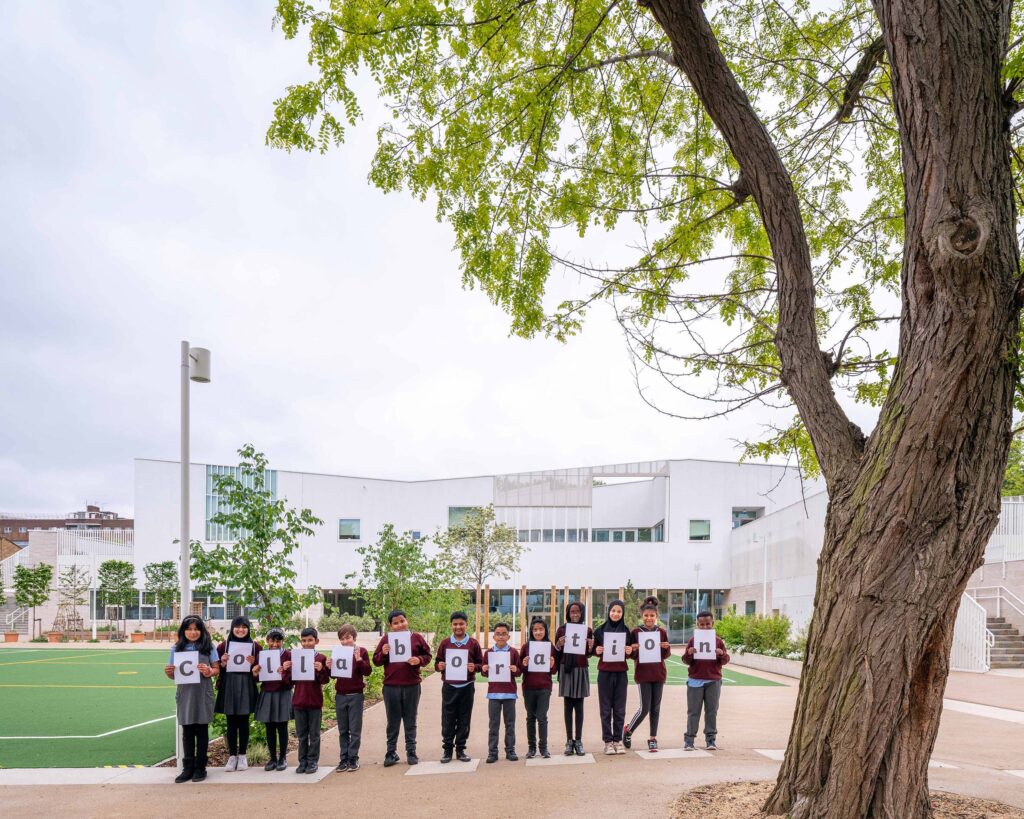
We have delivered many public school improvements that greatly increase access to education, connection and opportunity for local young persons. For example Edith Neville primary school is celebrated as a rich environment for children to use, located in central London in the underserved area of Somers Town.
We are currently working with many local groups across the Southwest at a range of scales, designing low-cost retrofits for community facilities that offer economic and social opportunity within underserved areas. This includes larger projects, progressing under ‘Levelling Up Funding’, such as Filwood Community Centre, as well as self-funded projects such as town youth centres and parkland hubs.
3. Does the majority of your work promote equity in society, and consider all people, not only building inhabitants
We have a practice policy on modern slavery and act in accordance with this. We acknowledge, however, that we can go further to protect the wider community and supply chain when specifying materials. We are currently working on the development of a materials and supplier tracker to aid in specification of materials that are regenerative and fair to supply.