
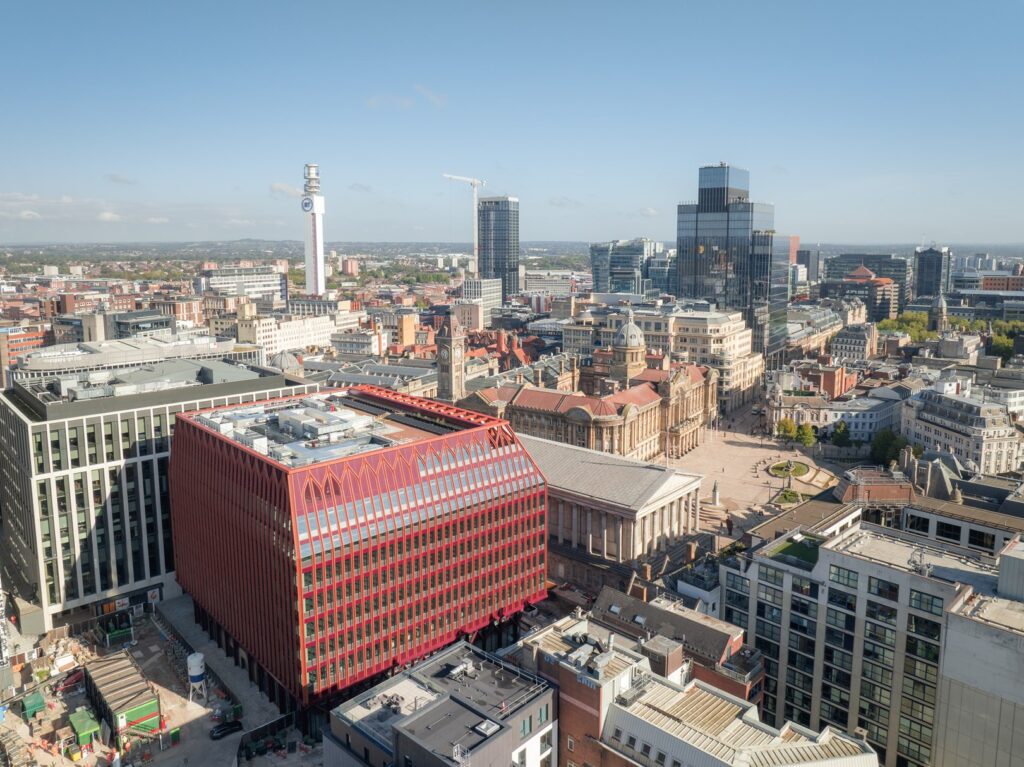
Submission by Feilden Clegg Bradley Studios.
Being a good ancestor
Practice
1. Do you have a clearly stated purpose aligned with the planetary emergency? We’re looking for a bold ambition here, and a culture which recognises the need for long-term thinking.
From our earliest work creating low energy houses in the 1970s, our architecture has always pushed boundaries in sustainable, democratic, and socially responsible design. We understand the challenges our clients face and offer practical, commercially viable solutions that work, both today and long into the future.
We use the OnePlanet.com framework to help steer the regenerative aspirations of our designs, integrating aspects of health, equity, culture, land, biodiversity, water, materials, zero carbon, food, travel, and resources use. In 2019, our 2030 Net Zero Routemap showed how we should aim to reach net zero carbon emissions in our architecture and our practice carbon reduction plan set out our business impact aspirations. We are working to meet the milestones in these trajectories, focusing on specifications to reduce whole life carbon impact, and assessing our performance to date.
We initiated and helped fund the Part Z initiative.
2. Do you have a clearly stated purpose aligned with the planetary emergency? We’re looking for a bold ambition here, and a culture which recognises the need for long-term thinking.
The practice was founded to move architecture forward. That’s why, for over 40 years, we’ve been pushing boundaries in sustainable, democratic, and socially responsible design. These values underpin and guide the practice.
The Partnership has always operated on the principle of wide membership, attracting new Partners, and providing succession opportunities.
As a Practice we have consistently operated open management and consultation processes, that reflect many of the aspects evident in Employee Ownership Trusts. We have an active Employee Forum which meets monthly and provides a staff voice in our operations. We are currently considering changes to the practice structure with potential moves towards an Employee Ownership Trust and B Corp accreditation under their new criteria.
3. Do you share research and knowledge for the benefit of society and the wider world?
We collaborate with research and campaigning groups – LETI, UKGBC, ACAN, The Edge, NZCBS – to advocate for and engage in low carbon design and regenerative design practices. We create exhibitions and related events, such as ‘Carbon Counts’ to raise awareness of the Embodied Carbon of materials, and Architecture for a Changing World, to share knowledge and generate discussion.
We host and participate in cross industry events, talking regularly at conferences and symposia. We co-authored several LETI publications.
We created the free FCBS CARBON design tool to help industry make critical decisions at the beginning of projects to reduce their embodied carbon. This has had over 9000 downloads from a mix of industry and student users. We publish the carbon impacts of our work in the press.
We colllaborate with UCL, Bath, Sheffield and Liverpool Universities on KTP and PhD research projects that bridge the divide between practice and academia.
Project
1. Do you advocate for long-term thinking at the outset of work? Do you initiate work with long-term thinking and challenge clients? Also, can the organisation demonstrate that this approach has worked?
We consistently advocate for long-term thinking from project inception, using early-stage brief development to challenge clients to consider legacy, adaptability and whole-life value. We encourage clients to be good ancestors, embedding decisions that respond to future generations rather than short-term constraints.
At Old Paradise Street, we convinced the client to make the forward-looking decision to change to a demountable mass timber structure.
At the Natural History Museum Collections Research and Digitisation Centre, we worked with the client to create a flexible chassis – a reconfigurable and expandable facility that meets current and unknown future technical requirements, alongside net zero operation
At Sheffield Town Hall, we challenged the brief to move beyond repair, proposing a holistic, once-in-a-generation intervention that secures the building’s civic role for the next century. By combining conservation, low-carbon upgrades and inclusive access, the approach ensures enduring relevance, reduced lifecycle cost and measurable social benefit.
2. Does your work take account of the future climate and the need for resilience?
Our work actively responds to future climate conditions and the need for long-term resilience, embedding adaptive strategies at both building and masterplanning scales.
At Three Chamberlain Square, resilience is achieved through a fabric-first, all-electric design that minimises operational carbon while enhancing comfort under future climate scenarios. Passive measures, including over 250 openable windows and high-performance façades, enable natural ventilation and reduce reliance on mechanical systems, supporting adaptability as climate conditions evolve.
At Green City Kigali, climate resilience is fundamental to the masterplan. The development integrates renewable energy, local materials and walkable neighbourhoods, reducing environmental impact while strengthening community self-sufficiency. The landscape-led approach weaves green infrastructure and food production into the urban fabric, improving biodiversity, mitigating urban heat, and supporting water management on challenging topography.
These projects embody our proactive, place-based approach that anticipates climate risk, reduces vulnerability, and delivers socially and environmentally resilient outcomes for future communities.
3. Does the majority of your work go beyond mitigating negatives and towards optimising positives?
Most of our work moves beyond mitigating negative impacts to actively creating positive environmental and socioeconomic outcomes.
The International Slavery Museum and Maritime Museum is key to NML’s £1BN Liverpool socioeconomic value uplift initiative, going beyond decarbonisation and heritage repair. Channelling decades of community co-production, the design creates a platform for education, reflection, storytelling and dialogue, transforming the waterfront into a catalyst for social change. New multifunctional spaces give the client future freedom to ensure the project generates lasting social and cultural value, not just reduced environmental harm.
Similarly, Eden Scotland exemplifies a regenerative, positive approach. The transformation of a former gasworks into a biodiverse, immersive landscape restores ecology while creating jobs, education and community connection. The project extends beyond its site through city-wide initiatives, including skills and training “guilds” and co-creation programmes, biodiversity infrastructure, and providing much-needed city flood resilience capacity, generating broader social and environmental benefits.
Co-evolving with nature
Practice
1. Do you use biophilia within your premises and/or do you regularly gather in natural settings?
Our annual summer get togethers are an opportunity to spend some time together in nature. Each of our studios make time for a get-together, whether a picnic in the park, a hike in the countryside or games at the local cricket club. In previous years, we have all come together at festivals, or created our own festival in Somerset. Such gatherings usually involve overnighting in tents on a campsite in a field.
2. Can you share examples of where you have considered nature in decision making?
We use landscape and natural systems as primary decision drivers, recognising that enhancing views to and access to these systems also enhances their restorative quality to our workspaces through biodiversity, mitigating the impacts of climate change, and enhancing resilience.
In 2025 we decided to look for new premises in London. The final choice of our new London studio was heavily influenced by the contact nature this site offered. Views into the canopy of three Black Locust trees immediately outside our second floor windows are available from all working positions and the two meeting rooms giving daily and seasonal character to the internal environment.
Our bright new London office supports a growing collection of office plants which soften the space, and which are responding positively to the deliberately focused care provided by our office manager.
We recently sold our two company cars and have office Bromptons for staff use.
3. Are you supporting nature locally and nationally?
We are partners in Forest of Imagination – an annual creative arts festival in Bath that encourages people to engage their creative minds and celebrate the natural world.
We support a local tree planting programme – co forest – initially with funding and with employee time, contributing to the creation of a new forest on the outskirts of Bristol.
Our Bath office is located adjacent to the river, and our staff take daily walks along a National Trust maintained river path, to which we contribute through the Friends of Bathampton Meadows.
Our office consumables, food and drinks are explicitly sourced from organic, low environmental impact, local producers, in reusable containers as far as possible.
Project
1. Can you demonstrate work that strives to match the performance of a mature ecosystem?
Biodiversity and collaboration with Landscape Designers is an important part of our work. We strive to achieve 20% BNG or more on all projects, above regulations.
A study of residents at Accordia found a neighbourhood with more communal gardens has higher levels of wellbeing and community. Our current work at Brabazon builds on this, furthermore delivering the habitat framework with the first homes, to protect ecological enhancements from being reduced in later phases.
We are working with Eden Project on a regenerative scheme on a former gasworks in Dundee, as a place to explore how we can learn from and reconnect with nature to achieve a regenerative future.
We aim to retain mature trees on our sites. Our 1200 student bed scheme for the University of Sussex, currently on site, retains over fifty existing trees between buildings and creates a scheme in sympathy with the adjacent South Downs National Park.
2. Are you working on material stewardship?
We co-led a LETI Circular Economy workstream, leading an industry effort to converge on a single circular economy metric (an opinion piece published by LETI in 2025).
In 2020 we launched a free early design stage embodied carbon tool for industry to calculate and monitor the impact of different materials on a project embodied carbon. In house, this has led to greater use of low carbon materials, but also a leaner approach to the use of higher carbon materials in our work.
A strong focus of our current research is on reuse of materials and the circular economy which we are putting into practice through work that focuses on material impacts, sourcing and reclamation, including the Dorothy Buchanan Centre at the University of Roehampton and the Office Innovation hub at the BRE.
We are a Built by Nature frontrunner, and collaborate with Build Zero, ASBP and ReLondon.
3. Does the majority of your work demonstrate the use of biologically-inspired approaches such as Bioregionalism, Biophilia or Biomimicry?
Eden Scotland, designed as a living system, prioritises resource sharing. Systems exchange heat between buildings, for example to use excess heat from the greenhouse power to ASHPs. Water is collected centrally for WCs and irrigation. One building is entirely biobased. The structurally efficient roof in the greenhouse resembles (not by accident) a tree. Profuse sitewide flora uses nature to inspire hope and action.
At “Plant”, the original integration of architecture and landscape is restored in the terraced “Hanging Gardens” using climate-resilient planting, enhancing biodiversity while strengthening occupants’ connection to nature, daylight, and seasonal change. The adaptable plann reflects biomimetic efficiency, supporting long-term flexibility and resource optimisation.
At Green City Kigali, a bioregional approach underpins the masterplan. The design responds directly to local climate, topography and cultural patterns, using indigenous materials and landscape-led planning to create walkable, productive neighbourhoods. Green infrastructure is woven throughout, supporting food production, biodiversity and water management.
Creating a just space for people
Practice
1. Do you have a progressive EDI policy and can you evidence many forms of diversity, which are welcomed and acknowledged, within your company/organisation?
The Practice has an EDI Plan of Action, which is reviewed and updated on a regular basis. Our plan outlines our commitment to EDI within the Practice and the wider industry and details several initiatives which we undertake to support this work.
We have signed the RIBA Inclusion Charter and our EDI Group regularly present at Partnership and all Practice meetings on the development of the Plan. We have an Employee Forum which has been a great source of initiatives that the practice has then implemented and followed up on.
We run a blind recruitment process for all roles across the Practice and have trained all managers involved on inclusive hiring.
Alongside this, we have a number of partnerships we support both financially and through volunteering time, to develop the diversity of the wider architectural profession, including Design West’s Shape My City, Regeneration Brainery, and Open City.
2. Do you operate a no overtime culture, meet the living wage consistently, and stipulate a fair salary ratio between staff of all levels?
As policy our minimum pay level is the real living wage which is monitored regularly. We operate salary grades and bandings at each level so there are fair and consistent pay structures across the Practice. Pay structures are regularly benchmarked across the industry to ensure they are in line with the market.
The Practice regularly monitors working hours and has put in place mechanisms to reduce the amount of overtime amongst the team. Through our regular resourcing reviews, we ensure projects are adequately resourced to avoid excessive overtime. Employees take time off in lieu where overtime has been unavoidable to meet project deadlines.
3. Do you support charities, community groups, social enterprises, action groups and others through pro-bono work, charitable giving or in-kind donations?
We contribute pro bono work both through the practice – eg for Forest of Imagination – and through our partnership with the Feilden Foundation to support educational projects in Africa including the Design Guide for schools in East Africa in 2023/4
We have a charitable fund through which we give to arts institutions and community groups, supporting sustainable forward-thinking ventures that broaden access to architecture as a profession – including Design West’s Shape my City, Regeneration Brainery, Accelerate and Open City, in addition to supporting the charity fundraising efforts of private individuals.
We co-founded and continue to co-lead the Part Z initiative. We co-founded AD. Our people are members of many action groups, including LETI, AD, ACAN, UKNZCBS,and we support this through time in kind and our expertise and networks. We hosted several AD and LETI events in our event space, bringing the industry together to share knowledge and take action.
4. Do you use an ethical framework to assess opportunities and/or supply chain partners and is them team consulted on these decisions?
Within the Partnership we always review and carefully consider projects we may choose to bid and will decline opportunities where we feel the client, country, regime, project funding or other circumstances are at odds with our ethical principles.
Project
1. Does your work demonstrate deep engagement with local stakeholders and end users?
Our ethos of meaningful engagement with local stakeholders and end users ensures that projects are shaped by those they serve.
At Camley Street, engagement was embedded since 2020 through collaboration with the Steering Group, residents, businesses and community organisations. A tailored engagement strategy enabled ongoing dialogue through events, consultations and festivals, with feedback directly shaping the evolving masterplan. This resulted in strong community support, with clear evidence of local priorities—affordable housing, employment opportunities and accessible green space—being translated into deliverable outcomes.
Similarly, at Our Cultural Heart in Huddersfield, stakeholder and public engagement was central to design development. Through the ‘Of Time and Place’ exhibition and wider consultation programme, we co-created proposals with local groups, cultural partners and residents, ensuring the scheme reflects local identity, heritage and aspirations.
These projects demonstrate commitment to inclusive, participatory processes that build trust, strengthen outcomes, and deliver places genuinely rooted in their communities.
2. Does your work create connected and resilient communities which positively contribute to neighbourhoods and allow equality of access?
Our work is deliberately structured to create connected, resilient communities that enhance neighbourhood vitality and ensure inclusive access.
The Brabazon masterplan establishes a framework of 15-minute neighbourhoods of homes, employment, education and leisure. Networks of pedestrian and cycle routes, green corridors and public spaces reduces car dependency while enabling safe, equitable access. The delivery of diverse housing types, including over 26% affordable homes, alongside community facilities and phased infrastructure, ensures long-term social resilience and inclusivity.
Tree-lined streets, shared gardens and “living streets” prioritise people over vehicles, fostering interaction, wellbeing and a strong sense of belonging.
At Heart of the City Sheffield, connectivity is achieved by stitching together heritage assets, new public realm and mixed uses to create a permeable, accessible city centre. Independent businesses, cultural venues and workplaces are integrated to support local economies and inclusive participation.
These projects demonstrate how our design enables equitable, connected and resilient communities.
3. Does the majority of your work promote equity in society, and consider all people, not only building inhabitants
Our Practice Policies have a Social Value workstream initiative and a Corporate Social Responsibility Statement that identify how we place our social and environmental responsibilities at the heart of our practice. We endeavour to operate ethically in everything we do, from minimising our carbon footprint to supporting charities and sourcing local products as well as supporting our own employees through every stage of their careers.
Through our charity foundation we support education and development in Africa.
Our Modern Slavery Policy, requires us to identify, assess and mitigate the areas of risk where slavery or human trafficking may exist in our business or supply chains. This includes consideration in all parts of the world where the practice provides services. We also review and monitor the practice’s suppliers and sub-consultants and assess the risk that they or their own suppliers and sub-consultants are susceptible to slavery and human trafficking.