
Submission by Cullinan Studio.
Being a good ancestor
Practice
1. Does the practice have a clearly stated purpose aligned with the planetary emergency? We are looking for a bold ambition here, and a practice culture which recognises the need for long-term thinking. For example, a strong mission, a theory of change, or a sustainability roadmap.
Our vision as set out in our Business Plan is “to be leaders in design for human and planetary wellbeing”. This is supported by our Mission Statement which is to “Design with Nature”. To reconnect people with nature: for health and wellbeing, for a fairer more balanced society, and towards a sustainable future for us all.”
2. Does the practice have a clear succession plan, which passes on ownership and protects the values and legacy of those who built and contributed to the practice? For example is the practice an employee owned trust.
We were established as a co-operative by Ted Cullinan and over the past 60 years have practiced in a unique structure based on equity and transparency, with cross-generational leadership structure that shares the roles and responsibilities of day-to-day practice. In addition to this:
- Critical roles in Design Quality and Business Development have leads and support roles that ensure short and mid-term coverage as well as mentoring and on the job knowledge share and training.
- We have a strong tradition of ethical and radical sustainable design which is conserved through an extensive, searchable digital archive as well as a programme of “inheritance” talks that supports our CPD programme.
3. Does the practice share research and knowledge for the benefit of society and the wider world? For example, you regularly carry out post occupancy evaluation and share information with others.
On a basic level we widely share data on our projects via presentations at conferences eg. Education Estates, NET Zero Festival, the University Design Forum, European Healthcare Design.
We self-funded 30% of our professional fees on Innovate-UK groundbreaking GreenSCIES research – the results have been published widely in CIBSE Journal and continues through the GreenSCIES Centre of Excellence at LSBU.
The low embodied carbon retrofit of our studio building and net zero operational carbon journey recorded in our Carbon Reduction Plan available on our website. Data has been studied and published on numerous occasions for example in ‘Building Knowledge: Pathways to Post Occupancy Evaluation’ published by the RIBA and University of Reading, and ‘Retrofit for Purpose’ published by RIBA Publishing.
Recent publication contribution by our Practice Leader, Carol Costello on Zero Avoidable Plastics in Construction in ‘Materials: An Environmental Primer’ published by RIBA Publishing 2024.
Project
1. Does the practice advocate for long-term thinking at the outset of projects? Do you initiate projects with long-term thinking and challenge the client on design life? Also, can the practice demonstrate that this approach has worked with a shorter or longer design life, or an innovative approach to financing or payback period?
Working with clients and stakeholders in the public sector over several decades has meant the long-term view is embedded in our approach. We advocate for “long life, loose fit” to prolong the life of our client’s buildings and spaces.
We are working with public sector clients on innovative procurement methods like Integrated Project Insurance (IPI) or insurance backed alliances, where we have achieved great success. At Dudley College Animal Studies Centre, completed in 2024, the IPI Alliance team challenged the brief that called for demolition and new build, demonstrating that a sustainable retrofit could achieve the same functional outcomes with a far lower carbon footprint and for the same cost – including the necessary 20% reduction to account for VAT.
Internally we have a foresight review process which sets expectations on design quality and sustainability aspirations at the outset of a project, a process which every project must go through.
2. Do your projects take account of the future climate and the need for resilience? For example, do the projects demonstrate flexibility, design for adaptation, design for disassembly, non-deterministic solutions, or demountable structures.
For us the fundamental ideas underpinning circular economy thinking are second nature:
- Our designs balance current needs with possible future requirements. At the National Automotive Innovation Centre, flexible workplaces with moveable walls make the building highly adaptable for the future needs of its users
- Our 60 years of project back catalogue affords us the unique perspective of revisiting projects when the building owners need to adapt to current requirements or remedy elements that have reached the end of their designed lifespan.
- In 2014, our RMC HQ project was one of the youngest buildings to be Grade 2* listed, preventing demolition and redevelopment. Completed in 1990 it was pioneering in its environmental design as a fully naturally ventilated office.
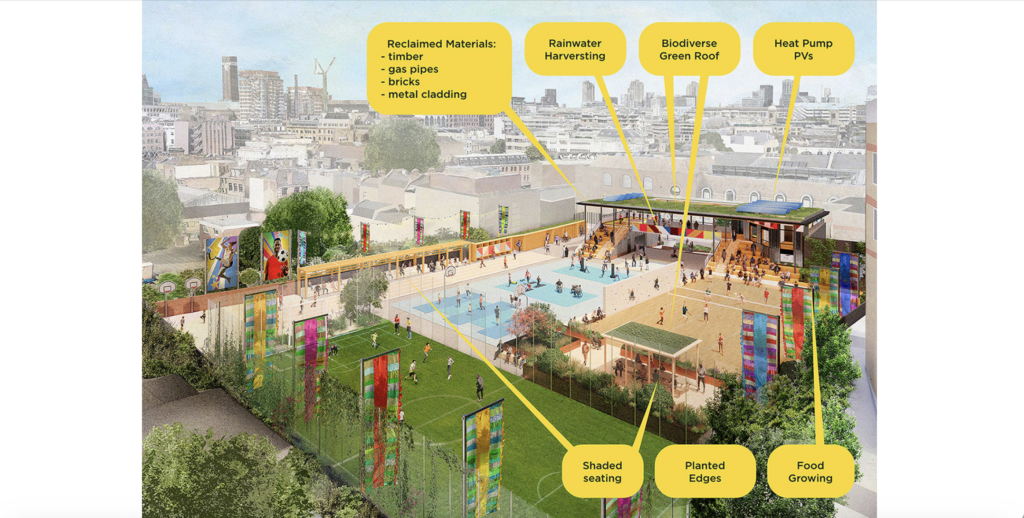
- We are working with BOST on the Marlborough Sports Garden – a fully circular economy project, using reclaimed materials, reusing existing structures, and constructed to be easily dismantled.
3. Do the majority of your projects go beyond mitigating negatives and towards optimising positives? For example, are they meeting or exceeding the RIBA 2030 Challenge.
We are signatories to the RIBA 2030 Climate Challenge, and have been measuring operational and embodied carbon on all projects since 2020, adopting RIBA 2030 and LETI as our main baseline criteria.
This relies on partnerships with our clients so that they are conversant with these targets over industry standard targets and local authority local plans.
We employ passive methods to achieve and often exceed low-carbon targets. On the Dudley College Animal Studies Centre retrofit, the embodied carbon of the building’s structure was cut to just 51kgCO2e/m2, far below the LETI school targets of 276kgCO2e/m2 (for a new build structure).
Co-evolving with nature
Practice
1. Does the practice use biophilia within the office or regularly host meetings and retreats in natural settings? For example do you have extensive planting within the office or rely on natural patterns and imagery for stress relief or quiet areas.
This is a huge part of our Design with Nature purpose and mission, we aspire to practice what we preach:
- Recent practice Visioning Days have taken place in natural settings, such as the RHS Garden Hyde Hall, and the Bankside Open Spaces Trust community gardens
- Our most recent practice team building trip was to the Cairngorms in the Scottish Highlands
- We use our self-planted canalside guerilla garden at our London Studio and the Regents Canal for walking meetings as part of our mentoring programme for newer team members
- We have grade II* listed timber roof trusses in our naturally ventilated studio space
- We have over 40 potted plants in our studio and meeting spaces, mostly selected from the NASA list of air purifying plants, and we propagate these to extend our collection.
2. Can the practice share examples where it has considered nature in decision making? For example by having a nature proxy to encourage eco-centric decision making, using natural systems as inspiration for the company structure, recognising the seasonal nature of people’s capacity and workload or celebrating equinoxes and solstices together.
Cullinan Studio operates under cooperative principles, so we respect our team’s individual requirements and support flexible working arrangements to suit preferred working times.
3. Is the practice supporting nature locally and nationally? For example, does the practice support local gardens, gardeners, planting programmes, rewilding programmes or advocate for changes in legislation to protect nature.
We have planted and maintained a canal-side “guerilla” garden next to our office building since 2012, for which we have won local Islington in Bloom Awards. Across the growing season this includes edible species such as fig trees and verbena as well as insect and pollinator friendly plants like hollyhocks, and passionflower.
Springtime tree-planting with our late founder Ted Cullinan was part of our seasonal offer to employees up until 2015.
Many of the team are keen gardeners, with their own allotments and have shared seeds and garden produce over the years.
Project
1. Can the practice demonstrate projects which strive to match the performance of a mature ecosystem? As a minimum this would mean achieving biodiversity net gain.
The buildings we design integrate with natural environments, with orientation optimised for daylight, provision of green spaces, and creation of visual and physical connections to landscapes.
- Maitland Park – Camden’s first project to achieve Homes Quality Mark accreditation – promotes wellbeing and contributes to biodiversity, supporting London’s goals for a greener, healthier city
- In our proposals for the Northolt Park Estate in Ealing, enhanced landscapes provide connections through the estate and parkland, and out to the wider context, meeting Biodiversity Net Gain (of 10.96%) and Urban Greening Factor requirements.
- Working with a landscape team, we applied regenerative landscape principles to create a new park in the heart of a city-based university campus. The (confidential) project worked hard to attenuate water through swales and basins, re-use waste materials, and create richly planted wild areas to encourage nature into the site, with a choice of spaces to enhance mental wellbeing.
2. Is the practice working on material stewardship? For example, evidence could be shown through repeated use of low carbon materials, extensive material libraries and research or publications supporting responsible use of materials and elimination of waste.
Cullinan Studio is a long-standing member of and collaborator with the Alliance for Sustainable Building Products (ASBP). Our most recent collaboration is on the Ecosurety-funded Zero Avoidable Packaging Waste in Construction (ZAP) research project. The project explored scalable solutions to help combat the prevalence of avoidable packaging plastic waste in construction. The Marlborough Sports Garden project has acted as a live case study to understand the ability to design our packaging waste in construction and operation.
The National Automotive Innovation Centre at University of Warwick, helped clients from automotive industry shift aspirations from a wholly glass and steel building to the largest timber roof in Europe at the time.
3. Do the majority of projects demonstrate the use of biologically-inspired approaches such as Bioregionalism, Biophilia, Biomimicry, Ecomimicry (also referred to as Ecosystems Thinking, Industrial Ecology or Industrial Symbiosis) or BioTRIZ?
We always work with the natural context – starting by understanding the local environment, culture and microclimate of the site. In this way we design buildings that works in harmony with their natural context. The buildings respond to nature by maximising daylight, natural ventilation, thermal mass, shading and views to maximum benefit for the building and its occupants.
Our buildings follow biophilic principles through a close connection to nature and the use of natural materials whenever possible. A range of therapeutic principles are applied to our designs that take lessons from evolutionary principles of restorative and therapeutic environments, such as prospect and refuge, legibility, coherence and complexity in architectural design.
For example, at the Catkin Centre and Sunflower House mental health facility for Alder Hey childrens hospital, we used timber extensively to create a non-institutional setting, daylight and natural ventilation, with all rooms and circulation around central therapeutic courtyards.
Creating a just space for people
Practice
1. Does the practice have a progressive EDI policy and can you evidence many forms of diversity, which are welcomed and acknowledged, within the practice?
Our cooperative structure supports people through mutual trust and understanding – essential to having a diverse team.
We have progressive policies on flexible working to support those with caring requirements and were early adopters of Shared Parental leave, offering an enhancement on par with our enhanced maternity pay offer for a non-birthing parent taking the second half of shared leave.
Our latest anonymous EDI survey results are as follows:
- 39% of our team identify as from a working class background
- 4% identify as a member of LGBTQI+ community
- 61% of our team are female
- 30% of our team are from an ethnic minority background
- 22% of our team have a disability or neurodivergence
As we are constantly aiming to refine our data for our annual survey due to be undertaken in June 2025 we will be splitting disability and neurodivergence into separate questions.
2. Does the practice operate a no overtime culture, meet the living wage consistently, and stipulate a fair salary ratio between staff of all levels?
- Non-partners in the cooperative are discouraged from overtime and we have a clear structure in place to review resourcing and ensure TOIL is taken for partners who have worked overtime
- We record timesheets accurately to ensure any unplanned overtime is tracked and that TOIL is taken immediately to rectify
- For partners who worked overtime in 2024, which was an unusually challenging year for the practice as well as the wider industry, we are implementing an overtime compensation scheme to backpay a proportion of all overtime hours
- We are a London Living Wage employer, which goes beyond the National Living Wage, which includes our cleaning staff member.
3. Does the practice support charities, community groups, social enterprises, action groups and others through pro-bono work, charitable giving or in-kind donations?
We have supported numerous charities and outreach programmes over the years, including Open City, Kingston Access to Architecture, Koestler Arts, National Saturday Art Club, Islington Giving’s Body & Soul, Shelter, HD5K.
We are voluntary committee member of local sustainability action group Islington Sustainability Network.
Our cooperative structure means the assets of the company are held separately from the main practice, and should the company cease trading all assets will be equally transferred to the following charities or equivalents agreed by the Trustees: War on Want, Womenkind Worldwide, Freedom from Torture and Practical Action.
4. Does the practice publicly refuse to work with certain clients, suppliers or organisations on ethical grounds?
No.
Project
1. Do the projects demonstrate deep engagement with local stakeholders and end users? For example, is there evidence that your project engagement goes beyond consultation towards co-design?
We are shifting focus to make our stakeholder consultation process less extractive by offering knowledge exchange alongside co-design events and activities. Recent project examples of this strategy include:
- GreenSCIES 2 research project where we led a whole work package on co-design of a smart district heat network with the local community in Islington. This consisted of a series of in-person and online events, looking at novel ways of combining distribution pipework with green and cycle infrastructure. The co-design sessions were delivered alongside “Keeping Warm” workshops which gave attendees strategies to reduce energy bills within their current system before looking to the future district heating design aspirations.
- A feasibility study for the reconfiguration of an area in the London Borough of Southwark where extensive stakeholder consultation included immersive visualisation workshops with local schools and healthy planting workshops for local community action groups.
2. Do your projects create connected and resilient places which positively contribute to their neighbourhoods and allow equality of access? For example, do your projects create economic opportunity, retain value locally and generate social value?
- A significant impact of our Maitland Park Estate Redevelopment has been the enhancement of living standards coupled with improved public spaces creating vibrant communal areas. The project has stimulated local economic activity, creating numerous local jobs during its construction, and improved infrastructure attracting new businesses to the area.
- At Alder Hey Children’s Hospital, our masterplan for Springfield Park creates inclusive public spaces that encourage interaction and foster a sense of belonging for the local community.
- On the Stonebridge Estate, we created a mixed-use development that responded to the needs of a culturally diverse community, integrating housing, a health centre, shops, and a community hub around a garden.
- The improved (free) facilities at Marlborough Sports Garden will deliver our client BOST’s objectives to create opportunity for health through sports in an inner city location where diet and lack of opportunity for exercise has exacerbated health issues.
3. Do the majority of your projects promote equity in society, and consider all people, not only the building inhabitants? For example, do your projects show due regard for workers within the supply chain and take active steps to avoid modern slavery?
Ethical practice is at the heart of how we work as a cooperative and we endeavour for this to translate across to our projects.
One level is designing and detailing buildings in a humane way that expresses construction. This means for those assembling the building there are often smaller structural member sizes, or expressed guttering and rainwater goods making for easier maintenance and replacement.
Using the transformative Integrated Project Insurance (IPI) model means that contractors, sub-contractors, consultants, and clients work together in a no-blame culture and design with safety of assembly and construction from early design stages. This was well demonstrated on the Black Country & Marches Institute of Technology, where the IPI approach had a revolutionary impact on the project team’s mental health, as they were no longer trying to pass the risk down the supply chain but instead could work collaboratively towards the most cost-effective solution.