
Submission by CULLINAN STUDIO.
Being a good ancestor
Practice
1. Do you have a clearly stated purpose aligned with the planetary emergency? We’re looking for a bold ambition here, and a culture which recognises the need for long-term thinking.
Our mission is to “Design with Nature”.
Cullinan Studio has a long reputation of designing low energy buildings, beautiful timber structures and, uniquely, working in botanic gardens. We are continuing to strive for design that co-evolves with nature. There is scientific evidence that connection to trees, plants and wildlife can aid recovery from injury and illness. We were lucky to work with two clients that understand this and embraced our approach to integrating gardens with therapeutic spaces. Firstly, Maggie’s and secondly, Alder Hey Children’s Hospital. In recent years, we have advanced our skills in PassivHaus techniques, “retrofit-first” thinking, and reclaimed materials. Two recent projects that exemplify this mindset are The Animal Studies Centre at Dudley College and the Marlborough Sports Garden in Southwark. We have educated our team to use resources wisely – not just for the end-product – but to avoid extracting virgin materials and destroying habitats elsewhere.
2. Do you have a clearly stated purpose aligned with the planetary emergency? We’re looking for a bold ambition here, and a culture which recognises the need for long-term thinking.
Ted Cullinan and his co-founders set up as a cooperative with an inspirational manifesto asserting ‘The design of buildings is a social act.’ Acknowledging that it takes a team to make architecture, and that everyone should be treated with respect and be compensated fairly. 60 years ago, we were a pioneer of employee ownership, and we continue to operate under this model while mentoring other businesses toward this structure.
In practice, this means that we have evolved through the generations while carrying on the ethical foundations of Ted’s vision. We operate under an employee trust, employees become partners in the business after a probation period but do not buy shares in the company. Partners salaries are decided together with full transparency. We aim to work creatively together for as long as we can, but if the company were to close, remaining assets would go to the trust’s defined charities.
3. Do you share research and knowledge for the benefit of society and the wider world?
Cullinan Studio has always encouraged and allowed our team to participate in part-time teaching, research activities and speaking opportunities to disseminate what we have learned. Notable recent activities include:
- Tom Bradly teaches at University of Nottingham and Richard Pulford at LSBU.
- Innovate UK funded research on Smart Local Energy Systems called GreenSCIES
- Ecosurety funded research with ASBP called ZAP: zero avoidable plastic packaging in construction
- AHRC-funded Dr Philip Graham proposes innovative ways of adapting homes
- Sahiba Chadha works with Open City Accelerate, to encourage students from underrepresented backgrounds.
- Carol Costello’s contribution to ‘Materials: An Environmental Primer’ (RIBA Publishing)
- Contributions to RIBA publications, ‘Building Knowledge: Pathways to Post Occupancy Evaluation’, ‘Retrofit for Purpose’ and ‘RIBA Plan for Use Guide’.
- Our Carbon Reduction Plan, is available on our website.
- Our fellow, Robin Nicholson, continues to steer the EDGE Debate in its research and campaigning on ethics and sustainability n the built environment.
Project
1. Do you advocate for long-term thinking at the outset of work? Do you initiate work with long-term thinking and challenge clients? Also, can the organisation demonstrate that this approach has worked?
From project inception, we look to empower our clients to exceed conventional sustainability goals and inspire long-term thinking around climate and social resilience.
Internally, we practice a foresight review process, and we now use the UK Architects Declare Regenerative Design Primer to guide decisions at each work stage.
We are one of the few firms capable of delivering projects through Integrated Project Insurance (IPI). This procurement method replaces adversarial traditional contracts with a blame-free, integrated team. The Dudley College Animal Studies Centre’s original brief called for demolition of existing 1950s college building, replaced with new building of similar size. Because we built a trusting relationship with the college through the IPI experience, we were able to work with the integrated team to demonstrate how the brief could be met by revitalising the 1950s building while making huge embodied and operational carbon savings without costing more than the new-build solution.
2. Does your work take account of the future climate and the need for resilience?
For us, the fundamental ideas underpinning circular economy thinking are second nature. Advocating for material honesty and design adaptability, our work balances contemporary needs whilst exploring solutions capable of meeting urgent climate demands. Evidenced through our ongoing work with BOST on the Marlborough Sports Garden, this fully circular economy project reuses existing structures, celebrates reclaimed materials and will be constructed to be easily adapted and dismantled.
Our recent retrofit work has given us the opportunity to improve the resilience of existing buildings. At Harvist Estate in Islington, we are upgrading four eighteen-storey residential towers, improving the building fabric to support better thermal comfort, alongside new solar and ventilation strategies. A new energy centre will also provide renewable, fossil-fuel-free heat for residents. Together, these upgrades will help improve comfort, efficiency and long-term performance across the estate. Proposals are co-designed with the residents and aim to improve health and reduce fuel poverty.
3. Does the majority of your work go beyond mitigating negatives and towards optimising positives?
We have many examples from our portfolio where we challenged/persuaded clients to go beyond the baseline for a truly exemplar solution for people and planet. Examples include:
- Catkin Centre and Sunflower House buildings at Alder Hey will be the first children’s hospital in Europe to be integrated within a new park – creating a 21st century Health Campus as a possible blueprint for the future of the NHS.
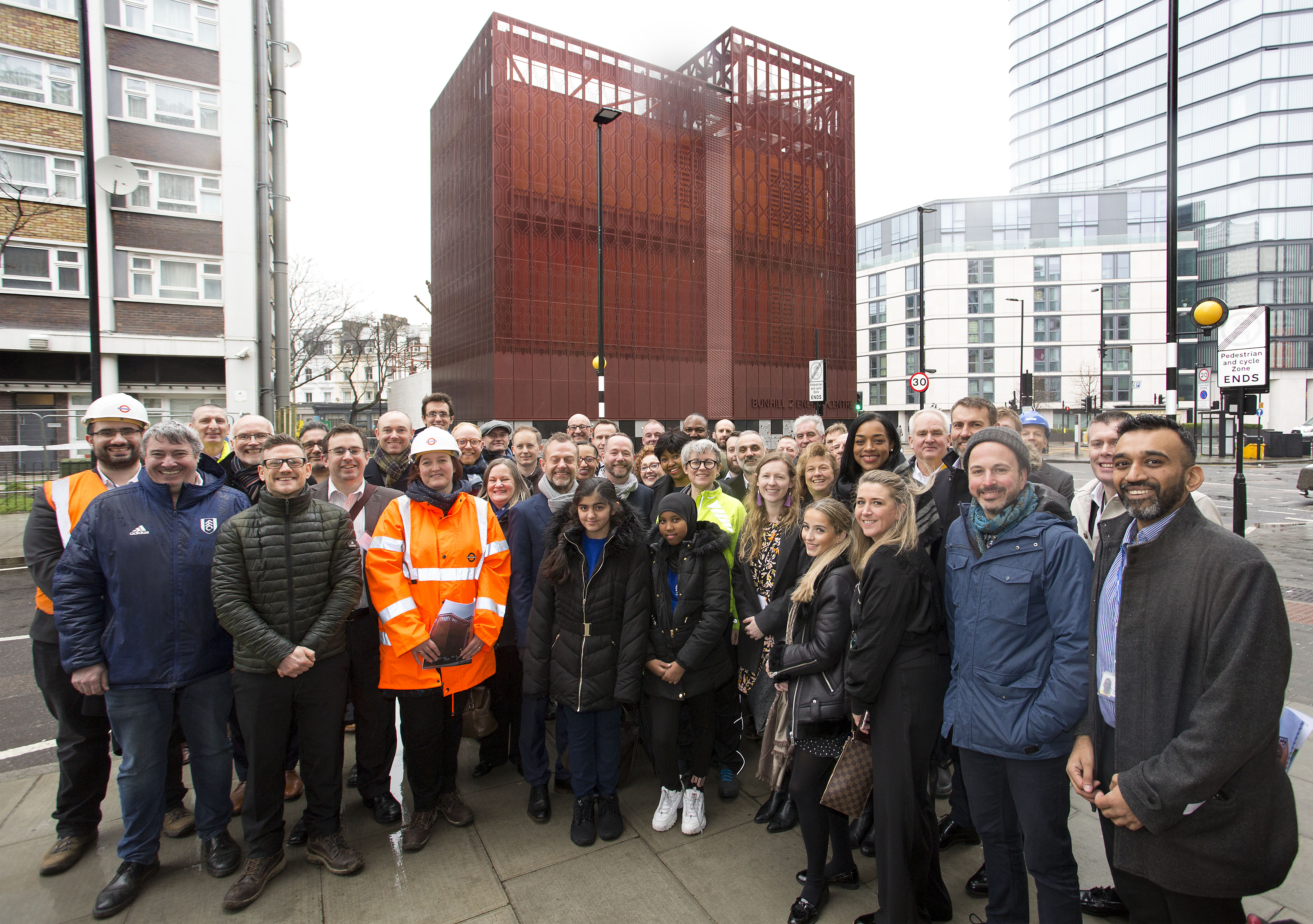
- Bunhill 2 Energy Centre is a world first in re-use of waste heat from London underground. It was designed with the community to reduce fuel poverty and carbon emissions. With a beautifully crafted façade it demonstrates how green tech can be pat of the neighbourhood.
- National Automotive Innovation Centre inspires a new generation of mobility designers to strive for a low carbon future. The expansive timber roof is an emblem of the aspirations of the University and industry working there.
Co-evolving with nature
Practice
1. Do you use biophilia within your premises and/or do you regularly gather in natural settings?
Connecting with our natural surroundings is a huge part of our mission to Design with Nature- and we aspire to practice what we preach. We retrofitted a canalside Victorian warehouse with high insultation, renewable energy and a guerilla towpath to lead by example and care for our team.
Recent practice Visioning Days have taken place in natural settings, such as the RHS Garden Hyde Hall, and the Bankside Open Spaces Trust community gardens.
Our most recent practice team building trip was to the Cairngorms in the Scottish Highlands.
We use the Regents Canal for walking meetings as part of our mentoring programme for newer team members.
We have grade II* listed timber roof trusses in our naturally ventilated studio space.
We have over 40 potted plants in our studio and meeting spaces, mostly selected from the NASA list of air purifying plants, and we propagate these to extend our collection.
2. Can you share examples of where you have considered nature in decision making?
We understand that buildings set in nature have huge wellbeing benefits over those that do not. Where places are deprived of nature we do what we can to introduce natural materials and living plant habitats.
Maggies Newcastle provides spaces for those affected by cancer which wrap round a courtyard garden to look at or be in. Catkin Centre and Sunflower House buildings at Alder Hey are organised around secluded gardens but also will connect to the new Springfield Park which we have master planned with Turkington Martin. Alder Hey will be the first children’s hospital in Europe to be integrated within a new park – creating a 21st century Health Campus as a possible blueprint for the future of the NHS.
Our GreenSCIES research explored ways that urban greening could be integrated with the route for the low carbon heat network and EV charging points.
3. Are you supporting nature locally and nationally?
We retrofitted a canalside Victorian warehouse with high insultation, renewable energy and a guerilla towpath to lead by example and care for our team. we offer an example to our neighbours and to our clients of how it can be done.
The Clore Learning Centre at Hyde Hall imagines a place that could inspire a nation to garden and grow. Award-winning landscape designer, Adam Frost, collaborated with Cullinan on the wider masterplan, integrating architecture with the garden and supporting nature to enhance the children’s skills and boost their development, improving physical and mental well-being.
Catkin Centre and Sunflower House buildings at Alder Hey connects to the new Springfield Park which we have master planned with Turkington Martin. Alder Hey will be the first children’s hospital in Europe to be integrated within a new park – creating a 21st century Health Campus as a blueprint for the future of the NHS.
Project
1. Can you demonstrate work that strives to match the performance of a mature ecosystem?
Our proposal for Northolt Park Estate in Ealing, enhances landscapes providing connections through the estate and parkland, and out to the wider context. Working with a landscape team, we applied regenerative landscape principles to create a new park in the heart of an urban university campus. The project worked hard to attenuate water through swales and basins, re-use waste materials, and create richly planted wild areas to encourage nature on site, with a choice of spaces to enhance mental wellbeing.
Our masterplan for RHS Hyde Hall was developed with the RHS horticulture team and Adam Frost. The masterplan goes beyond the formal horticultural displays to establish a 1.6 mile WildWood walk through established and new trees, and open meadow landscapes filled with native wildflowers, birds, insects. This creates an “ecotone” (a transition area between two biomes) which naturally hosts a much wider array of species than a uniform forest.
2. Are you working on material stewardship?
Our schemes go beyond mitigating negatives through design choices and instead actively promote material honesty. Cullinan Studio is a long-standing member of and collaborator with the Alliance for Sustainable Building Products (ASBP) where the shared mission is “To lead the transformation to a healthy low-carbon built environment by championing the understanding and use of demonstrably sustainable building products.” Our most recent collaboration is on the Ecosurety-funded Zero Avoidable Packaging Waste in Construction (ZAP) research project. The project explored scalable solutions to help combat the prevalence of avoidable packaging plastic waste in construction. Our work on The Marlborough Sports Garden project has acted as areal world case study to understand the ability to design our packaging waste in construction and operation, providing an opportunity for our design and client teams to get involved with maximising resource value and learn about the responsible management of materials across the scheme.
3. Does the majority of your work demonstrate the use of biologically-inspired approaches such as Bioregionalism, Biophilia or Biomimicry?
Our philosophical standpoint,‘Design with Nature’, aligns closely with biologically-inspired approaches. At the Catkin Centre and Sunflower House mental health facility for Alder Hey Children’s hospital, Liverpool, we used timber extensively to create a non-institutional setting. Revealed and expressed throughout, timber was chosen for its warmth, smell and feel, and its environmental and wellbeing benefits. Research underpins that we must re-forge our connection to nature to stimulate healing.
At the University of Warwick, we persuaded a sceptical stakeholder group of automotive designers to embrace a structural timber solution for the National Automotive Innovation Centre. One of the largest engineered timber roofs in Europe stands aloft the workshops, labs and atrium to inspire designers toward greener solutions in place and mobility.
At the University of Cambridge, the Centre for Mathematical Sciences integrates with the leafy surroundings by creating a vaulted green roof over the common room and sunken gardens between research pavilions.
Creating a just space for people
Practice
1. Do you have a progressive EDI policy and can you evidence many forms of diversity, which are welcomed and acknowledged, within your company/organisation?
Our cooperative structure supports people through mutual trust and understanding, essential to having a diverse team. We have progressive policies on flexible working to support those with caring requirements, and were early adopters of Shared Parental leave, offering an enhancement on par with our enhanced maternity pay offer for a non-birthing parent taking the second half of shared leave.
Our current EDI survey results evidence the how we include people from many backgrounds and abilities.
Female 50%
Male 50%
Ethnic minority 28%
LGBTQI+ 6% (some not disclosed)
Working class identity 28%
First in family to attend university 22%
Did not go to UK fee paying school 83%
Have a disability 17% (some not disclosed)
No survey respondents with neurodiversity 0%
Have a religion or belief 22%
2. Do you operate a no overtime culture, meet the living wage consistently, and stipulate a fair salary ratio between staff of all levels?
We have dramatically changed our working culture from the long hours expected through out the profession when the practice started 60 years ago, recognising the false economy and the damage to individuals and families it creates. Our cooperative structure has enabled us to evolve over time. Our mentoring policy makes us collectively aware of each other’s wellbeing. Non-partners in the team are discouraged from working overtime, and we have a clear structure in place to both review and optimise resourcing. Using accurately recorded timesheets, we ensure time off in lieu is granted for those who have worked overtime. for exceptional reasons. We are a London Living Wage employer. We have operated a transparent salary setting system from the practices founding while also stipulating a maximum 3:1 pay ratio for partners. new employees are asked to become partners after an initial probation period to fully participate in decision making.
3. Do you support charities, community groups, social enterprises, action groups and others through pro-bono work, charitable giving or in-kind donations?
We have worked for many charities over the years and donated our services while supporting fundraising activities. Maggie’s Newcastle is just one example where we provided concepts pro-bono, presented to donors and participated in the Maggies Night hike.
We have supported numerous outreach programmes over the years. From hosting activity workshops with Open City. Saturday Art Club and Koestler Arts, to hosting work experience students in the Summer months from Kingston Access to Architecture and others. Our team partakes in numerous events such as the industry charity run ‘HD5K’, as well as being voluntary committee members of Islington Sustainability Network.
Our cooperative structure means the assets of the company are held separately from the main practice, and should the company cease trading all assets will be equally transferred to the following charities or equivalents agreed by the Trustees: War on Want, Womenkind Worldwide, Freedom from Torture and Practical Action.
4. Do you use an ethical framework to assess opportunities and/or supply chain partners and is them team consulted on these decisions?
As a cooperative and an SME, we review all opportunities together and review them on a case-by-case method. We have turned down work for clients and in countries where we felt our values would be compromised or that the project would do harm.
We regularly survey our team about their thoughts on working abroad to canvas any opportunities but also to understand concerns for personal safety or ethical objections.
In practice, the great majority of our work is for local authorities, universities, colleges, academies and charities with our few private clients selecting us for our ethical approach to design, people and planet.
We have ISO-accredited Environmental and Quality Management systems which are both enshrined in policies written based on our high ethical standards of practice. These include commitments to assess and vet our supply chain against our own statements.
Project
1. Does your work demonstrate deep engagement with local stakeholders and end users?
At the Harvist Estate, we have sensitively led a series of presentations and discussions with a group of residents to discuss the design process and resulting design moves. Having input from people with lived experience of the buildings that we are working with helps guide the design towards solutions that truly respond to the needs of end-users. Taking the time to explain new technologies and methods to clients and communities has resulted in building trust and consensus toward the design solution.
GreenSCIES 2 is a research project where we led a whole work package on co-design of a smart district heat network with the local community in Islington. This consisted of a series of in-person and online events. The GreenSCIES co-design sessions were delivered alongside “Keeping Warm” workshops which gave attendees strategies to reduce energy bills within their current system before looking to the future district heating design aspirations.
2. Does your work create connected and resilient communities which positively contribute to neighbourhoods and allow equality of access?
The Bunhill 2 Energy Centre is an excellent example of our collaboration with local government, residents, schools and transport for London, to enable a pioneering project which is now a source of community pride.
World-First Innovation
- Tube Heat Capture: It is the first network globally to recycle waste heat from underground train tunnels (the Northern Line) to warm a city.
- Global Blueprint: The project serves as an international model for how major cities can successfully decarbonise urban heating.
Direct Community Benefits
- Eradicating Fuel Poverty: Managed by Islington Council, the network provides cheaper, greener heating to over 800 local council homes, offering residents a 10% discount on standard rates.
- Powering Public Spaces: The energy centre heats the Moreland Primary School, the Ironmonger Row Baths, and the Finsbury Leisure Centre.
- Free Electricity: The system generates communal electricity used to power the lifts and lighting of an adjacent housing tower block.
3. Does the majority of your work promote equity in society, and consider all people, not only building inhabitants
The great majority of our work is for local authorities, universities, colleges, academies and charities with our few private clients selecting us for our ethical approach to design, people and planet.
Recent examples of projects that reflect our values of equity include:
Stepping Stones House for the charity Waltham Forest Churches Night Shelter is the transformation of a deteriorating Victorian HMO into a ‘moving on’ house for people rebuilding their lives after homelessness. We applied Passivhaus design principles to keep residents warm while reducing energy costs.
Marlborough sports garden for charity BOST will enhance facilities for local people deprived of active spaces and suffering high rates of child-hood obesity. The building will also demonstrate the use of reclaimed materials.
Maggies Cancer Care for the Maggies charity, Located in the urban campus of the Freeman Hospital, provides a healing harbour for those caught up in the storm of cancer.