
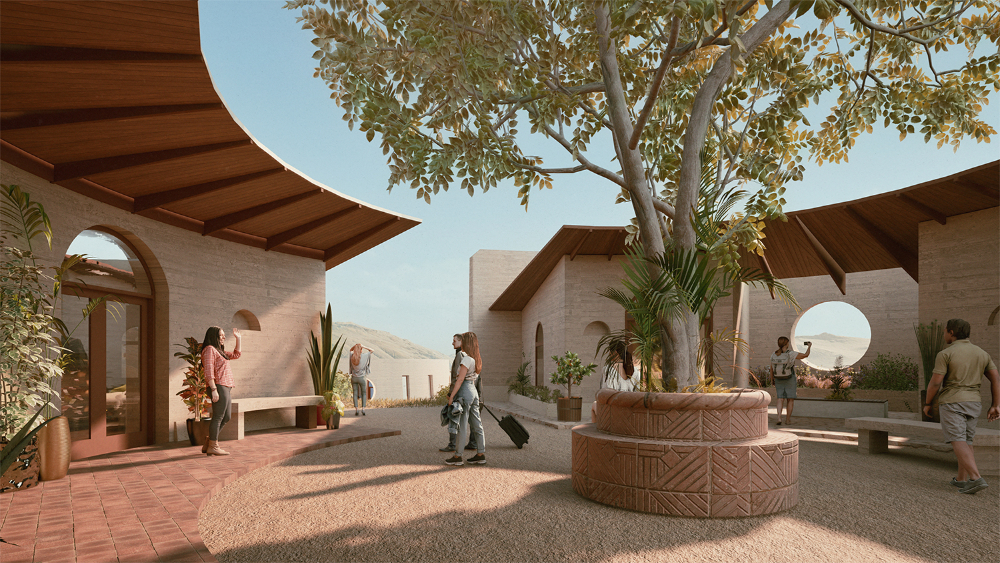
Submission by Collective Works.
Being a good ancestor
Practice
1. Does the practice have a clearly stated purpose aligned with the planetary emergency? We are looking for a bold ambition here, and a practice culture which recognises the need for long-term thinking. For example, a strong mission, a theory of change, or a sustainability roadmap.
Our mission is Responsible and Beautiful design. We developed this in dialogue with our team and identified nine criteria which personify these ideas for us;
Emotive, Harmonious, Considered, Promoting Wellbeing, Connected to Nature, Participatory, Low Carbon, Ethical, Evaluated.
Xanthe, our part 3 architect describes it as: “designing for wellbeing, both for our buildings’ occupants and the planet.”
We established a sustainability roadmap in 2020 and shared our learning widely. The 5 step “roadmap for change” set out a clear set of actions for practices, became Part 1 of the Architects Declare Practice Guide and informed the RIBA Sustainable Business Toolkit.
As our practice evolves, we continue to revisit this roadmap, and question the most effective way to mitigate our project and practice impacts. This year we moved office to a net zero studio in a recently retrofitted building, and continue to look at how we can minimise our practice impact.
2. Does the practice have a clear succession plan, which passes on ownership and protects the values and legacy of those who built and contributed to the practice? For example is the practice an employee owned trust.
While no longer a ‘young’ practice, Collective Works is very much a live concern with no plans for succession yet. For us the idea of building a business with the intention to exit is fundamentally not regenerative. So, as in a hive, we work for the common good of the practice. As we evolve, the practice will shift to suit the collective.
3. Does the practice share research and knowledge for the benefit of society and the wider world? For example, you regularly carry out post occupancy evaluation and share information with others.
Small projects have limited impact, so beyond our practice we call for collective action and knowledge sharing.
Having co-authored the RIBA Ethical Practice Guide, we continue to drive stronger engagement with ethics across the profession. This year we have developed the Ethical Practice Mandatory Competence for RIBA and delivered Core CPD module 1 on ethical behaviours – which will both reach RIBA’s 44,000 members.
We sponsored the Retrofit 25 exhibition and events series, sharing the urgency of retrofit in the UK with 1500 weekly visitors to the Building Centre.
We share project outcomes and best practice within the profession and with the general public: through our insights page; in the press; through awards and at conferences and public events. By sharing our Mid Terrace Dream deep retrofit project – including a piece in the Times which reached up to 843,766 readers – we are helping to normalise retrofit for homeowners.
Project
1. Does the practice advocate for long-term thinking at the outset of projects? Do you initiate projects with long-term thinking and challenge the client on design life? Also, can the practice demonstrate that this approach has worked with a shorter or longer design life, or an innovative approach to financing or payback period?
At the early stage of any project we run two workshops: Responsible and Beautiful, where we explore and challenge the brief, considering a more regenerative approach. Having established the best ways to align with our client’s values, we embed these within our agendas throughout the project.
Extending the life of existing stock through retrofit, and choosing appropriate low carbon, and durable materials is often our strategy and we routinely challenge the need for demolition, as well as the suggested design life. We also advocate low carbon options for materials wherever possible.
The majority of our work is with existing buildings. Whether renovating individual homes, or repurposing underused or poorly organised NHS buildings for new, more social purposes – like the Social Prescribing Centres in Ashfield and Victoria Central Hospital. If something good already exists, we want to incorporate it into our designs, not remove and replace it with something new.
2. Do your projects take account of the future climate and the need for resilience? For example, do the projects demonstrate flexibility, design for adaptation, design for disassembly, non-deterministic solutions, or demountable structures.
One of our early research projects looked at readily extendable contemporary housing. That idea took hold and has launched as an innovative housing firm, Root and Branch Homes.
We have delivered a series of temporary projects and pavilions made from rented or reclaimed materials. The Rise Temporary Theatre was a 17m cube made entirely from reusable, reclaimed and rented materials, in line with the show’s theme and the temporary nature of the performance. The main structure of scaffolding was clad in tensioned tarpaulin with foundations formed of rented water ballast.
Following the final performance, we made sure that all materials were either reused or gifted to other community projects.
In 2018, we delivered an LFA pavilion. The ”Royal Festival Haul” was built entirely from construction waste and industrial racking. Our ongoing work with the Remakery supports growing circular economy action in the community.
3. Do the majority of your projects go beyond mitigating negatives and towards optimising positives? For example, are they meeting or exceeding the RIBA 2030 Challenge.
We recognise the challenges of a diminishing carbon budget and advocate to reduce demolition and prioritise low carbon construction across all of our projects. We discuss responsibility in project meetings as well as the best way to meet the brief and hit RIBA 2030 targets.
We recently completed our first deep retrofit, and exceeded some of the targets within the RIBA Climate Challenge 2030.
Biophilia and the reintroduction of nature are becoming prominent themes in our non residential work, bringing biodiversity back to brownfield sites. We currently have two wellbeing schemes on the drawing board that aim to deliver wellbeing facilities for locals and visitors as well as bringing economic benefits to their rural communities.
Some of our more ambitious projects haven’t been built, or are still in development, but we are excited to be putting more of our learning and research into practice.
Co-evolving with nature
Practice
1. Does the practice use biophilia within the office or regularly host meetings and retreats in natural settings? For example do you have extensive planting within the office or rely on natural patterns and imagery for stress relief or quiet areas.
Our recent move to a fifth floor studio in a net zero office retrofit has given us amazing views of the sky and its ever changing cloudscape, connecting us to the weather and nature. We have several plants in the office that we jointly look after, and designed and built a custom birch ply shelving wall with a local carpenter.
We have meetings outside wherever possible and took all our staff to the fjords in Norway for an early company trip. We find decision making outside generally smoother and often more optimistic.
We also do occasional practice trips to local natural inspiring projects such as Lea Bridge Library Pavilion by Studio Weave.
2. Can the practice share examples where it has considered nature in decision making? For example by having a nature proxy to encourage eco-centric decision making, using natural systems as inspiration for the company structure, recognising the seasonal nature of people’s capacity and workload or celebrating equinoxes and solstices together.
‘Connected to nature’ is embedded as one of the core principles we strive for in our projects, recognising the importance of natural environments to our health and wellbeing. We look to restore the natural environments we’re working with and provide generous access to nature for those inhabiting our projects. We aim to enhance project site biodiversity compared to pre-project levels and encourage the use of natural or bio-based materials.
Within our leadership meetings we regularly use the language of seasons to frame the rhythm of company life. We resist the idea that we should be in a constant state of productive summer, and encourage the whole company and individuals to recognise the need for wintering and rest outside traditional holidays.
3. Is the practice supporting nature locally and nationally? For example, does the practice support local gardens, gardeners, planting programmes, rewilding programmes or advocate for changes in legislation to protect nature.
At a national and professional level, we raised awareness around the Rights of Nature and Law of Ecocide, through the Ethical Practice Guide, which Alasdair co authored.
More locally, at Wellington Way Health Centre in East London we opened up a semi-private garden for social prescribing uses such as yoga, meditation and gardening. Simple actions, like improving access with a simple timber ramp and including built-in planter seating created an informal outdoor waiting and breakout area for staff. We have since returned to participate in workshops and gardening groups which take place.
We have also created three outdoor classrooms for schools and nurseries in London. These simple projects create accessible, inclusive learning environments outdoors.
Project
1. Can the practice demonstrate projects which strive to match the performance of a mature ecosystem? As a minimum this would mean achieving biodiversity net gain.
We design with nature in mind – retaining existing mature trees, including green roofs, biodiverse gardens and aiming to comply with or exceed biodiversity net gain. We take advantage of opportunities to connect our clients with nature, which we know can help mental health and deepen social connections.
Whilst we can’t be confident any of our projects have reached the performance of a mature ecosystem, we have a few on the drawing board, such as The Regenerative Retreat or Almond Oasis in Granada, where we are being ambitious about creating low impact, well-integrated schemes positively uniting the buildings, people and landscape.
2. Is the practice working on material stewardship? For example, evidence could be shown through repeated use of low carbon materials, extensive material libraries and research or publications supporting responsible use of materials and elimination of waste.
We have a 12 year relationship with The Remakery: a co-operative workshop and hot desk space in South London developing opportunities around the reuse of surplus materials.
We encourage the use of low carbon natural and recycled materials in our projects: using timber structures and light foundations to reduce embodied carbon emissions and specifying wool insulation and natural finishes. We have a carefully chosen materials library, focussing on exposed timber, natural stone, textured finishes and low VOC paints to mimic nature and produce healthy buildings.
In a self-initiated research project, ‘The Quiet Room’, which we are now piloting at a north London hospital, we are proposing an acoustic product made from eelgrass, a COâ‚‚ binding material alongside cork, timber and low VOC natural paints. We hope the resulting space will promote visitor wellbeing and provide a much-needed space for respite from the stresses of the critical care unit.
3. Do the majority of projects demonstrate the use of biologically-inspired approaches such as Bioregionalism, Biophilia, Biomimicry, Ecomimicry (also referred to as Ecosystems Thinking, Industrial Ecology or Industrial Symbiosis) or BioTRIZ?
We regularly advocate for natural materials, which are local to the site we’re designing for. We’ve proposed rammed earth feature walls, created from earth on site, and hemp panels grown in Cambridgeshire.
Within our health care work, where we can’t be confident about the maintenance of living plants, we’ll commission bespoke imagery from photographers to create a sense of calm and sometimes a seasonal theme to specific rooms.
Creating a just space for people
Practice
1. Does the practice have a progressive EDI policy and can you evidence many forms of diversity, which are welcomed and acknowledged, within the practice?
Our practice is both female and global majority led. We are 50% female, 25% global majority and 25% neurodivergent.The more closely we and our consultant teams reflect the society we wish to serve, the more effectively we’ll be able to work with a broad range of clients and stakeholders.
Xanthe, part 3 architect says “diverse minds will inevitably come up with diverse and better explored solutions. I have talked about my dyslexia and general neurodivergent-ness and have been met with support and recognition. We have genuine interest and care for each other’s differences.”
Our practice structure allows us to fulfill our non-working roles as carers. 60% of us have children under 18 and this year we have made a lot of adjustments around people’s personal circumstances and preferred working methods.
We are part of the Paradigm network, speaking up regularly on gender inequity and supporting industry initiatives.
2. Does the practice operate a no overtime culture, meet the living wage consistently, and stipulate a fair salary ratio between staff of all levels?
We have championed a zero-overtime culture since our inception. Our team were predominantly contractors when we set up, and this helped us build a culture where each hour is paid, and overtime discouraged.
Our team are also given flexibility as standard, with remote working the norm. This meant one of our team members was able to move back to their home country and has been able to work remotely ever since.
The team enjoy the flexibility this culture enables and regularly adapt work around childcare, parental care, education, and advocacy.
This year, we ran a staff consultation about office culture, leading us to introduce regular office days. This has brought us together more, resulting in better collaboration, with more informal learning and social opportunities, while still allowing flexibility. This open dialogue continues to influence our working patterns.
We operate internal transparency on salaries and the largest differential is around 3:1.
3. Does the practice support charities, community groups, social enterprises, action groups and others through pro-bono work, charitable giving or in-kind donations?
Since our inception we have carried out annual pro bono or reduced fee projects including:
- Designing and assisting with the building of a Temporary Theatre for the Old Vic Community Company
- Designing and assisting with the building of a pavilion for Paradise Park Nursery
- Designing and assisting with the building of a temporary Pavilion for We Are Waterloo during the London Festival of Architecture
- Designing and assisting with the building of an Outdoor Classroom for Highgate Primary
- Designing and assisting with the building of an Outdoor Classroom for Chestnuts Pre-School Nursery
- Designing a Quiet Room for North Middlesex Hospital Critical Care Ward.
A 12 year relationship supporting The Remakery in Brixton in growing their ecologically minded community for good.
We are also either in kind or financial supporters of Business for Health, Architects Declare, Architecture Sans Frontiers UK, the Remakery and NHS charities.
4. Does the practice publicly refuse to work with certain clients, suppliers or organisations on ethical grounds?
We regularly review new projects within the practice and have two forums for ethical discussion – weekly partner meetings and fortnightly whole team design reviews.
We have developed a framework for ethical review, and have shared this with other practices. It allows us to consider contentious projects systematically, considering the alignment with our values, our need for experience, and economic factors. It moves beyond a binary yes/no approach and gives individuals the chance to veto a new project on moral grounds.
This has led us to jointly agree about and refuse a recent project for ethical reasons. We discussed this with those involved, and shared this news with our team. We’ll continue to develop this framework to ensure transparency as we deal with contentious issues.
We are happy to continue sharing this framework with other practices, and plan to share it publicly in the coming months.
Project
1. Do the projects demonstrate deep engagement with local stakeholders and end users? For example, is there evidence that your project engagement goes beyond consultation towards co-design?
Our buildings will be more resilient, where local communities are actively involved in codesign.
At Ashfield Health and Wellbeing Centre, conversations with healthcentre staff and local charities, shaped their social prescribing hub. We learnt the importance of both open and enclosed spaces, respectful of patients’ privacy but large enough to feel welcoming and host events.
In Hackney the BADU Centre of Excellence aims to transform the UK elite sports pathway and empower more women, especially from diverse backgrounds, to flourish.
We held a series of workshops with the young athletes to design the ideal clubhouse, before taking part in a fundraising sports day and consulting the wider BADU community on the plans the athletes had helped develop.
The Remakery grew out of the Transition Town community. We have worked closely with the group since 2013 to grow into a cooperative providing space for the community to work with surplus materials.
2. Do your projects create connected and resilient places which positively contribute to their neighbourhoods and allow equality of access? For example, do your projects create economic opportunity, retain value locally and generate social value?
We understand the challenges and aspirations of both third sector and public sector organisations and have enjoyed collaborating with a range of charities, community interest companies, education providers, trusts, advocacy groups and NHS service providers to deliver projects that engage, comfort, and empower.
Social prescribing offers a way for health professionals to refer people to groups and services offering practical and emotional support.
We have been involved in three social prescribing pilot projects and at Victoria Central Hospital in Liverpool, the Flourish wellbeing hub brings together many different support services under one roof.
We proposed a coworking hub to encourage collaborative work between the support services. The consulting rooms became a mixture of family and one-to-one spaces for often vulnerable people to discuss and handle sensitive information. The colour scheme focuses on homeliness and warmth, referencing the four seasons and the beauty of the natural world.
3. Do the majority of your projects promote equity in society, and consider all people, not only the building inhabitants? For example, do your projects show due regard for workers within the supply chain and take active steps to avoid modern slavery?
Yes, we’re conscious of the sectors we work in, and prioritise publicly accessible, socially engaged work, alongside our work for homeowners.
By seeking out value-aligned clients, and actively discussing the ethical dimensions of our work, we remain committed to creating positive impact within wider society.
We advocate for the creation of social value, and the elimination of modern slavery across all our projects.
In the wake of the Grenfell disaster, and with the role of Principal Designer expanding, we have positioned one of our partners, Khuzema Hussain, to be the technical champion and leader on safety within the practice.