
Submission by Collective Architecture.
Being a good ancestor
Practice
1. Does the practice have a clearly stated purpose aligned with the planetary emergency? We are looking for a bold ambition here, and a practice culture which recognises the need for long-term thinking. For example, a strong mission, a theory of change, or a sustainability roadmap.
Our mission is to redefine what a thriving and holistic architectural practice can be – for society, the planet and each other. We have an ambitious sustainability strategy that provides the framework for our journey to regenerative practice. It was developed through a process of engagement with all colleagues that was then refined and expanded by a working group populated by colleagues at all career stages. The strategy is wide ranging and covers: General Practice, Climate Justice, Operational Energy, Embodied Carbon, Circular Economy, Water Use, Ecology and Biodiversity, Living Locally, Health, Wellbeing and Monitoring.
The strategy has been peer reviewed by external experts with feedback layered into the ongoing process.
Our strategy is a live document that informs and guides practice running, training activities and project design decisions.
2. Does the practice have a clear succession plan, which passes on ownership and protects the values and legacy of those who built and contributed to the practice? For example is the practice an employee owned trust.
We are 100% owned by an employee owned and operated Trust of which all colleagues are beneficiaries. Our board of directors reports to the Trust which is made up of elected trustees from the wider practice cohort and guided by an external trustee. This approach allows succession to be meritocratic and based on the needs of the practice, the wider industry and society. It promotes long-term thinking based on the idea that we are stewards of the practice for future generations. We measures ourselves around four key objects that were developed through practice wide strategic reviews. They are: Create socially responsible architecture, Ensure a drive for commercial success, Be at the forefront of design and innovation, Maintain a creative and inclusive business model.
3. Does the practice share research and knowledge for the benefit of society and the wider world? For example, you regularly carry out post occupancy evaluation and share information with others.
Collective Architecture are active advocates for social and environmental change within our sector. We regularly speak about the insights and lessons learned from our daily practise.
Through partnering with academic institutions, social landlords, policy writers and other change makers we have been undertaking research projects to scale up retrofit through development of archetype pattern books.
By staying with projects after completion we are able to support our clients in optimising their buildings, taking the lessons learned forward to our studio work and the wider industry.
Knowledge gained through our regenerative design work is shared through our active programme of advocacy within the industry. Our mission is to show how regenerative design can be delivered and scaled up across our sector.
Project
1. Does the practice advocate for long-term thinking at the outset of projects? Do you initiate projects with long-term thinking and challenge the client on design life? Also, can the practice demonstrate that this approach has worked with a shorter or longer design life, or an innovative approach to financing or payback period?
At the heart of our sustainability strategy – towards a regenerative practice – is the commitment that our work should transcend generations and be designed and delivered as good ancestors. We prioritise retrofit over demolition, as shown in our transformation of the Woodside multi-storey towers. Originally slated for demolition, these well-loved homes were saved through resident engagement and retrofitted to EnerPHit standard, extending their lifespan by 60 years. We champion the use of durable, repairable, and recyclable materials–like aluminium-clad timber windows, marmoleum flooring, and tiled finishes instead of plastic based derivatives. Much of our work is in social housing, where small choices scale into major impact. collaborating with stakeholders, including local authority maintenance teams, enables us to promote long-term thinking and investment.
2. Do your projects take account of the future climate and the need for resilience? For example, do the projects demonstrate flexibility, design for adaptation, design for disassembly, non-deterministic solutions, or demountable structures.
As we continue to live, design and build in our evolving climate emergency, our work has become more acutely focussed on the importance of climate resilience in our strategy, new build, conservation and retrofit projects
The exposure to prolonged and extreme weather events is factored into our design through climate change compensation on wind driven rain and rainwater drainage assessments and WUFI calculations.
We consider all aspects of projects from first principles:
- We specify fabric and products with care on our retrofit projects to extend lifespans, reduce maintenance and improve comfort levels
- We investigate and consider the most appropriate location of buildings and greenspaces in relation to flooding in our strategic projects
- We design our new buildings for flexibility, adaptability and in response to their places and local climates and where possibly we apply principles of disassembly into the technical design.
3. Do the majority of your projects go beyond mitigating negatives and towards optimising positives? For example, are they meeting or exceeding the RIBA 2030 Challenge.
We advocate for measuring embodied carbon and operational energy on all of our projects and are targeting producing Whole Life Carbon analysis for all of our major projects by 2026 and are currently applying for BCorp certification. We have successfully advocated for retaining existing buildings on several of our recent projects including; Bellgrove, The Victoria Infirmary and Polton Street Intermediate Care Centre. We have exceeded the LETI 2030 best practice embodied carbon goals for our Bilbohall project.
Our approach optimises positives by weaving together active community engagement, data driven design through carbon, energy and biodiversity modelling alongside promoting creative and joyful solutions to complex problems for the good of society.
Co-evolving with a nature
Practice
1. Does the practice use biophilia within the office or regularly host meetings and retreats in natural settings? For example do you have extensive planting within the office or rely on natural patterns and imagery for stress relief or quiet areas.
We have extensive planting within our studios, our Glasgow studio is positioned to look over one of the few intensively planted green roof gardens in central Glasgow and our Leith studio has views to the Water of Leith and the sea beyond. All of our studios have quiet and private seating spaces for our colleagues. We have artwork placed in our studios to support stress relief sourced from local artists and are part of an art sharing network.
Within our teams we take regular walks across and out of the city to see our own and others’ projects, with the simple act of walking varying the pattern and experience of everyone’s day. We have three electric bikes available for use by all that are used to replace taxi and car journeys to local sites and meetings and are also used for commuting.
2. Can the practice share examples where it has considered nature in decision making? For example by having a nature proxy to encourage eco-centric decision making, using natural systems as inspiration for the company structure, recognising the seasonal nature of people’s capacity and workload or celebrating equinoxes and solstices together.
We work flexibly across the day and week to accommodate varying responses to the seasons. We have developed and adapted job roles and career trajectories informed by neurodiverse characteristics. Our system of organisation and governance is biomimetic with varied and interconnected roles available to all including; three year elected trustee roles, working within resourcing teams (job running) and across knowledge groups (practice development and research) along with opportunities for career development and growth within our specialist divisions (Energy, Strategy and Conservation) providing alternate routes to develop knowledge and feed it back into the architectural whole.
We celebrate together in May each year in recognition of the company’s founding, in June for Employee Ownership Day, in September at our AGM and in December in the depth of Scottish winter we come together to share the work of the year before closing all studios for two weeks with extra holidays for all.
3. Is the practice supporting nature locally and nationally? For example, does the practice support local gardens, gardeners, planting programmes, rewilding programmes or advocate for changes in legislation to protect nature.
We prioritise enhancing nature within our projects, making the case to our clients of the wider benefits that can flow through embracing nature – we prioritise bringing landscape architects and ecologists into projects. We advocate for and contribute to improving planning, heritage and building standards policies including NPF 4, HES’s guide to compliance with the Scottish Technical Standards and the Scottish Passivhaus Equivalent. We have colleagues directly contributing to all of these.
Our colleague Jo McCrae supports the reinstatement of Bothies in the Scottish Highlands to minimise the ecological impact of visitors to our most rural places. This takes the form of contributing to the repair of these traditional structures using best practice methods including lime repointing, slating and leadwork alongside path repair to protect routes.
Our colleague Chris Stewart contributes time pro-bono to Grey Friar’s Gardens on Glasgow’s High Street and to the Glasgow Necropolis.
Project
1. Can the practice demonstrate projects which strive to match the performance of a mature ecosystem? As a minimum this would mean achieving biodiversity net gain.
Yes, our projects demonstrate biodiversity net gain as a matter of course. We work closely with our Strategy team, landscape architects, ecologists and civil engineers to ensure that blue-green infrastructure is layered into our projects from the outset. This takes the form of connecting new parkland, streetscapes and surface water infrastructure within our sites to biodiverse corridors and landscapes around them. Our Hamiltonhill project exemplifies this with new parkland and streetscapes built in advance of housing to embed the new development within the local community and allow the mature ecosystem of the adjacent Claypits Nature Reserve to connect into the landscape of housing in advance of the new residents.
2. Is the practice working on material stewardship? For example, evidence could be shown through repeated use of low carbon materials, extensive material libraries and research or publications supporting responsible use of materials and elimination of waste.
Our Sustainability Strategy has themes dedicated to embodied carbon of materials and the circularity of material use, specification and detailing. All projects are encouraged to reduce embodied carbon, toxicity of materials, and promote circularity of material use. We have best practice examples available to all within our server and reinforce these through our weekly Friday Forums (our information sharing sessions open to all within the practice). Our Revit models have pre-loaded wall types that include measured u-values and carbon weight per material to allow early testing of design options. Our projects regularly demonstrate betterment of the LETI Best Practice 2030 goals with our recent Bilbohall housing project achieving of 268kgCO2/m2 with sequestration and 299kgCO2/m2 without sequestration taken into account. Our bi-monthly Climate Cafes promote discussion on these topics in conjunction with our Friday Forums.
3. Do the majority of projects demonstrate the use of biologically-inspired approaches such as Bioregionalism, Biophilia, Biomimicry, Ecomimicry (also referred to as Ecosystems Thinking, Industrial Ecology or Industrial Symbiosis) or BioTRIZ?
We are increasingly taking a Bioregional and Biophilic approach to the design and delivery of our projects. Consistent with the principles of ‘Mining the Anthropocene’ we seek to re-use materials where possible – including encouraging our engineers to do likewise – and make the case to our clients of the benefits of this approach. We seek to procure locally and naturally with locally sourced and built timber structures at the centre of much of our work.
Our strategic work prioritises integration with Ecosystems across all projects, with natural landscapes layered in and through our work – the site boundary is purely a reference point with a clear understanding that everything we do stretches out and impacts across towns, cities and regions. Our Granton project exemplifies this with a new regional coastal park reinforcing connections to the natural world and enhancing climate resilience.
Creating a just space for people
Practice
1. Does the practice have a progressive EDI policy and can you evidence many forms of diversity, which are welcomed and acknowledged, within the practice?
We have a progressive and embedded EDI policy that shapes every aspect of our practice. As an employee-owned studio, we use a transparent, fixed pay scale to eliminate bias, avoid hierarchical titles, and share our profits equally. Over 60% of our architects are 10+ years post-qualification, and we retain over 95% of our team, reflecting a supportive, inclusive culture, with 60% female leadership.
We welcome colleagues globally, and offer visa sponsorship to ensure our team reflects the diversity of the communities we serve. Inclusive pronoun use, menopause and anti-harassment training, and accessible sanitary provisions demonstrate our day-to-day commitment. We’ve long championed architecture without ego, with open forums and shared decision-making giving everyone a voice.
Our people-centred design ethos, built through decades of work with underrepresented communities, ensures that diversity is not just welcomed at Collective, it is integral to who we are and how we practise.
2. Does the practice operate a no overtime culture, meet the living wage consistently, and stipulate a fair salary ratio between staff of all levels?
We work to minimise the need for overtime by improving our organisation and efficiency and are improving on this year on year. Where overtime is worked it is on a equitable basis and recompensed through time in lieu or paid overtime. Our payscale is open to all and promotes an equitable balance of pay for staff across all levels. We are champions of the Real Living Wage.
3. Does the practice support charities, community groups, social enterprises, action groups and others through pro-bono work, charitable giving or in-kind donations?
Community impact is central to how we work at Collective Architecture. We set aside an annual budget of £30,000 for pro-bono work, and actively seek opportunities to support grassroots groups – running design workshops and staying closely involved with the people our projects affect. Many of our projects include commitments to deliver community benefits locally, and this is something we see as an opportunity, not a requirement.
We’re committed to widening our profession, offering work experience placements, attending careers fairs, and supporting upskilling and training initiatives that help people into employment.
Our support goes beyond architecture. We regularly support charities and social enterprises, and we make conscious choices in how we operate day-to-day, ensuring our spending supports positive social enterprises and outcomes. Doing this reflects our core values, and we’re proud to play a meaningful role in the communities we serve.
4. Does the practice publicly refuse to work with certain clients, suppliers or organisations on ethical grounds?
Well, the actual answer is ‘no’ because we haven’t been put in the position where we have had to say no. Our approach is to work with clients who share our values; we move towards the good, progressive, fair and climate responsible partners and projects. We are very clear on this in public and private so we do not attract clients or projects that sit in opposition to this. Our name, Collective, acts as a shield to the more ethically ambiguous parts of the industry.
Project
1. Do the projects demonstrate deep engagement with local stakeholders and end users? For example, is there evidence that your project engagement goes beyond consultation towards co-design?
Our creative and collective business model embeds a participatory approach which is fused with empathy so that we can shape places with everyone in society. All our projects start by us asking the right questions, being present, building trust, and listening properly so that everyone with an interest in the project feels heard. Our retrofit of Cables Wynd and Linksview Houses built on lessons from Woodside, using our own bespoke method–The Home Standard Tool–to help residents assess their homes across 14 themes, from warmth to adaptability. Their input shaped the brief before design began. Similarly, in Glasgow’s Liveable Neighbourhoods Tranche 3, we used inclusive, multi-format engagement–workshops, pop-ups, digital tools, and co-design–with a strong focus on children’s rights, ensuring all voices, including young people’s, influenced the proposals.
2. Do your projects create connected and resilient places which positively contribute to their neighbourhoods and allow equality of access? For example, do your projects create economic opportunity, retain value locally and generate social value?
We view our projects through a lens that is people centred, place-minded and climate conscious. Our project vision combines the big picture thinking with a human scaled, perspective. We know that creating resilient, connected places requires a design approach that is agile, participatory, and we have found that genuine collaboration is key to making well-loved, long-lasting places.
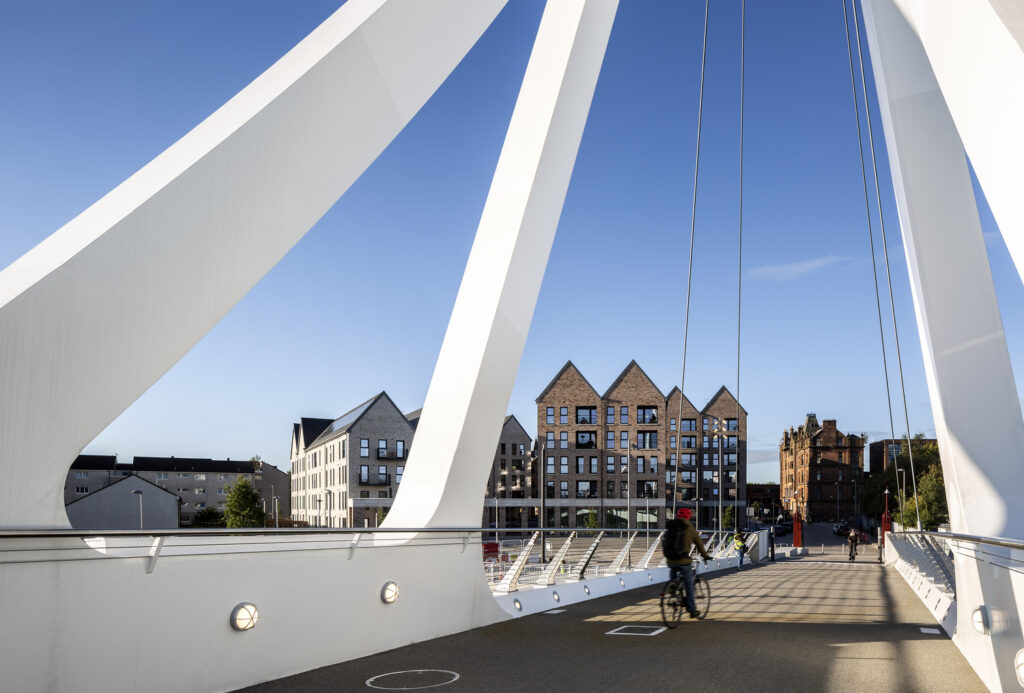
Our projects embrace this approach no matter the scale or budget, and positively contribute to their locale in a multitude of ways. At our Water Row project, following extensive community and stakeholder consultation, we developed ground floor commercial units in a variety of sizes to suit independent businesses, from a laundrette to a bakery. Our Anderston project saw the re-establishment of an essential connection across the site, prioritised for pedestrians, that has become a well-loved route for many in this inner city neighbourhood, with table tennis and play space for residents to enjoy.
3. Do the majority of your projects promote equity in society, and consider all people, not only the building inhabitants? For example, do your projects show due regard for workers within the supply chain and take active steps to avoid modern slavery?
Our name, Collective Architecture, reflects both our work ethic and our approach to equity in society. Over the last 27 years, we have been driving positive change from within the industry to the communities we serve. Our collective approach, responsibility, and service begins with our embedded social ethics and cultural responsibilities. Architecture has the power to drive systemic change, and through our commitment to sustainable design, ethical business practices, and industry-wide advocacy, we continue to challenge norms and lead by example. Our projects are typically publicly funded with care taken at all levels of supply chains to avoid modern slavery for which we have a clear and widely shared policy. We contribute to contract prelims which promote training and apprentice roles in many of our projects and advocate for this with client groups.