
Submission by CarverHaggard.
Being a good ancestor
Practice
1. Do you have a clearly stated purpose aligned with the planetary emergency? We’re looking for a bold ambition here, and a culture which recognises the need for long-term thinking.
We have a clear purpose aligned with the planetary emergency: to deliver public benefit through research and design, finding positive solutions to complex problems.
We are shaping our practice around long-term public benefit rather than short-term gain.
Our work is grounded in retrofit, reuse, low-carbon construction, regenerative design and integrated SuDS, alongside social value, co-design and inclusive access.
But many of our actions feel modest and straightforward: commonsense steps that shift how grassroots projects are briefed, designed and delivered. We are delivering decarbonisation, adapting existing buildings, reusing materials in the public realm, supporting local economies, improving climate resilience and creating places that remain useful over time.
For us, long-term thinking is a practical commitment to doing careful, useful work now that will leave buildings, streets and communities better equipped for the future.
2. Do you have a clearly stated purpose aligned with the planetary emergency? We’re looking for a bold ambition here, and a culture which recognises the need for long-term thinking.
We are a small organisation working for social impact rather than profit, so we think about succession and legacy not in terms of the practice as a business or institution, but through the ideas we develop, the projects we deliver, and the people we collaborate with; our team, clients, consultants, community partners and young people entering the profession.
We hope to build a legacy through innovation, shared learning, mentoring, open collaboration and a values-led culture that is bigger than any one individual. We aim to share and pass on methods of working, co-design approaches, low-carbon retrofit knowledge, and practical ways of creating public benefit. The key elements of any succession will be the capacity of others to continue the work in the future.
3. Do you share research and knowledge for the benefit of society and the wider world?
We see knowledge-sharing as part of our social purpose and we are committed to sharing research and knowledge through public and open channels. We are beginning to publish project lessons through our website and social media, increase our contributions to wider industry conversations, and turn live work into practical guidance for others. We are working on a set of CPD-style process notes for community retrofit projects inform, and we offer pro bono advice for local charities and community groups.
Our work has been used by others as case studies, for example by Timber Development UK and in the GLA’s “Tomorrow’s Market Good Practice Guide” and “Procuring Social Value & EDI” process notes.
We also share learning through workshops, exhibitions, mentoring and structured work experience for young people in South London. Our new studio space enables us to expand this further, with space for talks, mock-ups, training and public-facing events.
Project
1. Do you advocate for long-term thinking at the outset of work? Do you initiate work with long-term thinking and challenge clients? Also, can the organisation demonstrate that this approach has worked?
We advocate for long-term thinking from the outset through rigorous investigation: challenging briefs, testing reuse before other options, and designing for flexibility, public value and future adaptation.
At 198 Contemporary, we were able to retain a 1960s single-storey concrete building and then adapt, refurbish and extend it with over 400sqm of new low-carbon construction using the same foundations.
At Raw Material, long-term thinking meant transforming a 1990s building to maximise its use, retaining structure, improving accessibility and extending capacity, enabling the charity to grow its reach and audience significantly.
At North End Road and Chapel Market, it meant planning with traders and the council for a market fit for the future, combining practical infrastructure, biodiverse planting and adaptable event spaces.
2. Does your work take account of the future climate and the need for resilience?
Our building projects respond to future climate and the need for resilience through low carbon construction, retrofit, passive upgrades and disconnection from fossil fuels. In all three retrofit projects that we completed last year, we have disconnected fossil gas supplies and upgraded glazing, insulation and systems to cut heat loss and reduce EUI.
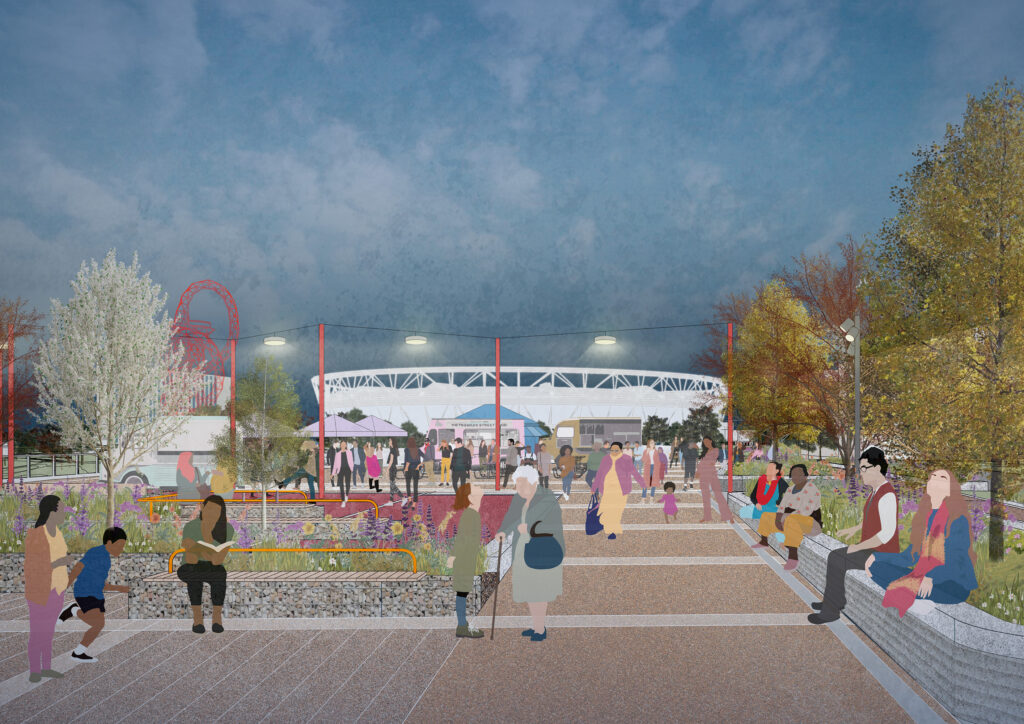
In strategic projects like Lambeth’s Low Line we are working to extend the resilience of inherited infrastructure, and in public realm projects like Kingsford Square and Queen Elizabeth Olympic Park we are looking at how to maximize resilient urban planting and integrate functional rain gardens and climate-resilient green infrastructure to manage polluted runoff, increase seasonal diversity and make public space more comfortable in hotter weather.
3. Does the majority of your work go beyond mitigating negatives and towards optimising positives?
All our projects work towards positive impact.
In retrofit we minimises embodied carbon to unlock social value, looking for win-wins, and we don’t advocate spending money on anything with a single function. Raw Material supported engagement with over 1,000 new people in its first year after reopening, alongside music tuition, public events and wellbeing programmes.
A pair of projects in Bexley used on-site fabrication to retrofit an underperforming business centre and reactivate a section of the town centre.
Town Centre projects at Shape Newham, Chapel Market, and North End Road combine environmental improvements with local economic activity, safety, inclusion and stronger neighbourhood identity.
We look for interventions that do several things at once: planted streets that are cool and welcoming, reused buildings that save carbon and support new programmes, and co-designed spaces that strengthen civic life. The shift from less bad to actively useful is central to our practice.
Co-evolving with nature
Practice
1. Do you use biophilia within your premises and/or do you regularly gather in natural settings?
Our new studio space in LJ Works is embedded in a community focused on urban growing, the circular economy and purpose-driven design. It is co-located with Loughborough Farm, part of a patchwork of community growing spaces bringing people together in South London.
We regularly gather and work in natural and outdoor settings through the character of our projects and partnerships. Much of our work centres on public realm, greening and climate adaptation, so site walks, outdoor workshops and landscape-based engagement are part of our normal practice.
We also use collaborative, hands-on sessions with community groups and young people to think through planting, streets and public space in direct relationship with place. For us, connection with nature is less about office interiors and more about regularly working in, learning from and designing with living urban environments.
2. Can you share examples of where you have considered nature in decision making?
Nature is a practical consideration in our decision-making, especially through climate adaptation, SuDS, greening and retrofit-first thinking. We ask how projects can work with natural systems rather than against them: reducing runoff, increasing shade, supporting biodiversity and making places more comfortable in changing weather.
This can be seen in Kingsford Square in Beckton, where an everyday public space between a supermarket, a library and a school has been transformed by removing excess paving to create rain gardens around the existing oak trees, absorbing the surface water from the square with playful stepping stones through the rain gardens.
In Queen Elizabeth Olympic Park, stepped rain gardens and planting are proposed to manage water and improve public life at the same time. In our other high street projects we have maximised soil area and under-planting for trees rather than plant standard street trees
3. Are you supporting nature locally and nationally?
We support nature locally through projects that bring greening, biodiversity and blue infrastructure into everyday urban places, and nationally through advocacy, knowledge-sharing and practice commitments. Our public realm work includes street trees, planting, rain gardens and SuDS, from Chapel Market and North End Road to Beckton and Queen Elizabeth Olympic Park.
These are not isolated features, but part of a wider approach to cooling streets, improving habitat, reducing runoff and making neighbourhoods healthier. Through project case studies and public sharing we aim to normalise greener, more resilient urban design and demonstrate best practice SuDS to local authorities.
Our contribution is practical and rooted in delivery: showing how nature can be repaired and supported in ordinary streets, markets, public spaces, and buildings.
Project
1. Can you demonstrate work that strives to match the performance of a mature ecosystem?
Our projects work to restore ecological function and aim to exceed the idea of nature as an add-on. In our collaboration on the Green Spine for Queen Elizabeth Olympic Park we have proposed a landscape-led strategy of avenue trees, stepped SuDS rain gardens and climate-resilient planting to connect major public spaces while managing runoff and increasing seasonal diversity.
In Kingsford Square in Beckton, removal of paving to improve the conditions for existing trees was the starting point for a retrofit SuDs scheme and new public space. Chapel Market and North End Road introduce new trees and planting beds into dense high streets with markets. Green Walk turns inaccessible roofs into planted terraces irrigated by collected rainwater. We try to use living systems – water, shade, planting and habitat – to make urban places healthier, more adaptive and more generous to both people and nature.
2. Are you working on material stewardship?
Material stewardship is a growing and important part of our work, especially through retrofit, selective reuse and readily achievable low-carbon construction. We begin by asking what can be kept, repaired or adapted before specifying new materials, with a preference for using softwood timber wherever possible.
At 198 Contemporary, hard thinking and site investigation led to a lightweight timber-framed solution for the upper floors, with straightforward spans and load paths, and glulam beams where necessary. Strengthening works were limited to a single steel post, At Raw Material the existing portal frame was retained and extended in timber rather than replaced with new steel. At Green Walk, the concrete frame was retained and extended with laminated timber beams and CLT panels, and the existing building fabric was upgraded rather than discarded.
3. Does the majority of your work demonstrate the use of biologically-inspired approaches such as Bioregionalism, Biophilia or Biomimicry?
To date we have focused on delivering low-carbon building projects at grassroots level, using straightforward and low-cost building plant-based materials wherever possible.
In the public realm we design with natural systems as active drivers of performance and experience; the proposals for Queen Elizabeth Olympic Park use water-sensitive landscape design, shade, planting and seasonal diversity to shape movement and public life. Green Walk introduces planted terraces, rainwater irrigation and a stronger relationship between workplace and climate-responsive outdoor space. Chapel Market and Shape Newham bring trees, planting and healthier street environments into dense urban conditions.
Creating a just space for people
Practice
1. Do you have a progressive EDI policy and can you evidence many forms of diversity, which are welcomed and acknowledged, within your company/organisation?
We have a progressive EDI policy and we are committed to making the built environment sector more inclusive, both through how we work and who we create opportunities for. Our changing team over the years has welcomed a diversity of ethnic backgrounds, sexualities, and neurodiversity.
We offer regular structured work experience for young people in the areas where we work, and to communities under-represented in built environment professions. We develop this through mentoring, studio visits and a long-term partnership with local organisation We Rise.
Our practice culture is collaborative, socially engaged and rooted in South London. We are a London Living Wage employer, have no unpaid internships, and are working towards the Mayor’s Good Work Standard. As a small practice, our focus is on building inclusion through practical routes like fair pay, supported placements, local partnerships and a working culture where diverse voices are actively welcomed.
2. Do you operate a no overtime culture, meet the living wage consistently, and stipulate a fair salary ratio between staff of all levels?
We are a London Living Wage employer and do not offer unpaid internships, reflecting our belief that fair access to the profession starts with fair pay.
As a small practice, we aim to maintain a supportive working culture rooted in collaboration, realistic workloads and inclusive working conditions, and we are working towards accreditation under the Mayor’s Good Work Standard.
Our size and structure support a straightforward and transparent approach to pay and responsibility, with a maximum ratio of directors’ pay to minimum pay of 2.5:1.
We reject the long-standing culture of unpaid or underpaid labour that was prevalent in our industry, and which has excluded too many people from architecture. Our commitment is practical: decent pay, meaningful work experience, no unpaid internships, and an environment where social value applies to workers as much as to projects.
3. Do you support charities, community groups, social enterprises, action groups and others through pro-bono work, charitable giving or in-kind donations?
Much of our work is for radically community-focused and charitable organisations, including Raw Material, 198 Contemporary Arts & Learning, Longfield Hall, Build Studios, and the Creighton Centre.
We also work to use our spare time, space and professional knowledge to strengthen the organisations and communities we work alongside, by offering our studio space for community workshops, pro bono consultations for local charities, and sharing learning drawn from recent retrofit projects. We regularly support education and outreach through studio visits, work experience and mentoring, with a particular focus on local young people. This is linked to our design work and part of our mission to deliver public benefit.
4. Do you use an ethical framework to assess opportunities and/or supply chain partners and is them team consulted on these decisions?
We use a values-led framework to assess projects, collaborators and supply chains. As a small practice decisions are shaped through a collaborative studio environment where mission, ethics and practical impact are connected. This is typically pre-empted by network outreach and project selection, and resolved through discussion, rather than formalised in a corporate tool.
We are strongly driven by social value in the projects we choose, with more than half our work for public bodies and community-focused organisations.
We seek collaborators who share our goals and challenge us to improve, and we support local economies, the circular economy, low-carbon design and public benefit. Our governance and commitments help provide accountability and team input is part of that culture.
Project
1. Does your work demonstrate deep engagement with local stakeholders and end users?
Deep engagement and co-design are defining features of our work and collaborations.
Shape Newham was an experiment in deliberative democracy where residents in eight neighbourhoods voted on locations, priorities and budgets, briefed the design team, and reviewed proposals as they developed.
In a series of collaborations with youth groups and other designers we have put young residents at the heart of the design process in a structured and measurable way. For example, In South Norwood workshops with Year 8 students gathered and preserved stories that became part of a place-based publication and informed the design of public realm elements and a mural. This has led to two shortlistings for the TET Awards, and supported participants going on to work experience and successful university applications for architecture and design.
2. Does your work create connected and resilient communities which positively contribute to neighbourhoods and allow equality of access?
At 198 Contemporary, the radical retrofit and extension of an existing building provided exemplary new spaces for art, education, and activism; enabling a Black-led and owned visual arts organisation to achieve their long-term vision while preserving their spirit and history.
Nearby, Raw Material’s retrofit has expanded capacity for workshops, events and affordable creative production, supporting mental health, skills and community participation in South London.
At Folca, the Art Deco former Debenhams site in the heart of Folkestone town centre, we are working to bring the building back into use with a future occupancy strategy for an NHS medical centre.
Our public realm work improves accessibility, safety, and wayfinding, with seating, play, lighting and greener routes designed for a wider range of users, while at Chapel Market and North End Road we have helped two long-standing street markets remain inclusive and viable.
3. Does the majority of your work promote equity in society, and consider all people, not only building inhabitants
All our projects aim to promote equity in society by thinking beyond the immediate client to respect current and future users and visitors, local communities, and local economies.
Most of our work is on civic, cultural and public realm projects where our design skills serve diverse and overlapping needs: residents, traders, visitors, young people, workers and community organisations.
Our community cultural projects like 198 Contemporary and Raw Material support creative development and mental health; Chapel Market protects affordable local trade; Shape Newham directs investment to town centres outside major regeneration areas; and youth-led engagement projects in Brixton and South Norwood give under-represented voices real influence over how places are understood and shaped.
As a small practice, our strongest contribution to equity is who we choose to work with and support, how we engage and collaborate, and how our design decisions lead to broader public benefit.