
Submission by Buckley Gray Yeoman.
Being a good ancestor
Practice
1. Do you have a clearly stated purpose aligned with the planetary emergency? We’re looking for a bold ambition here, and a culture which recognises the need for long-term thinking.
Sustainability and the reuse of existing buildings has driven BGY since 1997, encapsulated by our mission, “We take what we find.” Embracing retrofit, we transform existing buildings to meet client aspirations and respond to the climate emergency, continuously challenging the assumption that demolition is the default.
In 2022, we launched our Carbon Reduction & Regenerative Practice Plan, aligned with Architects Declare and Science Based Targets Initiative. This framework measures Scope 1, 2 and 3 emissions, setting a clear roadmap for practice-wide and project-level reductions. Through transparent reporting, we have met our 2030 target, reducing Scope 1 & 2 emissions by 48%, six years early.
Alongside carbon targets, we maintain qualitative roadmaps built on five principles: leveraging site opportunities, intelligent material use, maximising biodiversity, prioritising user wellbeing, and designing for long‑term adaptability. Reviewed annually, these documents ensure our work advances social good, fosters stakeholder engagement and strengthens ecological resilience across every commission.
2. Do you have a clearly stated purpose aligned with the planetary emergency? We’re looking for a bold ambition here, and a culture which recognises the need for long-term thinking.
Buckley Gray Yeoman was one of the pioneering architectural practices to become an employee-owned trust in 2020. Our founding directors recognised that to sustain the core values of innovation, sustainability, and collaboration, a succession plan that places employees at the heart of the business was essential. This plan ensures that everyone has a stake in the future of Buckley Gray Yeoman.
Employees elect a representative to sit on the Employee Ownership Trust (EOT) board, providing feedback and suggestions through Townhalls and Open Mic sessions. We also are constantly refining our employee forums to enhance engagement and ensure that employees have a meaningful voice in shaping the culture and direction of the practice. Transparency is maintained through quarterly updates on the company’s performance, allowing each member of staff to feel invested in the business. This approach ensures that everyone understands how they can contribute to driving success and meaningful change.
3. Do you share research and knowledge for the benefit of society and the wider world?
Our practice is committed to advancing collective knowledge. As Chair of NLA’s Retrofit & Conservation Expert Panel, we pioneer adaptive reuse strategies, tackling housing regeneration challenges and sharing insights through policy recommendations, case studies and practitioner workshops to shape conservation and retrofit projects across London.
We host industry events showcasing our pioneering work with Saint-Gobain and the FIS, piloting circular economy initiatives. A team member on Article 25’s Next Gen Board co-hosts presentations and roundtables on their “More Than a Building” campaign, fostering open dialogue on sustainable humanitarian design and sharing lessons globally.
In partnership with a UCL PhD candidate, we conducted a post-occupancy evaluation of the Verse Building, Old Street, examining natural ventilation and occupant behaviour’s impact on energy performance. Findings have been presented at industry conferences and published as an open-access report, informing both our practice and the wider discourse on performance-based, user-centred design.
Project
1. Do you advocate for long-term thinking at the outset of work? Do you initiate work with long-term thinking and challenge clients? Also, can the organisation demonstrate that this approach has worked?
Long‑term thinking underpins every commission, driving us to challenge demolition and champion adaptive reuse for both environmental and economic gain. By scrutinising client assumptions, future flexibility and lifecycle payback, we regularly uncover solutions that preserve and revitalise existing buildings.
For instance, YY London, a 1980s office block slated for demolition, was transformed via deep retrofit and reclad to best‑in‑class environmental standards, —extending its service life far beyond the original design intent. Similarly, at Portland House (Thirty High), we questioned the assumption that low floor‑to‑ceiling heights necessitated replacement. By proposing a retrofit instead of a rebuild, we preserved the structure, extended its usable lifespan and delivered stronger long‑term returns for our client.
2. Does your work take account of the future climate and the need for resilience?
All our projects embed climate resilience from day one, combining SuDS, solar shading and fabric upgrades to reduce flood risk, overheating and energy demand. At Campus Reading International, impermeable paving became rain gardens with arc‑planters that manage stormwater and boost biodiversity. At Waterloo Central, photovoltaic panels are integrated into the façade to provide future‑proof shading and generate on‑site renewable energy, buffering the building against grid volatility.
We also champion design for disassembly through CLT and hybrid structures. Our two‑storey CLT extension at Technique slashes embodied carbon and can be demounted for reuse. The same strategy drives our work at 206 Marylebone Road and the Broadgate Tower extension, where prefabricated timber and steel‑hybrid frames allow components to be separated, recycled or relocated as needs evolve.
3. Does the majority of your work go beyond mitigating negatives and towards optimising positives?
Many of our projects aim to go beyond mitigating environmental harm to optimise positive outcomes, echoing RIBA 2030 targets for energy, carbon and water. Recognising that project contexts vary, we expect a significant portion of our current pipeline of work to meet these aspirations. To gauge our progress, we have launched a internal project‑tracking tool this year to monitor performance against RIBA 2030 & UK NZCBS metrics, enabling transparent reporting and iterative refinement.
Beyond project delivery, we contribute thought leadership to advance industry understanding of net‑positive design. In an Architects’ Journal opinion piece, we examined the new Climate Change Committee report’s implications for practice, positioning it as a wake‑up call and urging colleagues to adopt rigorous performance targets from project inception (“The new Climate Change Committee report is a wake‑up call for architects”). By combining practical tools with public advocacy, we aim to help shift the profession towards genuinely regenerative design.
Co-evolving with nature
Practice
1. Do you use biophilia within your premises and/or do you regularly gather in natural settings?
Our practice embraces biophilia through abundant greenery across all our workspaces. Thriving plants foster wellbeing, reduce stress and improve air quality, creating a lush, living office environment. For larger gatherings and client meetings, we often retreat to the Shoreditch Arts Club, where banana plants and greenery in the foyer provide a vibrant, restorative setting.
Each year, we celebrate Mental Health Awareness Month by hosting a picnic in our local east London park and visiting Hackney City Farm, reconnecting our team with nature to boost wellbeing and strengthen connections beyond the workplace.
These initiatives, from our plant-filled studio to shared outdoor experiences, reflect our belief that connecting people with the natural world cultivates creativity, supports mental health and reinforces our commitment to a green, people-centred practice.
2. Can you share examples of where you have considered nature in decision making?
No.
3. Are you supporting nature locally and nationally?
This year, we beganEach year we supporting Arnold Circus, a community charity dedicated to regenerating and maintaining the historic bandstand and Boundary Gardens at the heart of the Boundary Estate near our Shoreditch office. Founded by local residents in 2004, Arnold Circus had fallen into disrepair; it’s now a vibrant, well‑tended oasis cherished by both our employees and the wider community. Looking ahead, we’re extending this approach beyond London, actively seeking out other neighbourhood green spaces to support around our Bristol and Madrid offices, —nurturing pockets of nature wherever we work.
Project
1. Can you demonstrate work that strives to match the performance of a mature ecosystem?
Many of our commissions begin with existing urban buildings set amid expanses of impermeable surfacing, so we always prioritise biodiversity enhancement, aiming to exceed Urban Greening Factor and Biodiversity Net Gain targets. At Edward Street Quarter, we planted new trees along pedestrian routes between the buildings, guiding visitors into a central landscaped courtyard that doubles as a vibrant public space and key thoroughfare. At YY London, we carved into the original façade to introduce planted terraces on every floor and created a secluded, biodiverse roof terrace. Meanwhile, at Campus Reading International, we transformed the late‑1990s business‑park palette,—minimising hard landscaping and layering native and adaptive species, —to foster ecological resilience and natural variation throughout the site.
2. Are you working on material stewardship?
Material stewardship underpins our approach, driving the repeated use of low‑carbon and reclaimed materials to minimise waste and embodied carbon. At Broadgate Tower, we are pioneering the reuse of structural steel, diverting tonnes of metal from landfill and proving that existing frames can meet modern performance standards. Across multiple schemes, we specify CLT for its renewability and carbon‑sequestering qualities, while fit‑outs for Hayfin at Davies House and Storey feature naturally low‑embodied‑carbon finishes such as cork and linoleum.
On Giltspur Street, we employed an innovative slab‑jacking technique to change slab level in situ to create an additional floor, eliminating the need for new concrete pours and reducing material waste. Behind the scenes, our evolving material library and ongoing research ensure that every project benefits from best‑practice guidance on sourcing, reuse and end‑of‑life recycling, embedding circularity at every stage.
3. Does the majority of your work demonstrate the use of biologically-inspired approaches such as Bioregionalism, Biophilia or Biomimicry?
We integrate biologically inspired strategies across our projects, assessing the connection between occupants and nature through our sustainability reviews and empowering teams with Climate Literacy CPDs on biomimicry, biophilia and related disciplines. On several schemes, we are integrating bio‑solar roofs, blending photovoltaic arrays with biodiverse green membranes of native sedums and grasses to mimic natural systems, enhancing energy generation, rainwater management, thermal regulation and pollinator habitats in one multifunctional layer.
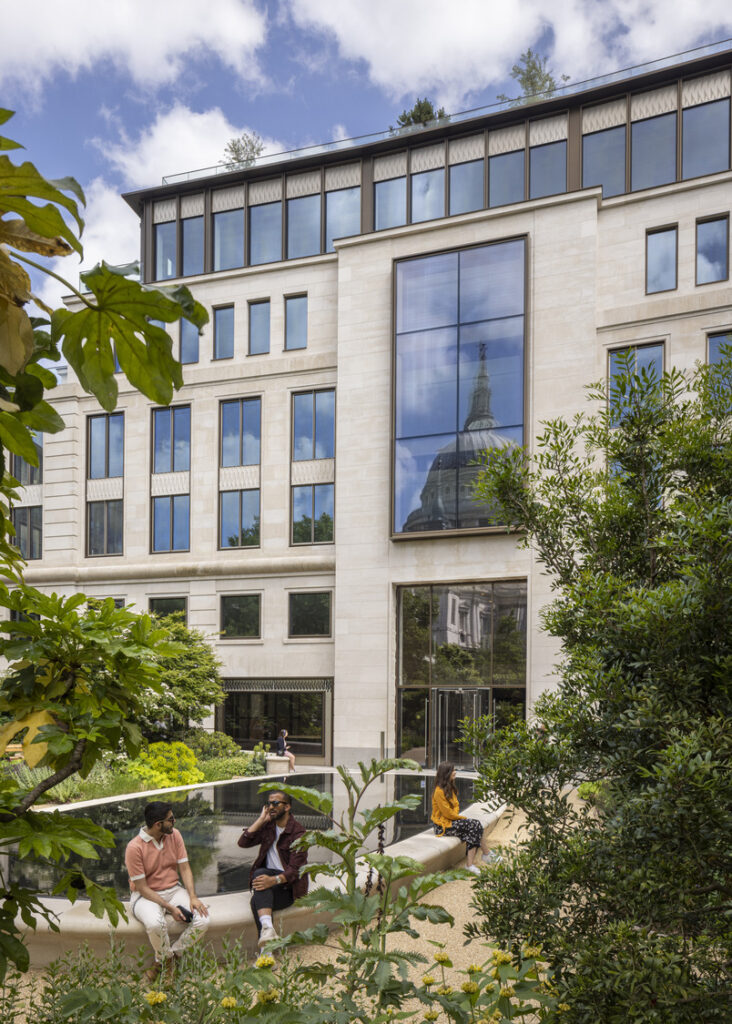
At 25 Cannon Street, we applied Terrapin Bright Green’s 14 Patterns of Biophilic Design to both the public garden and rooftop terrace. We orchestrated diurnal and seasonal shifts in texture, colour, scent and movement; provided prospect and refuge zones; integrated clean‑water features; and specified cladding panels that echo organic shapes. The result is a built environment that weaves nature into daily routines and sustains long‑term connections between people and place.
Creating a just space for people
Practice
1. Do you have a progressive EDI policy and can you evidence many forms of diversity, which are welcomed and acknowledged, within your company/organisation?
Our practice is underpinned upheld by a robust Equity, Diversity & Inclusion policy that we review annually to ensure it remains progressive and impactful. Each year, we report internal anonymised data on ethnic minority representation, and we voluntarily report our gender pay gap, which continues to narrow as we maintain a 50:50 gender balance.
We actively broaden our recruitment reach and partner with schools in Hackney and Tower Hamlets to spark early interest in the built‑environment sector among underrepresented communities. Within the studio, we foster authenticity, encouraging everyone to display their pronouns in email signatures and creating spaces where all voices are heard. We also support the “W” programme by providing mentorship, training and networking opportunities for women and other underrepresented groups, helping them advance and thrive in our industry.
2. Do you operate a no overtime culture, meet the living wage consistently, and stipulate a fair salary ratio between staff of all levels?
BGY proudly holds accreditation as a Living Wage Employer, ensuring that every member of our team receives a pay rate that genuinely meets their everyday needs, well above the statutory minimum. This commitment underpins supports our belief that fair remuneration drives motivation, reduces turnover and fosters a more inclusive workplace culture.
Our discretionary time‑in‑lieu policy allows staff to receive paid time off for overtime worked. This flexibility recognises the ebb and flow of project workloads while supporting work–life balance and staff wellbeing.
We also calculate our gender pay gap annually and publish the findings transparently. Where disparities emerge, we implement targeted actions, such as revising our salary bands, offering leadership mentorship for underrepresented groups and standardising recruitment and promotion processes, to narrow the gap and ensure equal opportunity at every career stage.
3. Do you support charities, community groups, social enterprises, action groups and others through pro-bono work, charitable giving or in-kind donations?
We channel our expertise and resources into community and charitable initiatives. Through Homes Energy Action Lab (HEAL), we conduct pro‑bono retrofit assessments for community buildings across Hackney, helping groups reduce energy costs and carbon footprints. We work at a reduced fee with a local co‑op on community energy fund projects in Tower Hamlets.
Our Social Value Forum allocates hours for voluntary outreach, including educational sessions in schools, and work‑experience workshops co‑hosted with BAM for underrepresented students aspiring to careers in construction and design. We’re proud supporters of the “Don’t Waste Buildings” campaign, offering sponsorship, report funding and case‑study tours that showcase adaptive‑reuse best practice.
Beyond fees-in‑kind, we participate in industry‑fundraisers, such as the Grosvenor Dragon Boat Race and JLL Property Triathlon, Microscope Ball & Variety 75’s PROPS Awards matching employee fundraising and donating in‑kind services. Through these efforts, we strive to make a tangible social impact across east London and beyond.
4. Do you use an ethical framework to assess opportunities and/or supply chain partners and is them team consulted on these decisions?
No.
Project
1. Does your work demonstrate deep engagement with local stakeholders and end users?
Our projects embrace genuine co‑design, moving beyond token consultation to forge lasting partnerships with end users and local communities. For Brixton International House, we ran a series of themed workshops, inviting paid participants drawn from the surrounding neighbourhood, to critique plans and elevations, explore precedents and articulate what aspects resonated or fell short. Their insights didn’t just inform but shaped the final proposals, ensuring the design truly reflects local needs and aspirations.
Similarly, in collaboration with Homes Energy Action Lab, we’ve undertaken deep engagement with community groups in Hackney to develop retrofit action plans. Rather than delivering off‑the‑shelf reports, we conducted in‑depth dialogues about how each building is used, mapped pain points and co‑ideated “quick wins” for energy efficiency. This immersive process fostered ownership among stakeholders and ensured that our technical recommendations align with on‑the‑ground realities.
2. Does your work create connected and resilient communities which positively contribute to neighbourhoods and allow equality of access?
Creating connected and resilient places that bolster local economies and guarantee equal access is central to our masterplanning approach.
At Edward Street Quarter, our plan introduced tree‑lined pedestrian routes and a central landscaped courtyard, knitting new public realm seamlessly into existing streets. This thoroughfare enhances accessibility, drives footfall for local businesses and fosters vibrant community interaction.
Similar principles guide our work in Fish Island, the Truman Brewery and Wheat Quarter. Each masterplan weaves new housing, workspace and cultural venues into established neighbourhoods, preserving heritage buildings, activating underused sites and embedding flexible public spaces. These schemes generate local employment, support pop‑up markets and creative workshops, creating economic opportunity while ensuring equality of access. By prioritising permeability, mixed‑use vitality and stakeholder co‑creation, we deliver places that evolve organically, retain value for residents and build resilience to future change.
3. Does the majority of your work promote equity in society, and consider all people, not only building inhabitants
BGY’s Sustainable Procurement Policy establishes a rigorous framework for responsible specification across all architectural and interior design projects. We prioritise low-carbon, locally sourced materials, targeting a minimum 60% of project value from within a 300-mile radius, while limiting sourcing beyond 500 miles to exceptional circumstances.
We require all suppliers to comply with the Modern Slavery Act 2015, publishing an annual statement and conducting regular audits to ensure fair wages and the right to work in the UK. New suppliers undergo thorough vetting, with preference given to those holding B-Corp, Fairtrade, SA8000 or BES 6001 certifications.
Our policy champions reclaimed and second-life materials, circular economy principles and material health, screening specifications against the ILFI Red List to protect occupant wellbeing. Environmental Product Declarations are requested for all major materials, and sustainability credentials are transparently documented for clients, ensuring accountability across our entire supply chain.