
Submission by Bricolage.
Being a good ancestor
Practice
1. Do you have a clearly stated purpose aligned with the planetary emergency? We’re looking for a bold ambition here, and a culture which recognises the need for long-term thinking.
Founded with purpose, our practice responds to the urgent challenges of our time: climate breakdown, biodiversity loss, resource scarcity and deepening inequality. Building today has real costs. Our role is to tread lightly and focus on repair as much as creation. We shape environments that are functional and beautiful, but also responsible and long-lasting.
We work with likeminded clients who understand that building with integrity is both necessary and rewarding. We believe in a hopeful future, where construction is guided by care rather than excess.
We combine design intelligence with strategic hands-on construction experience. We work with materials, sites and communities, championing reuse, adaptation and resourcefulness, and often take responsibility for delivering projects ourselves.
We work with councils, lead research, write guidance and collaborate across disciplines. This informs our design, and vice versa. We also teach, write and advocate, contributing steadily to a more equitable and responsible built environment.
2. Do you have a clearly stated purpose aligned with the planetary emergency? We’re looking for a bold ambition here, and a culture which recognises the need for long-term thinking.
We are a small operation founded recently. In the fullness of time, we would pass ownership to contributors, we would need to develop this strategy in the future.
3. Do you share research and knowledge for the benefit of society and the wider world?
The practice is predominantly advocating in its early days for communities to take control of their own housing, in terms of value, cost, resilience and carbon. The practice has demonstrated through project work that self initiated, managed and constructed projects can offer significant carbon and cost savings. We speak nationally and share knowledge of how to do this directly. We happy share general advice of how self builders and communities can depart on a journey to build their own homes.
Project
1. Do you advocate for long-term thinking at the outset of work? Do you initiate work with long-term thinking and challenge clients? Also, can the organisation demonstrate that this approach has worked?
The idea of creating resilient and enduring buildings and spaces is at the core of what we seek to do. We enjoy working with clients who plan to occupy their homes for the long term, and shy away from clients who seek to flip developments or build vaguely for the mass market. We challenge clients by enabling them to see the potential in their existing spaces, and hope that they choose to stay in their homes for longer. We consider robustness and design life from the start, advocating for building techniques and materials that are robust, and easy to maintain or modify later. This means less concealed build-ups, and more visible construction. Our process of self construction and direct labour management means we can set out structure to retain visible, and reduce over material use. This means our buildings can be understood and changed later more easily
2. Does your work take account of the future climate and the need for resilience?
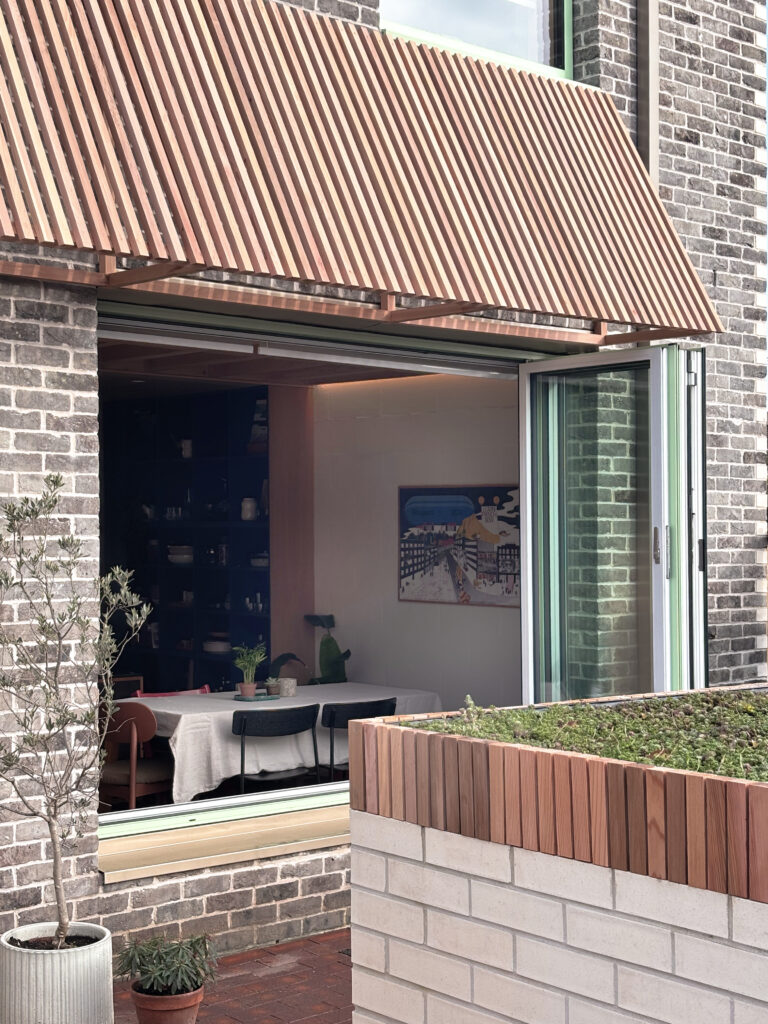
Yes. My practice treats future climate resilience as a practical design constraint, shaping how buildings are sited, made, serviced and inhabited over time. Castlands Road combines a compact form, high-performance fabric, triple glazing, MVHR and an air source heat pump, with actual annual energy use of 6,900 kWh, equivalent to 10.9 kgCO2/m². Its material strategy is equally concerned with resilience: salvaged bricks, a breathable clay block inner leaf, exposed British larch structure and reduced finishes make the building simpler to maintain, understand and adapt.
The project also tests a wider urban proposition: overlooked backland and garden sites can support gentle intensification without demolition-led redevelopment or excessive material use. Across the practice, resilience means more than technical performance. It means designing places that use fewer resources, can be cared for over time, and give people greater agency in shaping how they live.
3. Does the majority of your work go beyond mitigating negatives and towards optimising positives?
Yes. The practice is increasingly focused on work that moves beyond reducing harm towards creating positive social, environmental and cultural value. Castlands Road is a useful test case: it does not only reduce energy demand or embodied carbon compared to the status quo, but uses a small overlooked urban site to create a family home, support gentle intensification, demonstrate an alternative model of self-build housing, and make low-carbon construction legible through exposed, durable materials.
This approach carries through the wider work: retaining and adapting existing buildings where possible, using salvaged, bio-based or lower-carbon materials, reducing unnecessary finishes, and designing projects that strengthen people’s connection to place. The ambition is for each project to produce more than a lower-impact building: greater agency, better use of land, longer material life, and a deeper culture of care.
Co-evolving with nature
Practice
1. Do you use biophilia within your premises and/or do you regularly gather in natural settings?
Yes, but at a small-practice scale. I don’t operate from a large conventional studio, so biophilia is less about workplace fit-out and more about how work is structured and where thinking happens. Design work often takes place between home, garden and site conditions, where proximity to daylight, planting, weather and material testing is part of the everyday process.
2. Can you share examples of where you have considered nature in decision making?
Castlands Road was built on a garden, and so going above and beyond to ensure BNG, greening and proper drainage for the plot was critical. The front and rear gardens are planted extensively, with green roofs to bin and bike stores, and integrated intense planters. Permeable paving was used to ensure run off is minimised, and native plants used in the design of the garden to ensure maximum opportunity for pollinators etc. Frankly the garden has been left to run somewhat wild, as the idea of controlling it too tightly was resisted.
3. Are you supporting nature locally and nationally?
Yes, at a local scale, the practice supports nature by treating gardens, small sites and existing urban fabric as active ecological conditions rather than leftover space. Castlands Road was shaped around orientation, shade, planting, privacy and the relationship between house and garden, with a compact footprint that makes better use of urban land rather than contributing to expansion in the countryside.
Nationally, the contribution is through advocacy and demonstration. The practice uses built work, writing, awards, teaching and public discussion to promote small-site development, retrofit, reuse, low-carbon materials and more careful stewardship of land. The aim is to show that housing and nature are not opposing priorities: cities can accommodate more homes while using land more intelligently, reducing waste, and improving everyday contact with gardens, planting and local ecology.
Project
1. Can you demonstrate work that strives to match the performance of a mature ecosystem?
No.
2. Are you working on material stewardship?
Material stewardship is central to the practice, particularly through reuse, reduced finishes and direct engagement with how buildings are made. We have sourced materials from site leftovers and salvaged stock, prioritised use of UK by strictly integrating British larch joists and rafters in our projects. We’ve also had success using recycled plastic for worktops.
Across the practice, stewardship means treating materials as finite, specific and already culturally loaded. The aim is to design in ways that reduce waste, make construction legible, support repair and adaptation, and keep materials in use for longer.
3. Does the majority of your work demonstrate the use of biologically-inspired approaches such as Bioregionalism, Biophilia or Biomimicry?
Yes. The majority of my practice’s work is shaped by bioregional and biophilic thinking: designing from the specific conditions of site, climate, material availability, local skills and patterns of occupation. This is less about applying nature as an image, and more about learning from place. We would love to explore these practices on a deeply site specific basis, such as re-use of site clay. So far, we have explored predominately the use of locally reclaimed materials, accepting that our projects are also defined by local availability within the decline of a capitalist model. We have not yet had the opportunity to test this on a purist basis, but hope to in the future.
Creating a just space for people
Practice
1. Do you have a progressive EDI policy and can you evidence many forms of diversity, which are welcomed and acknowledged, within your company/organisation?
I am a practice of one person, but as we grow, EDI will be paramount in shaping the future of the practice.
2. Do you operate a no overtime culture, meet the living wage consistently, and stipulate a fair salary ratio between staff of all levels?
I am a practice of one person, but flexibility, a lack of overtime, and a focus on life around work is a founding principle of the business.
3. Do you support charities, community groups, social enterprises, action groups and others through pro-bono work, charitable giving or in-kind donations?
I have plans to support my child’s school through provision of pro-bono planning applications for installation of PV panels.
4. Do you use an ethical framework to assess opportunities and/or supply chain partners and is them team consulted on these decisions?
Within limited opportunities, yes, on an adhoc and personally researched basis.
Project
1. Does your work demonstrate deep engagement with local stakeholders and end users?
Yes. Much of the practice’s work is with domestic and consumer clients, where the end user is directly involved in almost every decision. These are deeply personal projects: homes, gardens, adaptations and small buildings shaped around family life, budgets, anxieties, routines, maintenance and long-term occupation. Engagement is continuous, informal and specific.
2. Does your work create connected and resilient communities which positively contribute to neighbourhoods and allow equality of access?
The practice sees small-scale self-build as a way of creating new homes that plug into existing communities, rather than arriving as large imposed developments with sudden impacts on place, infrastructure and social fabric.
At Castlands Road, the process of finding land, securing planning, building slowly and being physically present on site meant we became part of the street before moving in. Relationships with neighbours, local trades, suppliers and the planning context were part of the project, rather than external constraints. The house was conceived as a “terraced house in waiting”, contributing to the street and demonstrating how overlooked garden and backland sites can support gentle intensification.
This experience shapes the practice’s wider approach: helping people make homes within existing neighbourhoods, using smaller sites, local knowledge and direct engagement to create housing that feels embedded, legible and less extractive.
3. Does the majority of your work promote equity in society, and consider all people, not only building inhabitants
Agree with the principle, and will work towards real examples.