
Submission by Bond Bryan.
Being a good ancestor
Practice
1. Does the practice have a clearly stated purpose aligned with the planetary emergency? We are looking for a bold ambition here, and a practice culture which recognises the need for long-term thinking. For example, a strong mission, a theory of change, or a sustainability roadmap.
We are signatories of Architects Declare and the RIBA 2030 Climate Challenge. We aim to be Net Zero Carbon by 2030. We have an internal think tank called the Environmental Circularity group that addresses sustainability within our operations and our architecture, and we embed environmental sustainability principles into our projects, alongside gathering POE data. Our aims, actions and intentions are outlined within our Sustainability Roadmap and Carbon Reduction Plan. These are both updated annually, considering our most up to date carbon footprint data. We are passionate about changing our trajectory from ‘business-as-usual’ and understanding the importance of acting now to address the double emergencies of climate crisis and biodiversity loss. We actively upskill our staff through our regular CPD programme and have, since 2023, implemented a companywide sustainability training day. The purpose of this is to bring the whole practice together to act on our pledge.
2. Does the practice have a clear succession plan, which passes on ownership and protects the values and legacy of those who built and contributed to the practice? For example is the practice an employee owned trust.
The current CEO and Directors of the practice have progressed through the business, developing, and improving on our approach towards the environment. They are keen to develop the values of the business and ensure that these are included as part of their continually adapting succession plan. The succession plan aims to create a sustainable business, nurturing and recognising the contribution of senior management staff. It aims to encourage progression through the business at all levels and focusses on career development and business evolution. One such evolution is the nurturing of our dedicated Sustainability Lead, who has moved up within the business, starting as a Project Architect and transitioning over to full-time sustainability to ensure we continue to progress and improve with the planet in mind. Similarly, our Change and Innovation Lead, who has progressed through the business, ensures we are exploring and embracing better ways of working for the future.
3. Does the practice share research and knowledge for the benefit of society and the wider world? For example, you regularly carry out post occupancy evaluation and share information with others.
As a business we care deeply about people, and this philosophy goes beyond Bond Bryan. Our core business values include to develop, contribute and share knowledge with peers, wider industry, and society. We regularly share our sustainability journey, including lessons learnt, within the industry and have been involved in forums, such as Architects Declare and University Design Forum Research Group. We continue to develop our understanding of environmental sustainability and sharing our findings and expertise through involvement with the ‘Heads of Sustainability’ group. This is a large group of practices across the UK, sharing findings, knowledge, and expertise. We have also expanded this into a local West Midlands offshoot, since 2024, to further knowledge share locally. Over the years we have developed expertise and knowledge in various areas, such as the education sector and BIM, and we share this knowledge regularly through conferences, discussion groups, B2Bs and thought leadership pieces.
Project
1. Does the practice advocate for long-term thinking at the outset of projects? Do you initiate projects with long-term thinking and challenge the client on design life? Also, can the practice demonstrate that this approach has worked with a shorter or longer design life, or an innovative approach to financing or payback period?
From the outset, we support clients in embedding an environmentally sustainable way of designing, even where clients may not prioritise this. We support them in evaluating the project need holistically, using our ‘Client Engagement Tool’, and encourage long-term thinking with environmental consideration. We support them with whole life cycle costing and targets for whole life cycle carbon and apply knowledge from our Environmental Circularity group towards circular design, considering future use, and encourage clients to consider flexibility, reuse, and retrofit.
Our strategic team undertake space utilisation, advising clients on their existing estates, evaluating the appropriate approach and scale for a project. For any reuse or retrofit projects, our interiors team advise on the specification of materials, to ensure longevity. We also have experienced masterplanners who can advise on more longer-term strategies for larger estates. They work alongside our landscape team to ensure the right principles are considered and embedded.
2. Do your projects take account of the future climate and the need for resilience? For example, do the projects demonstrate flexibility, design for adaptation, design for disassembly, non-deterministic solutions, or demountable structures.
Since 2023 Bond Bryan have held dedicated environmental sustainability training days to educate staff on the climate crisis and biodiversity loss, fostering design strategies that consider future climatic scenarios and the need for adaptability.
Bond Bryan encourages accountability for future climatic or operational change, and the need for resilience within projects, designing buildings for flexibility and adaptability for future uses (short and long term), always considering end-of-life. Bond Bryan designed University of Kent – Kennedy Building was inherently designed for future flexibility considering zoning in future scenarios, and designing widened staircases, flexible floorplates and MEP systems that could be connected without major intervention if spaces were changed. Designed for the School of Economics, it now houses the School of Computing, having successfully been adapted for its new occupants.
We also explore alternative and innovative forms of construction, including MMC and hybrid solutions, to reduce carbon, minimise waste and encourage reuse.
3. Do the majority of your projects go beyond mitigating negatives and towards optimising positives? For example, are they meeting or exceeding the RIBA 2030 Challenge.
No.
Co-evolving with nature
Practice
1. Does the practice use biophilia within the office or regularly host meetings and retreats in natural settings? For example do you have extensive planting within the office or rely on natural patterns and imagery for stress relief or quiet areas.
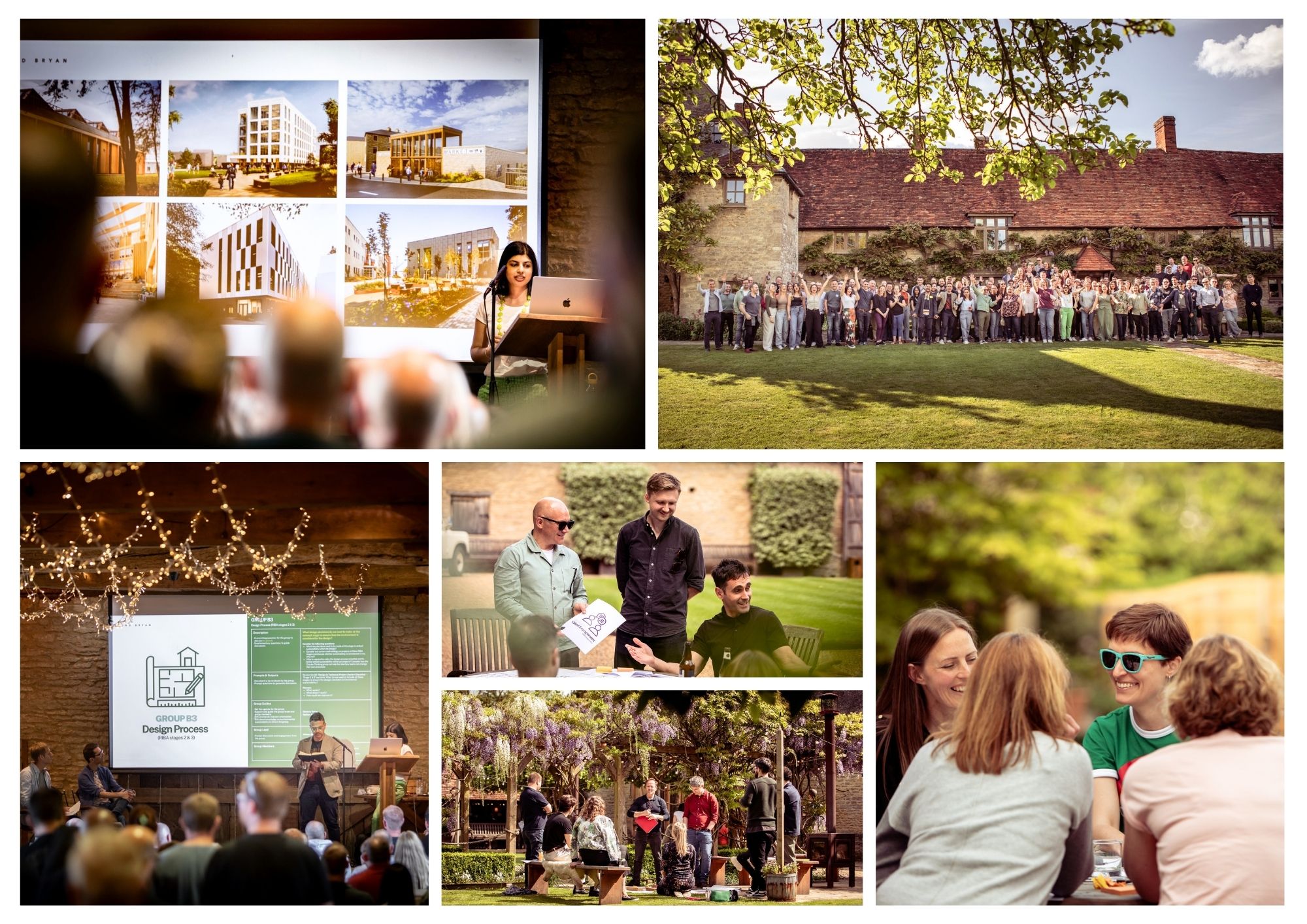
In our offices we prioritise WELL principles by incorporating a range of planting and the recent fitout of our new Birmingham office has achieved a self-certified silver rating. To lower our commuting emissions, we have located as many of our offices in city centre locations with easy access to public transport. We also regularly hold social and business events within natural settings, such as our dedicated sustainability training away day last year, which was held in rural Oxfordshire.
Throughout the year we have companywide events, such as walks in the Peak District and other social events in the natural environment. We believe this is important for the health and well-being of our staff. In 2023 we held a festival, which was a social and well-being event, for the whole practice, in a natural setting in Northamptonshire.
2. Can the practice share examples where it has considered nature in decision making? For example by having a nature proxy to encourage eco-centric decision making, using natural systems as inspiration for the company structure, recognising the seasonal nature of people’s capacity and workload or celebrating equinoxes and solstices together.
At Bond Bryan, we prioritise our staff as our most valuable asset, embodying a people-centric approach providing flexibility and promoting health and well-being. We recognise that everyone operates on their own natural rhythms, so we empower staff to work according to their individual needs, including different life stages, such as maternity and paternity. We offer wellbeing activities – yoga sessions, massages, as well as encouraging flexibility by allowing staff to go on lunchtime walks and runs, accommodating diverse preferences. Our social and well-being calendar adapts to weather and seasonal changes, ensuring activities are enjoyable and suitable for all and in tune with natural systems.
As a company we learn from other species to help inform how we may behave as a business. Ant colonies provide some great examples of how collective action and shared goals can reap great benefits, not only for a happier business but a healthier planet too.
3. Is the practice supporting nature locally and nationally? For example, does the practice support local gardens, gardeners, planting programmes, rewilding programmes or advocate for changes in legislation to protect nature.
Bond Bryan’s in-house landscape team are advocates of landscape led design and enhancing biodiversity on all projects we influence, supporting nature whilst engaging with local communities. Our team has carried out pro-bono work supporting local schools to develop their habitat and SuDS areas, assisted with schemes to develop community facilities, and supported schools with their planting programmes.
Recently we have introduced 2 volunteering days for each member of staff, we hope that this will encourage more staff (individually and as teams) to positively embrace nature conservation and enhancement initiatives. As part of this we have and continue to undertake volunteering with the local community of Westerham to help maintain Long Pond. This has involved gardening and maintenance. We have also created a broader plan to introduce nature and wildlife habitats, such as bird boxes and bee houses.
Project
1. Can the practice demonstrate projects which strive to match the performance of a mature ecosystem? As a minimum this would mean achieving biodiversity net gain.
Bond Bryan’s landscape team support on a wide range of projects. On larger schemes we are able to create significant eco-systems and green corridors to existing green infrastructure. Besides following policy requirements for Biodiversity Net Gain and Urban Green Factor, the creation of mature eco-systems require additional consideration, such as designing with the ‘bigger, better and more connected’ principles in mind.
Recently it has been difficult to retain significant green infrastructure on projects due to overriding budgetary constraints, but as planning policy adapts to address ecological issues, opportunities, and client buy-in have increased, which we are equipped to support with. We are committed to upskilling our staff in line with the emerging policies, alongside principles such as sustainable drainage, biophilic design, and softer skills and confidence to advocate for the environment. On projects we also provide a 30-year landscape maintenance and management plan to ensure the systems created have longevity.
2. Is the practice working on material stewardship? For example, evidence could be shown through repeated use of low carbon materials, extensive material libraries and research or publications supporting responsible use of materials and elimination of waste.
Since establishing our in-house Environmental Circularity Group, in 2020, we have maintained focus on materials research. Last year we developed an internal database of low carbon products using EPD data and embedded this into an integral carbon calculator template (Design LCA) within our design software (Archicad). This allows project teams to undertake high-level carbon calculations of their designs, using accurate quantity data, to make informed decisions about material selection. This year we have also updated our in-house ‘Sustainable Design Guide’ that expands beyond carbon, towards circularity, reuse and regenerative design.
Across all our studios our Sustainability Lead holds regular project specific workshops where material choice and specification are discussed, to drive the design towards specification of low carbon alternatives. This has been successful on our Chichester College Group STEM project where close collaboration with the contractor has allowed us to really make this an exemplar in terms of carbon reduction.
3. Do the majority of projects demonstrate the use of biologically-inspired approaches such as Bioregionalism, Biophilia, Biomimicry, Ecomimicry (also referred to as Ecosystems Thinking, Industrial Ecology or Industrial Symbiosis) or BioTRIZ?
No.
Creating a just space for people
Practice
1. Does the practice have a progressive EDI policy and can you evidence many forms of diversity, which are welcomed and acknowledged, within the practice?
We have an equal opportunities policy to prevent unlawful discrimination in all aspects of employment including recruitment and selection, promotion, transfer, opportunities for training, pay and benefits, other terms of employment, discipline, selection for redundancy and dismissal.
Bond Bryan train all line managers to help ensure they actively promote equality of opportunity within the departments for which they are responsible. We also provide training to all employees to help them understand their rights and responsibilities in relation to equal opportunities and what they can do to create a work environment that is free from discrimination.
We also have a Dignity at Work policy to provide a work environment in which all employees are treated with respect and dignity and that is free from harassment, bullying and intimidation. This covers our workplaces and work-related settings, for example during business trips, at external training events or at work-related social events.
2. Does the practice operate a no overtime culture, meet the living wage consistently, and stipulate a fair salary ratio between staff of all levels?
We always endeavour to adequately resource projects to ensure overtime working is not necessary. However, we acknowledge that working some additional hours is sometimes necessary for the proper performance of our duties and to meet the needs of our clients.
Our Overtime and Time Off In Lieu procedures ensure that staff are adequately compensated for unavoidable extended periods of additional work, either through payment for additional hours, or by taking time off in lieu.
Salaries are benchmarked and adjusted annually, and for all new appointments, to ensure that they meet the living wage for all age groups and employment types. We pay particular attention to apprentices and trainees to ensure that their wages are above the minimum and reviewed regularly. Salaries are also benchmarked against industry market rates and reviewed across all levels of the business to ensure fair salary ratios across all staff grades.
3. Does the practice support charities, community groups, social enterprises, action groups and others through pro-bono work, charitable giving or in-kind donations?
At Bond Bryan, we are dedicated to supporting the wider community through education and industry outreach. Guided by the UN Development Goals, National Social Value Standard, and National TOMs, our social value strategy emphasises sharing our time and skills. We collaborate with local groups like Talent United, Barnsley and Built Environment.
A key initiative is the Bond Bryan Academy, which helps prepare the next generation of architects, architectural technologists, and interior designers by connecting students with industry professionals. Through lectures, workshops, and mentoring, we offer real-world insights and pro-bono support to bridge the gap between education and practice. Our efforts include establishing academies at Bradford and Barnsley Colleges, our University Outreach programme, and partnerships with charities such as Yorkshire Children’s Charity and Shine Cancer Support. We also run a mentoring and work placement scheme, all with the goal of creating a stronger, more inclusive future for built environment professionals.
4. Does the practice publicly refuse to work with certain clients, suppliers or organisations on ethical grounds?
No.
Project
1. Do the projects demonstrate deep engagement with local stakeholders and end users? For example, is there evidence that your project engagement goes beyond consultation towards co-design?
Our education projects such as schools, colleges, universities, in particular, provide an opportunity for deep engagement with the end users of the environments we design. This begins with developing a shared understanding of the estate; working with the estates teams to analyse the state and utilisation of the existing estate and to collectively define the vision and brief for the project. The brief is then tested via a thorough end user engagement process with students, staff, and other stakeholders to develop and influence the design and ultimate output. This deeper level of engagement ensures that the design outcomes, and eventually the building, is a genuine collaborative effort, ensuring that the final product fully meets the needs of the users.
During the initiation stages, we often lead and facilitate idea generation workshops with school students, this may cover specific areas of the building or the external spaces in between.
2. Do your projects create connected and resilient places which positively contribute to their neighbourhoods and allow equality of access? For example, do your projects create economic opportunity, retain value locally and generate social value?
Bond Bryan is a multi-disciplinary practice with expertise in masterplanning and landscape. As such, we benefit from input from our staff working in these disciplines to develop designs that consider beyond the building. For example, we often design public realm spaces within urban and rural centres that create positive spaces connecting communities and neighbourhoods.
We specialise in education buildings, which not only provide vital skills training that are relevant to the local economy but also generate jobs for those who work within the buildings. Many of our arts, culture and sports projects become community hubs and serve as beacons at the heart of the communities they serve.
We also have expertise within advanced manufacturing, logistics and commercial offices and these projects are often key generators of employment in their immediate area, contribute towards levelling up, facilitate regeneration and create economic opportunities in commonly previously deprived areas.
3. Do the majority of your projects promote equity in society, and consider all people, not only the building inhabitants? For example, do your projects show due regard for workers within the supply chain and take active steps to avoid modern slavery?
At Bond Bryan, we collaborate with construction professionals and supply chain to design and deliver a variety of environments that promote inclusivity and equity in society. Whilst most of our projects are designed to be inclusive, our civic community buildings and urban realm projects, in particular, are designed to welcome wider society beyond the specific building users.
Our anti-slavery and human trafficking policy is part of a suite of documents to ensure we operate with integrity. Bond Bryan has a zero-tolerance approach to modern slavery and is committed to acting ethically and with integrity and transparency in all its business dealings and relationships. We implement and enforce effective systems and controls to ensure that modern slavery and human trafficking are not taking place anywhere within our own business or in any of our supply chains. We assess our supply chain to ensure they also have policies and procedures in place.