
Submission by Bennetts Associates.
Being a good ancestor
Practice
1. Does the practice have a clearly stated purpose aligned with the planetary emergency? We are looking for a bold ambition here, and a practice culture which recognises the need for long-term thinking. For example, a strong mission, a theory of change, or a sustainability roadmap.
As a B Corp our articles of association require us to consider environmental and social aspects alongside economic, and being a fully employee owned company our EOT charter sets out these principles against which the EOT can review director’s progress.
Building on our existing success, particularly following B Corp accreditation, our latest business plan launched this year has the vision to create: resource-conscious architecture that is elegant in its simplicity and created with generosity. This is partly based around the need to move beyond a focus on just climate change.
This is being enacted through a genuine understanding of the need for realistic and habit changing strategies, including the creation of standard specifications which we will gradually improve, but which already include our work on earth blocks.
2. Does the practice have a clear succession plan, which passes on ownership and protects the values and legacy of those who built and contributed to the practice? For example is the practice an employee owned trust.
The practice is 100% employee owned, with a group of trustees elected via sortition on a rotating basis which cover all levels and geographies of the practice. The practice’s values are set out in an EOT values statement which the trustees review key decisions against, and this document includes the need for “ethical business”.
3. Does the practice share research and knowledge for the benefit of society and the wider world? For example, you regularly carry out post occupancy evaluation and share information with others.
Whilst we do undertake in-house research which is then made public (such as our Net Zero labs study) we have traditionally tried to support and finance industry wide organisations. This has historically been via the UKGBC of which we are a founding member (and now a keystone sponsor), but in the past year this has primarily focussed on the UK Net Zero Carbon Building standard of which we are a silver sponsor and had the joint highest number of contributors to.
Our full project portfolio from Stage 3 onwards is published in our B Corp report with associated upfront carbon data. We plan to expand this to include all POE data, and are currently undertaking POE on three projects as part of the UKNZCBS pilot phase.
Project
1. Does the practice advocate for long-term thinking at the outset of projects? Do you initiate projects with long-term thinking and challenge the client on design life? Also, can the practice demonstrate that this approach has worked with a shorter or longer design life, or an innovative approach to financing or payback period?
We do push back on all aspects of clients briefs, though this can often be nuanced. For example, we will typically push for longer design lives where this is primarily a free choice that just requires additional calculations or improved structural connections, but we won’t always advocate for longer lasting materials if we think this is going to be higher carbon. We do so many retrofits that we are very well aware that not all projects last 100 years untouched and as such believe that adaptability, demountability and low upfront carbon are typically the most important approaches.
2. Do your projects take account of the future climate and the need for resilience? For example, do the projects demonstrate flexibility, design for adaptation, design for disassembly, non-deterministic solutions, or demountable structures.
We aim to make designs as adaptable as possible based on our experience of being invited back into projects after 10-20 years due to make changes following cultural shifts that make the original brief redundant. We do ask questions of engineers to make sure that they are always thinking about long-term resilience, though will sometimes ask the client if they want to spend carbon and cost to make the building resilient from day one versus having an upgrade path that can easily be implemented.
3. Do the majority of your projects go beyond mitigating negatives and towards optimising positives? For example, are they meeting or exceeding the RIBA 2030 Challenge.
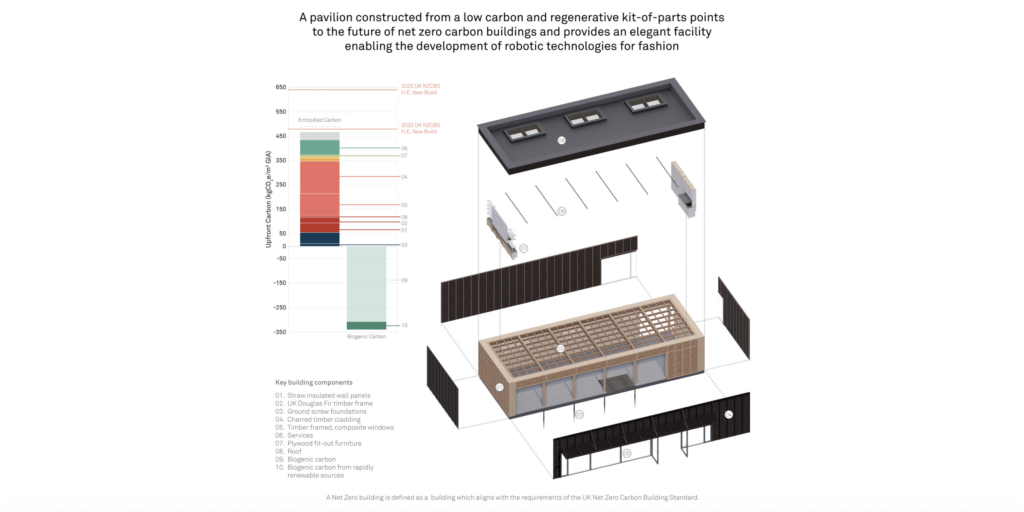
We would push back on any suggestion that meeting the RIBA 2030 (or NZCBS) limits amounted to regenerative practice as they are inherently still about doing less bad, though we do aim to achieve this. We have projects that are starting to use materials like straw and local timber which we think could be considered regenerative, and think that many of our projects are net-positive on the social side. Whilst we believe we go much further than most others, we’re still trying to tackle the next shift to move to a doughnut economics style design framework (which is what our new vision statement alludes to).
Co-evolving with nature
Practice
1. Does the practice use biophilia within the office or regularly host meetings and retreats in natural settings? For example do you have extensive planting within the office or rely on natural patterns and imagery for stress relief or quiet areas.
Our studios do include extensive use of plants, and our London studios have sedum roofs visible from most locations. We also have a wellbeing team that provide resources to encourage walking locally to the office, but we don’t currently host meetings in nature (which is a great idea). We have collaborated with Tom Massey on climate resilient gardens for projects that are also a source of serenity, so should look at how we can bring that back to our own offices.
2. Can the practice share examples where it has considered nature in decision making? For example by having a nature proxy to encourage eco-centric decision making, using natural systems as inspiration for the company structure, recognising the seasonal nature of people’s capacity and workload or celebrating equinoxes and solstices together.
Being honest (which we try to be in all award submissions – hard as that may be) this isn’t something that we do much of. Our business plan is definitely geared around understanding nature as a similar issue to climate change, and we are trying to move our projects towards thinking about this, mostly from an embodied point of view, but we do not use nature as inspiration for our workflows.
3. Is the practice supporting nature locally and nationally? For example, does the practice support local gardens, gardeners, planting programmes, rewilding programmes or advocate for changes in legislation to protect nature.
Again, this is not something we have done much of. The carbon removal scheme that we have supported since its founding creates Biochar which is then used for farming and soil improvement, and we have previously supported the improvement of local green spaces (but not this year).
Project
1. Can the practice demonstrate projects which strive to match the performance of a mature ecosystem? As a minimum this would mean achieving biodiversity net gain.
We try to align with the national standards on BNG, but have not had many projects move through early stages to test this out. We have a project in India which is incredibly focussed on biodiversity (partly due to a client focus) but are currently looking at how we can bring this knowledge into other projects, particularly our masterplanning. What we do often find ourselves doing is fighting for nature based water management solutions on a neighbourhood basis rather than the often required plastic crates burried below ground.
2. Is the practice working on material stewardship? For example, evidence could be shown through repeated use of low carbon materials, extensive material libraries and research or publications supporting responsible use of materials and elimination of waste.
Materials is one of the focus areas for our latest business plan activity. We have developed a low-carbon/regenerative materials library which is currently being digitised. Alongside this we are working to remove the frictions that prevent implementation, and are focussing on creating template assemblies which move towards regenerative practice (such as earth block walls).
3. Do the majority of projects demonstrate the use of biologically-inspired approaches such as Bioregionalism, Biophilia, Biomimicry, Ecomimicry (also referred to as Ecosystems Thinking, Industrial Ecology or Industrial Symbiosis) or BioTRIZ?
No.
Creating a just space for people
Practice
1. Does the practice have a progressive EDI policy and can you evidence many forms of diversity, which are welcomed and acknowledged, within the practice?
Since 2020 the practice has implemented an EDI policy which was co-designed with all employees and the consultancy Built By Us. This has included initial training for all staff on bias and allyship, but has most affected the recruitment process which saw us widening our pool and rewording job descriptions. We are also a disability confident employer.
The business plan acknowledges that whilst the strategy has improved diversity in the younger areas of the practice we have a lack of diversity at director and management levels, and this is seen as a key area for improvement. We record and publish our demographic data annually via our B Corp report which evidences diversity over many facets of the practice. We have also started to implement policies like gender neutral parental leave, pronunciations of names in our bios and the ability to move easter bank holidays to other religious dates.
2. Does the practice operate a no overtime culture, meet the living wage consistently, and stipulate a fair salary ratio between staff of all levels?
Whilst overtime is not banned, it is typically only present around major deadlines, and even then is seen as a failure of resourcing and design management (and often compensated for via time-in-lieu). We meet the living wage (as all chartered practices are supposed to) and have a salary ratio of around 1:X.
Alongside this we also have transparent salary bands internally which makes it clear where staff are in relation to their peers.
3. Does the practice support charities, community groups, social enterprises, action groups and others through pro-bono work, charitable giving or in-kind donations?
In the previous year we gave 0.24% of turnover to charity, and have committed to increasing this to 0.5% via a newly implemented policy. In addition to this we partner with GoodPAYE to support charitable donations via salary sacrifice which raised a further £3.5k for charities in the past year.
We also have two volunteer days available to all staff for any activity of their choice, and alongside this support a number of organisations on a pro-bono basis (such as the UK NZCBS, Islington Sustainability Network and the Manchester Climate Change Partnership. We are also active in providing work experience to local schools to avoid places being given over only to contacts of the practice.
4. Does the practice publicly refuse to work with certain clients, suppliers or organisations on ethical grounds?
We have previously publicly ruled out working in the middle east due to ethical issues around labour treatment. We are currently considering how we publicly outline our principles, as internally we have refused work on airports and for clients that are linked to fossil fuel extraction, but appreciate that this is most impactful when outlined publicly.
In terms of suppliers of products this is something we would like to look at more as we seek to understand the supply chain of our preferred assemblies.
Project
1. Do the projects demonstrate deep engagement with local stakeholders and end users? For example, is there evidence that your project engagement goes beyond consultation towards co-design?
This question was answered primarily due to internal stakeholders within the client where we do a significant amount of workshopping and co-design. We often find that clients, particularly public clients, push back on external co-design beyond consultation, but do plan to push further on this.
2. Do your projects create connected and resilient places which positively contribute to their neighbourhoods and allow equality of access? For example, do your projects create economic opportunity, retain value locally and generate social value?
We believe that our ethos of creating good places that are not intended as stand alone icons tends to create buildings that are connected to their location. Often we integrate public routes or spaces into buildings (though this is increasingly often required by planners).
3. Do the majority of your projects promote equity in society, and consider all people, not only the building inhabitants? For example, do your projects show due regard for workers within the supply chain and take active steps to avoid modern slavery?
Yes, but probably not beyond industry good practice. We certainly consider users and local residents when designing buildings, and naturally through a care of how buildings are built and involvement in construction stages we think about the site impacts. As per question 3.1.4 we could understand the supply chain of our preferred products better.