
Submission by Atelier One.
Being a good ancestor
Practice
1. Does the practice have a clearly stated purpose aligned with the planetary emergency? We are looking for a bold ambition here, and a practice culture which recognises the need for long-term thinking. For example, a strong mission, a theory of change, or a sustainability roadmap.
Since the conception of Atelier One 30 years ago, one of the core aims of our practice has been to endeavour to achieve sustainability in construction. Our approach has been threefold.
- We regularly challenge the brief, considering the design holistically and engaging beyond the traditional structural scope to ensure that the overall solution is judicious.
- We strive to find the most efficient structural solutions requiring the least resources. In parallel, we are continually researching materials, systems and construction methods that reduce energy consumption and regulate harmful emissions.
- As part of a wider design team we embrace all new technologies, carefully integrating them where appropriate to achieve more environmentally responsible proposals
Does the practice have a clear succession plan, which passes on ownership and protects the values and legacy of those who built and contributed to the practice? For example is the practice an employee owned trust.
No.
3. Does the practice share research and knowledge for the benefit of society and the wider world? For example, you regularly carry out post occupancy evaluation and share information with others.
Founding director, Neil Thomas, recently gave a keynote presentation about addressing global challenges through sustainable and collaborative design at the Structural Engineering World Congress in Shanghai. He was subsequently awarded the Ronald Sharpe medal acknowledging his contribution internationally to structural engineering.
Our team regularly present at conferences, universities, architecture practices and even to other structural engineering practices. We also collaborate in research projects with universities including current collaborations with UBC, Cambridge, Sheffield and Coventry. We also write publicly available articles, most recently for the Fourth Door magazine.
Our team voluntarily sit on various panels. For example Neil Thomas is a member of the UN Technical Review Committee, the MIT Environmental Solutions Initiative Advisory Committee INBAR and INBAR Taskforce. Chris Matthews shares our sustainability knowledge with the Institution of Structural Engineers Sustainability Panel.
Project
1. Does the practice advocate for long-term thinking at the outset of projects? Do you initiate projects with long-term thinking and challenge the client on design life? Also, can the practice demonstrate that this approach has worked with a shorter or longer design life, or an innovative approach to financing or payback period?
No.
2. Do your projects take account of the future climate and the need for resilience? For example, do the projects demonstrate flexibility, design for adaptation, design for disassembly, non-deterministic solutions, or demountable structures.
The ABBA Arena is the largest demountable theatre in the world. The construction sequence included low level assembly of the roof which was then lifted into position. The roof will be lowered again for disassembly. All connections are bolted to allow disassembly. Member sizes and panel sizes are designed to allow transportation. The project was awarded a Structural Award 2023 for “Celebrating modular, demountable timber at scale”.
Atelier One design numerous staging structures. These commonly consist of modular components such as trusses that can be reconfigured for different shows. One such system, Spaceframe, supports LED screens up to 13.2m high of any width and curvature and was awarded a Structural Award in 2018 for Construction Innovation. Since then, it has been deployed worldwide, including on Coldplay’s Environmentally Beneficial Music of the Sphere’s Tour. The design reduces trucking volume and thus number of trucks travelling between venues.
3. Do the majority of your projects go beyond mitigating negatives and towards optimising positives? For example, are they meeting or exceeding the RIBA 2030 Challenge.
Our preferred approach is that we will only work on projects that are beneficial. They commonly utilise low carbon materials, demonstrate or expand best practice and have a positive impact on their surroundings.
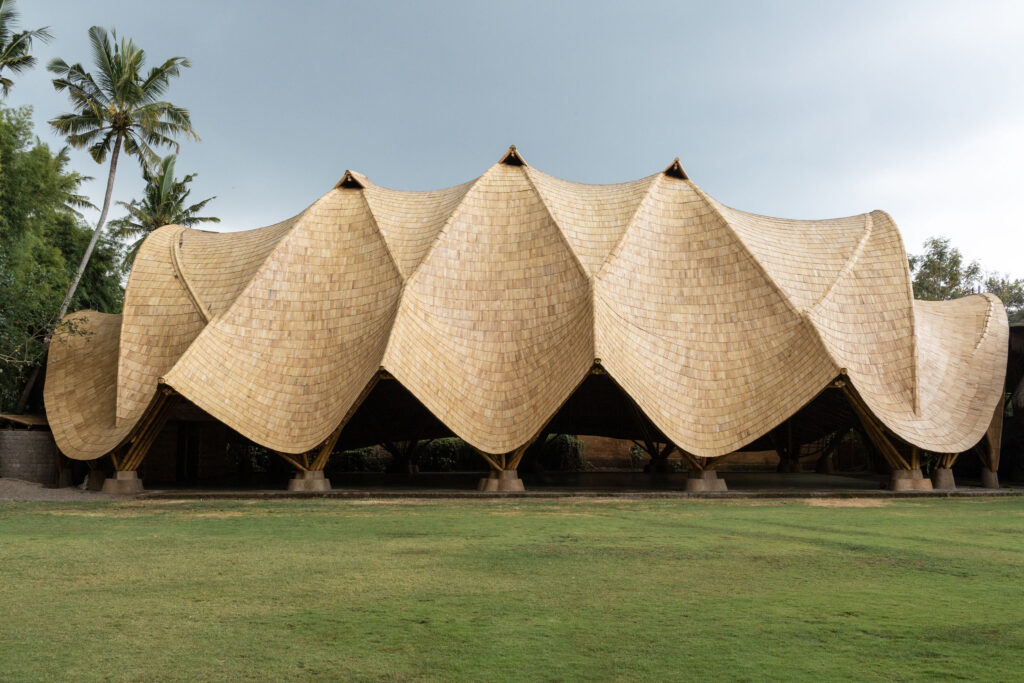
The Arc at the Green School optimises positives, enabled by structural engineering. A relatively poor quality structure that had reached the end of its life was replaced, but elements that could be reused such as the foundations were retained. Utilising bamboo, a rapidly renewable and carbon-sequestering material, resulted in an “A++ embodied carbon rating” from the IStructE Carbon Calculator. The structure has brought international attention to the potential for bamboo as a mainstream, regenerative material, encouraging adoption by others.
Similarly, SEE Monster, a repurposed end-of-life Oil Rig brought to Weston-Super-Mare and adapted to be a public art installation, has highlighted the potential for large scale reuse of industrial steel structures.
Co-evolving with nature
Practice
1. Does the practice use biophilia within the office or regularly host meetings and retreats in natural settings? For example do you have extensive planting within the office or rely on natural patterns and imagery for stress relief or quiet areas.
Numerous plants are prominent within our office and maintained regularly for the benefit of our team.
2. Can the practice share examples where it has considered nature in decision making? For example by having a nature proxy to encourage eco-centric decision making, using natural systems as inspiration for the company structure, recognising the seasonal nature of people’s capacity and workload or celebrating equinoxes and solstices together.
No.
3. Is the practice supporting nature locally and nationally? For example, does the practice support local gardens, gardeners, planting programmes, rewilding programmes or advocate for changes in legislation to protect nature.
The practice is currently championing the planting of bamboo as both a building material and a tool for bio-based regeneration and phytoremediation. This includes across large scale masterplan projects internationally. This work is ongoing within the UK with the practice supporting the Imagine Bamboo programme. Atelier One is currently lobbying government to support the development of bamboo within the UK.
Project
1. Can the practice demonstrate projects which strive to match the performance of a mature ecosystem? As a minimum this would mean achieving biodiversity net gain.
During masterplan schemes, biodiversity net gain is a criteria we always include. When discussing bamboo planting, we also explain how planting is able to support other species if properly implemented.
2. Is the practice working on material stewardship? For example, evidence could be shown through repeated use of low carbon materials, extensive material libraries and research or publications supporting responsible use of materials and elimination of waste.
We prioritise the use of low carbon materials within our designs, and in particular have been behind ground breaking designs in both timber and bamboo. Timber examples include the Earth Centre Canopy in Doncaster – the largest photovoltaic roof in the UK when built, Kent House – one of the first CLT buildings in the UK and most recently the UK Pavilion at the Dubai Expo, demonstrating the use of a previously scarcely used material in the UAE. Our bamboo examples include the Arc Gymnasium at the Green School in Bali. We have a dedicated head of bio-based materials.
We regularly research and proposed new materials. We also include a sustainability section in all stage reports, making suggestions for how the sustainability of a design can be improved.
3. Do the majority of projects demonstrate the use of biologically-inspired approaches such as Bioregionalism, Biophilia, Biomimicry, Ecomimicry (also referred to as Ecosystems Thinking, Industrial Ecology or Industrial Symbiosis) or BioTRIZ?
Directors Neil Thomas and Aran Chadwick have previously lectured at MIT and Yale on the theme of biomimicry. We have incorporated these principles into designs on a number of occasions, including the rib-like form of the Arc Gymnasium in Bali.
We appreciate the positive impact bio-based materials can have on the user experience within a building. We were the structural engineers behind York St John Creative Centre, a previous regenerative design index award winner, commended for its wide spread use of timber to improve the learning environment. We have championed the use of bio-based materials in many of our projects.
Creating a just space for people
Practice
1. Does the practice have a progressive EDI policy and can you evidence many forms of diversity, which are welcomed and acknowledged, within the practice?
Although we have an EDI Policy in place, we have no specific examples of diversity has been acknowledges within the work place.
2. Does the practice operate a no overtime culture, meet the living wage consistently, and stipulate a fair salary ratio between staff of all levels?
We seek to avoid overtime, with work re-distributed when required. We always pays the London Living Wage, including to summer placement students.
3. Does the practice support charities, community groups, social enterprises, action groups and others through pro-bono work, charitable giving or in-kind donations?
We often reduce fees for social enterprises. For example, we offered a reduced rate to Community Interest Company (CIC) Brilliant Bamboo for a 2-day bamboo workshop in Stoke. We are currently supporting a social housing project in Mexico.
We also offer our time free of charge to worthy causes. For example, Chris Matthews contributes to the Institution of Structural Engineers Sustainability Panel. Neil Thomas regularly presents at conferences and universities. We are unpaid mentors for a number of university project students.
4. Does the practice publicly refuse to work with certain clients, suppliers or organisations on ethical grounds?
No.
Project
1. Do the projects demonstrate deep engagement with local stakeholders and end users? For example, is there evidence that your project engagement goes beyond consultation towards co-design?
Yes, we actively seek the opinions of all those affected by a project to ensure a cohesive and holistic design.
One such example is Tekαkαpimək Contact Station in Maine. The creation of Katahdin Woods and Waters National Monument brought with it a commitment to revitalise the region’s recreation economy. Tekαkαpimək plays a central role in that vision, acting as a catalyst for visitor spending on lodging, food, guiding, and local crafts. Its construction alone generated an estimated $28 million in local economic impact–representing 80% of total expenditure–and directly supported contractors, artisans, and Tribal members across the region. Just as importantly, the collaborative process deepened relationships with the Wabanaki Nations, enabling a rich exchange of knowledge, craft, and story that continues to shape and enrich both local communities and the visitor experience.
2. Do your projects create connected and resilient places which positively contribute to their neighbourhoods and allow equality of access? For example, do your projects create economic opportunity, retain value locally and generate social value?
We have ongoing bamboo projects in Indonesia, the Philippines, Costa Rica and Mexico. In all of these locations, local bamboo and craftspeople are used where possible.
We are a partner in Kuna, a social housing initiative in Mexico. This shows local communities how they can build their own houses in a low cost yet high quality manner using bamboo construction techniques.
3. Do the majority of your projects promote equity in society, and consider all people, not only the building inhabitants? For example, do your projects show due regard for workers within the supply chain and take active steps to avoid modern slavery?
No.