
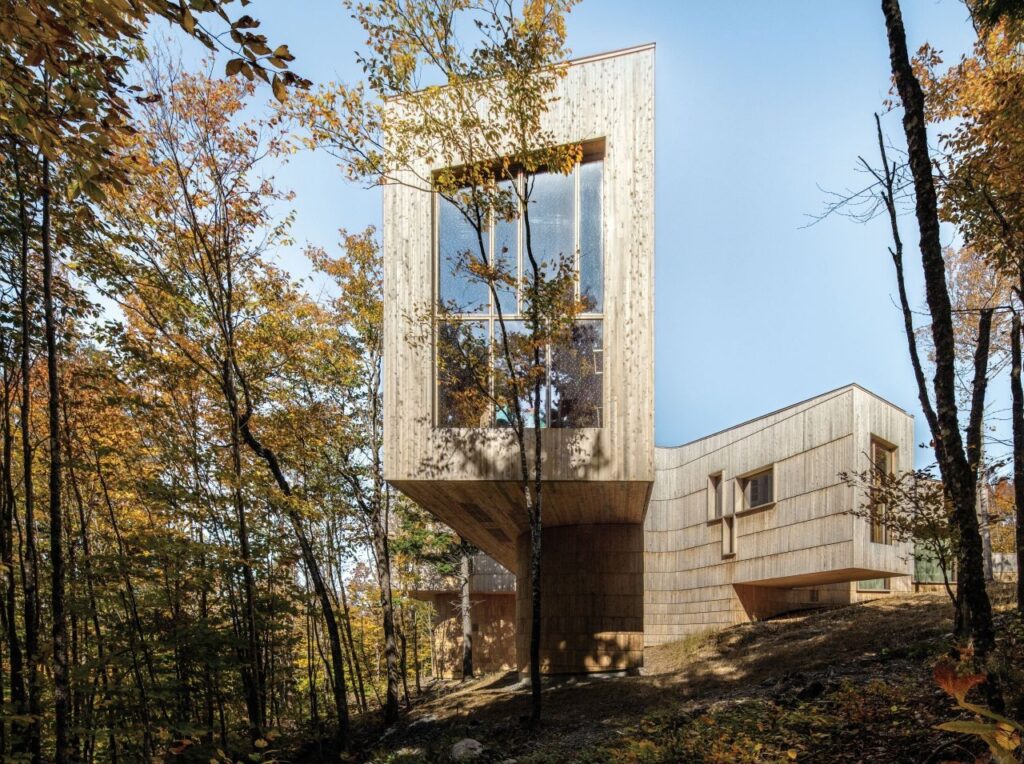
Submission by Atelier One.
Being a good ancestor
Practice
1. Do you have a clearly stated purpose aligned with the planetary emergency? We’re looking for a bold ambition here, and a culture which recognises the need for long-term thinking.
Since the conception of Atelier One 30 years ago, one of the core aims of our practice has been to endeavour to achieve sustainability in construction. Our approach has been threefold:
- We regularly challenge the brief, considering the design holistically and engaging beyond the traditional structural scope to ensure that the overall solution is judicious.
- We strive to find the most efficient structural solutions requiring the least resources.
- In parallel, we are continually researching materials, systems and construction methods that reduce energy consumption and regulate harmful emissions. As part of a wider design team we embrace all new technologies, carefully integrating them where appropriate to achieve more environmentally responsible proposals.
2. Do you have a clearly stated purpose aligned with the planetary emergency? We’re looking for a bold ambition here, and a culture which recognises the need for long-term thinking.
No.
3. Do you share research and knowledge for the benefit of society and the wider world?
Yes. Founding director, Neil Thomas, recently gave a keynote presentation about addressing global challenges through sustainable and collaborative design at the Structural Engineering World Congress in Shanghai. He was subsequently awarded the Ronald Sharpe medal acknowledging his contribution internationally to structural engineering.
Our team regularly presents at conferences, universities, architecture practices and even to other structural engineering practices. We also collaborate in research projects with universities including current collaborations with UBC, Cambridge, Sheffield and Coventry. We also write publicly available articles, most recent for the Fourth Door magazine.
Our team voluntarily sits on various panels. For example, Neil Thomas is a member of the UN Technical Review Committee, the MIT Environmental Solutions Initiative Advisory Committee INBAR and INBAR Taskforce. Chris Matthews shares our sustainability knowledge with the Institution of Structural Engineers Sustainability Panel. We were reviewers for the recent IStructE Manual for Design of Bamboo Structures.
Project
1. Do you advocate for long-term thinking at the outset of work? Do you initiate work with long-term thinking and challenge clients? Also, can the organisation demonstrate that this approach has worked?
At Atelier One, we advocate for long-term thinking by challenging briefs to ensure structural solutions are judicious and resilient for future generations. The ABBA Arena exemplifies this; as the world’s largest demountable theatre, every connection is bolted to facilitate future disassembly and relocation.
Similarly, the Tekαkαpimək Contact Station was initiated through deep collaboration with the Wabanaki Confederacy. By prioritizing a “local-first” strategy—utilising regional sawmills and local tradespeople—we ensured 80% of project expenditure remained in the local economy, fostering long-term community relationships and developing expertise.
2. Does your work take account of the future climate and the need for resilience?
The ABBA Arena is the largest demountable theatre in the world. The construction sequence included low level assembly of the roof which was then lifted into position. The roof will be lowered again for disassembly. All connections are bolted to allow disassembly. Member sizes and panel sizes are designed to allow transportation. The project was awarded a Structural Award 2023 for “Celebrating modular, demountable timber at scale”.
Similarly, the signature cone of the UK Pavilion for the Dubai Expo 2020 was designed using demountable timber cassettes, allowing rapid disassembly at the end of the Expo.
Atelier One design numerous staging structures. These commonly consist of modular components such as trusses that can be reconfigured for different shows. One such system, Spaceframe, allows LED screens up to 13.2m high of any width and curvature and was awarded a Structural Award in 2018 for Construction Innovation.
3. Does the majority of your work go beyond mitigating negatives and towards optimising positives?
Our mantra is that we will only work on projects that are beneficial. They commonly utilise low carbon materials, demonstrate or expand best practice and have a positive impact on their surroundings.
The Arc at the Green School optimises positives, enabled by structural engineering. A relatively poor-quality structure that had reached the end of its life was replaced, but elements that could be reused such as the foundations were retained. Utilising bamboo, a rapidly renewable and carbon-sequestering material, resulted in an “A++ embodied carbon rating” from the IStructE Carbon Calculator. The structure has brought international attention to the potential for bamboo as a mainstream, regenerative material, encouraging adoption by others.
Similarly, SEE Monster, a repurposed end-of-life Oil Rig brought to Weston-Super-Mare and adapted to be a public art installation, has highlighted the potential for large scale reuse of industrial steel structures.
Co-evolving with nature
Practice
1. Do you use biophilia within your premises and/or do you regularly gather in natural settings?
Yes. Numerous plants are prominent within our office and maintained regularly for the benefit of our team.
2. Can you share examples of where you have considered nature in decision making?
The decision-making process for the Tekαkαpimək Contact Station prioritised minimising environmental impact and responding to the site’s remote, ecologically sensitive location. The team integrated structural and environmental strategies from the outset, ensuring the building functions as a high-mass thermal battery. This design utilises passive solar gain and natural cross-ventilation to modulate seasonal temperature extremes while achieving near-zero operational carbon emissions.
Resource management was central to preserving the ecosystem. The team selected locally abundant Douglas Fir to reduce transport emissions and pressure on vulnerable species. On-site, biodiversity was protected by avoiding non-native plants and redeploying late-successional forest topsoil to encourage natural regeneration. Excavated bedrock and glacial erratics were repurposed for infrastructure, while the absence of site-wide lighting preserved the area’s International Dark Sky Sanctuary status. Every structural choice—from off-grid power to raw cedar cladding—was designed for harmony with the landscape.
3. Are you supporting nature locally and nationally?
Yes. The practice is currently championing the planting of bamboo as both a building material and a tool for bio-based regeneration. This includes across large scale masterplan projects internationally. This work is ongoing within the UK with the practice supporting the Imagine Bamboo programme. Atelier One is currently lobbying government to support the development of bamboo within the UK and is pursuning the construction of the UK’s first bamboo house.
Project
1. Can you demonstrate work that strives to match the performance of a mature ecosystem?
The Tekαkαpimək Contact Station demonstrates design that mimics the self-regulating performance of a mature ecosystem. Functioning as a high-mass thermal battery, the building utilizes passive solar gain and natural cross-ventilation to modulate temperature extremes, achieving near-zero operational carbon. The project protected local biodiversity by redeploying late-successional forest topsoil to encourage natural on-site regeneration.
Resource management mirrored closed-loop systems by repurposing excavated bedrock and glacial erratics for infrastructure and utilizing locally abundant Douglas Fir. Furthermore, the design preserves the site’s International Dark Sky Sanctuary status by avoiding site-wide lighting, ensuring the built environment does not disrupt nocturnal ecological cycles.
2. Are you working on material stewardship?
Yes. We prioritise the use of low carbon materials within our designs, and in particular have been behind groundbreaking designs in both timber and bamboo. Timber examples include the Earth Centre Canopy in Doncaster – the largest photovoltaic roof in the UK when built, Kent House – one of the first CLT buildings in the UK and most recently the UK Pavilion at the Dubai Expo, demonstrating the use of a previously scarcely used material in the UAE. Our bamboo examples include the Arc Gymnasium at the Green School in Bali.
We regularly research and proposed new materials. We also include a sustainability section in all stage reports, making suggestions for how the sustainability of a design can be improved and encouraging a dialogue with clients.
3. Does the majority of your work demonstrate the use of biologically-inspired approaches such as Bioregionalism, Biophilia or Biomimicry?
Directors Neil Thomas and Aran Chadwick have previously lectured at MIT and Yale on the theme of biomimicry. We have incorporated these principles into designs on a number of occasions, including the rib-like form of the Arc Gymnasium in Bali.
We appreciate the positive impact bio-based materials can have on the user experience within a building. We were the structural engineers behind York St John Creative Centre, a previous regenerative design index award winner, commended for its widespread use of timber to improve the learning environment. We have championed the use of bio-based materials in many of our projects.
Two of our projects were featured within Michael Pawlyn’s latest edition of “Biomimicry in Architecture”.
Creating a just space for people
Practice
1. Do you have a progressive EDI policy and can you evidence many forms of diversity, which are welcomed and acknowledged, within your company/organisation?
Yes. Although we have an EDI Policy in place, we have no specific examples of how diversity has been acknowledged within the workplace.
2. Do you operate a no overtime culture, meet the living wage consistently, and stipulate a fair salary ratio between staff of all levels?
No.
3. Do you support charities, community groups, social enterprises, action groups and others through pro-bono work, charitable giving or in-kind donations?
We regularly support Brilliant Bamboo, a CIC set-up to use bamboo as a tool for community engagement within Stoke and the West Midlands.
We are also supporting the social housing project “Casa Congo”.
4. Do you use an ethical framework to assess opportunities and/or supply chain partners and is them team consulted on these decisions?
No.
Project
1. Does your work demonstrate deep engagement with local stakeholders and end users?
The Tekαkαpimək Contact Station exemplifies our deep commitment to stakeholder engagement. Central to the project was a profound collaboration with the Wabanaki Confederacy, ensuring the building’s name, orientation, and design reflected 11,000 years of Indigenous stewardship. Critically, it is acknowledged throughout the project that all shared Cultural Knowledge remains the property of the Wabanaki Nations.
To ensure local impact, we rejected imported timber products in favour of standard 4×2” planks that could be handled by local tradespeople. This “local-first” approach involved intensive consultation with regional sawmills, culminating in fabrication within a repurposed potato barn in Maine. This strategy generated an estimated $28 million local economic impact—80% of total expenditure—directly supporting contractors, Tribal members and artisans. By fostering new regional skills, we ensured the project delivered a lasting positive legacy for the community and end-users.
2. Does your work create connected and resilient communities which positively contribute to neighbourhoods and allow equality of access?
We have ongoing bamboo projects in Indonesia, the Philippines, Costa Rica and Mexico. In all of these locations, local bamboo and craftspeople are used where possible.
We are a partner in Casa Congo, a social housing initiative in Mexico. This shows local communities how they can build their own houses in a low cost yet high-quality manner using bamboo construction techniques.
3. Does the majority of your work promote equity in society, and consider all people, not only building inhabitants
No.