
Submission by Atelier Architecture and Design Ltd.
Being a good ancestor
Practice
1. Do you have a clearly stated purpose aligned with the planetary emergency? We’re looking for a bold ambition here, and a culture which recognises the need for long-term thinking.
Our purpose is to restore right relationship — between people, place and the living systems that sustain us. This begins not with buildings, but with awareness.
The Pioneer Nature Method, developed through the practice, has evolved beyond a design approach into a framework — shaped by lived experience, research and a growing understanding that the environmental crisis is, at its root, a crisis of perception. We believe regeneration is not just something we apply to projects, but first and foremost something we must embody in how we think, decide and act.
Rather than bringing nature into buildings, we align buildings with nature — with geology, climate, ecology and the deeper patterns of place.
In a time of uncertainty, we see architecture as a quiet but powerful tool for restoring coherence — supporting right relationship and long-term cultural and ecological continuity.
2. Do you have a clearly stated purpose aligned with the planetary emergency? We’re looking for a bold ambition here, and a culture which recognises the need for long-term thinking.
Our approach to succession is less about ownership structures and more about the continuity of values, culture and thinking.
We are a small, closely connected practice working across a distributed international team spanning Europe, South America and India, united by shared principles and a commitment to deepening cultural and ecological awareness. Our focus is on cultivating shared authorship — where responsibility, creativity and decision-making are increasingly distributed. This requires a level of self-awareness that extends beyond traditional practice models.
We are exploring a transition toward employee ownership alongside profit-sharing, embedding long-term stewardship. However, true succession lies in passing on a way of seeing and working that can evolve beyond the founders.
Many who have worked with us now carry these principles into their own fields. Our aim is not simply to sustain AA+D, but to allow it to transform — maintaining continued relevance across generations.
3. Do you share research and knowledge for the benefit of society and the wider world?
We see the sharing of knowledge as integral to how regenerative thinking evolves.
Our work operates at the intersection of design, research and lived experience. Through recent publications including ‘Why some buildings stay with us’ in Architecture Today and the Journal of Biophilic Design, alongside teaching, lecturing and participation in forums such as the World Architecture Festival, we contribute to the wider discourse shaping the discipline.
Our research is also formalised through academic work. Our paper, Echoes of Mývatn: In Search of Resonance in Architecture, developed through the School of Collectively Building, has been accepted for publication in June 2026.
Projects such as the Young Mothers’ Refuge in Mbale, Uganda extend this work into social and cultural contexts, where knowledge is exchanged through collaboration and lived experience.
We believe knowledge is not neutral — it reflects how we see the world and must evolve to support right relationship.
Project
1. Do you advocate for long-term thinking at the outset of work? Do you initiate work with long-term thinking and challenge clients? Also, can the organisation demonstrate that this approach has worked?
Long-term thinking begins before design — in how we frame the purpose of a project and the role of the client within it.
We actively challenge clients to move beyond short-term value and consider their project as part of a longer continuum — environmentally, culturally and socially. This involves a shift from ownership to stewardship, where success is measured by what a project gives back overtime. This often requires a reframing of success itself — from immediate return to long-term contribution.
This approach is embedded early in whole-life carbon thinking, landscape-led design and collaboration with specialists such as GRAIN Sustainability. On rural and Green Belt projects, this has resulted in biodiversity net gain significantly exceeding 10% and the restoration of degraded land.
Our Ossulton Court Almshouses, Uxbridge demonstrates how this thinking translates into lasting social value and continued relevance.
2. Does your work take account of the future climate and the need for resilience?
We approach resilience not as a fixed outcome, but as an ongoing capacity to adapt — recognising that buildings and landscapes are part of dynamic, evolving systems.
Our projects integrate passive environmental strategies, mixed-mode ventilation, low-impact materials and fully electric systems. Beyond performance, we prioritise flexibility and long-term adaptability. This requires letting go of the idea of buildings as static objects and instead seeing them as participants within living systems.
In sensitive contexts, we work with natural systems to manage risk and restore ecological function — using rain gardens, bio-swales and biodiversity-led drainage.
Our built work such as Ossulton Court Almshouses, Uxbridge — winner of the Almshouse Association Innovative Housing Award 2025 — demonstrates how these principles can translate into socially resilient, enduring places.
Adaptability is also embedded in construction, with modular systems designed for reuse across contexts.
We design not for permanence, but for continued relevance.
3. Does the majority of your work go beyond mitigating negatives and towards optimising positives?
We approach performance standards not as targets to meet, but as baselines to move beyond.
While aligning with frameworks such as the RIBA 2030 Challenge, our focus is on generating positive outcomes — asking how each project can actively restore rather than reduce harm. This represents a shift from sustainability as mitigation to regeneration as participation. This requires a shift in mindset — from isolated interventions to wider ecological and social systems.
Through our projects, we consistently exceed 10% biodiversity net gain through landscape restoration strategies.
Alongside environmental performance, we prioritise long-term cultural and social value — supporting right relationship between people, places and nature.
We see each project as an opportunity to contribute positively — where design becomes a form of quiet, long-term activism.
Co-evolving with nature
Practice
1. Do you use biophilia within your premises and/or do you regularly gather in natural settings?
Our relationship with nature is not applied — it is lived and continuously evolving.
The studio sits within a landscape of water, woodland and open views across the Chilterns. While planting and natural materials support wellbeing internally, it is our ongoing immersion in nature that shapes the practice. Regular walks, seasonal day trips and time spent in wild environments create a deeper awareness of natural systems and cycles.
Within the team are climbers, surfers, divers and walkers — individuals whose direct engagement with gravity, weather and geology informs how we think and design. These experiences cultivate a sensitivity to forces that extend beyond the studio.
We see biophilia not as a design layer, but as a process of attunement — where sustained contact with nature informs perception, decision-making and creative output.
In this sense, our practice co-evolves with the environments we inhabit.
2. Can you share examples of where you have considered nature in decision making?
Nature is not a reference point in our work — it is an active presence in how we think, decide, and operate.
Nature informs decision-making through seasonal awareness, site immersion and a design process that begins with landscape rather than form. Our approach is grounded in listening — to geology, climate, ecology and the subtle patterns of place, seeking resonance rather than control.
This can be seen in our proposal for ‘Inner Retreat’, Mývatn in Iceland, where the design responds to elemental forces that shape the landscape over millennia — volcanic processes, geothermal systems, rainwater streams and the gradual recolonisation of native ecologies including moss, fern and birch woodland. Rather than imposing form onto the site, the project seeks alignment with these ongoing natural processes and cycles of ecological recovery.
We ask not only what a building should be, but what the landscape itself is asking for.
3. Are you supporting nature locally and nationally?
Our work in support of nature extends beyond individual projects — it is embedded in how we operate locally and connect globally.
The practice is based within a landscape of ecological significance, close to College Lake and Tring Reservoirs, with ongoing engagement with the Berkshire, Buckinghamshire and Oxfordshire Wildlife Trust. Our work in the Chilterns National Landscape focuses on restoring ecological integrity — from woodland and meadow creation to strengthening biodiversity networks.
We are also engaged in rewilding initiatives, including work in the Duddon Valley in the Lake District, contributing to long-term landscape recovery.
This commitment extends through our international team across Europe, South America and India, where local knowledge and ecological practices inform a broader, bioregional understanding — recognising that meaningful ecological change requires action across multiple scales, from local habitats to global systems.
We work in service of living systems through design, advocacy and stewardship.
Project
1. Can you demonstrate work that strives to match the performance of a mature ecosystem?
Our projects aim to move beyond mitigation, working towards the restoration of ecological systems and the conditions for long-term regeneration.
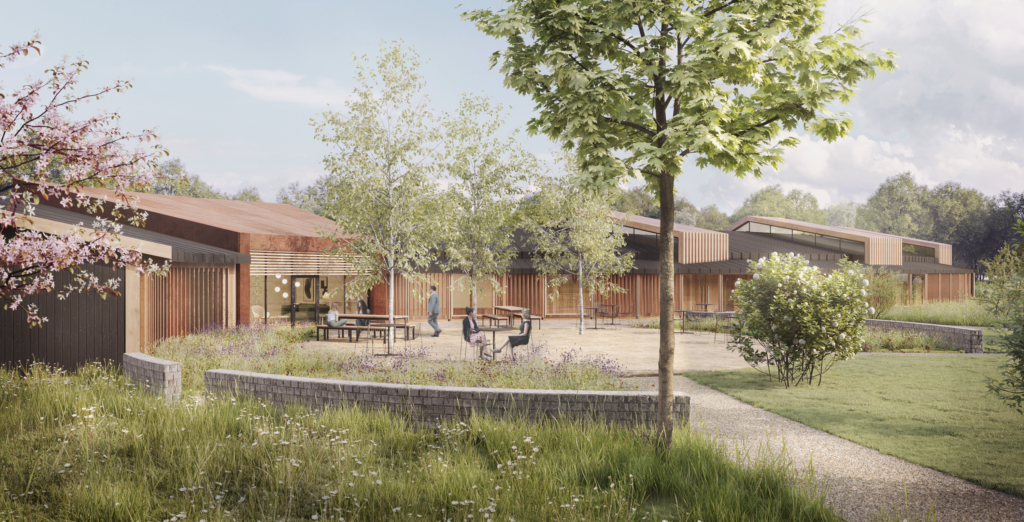
At Pilsworth Lake Visitor Centre, the design is conceived as a functioning ecosystem, delivering biodiversity net gains of 2.41 area units, 2.69 hedgerow units and 4.68 watercourse units. Native woodland, hedgerows, wildflower meadows and integrated water systems support habitat creation, soil health and ecological connectivity, supported by long-term management.
This approach extends internationally through Inner Retreat, Mývatn, Iceland — shortlisted at the World Architecture Festival 2025. Responding to landscape degradation caused by deforestation and geothermal water diversion, the project reintroduces hydrological balance and supports reforestation — seeking resonance between land, water and human intervention.
Across our work, we create buildings that behave less like objects and more like environments — dynamic, interconnected and capable of co-evolving with the landscapes they inhabit.
2. Are you working on material stewardship?
We approach materials not as commodities, but as part of a longer ecological and cultural continuum.
Our work prioritises low-impact, bio-based materials, including FSC-certified timber, alongside circular construction methods that support assembly, disassembly and reuse. In our Norway retreat, modular timber cassettes enable efficient construction while allowing adaptation or relocation over time.
We minimise waste through lean design, retention of existing structures and the use of durable materials that age well. Local sourcing reduces embodied carbon and supports regional supply chains.
However, stewardship extends beyond specification. It requires recognising materials as finite, with histories and futures beyond a single building — supporting a more balanced relationship between resource, construction and future use.
Through research, teaching and practice, we advocate for responsible material culture — designing with care, restraint and long-term awareness.
3. Does the majority of your work demonstrate the use of biologically-inspired approaches such as Bioregionalism, Biophilia or Biomimicry?
We draw from biophilia but seek to move beyond it. Rather than bringing nature to buildings, we ask how buildings can be brought into right relationship with nature — shaped by landscape, climate and place.
This thinking underpins the Pioneer Nature Method, a methodology developed through lived experience, including time spent in remote and extreme environments, and shaped by personal processes of resilience and recovery. These experiences cultivate an embodied understanding of ecological systems that informs how we design — not through imitation, but through attunement.
In recent projects, we have explored bioregional approaches, including a mountain retreat and a micro-city vision for Iceland rooted in geothermal energy and decentralised systems. We have also collaborated with geomantic consultants to align with underlying landscape patterns.
We treat nature as a co-designer — creating architecture that emerges from place and co-evolves with the systems that sustain it.
Creating a just space for people
Practice
1. Do you have a progressive EDI policy and can you evidence many forms of diversity, which are welcomed and acknowledged, within your company/organisation?
For us, diversity is not simply about representation. It is about creating an environment where people feel respected, supported and able to thrive.
Over the past 17 years, our team has included individuals from across Europe, South America, Asia and the Middle East, bringing diverse cultural perspectives and lived experiences into the practice. We are an LGBTQ+ inclusive studio and support flexible working and compassionate approaches to wellbeing, including for those navigating long-term health conditions, personal challenges or invisible conditions that are not always immediately seen or understood.
This understanding is informed not only by policy, but by lived experience. We recognise that people work, communicate and contribute differently, and we seek to create a culture rooted in empathy, attentiveness and mutual respect.
We do not see equity as separate from regenerative practice. Creating a just space for people begins with how people are treated within the practice itself.
2. Do you operate a no overtime culture, meet the living wage consistently, and stipulate a fair salary ratio between staff of all levels?
We believe rest, balance and wellbeing are essential to creative and regenerative practice.
Our team is never expected to work overtime, and we go well beyond meeting the living wage. We encourage a healthier working rhythm — one that values reflection, movement and recovery alongside productivity. Shared lunches, walking meetings, yoga, meditation and time outdoors are all part of the studio culture.
Located beside a canal and close to nature reserves, the practice benefits from daily connection to landscape and seasonal change. Sometimes this is as simple as stepping outside to listen to the sound of water by the nearby lock.
We trust people to do their best work when they feel supported, respected and able to engage fully with life beyond the studio.
For us, regenerative practice begins internally — by creating a culture that sustains people rather than exhausting them.
3. Do you support charities, community groups, social enterprises, action groups and others through pro-bono work, charitable giving or in-kind donations?
Our commitment to regeneration extends beyond architecture into social and community engagement.
Alongside supporting organisations including Save the Children, the RSPCA and regional Wildlife Trusts, we contribute time, care and advocacy to initiatives connected to environmental restoration, cultural stewardship and social wellbeing. This includes ongoing support for local churches and ecological projects across the Chilterns National Landscape.
More recently, our work has expanded internationally through the Young Mothers’ Refuge in Uganda, developed in collaboration with Evergreen Africa, a British charity supporting vulnerable communities. The project is rooted not only in shelter, but in dignity, opportunity and long-term empowerment. It has deepened our understanding of how architecture can support social, environmental and cultural resilience, particularly for those facing social, economic or personal vulnerability.
Regenerative practice, for us, includes supporting the conditions in which both people and nature can flourish.
4. Do you use an ethical framework to assess opportunities and/or supply chain partners and is them team consulted on these decisions?
We believe regenerative practice requires alignment between values, people and purpose.
If a project, client or collaboration conflicts with our environmental or social principles, we are prepared to step away. Misalignment is often recognised early through conversations about intention, responsibility and long-term impact. Recently, we withdrew from a project during Stage 2 following a clear divergence in values and direction.
The same approach informs recruitment and specification. We seek collaborators, suppliers and team members whose thinking aligns with the culture we are trying to cultivate — one rooted in care, stewardship and mutual respect. Frameworks such as the B Corp controversial industries list help guide this process alongside our own internal principles.
Regenerative practice cannot be separated from ethical responsibility. For us, integrity means making conscious decisions that protect the long-term coherence of the practice and the values it exists to serve.
Project
1. Does your work demonstrate deep engagement with local stakeholders and end users?
We design with people, not simply for them. Every project begins with listening — building trust, understanding context and creating space for meaningful participation from the outset.
Our engagement process extends beyond formal consultation. Through dialogue, workshops, sketches, models and shared conversations, clients and stakeholders become active participants in shaping projects as they evolve. We use visual and accessible design tools to encourage openness, clarity and shared understanding throughout the process.
We see co-design not only as a method, but as a way of fostering long-term stewardship. When people feel genuinely connected to the process, they are more likely to care for and sustain the places created together.
This approach also requires humility — recognising that local knowledge, lived experience and community insight often hold information that cannot be found through analysis alone, particularly within vulnerable or underrepresented communities.
For us, meaningful engagement creates architecture that is socially rooted and resilient.
2. Does your work create connected and resilient communities which positively contribute to neighbourhoods and allow equality of access?
We see buildings as part of a wider social and ecological fabric, with the capacity to strengthen dignity, belonging and long-term community resilience.
Our projects aim to contribute positively beyond their immediate boundaries — supporting connection, wellbeing and a stronger sense of place. Ossulton Court Almshouses, Uxbridge — winner of the Almshouse Association Innovative Housing Award 2025 — was described by the local council as “the best social housing in the borough.” More than improving the site itself, the project helped restore pride, identity and social value within the wider neighbourhood.
Whether working in urban or rural contexts, we consider how places remain accessible, adaptable and socially rooted over time. This includes encouraging connection to nature, supporting intergenerational living and creating environments that foster care and stewardship.
A resilient place is not only well designed. It is valued, cared for and capable of evolving alongside the people who inhabit it.
3. Does the majority of your work promote equity in society, and consider all people, not only building inhabitants
For us, equity means extending care beyond the immediate building and considering the wider human systems connected to its creation.
Alongside ongoing work around ethical procurement and supply chain responsibility, we are increasingly focused on how architecture can support vulnerable communities directly. A key example is the Young Mothers’ Refuge and Occupational Training Centre in Uganda, developed in collaboration with Evergreen Africa. The project supports young women and children facing social and economic vulnerability, creating not only shelter, but opportunities for education, care, skills development and long-term resilience.
This work has deepened our understanding of architecture as social infrastructure — capable of supporting dignity, safety and future opportunity across generations.
Our projects have also included housing for older residents and homes supporting families raising children with disabilities, further strengthening our understanding of accessibility, care and inclusion.
Regenerative practice must consider human impact as carefully as environmental impact.