
Submission by Artel31.
Being a good ancestor
Practice
1. Do you have a clearly stated purpose aligned with the planetary emergency? We’re looking for a bold ambition here, and a culture which recognises the need for long-term thinking.
We have long sought to ensure our designs strive to actively improve their setting in all the tenets of sustainability. Our articles of association specifically aim to balance economic sustainability with the imperative ecological and societal benefits of regenerative practice. Moreover, we run a construction firm so that we can personally understand the reality when it comes to making these advancements achievable to a mass market.
2. Do you have a clearly stated purpose aligned with the planetary emergency? We’re looking for a bold ambition here, and a culture which recognises the need for long-term thinking.
As a small practice, we have already split the ownership down to ensure longevity and accountability. We are open about our aims to achieve the highest standards of sustainability and life quality for us, our coworkers and our clients alike.
Anyone joining our work force or employing us is under no illusion that we will be challenging them to live better lives whether that be through becoming actively involved in the crafting of their scheme or through our designs challenging them to live more healthy active lives.
3. Do you share research and knowledge for the benefit of society and the wider world?
We actively engage in our local community sharing knowledge freely to create a groundswell of momentum that can greatly exceed the otherwise likely outcomes. We try to remain open about the successes and failures of our research to allow others to take it forward and actively engage with the regular academic contact we get regarding our schemes.
We’ve written a number of published articles and continue to do so, these are always aimed at opening dialogue rather than presenting successes.
We’re working on a way to release all WLCA’s for our projects to allow public scrutiny and feedback.
Project
1. Do you advocate for long-term thinking at the outset of work? Do you initiate work with long-term thinking and challenge clients? Also, can the organisation demonstrate that this approach has worked?
It’s easy to herald the practice’s successes in carbon reduction and biodiversity when compared with the positively mediocre ‘average’ new build or the terrible rabbit-caged greenfield developments blighting our landscape. Thanks in part to our own activism, our clients almost exclusively want to achieve better and to push what is possible in terms of regeneration rather than consumption.
Architecture affords so many options for the positive enhancement of a location, far beyond any developer, charity or homeowner will have thought of prior to the start of a project and we celebrate our role as agitator protagonists.
From huge underground hibernacula created with little more than a few hours extra work to climate change resilient barn conversions, our schemes always seek better outcomes.
2. Does your work take account of the future climate and the need for resilience?
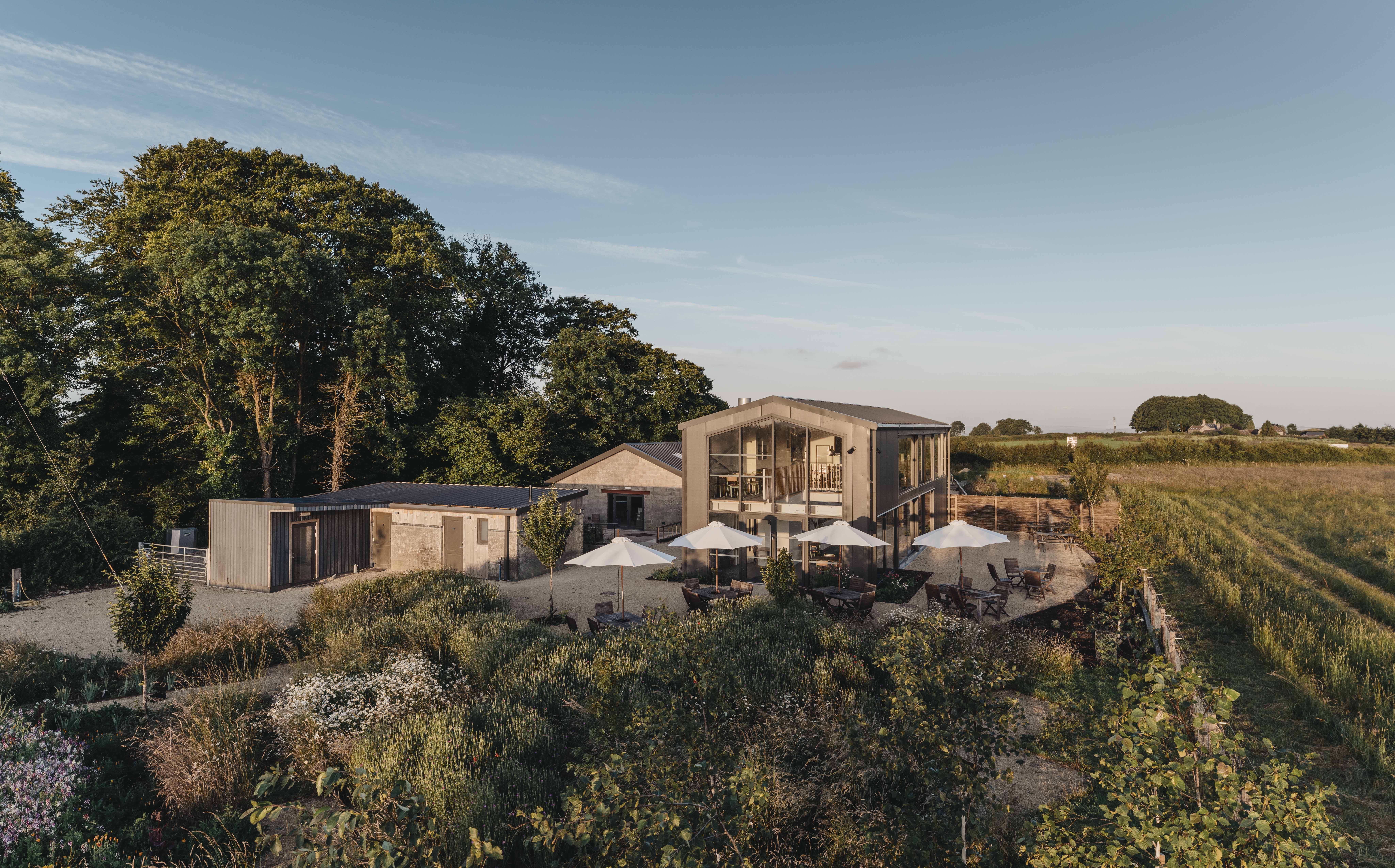
Our recently completed ‘House in a Barn’ uses novel solutions in the reuse of rural buildings creating form and functionality beyond that which could reasonably be economically justified had the opportunities not already existed.
Extreme weather events are likely to require not only protection from higher summertime temperatures and periods of drought but also extreme rainfall, wind and potentially harsher winters.
3. Does the majority of your work go beyond mitigating negatives and towards optimising positives?
Yes. Every project has opportunities that are achievable both financially and aesthetically that extend its benefits beyond simply meeting our clients’ material needs or wants. Sometimes we identify this to the client and sometimes we hide them to minimise the risk of their removal because of some unwarranted fear of increased management or risk that is no more real than the monsters under our children’s beds!
Co-evolving with nature
Practice
1. Do you use biophilia within your premises and/or do you regularly gather in natural settings?
Our office and its neighbours were designed to take back a car park and turn it into an active public realm, though small it reduced surface runoff to a combined sewer by 100% and created a new public park that has created a local centre now spreading into the wider area with a designated zone within the local plan. We regularly spend time hanging out in our little park, playing ping pong and discussing the merits or negatives of our own and others’ projects.
2. Can you share examples of where you have considered nature in decision making?
The idea of not considering nature as part of a design process is so alien to us as a practice that we can’t really comprehend how practices do so. Nature plays a huge part in every scheme we design. Architecture is fundamentally about understanding your location, to exclude the existing ecosystems or climates from that thinking is so base as to warrant exclusion from our profession.
3. Are you supporting nature locally and nationally?
Yes! Actively wherever and whenever we possibly can. I’m writing this in my garden where the wildflowers (others’ weeds) are higher than my head but it is full or buzzing and tweeting and activity, enough to distract me multiple times and very much delay my writing! You can keep your monocultures… I’ll keep my weeds! We support and sponsor local and regional planting initiatives and as our work area has expanded nationally we have taken our concepts with us – planting wild non managed gardens and supporting local ecosystems.
Project
1. Can you demonstrate work that strives to match the performance of a mature ecosystem?
Of course we strive to match the performance of nature, but it’s impossible to achieve it. We either just add a little bit to an existing system or simply create a very good base for an ecosystem to develop the idea that a human designed system could ever match the complexity of that which is infinitely complex in futile. It makes our hearts fly when we visit a site where we designed a hibernacula for reptiles and we come across juvenile grass snakes in spring or badger cubs playing in parkland but we didn’t do that, nature did, we just left the door open!
2. Are you working on material stewardship?
We always seek to use material hierarchies to specify and then understand how each can maximise its potential with minimal management before eventual reuse or recycling. Material reuse is a passion of our practice and we love to find novel solutions to facilitate the retention of anything headed to landfill.
3. Does the majority of your work demonstrate the use of biologically-inspired approaches such as Bioregionalism, Biophilia or Biomimicry?
Our projects seek to balance material need with regenerative or beneficial practices, the majority of our projects achieve small wins such as drystone walling to create habitats, minimised cement content, etc alongside minimised whole life carbon. However, biophilia is fundamental in all our projects, the need for connection to nature and the fundamental need for light and air in our lives opens the schemes and connects them to the ecosystems around them
Creating a just space for people
Practice
1. Do you have a progressive EDI policy and can you evidence many forms of diversity, which are welcomed and acknowledged, within your company/organisation?
Our studio is home to an ever evolving range of ages, beliefs, sexes, races, sexualities, physical and mental abilities but you wouldn’t know to walk in the door as we are a single family. We pride ourselves on our work environment being a positive influence on whoever joins us be they co-workers, collaborators or clients. We work together to do better.
2. Do you operate a no overtime culture, meet the living wage consistently, and stipulate a fair salary ratio between staff of all levels?
We are very strict about life quality and have an active family first policy where employees are encouraged to prioritise their own and their family’s mental health and quality of life. We pay the Living Wage foundation rates as a bare minimum and encourage everyone to speak up at regular private review sessions if they feel they are worth more or need flexibility.
3. Do you support charities, community groups, social enterprises, action groups and others through pro-bono work, charitable giving or in-kind donations?
We presently actively participate in over 15 local organisations including cycle network improvement, primary schools, youth clubs, sports clubs, non-profits and environmental stewardship groups on top of that we donate over 1% of profit directly to charities each year.
4. Do you use an ethical framework to assess opportunities and/or supply chain partners and is them team consulted on these decisions?
At out scale we do not use a specific framework to assess opportunities but we actively ensure that we only take on work we feel we are able to justify to our children. We personally have been victims of ‘regeneration’ rather than regenerative architecture and we actively seek to disassociate ourselves with the idea of a design group understanding a place better than the people that formed it over many tens or hundreds of years. May that be a small rural community or a community group in an inner city ‘development’ zone.
Project
1. Does your work demonstrate deep engagement with local stakeholders and end users?
Our larger residential schemes have been fully consulted and staged to ensure awareness and engagement as far as possible to create communities not buildings or estates. Our third sector projects to date have been firmly anchored in collaborative practice with multiple rounds of engagement at all levels from end users, the local community, key stakeholders etc, taking years to slowly craft an end scheme.
2. Does your work create connected and resilient communities which positively contribute to neighbourhoods and allow equality of access?
Our projects have on multiple occasions won local and regional civic awards for their creation of new public realms. These schemes often use exclusion through inclusion to limit anti-social behaviour without draconian measures. We believe early engagement with disparate groups afford ownership that then lends itself to the protection and enhancement of the end public realm. Ball games and skateboarding are encouraged because we design spaces which everyone can inhabit.
3. Does the majority of your work promote equity in society, and consider all people, not only building inhabitants
The majority of our projects remain for owner occupiers and as such the wider benefits are limited, however, as we’ve said above our community or third sector work always places the existing wider community throughout the process and clearly documents decisions where conflicting views were evaluated for the greater public benefit. This means we are able to stand in public meetings and passionately advocate for positive change in communities rather than capitalist based displacement regeneration.