
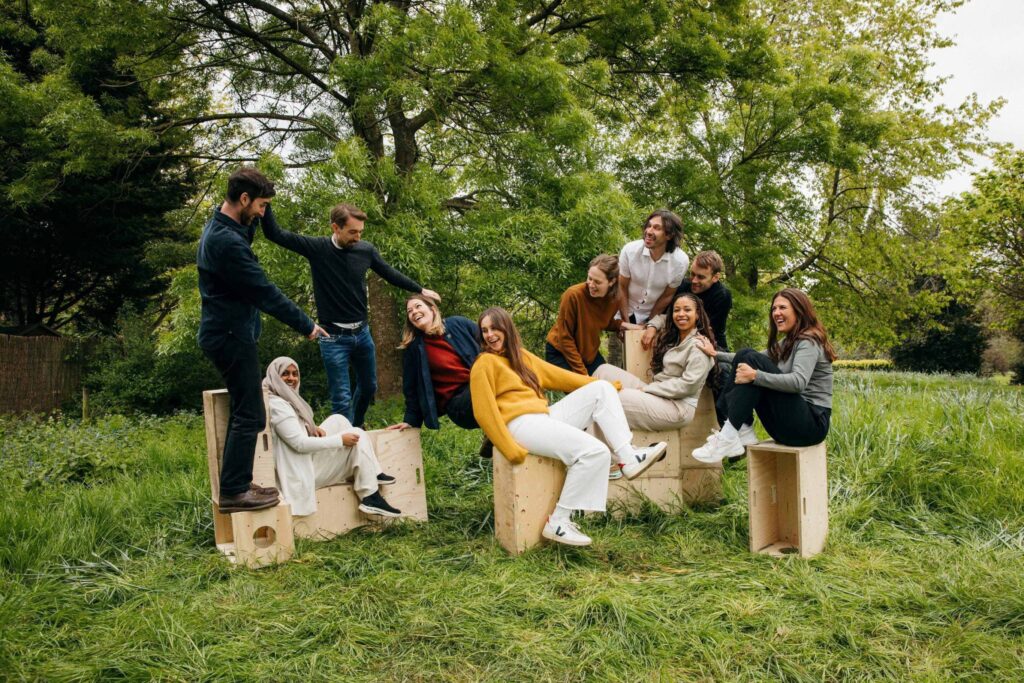
Submission by Studio Bark.
Being a good ancestor
Practice
1. Does the practice have a clearly stated purpose aligned with the planetary emergency? We are looking for a bold ambition here, and a practice culture which recognises the need for long-term thinking. For example, a strong mission, a theory of change, or a sustainability roadmap.
We are architects for a better future. This means thinking beyond the present – designing buildings and systems that will remain adaptable, low-carbon, and life-enhancing for generations to come. Our work is rooted in natural materials, local context, and rigorous low carbon design.
Our business plan is driven by four key values:
- Planet: Staying below the ‘ecological ceiling’.
- People: Staying above the ‘social foundation’.
- Influence: Pushing for positive change in our industry and beyond
- Studio happiness and wellbeing: Valuing mutual respect, transparency and fairness
Our approach to reach our goals is to be Disruptive, Compassionate and Responsible:
- We create disruption. Led by science, we are outspoken and courageous with our words and actions to drive forward change
- We show compassion. We are motivated by compassion towards people, the planet, and each other
- We take responsibility. We are thorough in our work, conscientious in our business practices, and committed to continuous upskilling.
2. Does the practice have a clear succession plan, which passes on ownership and protects the values and legacy of those who built and contributed to the practice? For example is the practice an employee owned trust.
Studio Bark embraces a non-hierarchical model, where responsibility is shared and all team members are empowered to lead in different ways. We provide transparency on finances, bringing all team members into business direction discussions at a monthly management meeting. This democratic approach gives everyone a sense of ownership of our values, methods, and impacts. Individual upskilling plans and collaborative workload forecasting ensure that each team member is empowered.
All team members have been offered an equity share in the parent company, Studio Bark Holdings, giving all who opt-in the opportunity to share in profit made within the business. This gives a structural backing to the inclusive, distributed culture we aspire to cultivate.
We value flexibility as a studio, recognising that this supports increased team diversity and retention; enabling team members to stay long term when individual circumstances shift.
3. Does the practice share research and knowledge for the benefit of society and the wider world? For example, you regularly carry out post occupancy evaluation and share information with others.
Sharing our research and knowledge is central to our way of operating. We regularly engage the public through exhibitions such as Barricade and Beacon (V&A), events (Open City), and publications such as Protest Architecture (RIBA), alongside press features. Beyond this, we have a number of open-access initiatives, at varying stages of development:
- SmallCarbon: A user-friendly, affordable whole life carbon tool for SMEs, aiming to make carbon-informed design more accessible
- Our live build education programmes look at diversity and climate literacy gaps, offering students hands-on experience of low-impact construction
- Materials Research: On live projects, we experiment with natural materials – e.g. structural uses for waste timber, rammed stone and earth – to broaden industry understanding
Open Source Planning Research: We share our expertise in rural planning to support others in realising environmental homes that enhance landscape and ecology.
Project
1. Does the practice advocate for long-term thinking at the outset of projects? Do you initiate projects with long-term thinking and challenge the client on design life? Also, can the practice demonstrate that this approach has worked – with a shorter or longer design life, or an innovative approach to financing or payback period?
We embed long-term thinking from project outset through early-stage whole life carbon assessments, which guide decision-making and raise client awareness and literacy. On rural sites, we explore the potential of land to act as a carbon sink – designing site strategies that support long-term carbon drawdown and ecological regeneration.
We developed our modular timber construction system, U-Build, to provide an intuitive, accessible approach to self-build. Lifecycle flexibility is fundamental to the system, enabling buildings to be readily dismantled and reconfigured, offering robust, long-lasting structures that can adapt as circumstances change.
High turnover commercial fit-out is a particularly suitable application, exemplified by U-Build’s workspace install for Sustainable Ventures at County Hall. As the client’s lease changed, the entire fit-out was moved from the third to fifth floor, with 95% of materials reused. Many components had already seen multiple uses, demonstrating the system’s ability to deliver on circularity.
2. Do your projects take account of the future climate and the need for resilience? For example, do the projects demonstrate flexibility, design for adaptation, design for disassembly, non-deterministic solutions, or demountable structures.
We created U-Build foreseeing the need for an inherently flexible, accessible construction solution fit for changing conditions. Designed for adaptability and disassembly, the user can reconfigure parts as circumstances and needs change.
We apply adaptation measures to our projects at Studio Bark more widely, for instance integrating measures for passive cooling and shading. Each project has an environmental strategy which accounts for site microclimate, occupant comfort and project type. Thermal modelling and energy studies bring rigour to project concepts.
An example of futureproofing is our Meadow Road retrofit. We upgraded the fabric performance of an existing home while considering issues such as moisture and durability. The thermal strategy of external insulation makes best use of the heavy thermal mass of a masonry Victorian house, allowing internal temperatures to remain stable even as ambient conditions fluctuate. This creates thermal resilience to future fluctuations in extreme temperatures as our climate destabilises.
3. Do the majority of your projects go beyond mitigating negatives and towards optimising positives? For example, are they meeting or exceeding the RIBA 2030 Challenge.
We look carefully at embodied and whole life carbon impacts from early design stages (typically stage 2 onwards). We benchmark our project impacts against RIBA 2030 and LETI targets. As part of a broader environmental strategy for each project, we look at the potential to integrate renewable energy generation and enhance resource efficiency, tailored to the specific context and conditions of each site and programme.
Many of our rural projects are on agricultural land which has been ecologically degraded over a long time period. Here we look to enrich ecology through rewilding and biodiversity net gain, while making provision for on-site carbon drawdown. For example, at Breach House we will plant at least 200 native trees to achieve carbon ‘break-even’ within 25 years. We prioritise on-site offsetting, as it can be better controlled than off-site offsetting which can be less effective and incurs transparency issues.
Co-evolving with nature
Practice
1. Does the practice use biophilia within the office or regularly host meetings and retreats in natural settings? For example do you have extensive planting within the office or rely on natural patterns and imagery for stress relief or quiet areas.
We have extensive planting within our office, and in 2025 we improved planting on the street outside, adding wildlife-friendly plants to contribute to urban biodiversity while improving the surroundings for our team and neighbours.
Our founders own a piece of open field and woodland in Worcestershire. It includes a U-Build pod for our team to work remotely for some quiet time outdoors. We’ve also run student live build projects on this site, creating a dwelling from site-sourced timber. We host a festival there each year, enjoying the outdoors for a weekend with friends and family. We encourage public transport to the site, and provide vegan food and camping.
We regularly arrange whole-team visits to inspirational projects. In 2025 we visited Wild Ken Hill, an exemplar of rewilding, conservation and regenerative agriculture; growing our collective knowledge of regenerative systems, and feeding our appetite to support similar projects.
2. Can the practice share examples where it has considered nature in decision making? For example by having a nature proxy to encourage eco-centric decision making, using natural systems as inspiration for the company structure, recognising the seasonal nature of people’s capacity and workload or celebrating equinoxes and solstices together.
At Studio Bark, nature is foundational to our identity and choices. Our name, ‘Bark’ reflects this ethos, evoking the essential, life-giving layer of a tree. The first core value of our business plan is ‘Planet: Staying below the ecological ceiling’, guided by the nine planetary boundaries.
Our projects are always informed by nature. At Breach House, we drew inspiration from water on site, using this context to create a positive impact: reducing flood surges, providing filtration, and enriching ecology. We design for “more than human” populations, providing habitats for wildlife such as birds, bees and bats.
We’re deeply aware of how nature shapes our team’s wellbeing, creativity, and capacity. We’ve designed nature into our working environment – choosing a studio near Victoria Park to encourage outdoor lunchtime walks, prioritising natural daylight, minimising noise pollution, and active transport options. We operate a nine-day fortnight, promoting rest and time spent beyond the screen.
3. Is the practice supporting nature locally and nationally? For example, does the practice support local gardens, gardeners, planting programmes, rewilding programmes or advocate for changes in legislation to protect nature.
We are advocates for rewilding and seek to promote nature recovery whenever we participate in talks and events, either for industry or within an education setting. Some of us have been involved in environmental campaign groups including XR (Extinction Rebellion). We have previously worked with the Knepp estate and seek to keep the ecological aspects of our projects front and centre.
We have started our own street planting project to bring nature into a nature-deficient urban area. We recognise that we could be doing more on this front in terms of engagement with various community gardens and nature groups that we’re aware of in our area.
The intention behind our Founders ownership of an area of land in Worcestershire is to support nature on the site with the land being left fallow and allowed to recover over time.
Project
1. Can the practice demonstrate projects which strive to match the performance of a mature ecosystem? As a minimum this would mean achieving biodiversity net gain.
Our rural projects aspire to achieve significant biodiversity net gains, intending to assist the recovery of ecologically degraded land into thriving ecosystems over time. This is a requirement of our Paragraph 84 projects that we approach in a maximalist way, to meaningfully inform our proposals at a strategic level. We collaborate with ecologists to analyse project sites and get a full picture of the ecosystem, and landscape architects who bring a wealth of knowledge and expertise.
To illustrate this, at Breach House, ecologists determined that we will achieve a more than 60% biodiversity net gain through various measures and enhancements. The scheme incorporates additional measures which are not formally part of the BNG calculation metric, such as bird nesting and a large bat attic.
While these measures are ambitious in terms of biodiversity net gain, we recognise a need to look further at how they compare to a mature ecosystem.
2. Is the practice working on material stewardship? For example, evidence could be shown through repeated use of low carbon materials, extensive material libraries and research or publications supporting responsible use of materials and elimination of waste.
We prioritise natural materials like timber, earth, cork, and wool, and focus on repair, reuse, and sourcing locally. For instance, Land House in Oxfordshire used rammed stone from local quarry waste, and Thatch House incorporated locally sourced straw insulation.
Our carbon tool, SmallCarbon, integrates an extensive material library, aiding comparisons at early design stages, and encouraging deeper consideration among users.
We developed U-Build to eliminate construction waste and promote circularity, encouraging the reuse of components at the end of a project’s life. This year we have obtained an EPD for the U-Build system. Our “Library of Boxes” for lending to shorter term community-use and events, further supports circular practice.
Additionally, we engage the public in material stewardship. For Leeds City of Culture 2023, we collaborated with artist Michael Pinsky on Making A Stand, an immersive artwork addressing timber sourcing, accompanied by digital storytelling at www.makingastand.co.uk.
3. Do the majority of projects demonstrate the use of biologically-inspired approaches such as Bioregionalism, Biophilia, Biomimicry, Ecomimicry (also referred to as Ecosystems Thinking, Industrial Ecology or Industrial Symbiosis) or BioTRIZ?
We approach architecture, landscape, and people as a co-evolving whole. We work with specialists such as ecologists, arboriculturalists, landscape architects and hydrologists to seek a beneficial outcome for ecology; involving communities to ensure connection between land and people.
We apply Bioregionalism to all projects, through mapping and sourcing local materials. An example of this is Thatch House, where options were presented for sawmills, quarries and thatchers within ten miles of the site. However in order to create a low impact house, with steel screw-piles, PV panels, and heat pumps, some materials were required to come from further afield. The approach is to create a hierarchy of sourcing, so that whatever can be procured locally, will be.
Our public art project Making A Stand was a complete exercise in Bioregionalism, with the timber procured locally and the supply chain journey forming part of the artwork itself via online storytelling.
Creating a just space for people
Practice
1. Does the practice have a progressive EDI policy and can you evidence many forms of diversity, which are welcomed and acknowledged, within the practice?
Our Equality, Diversity, and Inclusion policy is proactive rather than reactive; emphasising inclusive leadership, shared responsibility, and collective care. It is informed by the BRAVE leadership framework, embedding key attributes: Bold, Resilient, Agile, Versatile, Ethical.
For the past four years, our whole team has taken part in annual Cultural Intelligence training with Dian Small (The Cultural Architect), covering racial awareness, personal CQ assessments, and active reflection. Our latest training included hands-on modelling exercises to apply BRAVE principles to daily studio life.
Beyond our studio, we address diversity through our work. At the Women of the World festival in Rotherham (May 2025), we co-produced a public installation with girls aged 13-15, “built by girls – for everyone”.
Our team is 62.5% female and 12.5% ethnic minority. We prioritise flexible working to support life changes, enabling long-term retention and a more inclusive, adaptive workplace.
2. Does the practice operate a no overtime culture, meet the living wage consistently, and stipulate a fair salary ratio between staff of all levels?
Studio Bark operate a no-overtime culture, backed by clear, progressive policies and a people-first approach. Since 2023, we’ve worked a 9-day fortnight, giving all staff every second Friday off to support wellbeing, reflection, and balance. Overtime is discouraged and only considered for specific, pre-agreed reasons (e.g. events), with equal time off in lieu. Our resourcing system ensures work is fairly distributed, and we maintain clear boundaries and generally avoid out-of-hours communication about work.
We consistently pay at least the London Living Wage and are currently progressing toward formal accreditation as a Living Wage Employer. We also operate a capped salary ratio of 1:3, ensuring no team member earns more than three times another. In practice, our salaries sit well within this cap, reflecting our commitment to fairness, transparency and equity across all levels of practice.
3. Does the practice support charities, community groups, social enterprises, action groups and others through pro-bono work, charitable giving or in-kind donations?
We actively collaborate with a wider ecosystem of individuals and organisations who share our ethos. We believe impact is greatest when we work in partnership – sharing our time, knowledge, and materials to support others creating bold, positive change.
Some of us are founding members of ACAN and give ongoing support in the form of skills, materials and time. We donate to support the work of Architects Declare. We make an annual charitable donation at the end of each year, the last being to MAP – Medical Aid for Palestinians.
U-Build operate a box lending library, which is frequently in circulation for various community uses. This was called-upon for the ACAN stand at Futurebuild 2025, enabling a team of volunteers to co-create the stand. These materials were then lent to Waltham Forest College in collaboration with Her Retrofit Space for the ‘Build Tomorrow’ youth summit.
4. Does the practice publicly refuse to work with certain clients, suppliers or organisations on ethical grounds?
We seek to work with clients and projects which align with our values – and are prepared to turn down opportunities which conflict with our principles.
Our enquiry tool helps assess alignment with our environmental and social goals from the outset, including:
- Scoring clients on their background or alignment with our values
- Rating clients on their openness to environmental thinking
- Asking clients to share their environmental goals early, including aspirations for site ecology
- Prioritising sectors that align with our mission – such as regenerative agriculture, circular commercial fitouts, or community land trusts
We specify materials based on a clear hierarchy, favouring local, ethical, and transparent suppliers. Our project Making A Stand, a public art installation about timber sourcing, illustrates this thinking.
For our studio needs, where possible we favour suppliers within the local community. For example we purchase a weekly company lunch delivery from local caterers Gaia Pulses.
Project
1. Do the projects demonstrate deep engagement with local stakeholders and end users? For example, is there evidence that your project engagement goes beyond consultation towards co-design?
At Studio Bark, we’re committed to making our regenerative approach inclusive. We designed U-Build to be inherently democratic – allowing end users to shape and construct their spaces regardless of prior experience. This ethos of co-design informs much of our work.
Examples of U-Build as a co-design tool include:
- Project Malachi, co-creating outdoor space at a Salvation Army hostel
- Boar Lane Studios, developing a pop-up arts venue with residents
- ACAN at Futurebuild, a co-designed exhibition stand
- WOW Rotherham, youth-led design workshops
Our SmallCarbon tool was also developed through user co-design, shaped by user feedback and testing.
We collaborate closely with domestic clients – often supporting them as self-builders – and have contributed early design work to community groups like Forest CLT and Heads Together. We aspire to deepen our work with community groups and welcome opportunities to collaborate with others across the Regenerative Architecture Index.
2. Do your projects create connected and resilient places which positively contribute to their neighbourhoods and allow equality of access? For example, do your projects create economic opportunity, retain value locally and generate social value?
Our live-build and construction week programmes seek to generate social value by offering real-world construction experience to students from diverse backgrounds – building skills and awareness needed for a regenerative, low-carbon future.
In rural contexts, we see regenerative design as a tool for supporting resilient and connected places. We’ve begun collaborating with community land trusts and agroecology businesses – helping retain value locally, support habitat recovery, and create long-term economic opportunity.
Sourcing local or UK-based materials is a core strategy – reducing carbon, building transparent supply chains, and strengthening local economies. Our public artwork Making A Stand brought this to life, celebrating regional timber and local craft.
We’ve put a lot of work into these foundations, but recognise this is an area for further development. We are in the process of building strategies to deepen the social value and resilience within our projects.
3. Do the majority of your projects promote equity in society, and consider all people, not only the building inhabitants? For example, do your projects show due regard for workers within the supply chain and take active steps to avoid modern slavery?
We seek to work with local and transparent suppliers as much as possible, to reduce risks in the supply chain and invest in the local economy of our projects. Our public art project Making A Stand brought the complexity of supply chains to the public eye. By telling the story of the timber supply chain we invited the general public to consider the journey of their belongings.
As a RIBA Chartered Practice we have policies in place on Health & Safety, ED&I, Employment and Environmental Management, and Modern Slavery. However, we recognise that we have more work to do in this area.