
Submission by Purcell.
Being a good ancestor
Practice
1. Does the practice have a clearly stated purpose aligned with the planetary emergency? We are looking for a bold ambition here, and a practice culture which recognises the need for long-term thinking. For example, a strong mission, a theory of change, or a sustainability roadmap.
Purcell was founded 75 years ago on an instinct to save heritage buildings before they were lost in the post-war rush to rebuild Britain. Today we represent a collective of heritage and conservation specialists seeking to safeguard our inherited world for future generations. We see ourselves as creative custodians, caring for and maintaining our built heritage, sensitively adapting it to meet the needs of today whilst planning for a more resilient tomorrow. This year we celebrate becoming B Corp certified, a journey which we started three years ago when we reaffirmed our commitment to being a practice that drives our business as a force for good. Aligned with this, we updated our stated mission: “Together we reimagine heritage in new ways, sustainably designing places where people can belong”.
2. Does the practice have a clear succession plan, which passes on ownership and protects the values and legacy of those who built and contributed to the practice? For example is the practice an employee owned trust.
We are a proud Employee-Owned Trust, continually striving to be the best team of heritage and conservation experts we can be. Our trustees are representatives from each region we work within, meeting periodically to review progress against our Collective Ambition and holding our board to account. In 2024 our Employee Council was relaunched. Representing the collective voice of the practice, the council’s primary purpose is to drive innovation and change to build a better business for all our employees. The relaunch spearheads a new approach of engaging with leaders to better understand key pinch points within the business, find solutions and ensure employees are playing a vital role in the evolving nature of the business. In 2024 we also established our Justice, Equity, Diversity and Inclusion Steering Group, who work alongside the Board, Trustees, and Council, to ensure the diverse range of backgrounds across the practice is properly represented.
3. Does the practice share research and knowledge for the benefit of society and the wider world? For example, you regularly carry out post occupancy evaluation and share information with others.
We have an active Research & Development fund which is used for original research into areas that will broaden and add to the debate around the environmental and social impacts of conservation and heritage. The fund has facilitated publicly available resources such as our Guidance on RAAC in Listed Buildings, which was launched at the Houses of Parliament in May 2024. We have embedded a requirement to carry out building performance evaluations on projects in our Collective Ambition KPIs and regularly monitor and report our progress. We are currently in the process of collaborating with several clients and higher education institutions to carry out research into our building’s performance, including working with the University of Manchester to assess the life cycle impacts of our energy efficiency interventions at Salford Cathedral. We intend to publish this important piece of work later this year following a thorough peer review process.
Project
1. Does the practice advocate for long-term thinking at the outset of projects? Do you initiate projects with long-term thinking and challenge the client on design life? Also, can the practice demonstrate that this approach has worked – with a shorter or longer design life, or an innovative approach to financing or payback period?
More than 95% of our projects involve existing buildings, the majority of which are centuries old. Legacy and stewardship are central to our values. We act as custodians of significant landmarks like the Palace of Westminster, Canterbury Cathedral, and Aukland Castle. All our projects are potentially timeless, and we think in hundreds of years design life, rather than decades, because that is the context within which we work. Our multi-disciplined team of architects, heritage consultants, surveyors and sustainability specialists provide a holistic approach which balances building performance, heritage significance, and contextual understanding, to ensure the buildings long-term future. New interventions are often reversable, aligned with conservation principles. For example, where we insulated the internal face of the external walls at the Grade I listed St John’s College Cambridge (reducing the peak heating demand by 39%), the details were developed to enable this to be reversed in the future.
2. Do your projects take account of the future climate and the need for resilience? For example, do the projects demonstrate flexibility, design for adaptation, design for disassembly, non-deterministic solutions, or demountable structures.
By prolonging the life of our existing buildings, advocating for adaptability, good maintenance, and promoting local skills and materials, we are reducing our reliance on virgin resources and fragile global supply chains, creating a more resilient built environment. In addition, our projects are increasingly needing to respond to the adverse effects our changing climate are having on our existing building stock. As part of our opensource Heritage Building Retrofit Toolkit, developed with the City of London, we included a Climate Hazard Risk Assessment template, specifically to help building owners understand and prepare for the various climate hazards and the associated risks. In our Conservation Management Plans we incorporate this thinking, setting out clear mitigation measures that can be planned into the ongoing maintenance and stewardship of a site.
3. Do the majority of your projects go beyond mitigating negatives and towards optimising positives? For example, are they meeting or exceeding the RIBA 2030 Challenge.
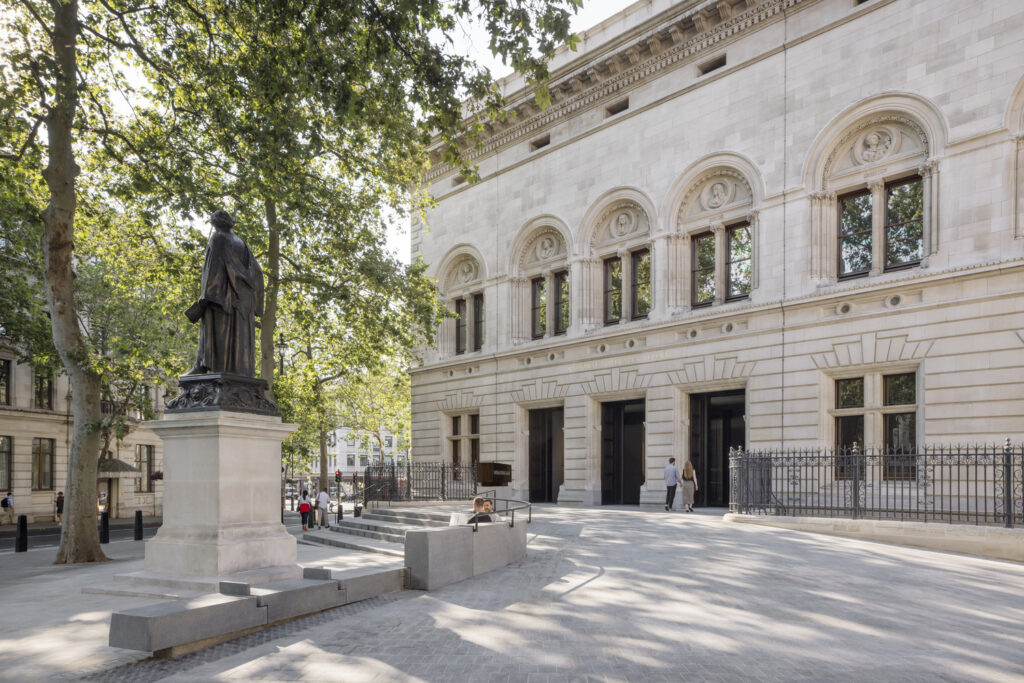
Our projects balance heritage conservation with the evolving needs of building users and the wider community. This often involves carefully navigating conflicting priorities which are not always naturally aligned with the aspirations of the RIBA 2030 Challenge. Conservation of heritage vs. conservation of energy is at the heart of the debate we face daily, one which we are actively trying to shift with initiatives like the Heritage Building Retrofit Toolkit which we authored in collaboration with the City of London. These must also be balanced with social impacts. At the National Portrait Gallery our collaboration with Jamie Fobert Architects led to an we created only 42m² of new build but transformed an underused 950m² into public space. These changes address decades of inadequate access and inclusivity. There has been a 300% increase in disabled visitors since the reopening. The gallery are now embarking on a decarbonisation strategy with PSDS funding.
Co-evolving with nature
Practice
1. Does the practice use biophilia within the office or regularly host meetings and retreats in natural settings? For example do you have extensive planting within the office or rely on natural patterns and imagery for stress relief or quiet areas.
We regularly host our annual Practice Day Out within the setting of a registered park or garden, for example Stowe, and this year at Nevill Holt Hall, this is driven by desire to be in a heritage setting. In addition, our Design Program, now in it’s seventh year and open to applicants from across the business, was hosted at Hooke Park in 2024. Learning was focused around sustainable uses of timber, offering an opportunity to learn, share ideas, collaborate and innovate without the constraints of a live project.
2. Can the practice share examples where it has considered nature in decision making? For example by having a nature proxy to encourage eco-centric decision making, using natural systems as inspiration for the company structure, recognising the seasonal nature of people’s capacity and workload or celebrating equinoxes and solstices together.
Last year, we submitted a proposal to put nature on our Board of Trustees. We have submitted a formal application on behalf of nature to a recent call for new trustee members. The existing Trustees felt it was not the right time to formally have nature on the Board of Trustees, but recognised the need for this clearly to be taken into decision making. As a result, we have started a programme of sending Board members on the UKGBC Recalibrate Programme aimed at advocating better decision making at board level.
3. Is the practice supporting nature locally and nationally? For example, does the practice support local gardens, gardeners, planting programmes, rewilding programmes or advocate for changes in legislation to protect nature.
nO.
Project
1. Can the practice demonstrate projects which strive to match the performance of a mature ecosystem? As a minimum this would mean achieving biodiversity net gain.
Whilst our projects are now needing to respond to new BNG legislation, this is very much in its infancy and is not something we have found easy to push on projects that don’t already have that commitment from clients. The new legislation will help prioritise this important issue and help us strive to be more ambitious in creating more biodiverse places.
2. Is the practice working on material stewardship? For example, evidence could be shown through repeated use of low carbon materials, extensive material libraries and research or publications supporting responsible use of materials and elimination of waste.
The majority of our projects involve the conservation of historic buildings. We regularly default to using natural materials, like stone and timber, using materials that are vernacular to the area, and often sourced locally. We created an internal Little Book of Materials, designed specifically to help teams get a good understanding of materials by comparing them on a ‘sliding scale of bad’. As conservation architects we have been operating in a circular economy for decades. At the National Gallery NG200 project, we created a reuse schedule which catalogued every existing item, and specified how it should be reused or recycled. All items that weren’t needed were required to be listed on Globe Chain for at least two weeks before disposal. We have since rolled out these lessons onto other projects.
3. Do the majority of projects demonstrate the use of biologically-inspired approaches such as Bioregionalism, Biophilia, Biomimicry, Ecomimicry (also referred to as Ecosystems Thinking, Industrial Ecology or Industrial Symbiosis) or BioTRIZ?
No.
Creating a just space for people
Practice
1. Does the practice have a progressive EDI policy and can you evidence many forms of diversity, which are welcomed and acknowledged, within the practice?
Last year we established our JEDI (Justice Equity Diversity and Inclusion) Council. This has been brought together to ensure Purcell is ensuring all staff wellbeing. We have recently launched a new family leave policy in tandem with the JEDI council with progressive policies such as menopause leave. In 2024, 53% of our employees were female. Despite this, we recognise that our industry has significant strides to make with diversity, especially at leadership level. To directly address this and to actively recruit the best talent from diverse backgrounds, Purcell uses specialist agencies (Diversifying Group, Inclusive Recruitment) who proactively seek candidates from a range of backgrounds. We work with PlanBEE (Plan Built Environment Education) to manage the rotation of apprentices across our supply chain on several projects. Many of our projects are community-led, enabling engagement with diverse organisations.
2. Does the practice operate a no overtime culture, meet the living wage consistently, and stipulate a fair salary ratio between staff of all levels?
Though not actively encouraged, overtime is sometimes unavoidable. We use resource management software, Rapport, to record all hours worked and monitor employees recording excess hours to ensure they’re neither overloaded nor overworking. Purcell has been an accredited Living Wage Foundation employer since before we transitioned to employee ownership. This also applies to our contracted staff (e.g., cleaners) and is a stipulated requirement for all of our supply chain. Rewarding employees with salary increases and bonuses is a key ambition for us. Provided we meet a specified profit margin, our employees receive annual inflation-matching salary rises or the equivalent through a bonus scheme. In leaner years, we have taken steps to ensure our lowest paid employees receive higher ratio payrises to offset cost-of-living impacts. In 2023, Associate Partners, Partners and the Board forewent any change in pay to ensure those at junior levels could receive increases without affecting our financial stability.
3. Does the practice support charities, community groups, social enterprises, action groups and others through pro-bono work, charitable giving or in-kind donations?
Our Social Value Steering Group and network of Social Value Champions encourage, facilitate and record Purcell’s contributions to society outside of our project work. In 2024, we delivered 412 days of social value, including mentoring, career advice, work placements, site tours and practical training opportunities, spending £167,241 in pro-bono services, including donations of time and expertise by Purcell staff to heritage groups like the Cathedral Fabric Commission for England, Enfield Society Heritage and Conservation Group, and the Diocese of Chelmsford Advisory Committee. As well as working with climate action groups like Architects Declare and LETI to upskill the built environment sector. We delivered 192 hours of delivering career training and advice. Including mentoring, career advice, work placements, site tours and practical training opportunities.
4. Does the practice publicly refuse to work with certain clients, suppliers or organisations on ethical grounds?
No. Though there has definitely been a shift in recent years, with an increasing focus on our red lines and how we balance competing perspectives. This is often linked to a question of reputational risk. However we have never publicly refused to work with certain clients, suppliers or organisations on ethical grounds.
Project
1. Do the projects demonstrate deep engagement with local stakeholders and end users? For example, is there evidence that your project engagement goes beyond consultation towards co-design?
Providing sustainable legacies means meeting the objectives of those who will use buildings after we hand them over and we are increasingly discovering correlations between meaningful participation and successful legacies. For participation to be meaningful – culminating in ‘co-design/production’ – we give contributors significant buy-in and shared ownership of the proposal. Our role is often to tease out what’s important to communities; finding gems of insight to spark innovation and provide end-products that speak to their identity. This is typically achieved through engagement workshops and design charrettes. At the Oxford Story Museum, our community co-designers asked us to prioritise dynamic functionality in the way the spaces could be used and adapted once complete. Consequently, we worked with the exhibition designer, Autism Oxford, and Oxford University’s E&D Unit to integrate lighting and colours that brought order and legibility to the complex circulation, whilst also being suitable for the neurodivergent needs of any visitor.
2. Do your projects create connected and resilient places which positively contribute to their neighbourhoods and allow equality of access? For example, do your projects create economic opportunity, retain value locally and generate social value?
We know the greatest impact we have is through the projects we are involved in. We corroboratively apply our expertise and contextual understanding of the continuing history of places to deliver a sustainable legacy for every building we work on. This means reaching beyond the boundaries of the site to serve the surrounding communities and our broader supply chain. For example, our transformation of the Grade I listed Manchester Town Hall, one of the largest conservation projects currently being undertaken, will see the integration of 8 new lifts to provide access for all throughout the building. To date, Purcell have delivered £385,395 of social value specifically on this project, including providing apprenticeships, promoting training and skills, and volunteer hours.
3. Do the majority of your projects promote equity in society, and consider all people, not only the building inhabitants? For example, do your projects show due regard for workers within the supply chain and take active steps to avoid modern slavery?
Purcell does not have legal obligations under the Modern Slavery Act 2015. However, we are committed to ensuring our business practices are of exemplary standards both practically and ethically, and we have embedded and long-standing Corporate Social Responsibility (CSR) principles. As such, Purcell voluntarily operates this policy and a Modern Slavery and Human Trafficking Statement, outlining our commitment to preventing slavery, human trafficking and forced and child labour in any part of our own business and our supply chain. As signatories to the RIBA Inclusion Charter, we are part of a new community of equity champions and role models with a shared purpose to driving change through equality and new opportunities. RIBA have, in the past, accredited the Purcell Conservation School, a residential programme founded in 2016 and focused on transferring the knowledge of traditional and acute conservation techniques that are crucial facets of the heritage-driven services Purcell specialises in.