
Submission by PRP.
Being a good ancestor
Practice
1. Does the practice have a clearly stated purpose aligned with the planetary emergency? We are looking for a bold ambition here, and a practice culture which recognises the need for long-term thinking. For example, a strong mission, a theory of change, or a sustainability roadmap.
Low-energy design has been a central part of our service since the mid-1980s, we subsequently expanded our services in environmental sustainability. PRP is a signatory of RIBA’s 2030 Climate Challenge, Architect’s Declare and the Architects’ Journal RetroFirst Campaign and is also a supporter of LETI and a member of the UK Green Building Council. We have recently been awarded BCorp certification and are committed to becoming a carbon negative organisation by 2050 by both reducing and offsetting our carbon emissions. To deal with and mitigate residual emissions, we have signed a partnership agreement with Forest Carbon to support woodland creation in Cumbria and Northumberland. More than 2,800 tonnes of CO2 are expected to be recaptured over the next 30 years.
We have also refined our service offering to provide a more integrated design and technical service to clients, to address the challenges in tackling climate change and reducing carbon emissions.
2. Does the practice have a clear succession plan, which passes on ownership and protects the values and legacy of those who built and contributed to the practice? For example is the practice an employee owned trust.
The Practice is an LLP with 7 Partners and 43 Members. Partners own the business and Members are financially invested. The Members consist of a diverse and talented cohort of Associate Directors and Directors. Membership is offered to people whom the Board believe are the future leaders of the LLP.
3. Does the practice share research and knowledge for the benefit of society and the wider world? For example, you regularly carry out post occupancy evaluation and share information with others.
PRP has written numerous design guides for a variety of clients including government departments, local authorities, public and private sector clients and charitable organisations. Our experience from designing housing through to delivery and post-occupancy reviews with the end users, has informed this guidance. This includes a design guide for Essex County Council and a Factsheet on Landscape Design Principles for Dementia Care for Housing LIN. We have also undertaken research for the Department of Levelling Up, Housing and Communities (DLUHC) into Fire Safety within Specialised Housing and Care Homes.
Project
1. Does the practice advocate for long-term thinking at the outset of projects? Do you initiate projects with long-term thinking and challenge the client on design life? Also, can the practice demonstrate that this approach has worked – with a shorter or longer design life, or an innovative approach to financing or payback period?
We believe that sustainable and resilient design must account for the future, ensuring that spaces remain functional, efficient, and relevant over time. This philosophy often drives us to encourage our clients on the concept of design life, to consider not just immediate needs but also the longevity and adaptability of their assets.
We design buildings with a clear focus on durability, flexibility, and future-proofing. This includes advocating for the use of durable materials and incorporating adaptable design elements that can accommodate changing uses over the building’s predicted lifespan. We emphasise the importance of whole-life cost and carbon analyses, which constantly reveal that investing in sustainability and durability results in significant long-term savings and notable environmental benefits. The success of this approach is demonstrated through various PRP projects, such Twyford Abbey, Oakleigh House, and Chobham Manor, which included innovative solutions that led to a short payback period and enhanced environmental performance.
2. Do your projects take account of the future climate and the need for resilience? For example, do the projects demonstrate flexibility, design for adaptation, design for disassembly, non-deterministic solutions, or demountable structures.
Our approach commits us to making real and lasting changes to the way we operate and advise our clients and their properties. With extensive experience in the Later Living sector, adaptation is key when designing spaces inclusive of different abilities and ages with the aim to last for years to come. Additionally, creating spaces that can adapt to the changing climate are equally as important, for example creating spaces from materials that hold or expel heat based on the external temperature. Multi-use spaces are another way that PRP create adaptability and demonstrate flexibility within a scheme in order to prolong the longevity of the buildings.
3. Do the majority of your projects go beyond mitigating negatives and towards optimising positives? For example, are they meeting or exceeding the RIBA 2030 Challenge.
Our sustainability commitments often go beyond mitigating negative impacts and ensuring positive outcomes from the start. Our projects often exceed industry benchmarks and targets, including those set by the RIBA 2030 Climate Challenge and LETI’s Climate Emergency Design Guide. We take pride in pushing the boundaries of sustainable design, ensuring our projects comply with these rigorous standards and serve as exemplars of best practices in the industry.
PRP is a recognised industry leader in promoting health and wellbeing for all. Our recent awards, like those from the Building Design WA100 2025 and the Housing Design Awards, highlight our success in creating welcoming, attentive and sustainable places, particularly for the most vulnerable populations in the cases of our care homes projects. These awards underscore our dedication to designing spaces that prioritise comfort and well-being while also being mindful of our industry’s environmental impacts and taking action towards reducing them.
Co-evolving with nature
Practice
1. Does the practice use biophilia within the office or regularly host meetings and retreats in natural settings? For example do you have extensive planting within the office or rely on natural patterns and imagery for stress relief or quiet areas.
Our workspace is enriched with a diverse array of plants, creating a calming and refreshing atmosphere that promotes overall well-being. The strategic placement of greenery enhances the aesthetic appeal and also improves air quality and reduces stress levels among our team members. We incorporate natural patterns and imagery throughout the office, which serve to further alleviate stress and provide serene, quiet areas for relaxation and mindfulness.
We regularly host meetings and retreats in natural settings to deepen our connection with nature and support our team’s well-being. We organize visits to nurseries and garden outings, which offer substantial mental health benefits and a relaxed, engaging way of learning. These excursions let us unwind and rejuvenate while gaining valuable knowledge about various plants and sustainable practices. This approach not only enhances personal well-being but also fosters professional growth, as we bring back insights and inspiration from these natural experiences to their work.
2. Can the practice share examples where it has considered nature in decision making? For example by having a nature proxy to encourage eco-centric decision making, using natural systems as inspiration for the company structure, recognising the seasonal nature of people’s capacity and workload or celebrating equinoxes and solstices together.
No.
3. Is the practice supporting nature locally and nationally? For example, does the practice support local gardens, gardeners, planting programmes, rewilding programmes or advocate for changes in legislation to protect nature.
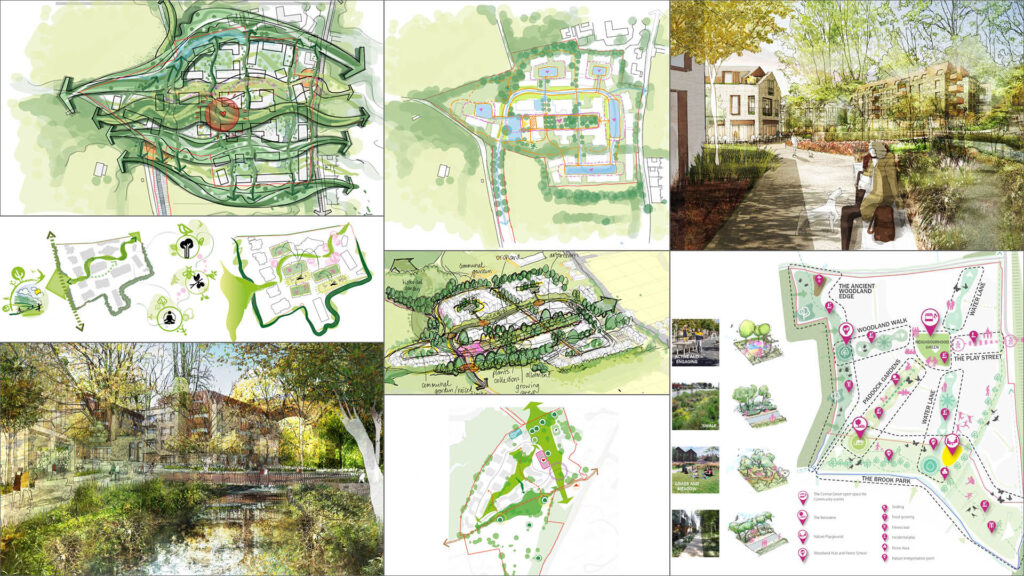
We work closely with the community, local stakeholders, specialists, and the client’s team, carrying out community engagement programmes. Central to this approach is the collaboration that enables us to clearly understand the community’s views and concerns. Our proposal for any scheme, therefore, is cast with a people-first approach and their ultimate desire to have a scheme that works with nature for the long term. People value living in places that are close to nature. As well as allowing wildlife to thrive, green infrastructure – such as open spaces, the river, or play areas – provides spaces for people to enjoy, and cost-effective ways to manage water naturally and prevent flooding.
Our ‘The Building with Nature’ accreditation provides us with a good understanding of how to easily deliver and maintain the green infrastructure proposed, and functions and benefits as ecosystem services, for people and wildlife with consideration for long-term management.
Project
1. Can the practice demonstrate projects which strive to match the performance of a mature ecosystem? As a minimum this would mean achieving biodiversity net gain.
There are many factors and considerations when designing habitats to achieve BNG:
- Set the design objectives
- Collect baseline data to design BNG
- Adopt a collaborative design approach
- Consider how habitat will work
- Understand the various solutions in an urban context
- Be patient with supply chains
The above key principles are what we weave through our scheme to ensure that what we design will achieve a mature ecosystem.
PRP developed the masterplan for the Olympic Park, Chobham Manor. Owing to the site being such an important part of the Olympic legacy, the design embraced high standards to deliver health and wellbeing and environmental features. The development is being built to extremely ambitious sustainability standards, including the Zero Carbon Hub’s 2016 Fabric Energy Efficiency Standard. We are appointed, by Transport for London and the Greater London Authority, as a lead consultant to conduct the post occupancy evaluation.
Other projects include: Bovingdon Airfield, Bicester EcoTown and others.
2. Is the practice working on material stewardship? For example, evidence could be shown through repeated use of low carbon materials, extensive material libraries and research or publications supporting responsible use of materials and elimination of waste.
We take particular care in the longevity of building materials through flexible and adaptable designs and specification of building materials with low environmental impact, where possible. We prioritise the re-use of buildings and building materials and put effort into finding locally-sourced materials with low embodied carbon where practical.
3. Do the majority of projects demonstrate the use of biologically-inspired approaches such as Bioregionalism, Biophilia, Biomimicry, Ecomimicry (also referred to as Ecosystems Thinking, Industrial Ecology or Industrial Symbiosis) or BioTRIZ?
The majority of our projects look to Biomimicry as a concept and look to a nature-based solution for the creation of successful regeneration of a place. The integration of architecture and landscape is valued as we value what nature can bring to our various schemes. The 3 essential elements of biomimicry – emulate, ethos and reconnect is what we initiate so that we create a harmonious, regenerative design that supports not only wellbeing but also mental wellbeing.
Creating a just space for people
Practice
1. Does the practice have a progressive EDI policy and can you evidence many forms of diversity, which are welcomed and acknowledged, within the practice?
PRP is almost 50/50 a male female ratio and we have a wide diversity of ethnicity and ages within our Practice. We have several Employee Resource Groups known collectively as ‘PRP Spirit’ and our ED&I Group has over 30 volunteers. We hosted a menopause panel session for our staff which had 50% attendance including inviting questions from male colleagues. We host events for ED&I, Wellbeing & Sustainability monthly.
ED&I at PRP means giving all members of a company the opportunity to be themselves and show their strengths. We offer ED&I training to all new joiners and have trained over 25 people to become ED&I coaches within our practice. Our ED&I Coaches are there to help people navigate some of the most common themes that come up around inclusive language and behaviours. They are there to ask questions that people may not otherwise feel confident in asking their peers.
2. Does the practice operate a no overtime culture, meet the living wage consistently, and stipulate a fair salary ratio between staff of all levels?
At PRP we do not encourage a ‘face time’ culture where people are expected to stay late. We recognise outcomes rather than hours worked. This is led from the Board Partners who will often check in on someone if they are working after hours.
We meet the London living wage standards in our Smithfield studio and we benchmark our salaries based on industry reports. We review the RIBA salary benchmarking and are part of an Architectural cohort where we publish our salaries (anonymised) and pay a subscription every year to receive the report which includes 100 other architectural practices. We have a calculation methodology which we use to ensure we are competitive within the industry with our salary payments.
3. Does the practice support charities, community groups, social enterprises, action groups and others through pro-bono work, charitable giving or in-kind donations?
Our Head of People & Culture is responsible for our Social Value offerings and sits on an ESG steering group with 3 Board Partners. The steering group reviews the work we do within the communities we serve. We have 5 Social Value Champions who work within each division and they are responsible for promoting and capturing people’s volunteering activities. We give employees one day a year to volunteer with a charity of their choice and have assigned a timesheet code for people to record any social value activities they have taken part in. Our bids team curates SV reports on a quarterly basis which captures, impact statements, time given money raised an photos. Some charities we support have included but are not limited to: Jolly Josh, Age UK, St. Ann’s and individual client chosen charities. We raise money through internal competitions, pub quizzes, bake sales and other events like Christmas gift donations.
4. Does the practice publicly refuse to work with certain clients, suppliers or organisations on ethical grounds?
No.
Project
1. Do the projects demonstrate deep engagement with local stakeholders and end users? For example, is there evidence that your project engagement goes beyond consultation towards co-design?
PRP is an expert in community partnerships and engagement. Each project, regardless of size, requires a bespoke approach to community engagement to create a truly inclusive design. For our project at High Path Estate, the PRP team used an innovative tool-kit of engagement techniques including co-design to encourage genuine participation and meaningful conversation between varied stakeholders from very early stages. We encouraged different methods of capturing, recording and presenting feedback. We held co-design and 3D model-making workshops, including a ‘Self Build Play’ workshop, with children 8-11 years old to get them involved in designing for their community. We also hosted ‘Have your Say’ exhibitions for the community, so local stakeholders and residents’ groups could share their thoughts directly with our team and have an impact on the final design. PRP’s approach is consultative and collaborative and we will always involve the community where possible in influencing the design development journey.
2. Do your projects create connected and resilient places which positively contribute to their neighbourhoods and allow equality of access? For example, do your projects create economic opportunity, retain value locally and generate social value?
Our commitment is to create positive and enduring change in the communities where we live and work. Our approach to design centres on human needs, embedding sustainability, inclusivity, health, and wellbeing into every project.
Social responsibility and civic change are foundational to our work, not just in the buildings we design, but in our collaboration with the communities we serve. We aim to build healthy, diverse, sustainable, and vibrant communities for future generations, co-creating neighbourhoods with lasting value.
3. Do the majority of your projects promote equity in society, and consider all people, not only the building inhabitants? For example, do your projects show due regard for workers within the supply chain and take active steps to avoid modern slavery?
We have a modern slavery and child labour policy that we ask all new joiners to read and acknowledge as part of their onboarding journey. The policy is supported by an interactive online training course on Modern Slavery awareness which all new joiners are asked to complete within their probation period. The training includes a test at the end to confirm their understanding and awareness of what to look out for when dealing with our supply chain.