
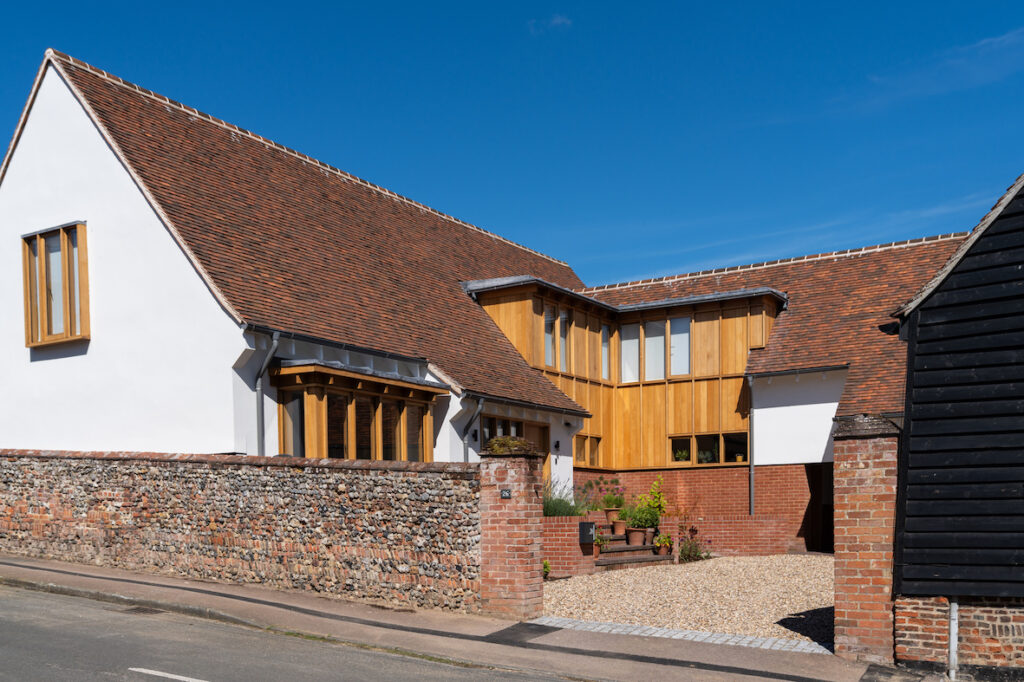
Submission by Project Orange.
Being a good ancestor
Practice
1. Does the practice have a clearly stated purpose aligned with the planetary emergency? We are looking for a bold ambition here, and a practice culture which recognises the need for long-term thinking. For example, a strong mission, a theory of change, or a sustainability roadmap.
In 2020 Project Orange published PO Box4 – Help! The introduction, by Rae Whittow Williams, notes:
By repositioning the relationship between practice and process, and evaluating processes against outcomes, Project Orange have sought to use the latest issue of PO BOX as a vehicle to determine how they can begin to move the debate surrounding the climate emergency forward. Through a series of reflections and propositions this collection of essays investigates how to meaningfully re-position the drivers and working methods of the practice with ‘the way things ought to be’, further embedding the relationship between research and practice into the culture of the studio. It is not intended as a solution but a springboard: to work collaboratively as a team, craft a renewed set of practice values, challenge the status quo surrounding city making, inspire action and behaviour change in others, and ultimately forge the path ahead.
2. Does the practice have a clear succession plan, which passes on ownership and protects the values and legacy of those who built and contributed to the practice? For example is the practice an employee owned trust.
No.
3. Does the practice share research and knowledge for the benefit of society and the wider world? For example, you regularly carry out post occupancy evaluation and share information with others.
Director James Soane is also a founding Director of the London School of Architecture (LSA) where he set up the Architectural Theory course and now teaches ‘Humanity and the Planet’. The high level aim of the school is to connect academia and practice in the context of the climate emergency. We ask what happens when the stories we tell ourselves are the wrong ones; not quite true or damaged? We must feel and accept the essential limits of the planetary system on which we depend, and embrace our capacity to remake our collective narratives thus redistribute social and political power. Grass roots action has never been more important in showing resistance to predominant ideologies that favour inequality, extraction and destruction of the environment. Our practice attempts to answer these questions though our project and community work. Our publications (PO Box) offers critical reflections which we share.
Project
1. Does the practice advocate for long-term thinking at the outset of projects? Do you initiate projects with long-term thinking and challenge the client on design life? Also, can the practice demonstrate that this approach has worked – with a shorter or longer design life, or an innovative approach to financing or payback period?
The practice aims to embed qualities of maintenance and repair in all our projects, whether retro-fit or new build. A recent example has been Room2 Hotel in Chiswick, London. Here we installed bore holes 200m deep across the site which provide a long term energy source, both heating and cooling, for the hotel. The client is committed to making all aspects of the building in use low carbon noting on their website: ‘As a net zero hometel, 100% of the carbon emissions from conception through to end-of-life have been reduced and rebalanced to zero. This is the 1st hotel in the world to do so.’
The hotel also has two lab rooms, which learns over the long run how our guests use the rooms. It tracks everything from energy, appliances, lighting and heating, water and air quality, so we can get better and drive down energy further
https://room2.com/chiswick/
2. Do your projects take account of the future climate and the need for resilience? For example, do the projects demonstrate flexibility, design for adaptation, design for disassembly, non-deterministic solutions, or demountable structures.
We have completed a new-build house for a retired couple that will be ‘off grid’. This means we have solar panels, water collection as well as maximum insulation. We have used new materials such as Glapor for the sub base/insulation, hemp insulation grown locally as well as steel that has been recycled. The design includes a 2 story element that has a bedroom above with living below connecting to the kitchen. It has a side door and is designed to be a self contained apartment should the couple require a carer. The project meets AECB criteria.
Overall our expertise is in designing lasting structures that can be adapted and repaired. Our mixed use Tramshed scheme in Dalkey keeps the existing buildings to create a public square with kiosks around the edge. The uses inside continue to evolve, but flexibility is a positive here.
3. Do the majority of your projects go beyond mitigating negatives and towards optimising positives? For example, are they meeting or exceeding the RIBA 2030 Challenge.
Our ethos is to consider the circular economy and the principles of regenerative design. For us this means balancing clients immediate requirements with the possibility of future needs. In particular we pay attention to the possibility of over-heating. A recent domestic project installed solar slates (in a conservation area) in order to power the minimal heating for winter and an air cooling system in summer.
Back in Dalkey we won the competition as the only company who kept the existing structures. The use of solar panels, fabric retention and re-use of on-site materials also won over the locals and planners, on this very contested site. Our proposal shows it is possible to combine civic and commercial space within a historic context to bring vibrancy, people and no cars.
Co-evolving with nature
Practice
1. Does the practice use biophilia within the office or regularly host meetings and retreats in natural settings? For example do you have extensive planting within the office or rely on natural patterns and imagery for stress relief or quiet areas.
We believe our connection with nature has been damaged and we have a duty to repair and enhance where we can.
Our studio is set into a small garden with an olive tree where we grow fruit and herbs. We have a table and chairs on our terrace where we regularly have meetings in summer. We are able to compost our waste. An outside kitchen area allows us to prepare food. Inside we clad the interior with reclaimed timber, our desks are bamboo with natural linoleum surfaces. Our meeting room is clad in natural felt to give better acoustics as well as providing comfort. It is a gentle space to work from where we can witness the seasons.
We also run our village Hidden Gardens (last year we raised £10k for local charities) and open our own garden (across the road from the studio, so zero commute).
2. Can the practice share examples where it has considered nature in decision making? For example by having a nature proxy to encourage eco-centric decision making, using natural systems as inspiration for the company structure, recognising the seasonal nature of people’s capacity and workload or celebrating equinoxes and solstices together.
We often frame our role on a project as gardeners, who are tending and nurturing, as opposed to the kind of architecture that favours a Tabula Rasa approach.
Every year we go for a hike with the studio, which provides a wonderful opportunity to experience nature together and share our thoughts as we tramp through the countryside.
Durning Covid we worked on a large scale housing project with a ‘landscape first’ approach. We had lunches outdoors with our landscape collaborator (AREA) which certainly helped us feel the importance of the natural world. Our client is one of the founders of Wild East – an initiative to take responsibility to restore nature. Wild East wants our region to become one of the world’s biggest and best nature reserves, enriching our lives, and restoring our wild hearts. The scheme we worked on received planning permission and praised for significantly enhancing biodiversity.
3. Is the practice supporting nature locally and nationally? For example, does the practice support local gardens, gardeners, planting programmes, rewilding programmes or advocate for changes in legislation to protect nature.
Yes! We run our village Hidden Gardens with a local landscape gardener and recently we all attended an inspiring two day seminar run by the Beth Chatto Trust entitled ‘Wilding the Mind’. We also subscribe to East Anglia Sustain and attended their conference in January with a keynote from MP Caroline Lucas. Last month we supported a radical new film, 6 Inches of Soil, which was screened in a nearby farm.
At a more strategic level we have been involved in a 3 year project of rewriting our Neighbourhood Plan. As part of the team we all agreed to frame the project as creating a plan for climate change. We helped the parish Council declare a climate emergency. The county council noted that this was the first ‘sustainable’ neighbourhood plan they had seen. We also commissioned a Landscape Character assessment. We also designed an RHS Chelsea Garden.
Project
1. Can the practice demonstrate projects which strive to match the performance of a mature ecosystem? As a minimum this would mean achieving biodiversity net gain.
Our two housing schemes in Somerleyton, Suffolk, both significantly add to net biodiversity. At Old Forge, a group of 10 new houses, we were able to preserve an Oak Tree, which was not subject to a TPO, and was located in the centre of the site. We made this the organising principle and it creates a yard around which houses wrap. The space under the tree is a community space with a bench around the trunk. The larger site of 35 homes has a rich diverse landscape including public heath land, a wetland zone (doubling up as SUDs) and front gardens that will be managed by the Estate to ensure they remain healthy and green.
We were also part of a multi disciplinary team commissioned by Peabody to work up a proposal for a Green and Blue Thamesmead master plan that will be valid for 25 years.
2. Is the practice working on material stewardship? For example, evidence could be shown through repeated use of low carbon materials, extensive material libraries and research or publications supporting responsible use of materials and elimination of waste.
We are at an early stage. However when we re-located from London to Suffolk we stripped our material library of products we did not believe to be sustainable (all the paper went to a special recycling facility and the fabric to the patchwork society!).
Through working closely with local contractors in the county we are beginning to create a data base of hyper-local suppliers and skills. This could be a local joinery shop using reclaimed timber (there is one in the village), a blacksmith to make ironwork and two women in Norfolk who baked all the pamet floor tiles for a recent extension (in their kitchen).
James recently contributed a book tilted Towards an Architectural Theory for Sustainability, where his chapter ‘Architecture in the Future Imperfect’, argues for a more patchwork approach to design and aesthetics alongside an understanding of the circular economy.
3. Do the majority of projects demonstrate the use of biologically-inspired approaches such as Bioregionalism, Biophilia, Biomimicry, Ecomimicry (also referred to as Ecosystems Thinking, Industrial Ecology or Industrial Symbiosis) or BioTRIZ?
We do not subscribe to the sometimes simplistic idea that if something looks like nature then it is naturally good. The dangers of which are often evidenced in extraneous parametric design. However we believe in the idea that we are part of an ecosystem where materials need to be treated as nutrients – biological and technical. These need to be deployed with care and consideration.
We have studied Jem Bendells’ ‘Deep Adaptation’ paper and James attended his week long retreat in Devon to learn more. Key to understanding this is to acknowledge that whilst nature is our only source of wealth, it is finite. Now is the time to protect and ration what is left. Buildings are a collection of materials and invested energy that require careful management. We have to challenge the hegemony of market driven technological and industrial advances that are leading to Ecocide.
Creating a just space for people
Practice
1. Does the practice have a progressive EDI policy and can you evidence many forms of diversity, which are welcomed and acknowledged, within the practice?
We have a policy. However as a small practice of 6 people (including ourselves) our diversity changes depending on who stays and goes. We are 50% LGBTQ+ (both directors being civil partnered). Over the years we have employed staff from the EU, Asia and USA. Often we have a 50:50 gender balance. However recruiting for a rural practice is challenging as candidates are local.
Recent analysis of all our alumni showed that in 20 years, 55% of staff went on to set up their own practice, which we celebrate. We now call ourselves a ‘stepping stone’ practice
Last year we helped sponsor a young architect from Azerbijan who became a refugee in UK (for speaking out over workers rights). We were able to find him work, give him a decent computer, and assist his travel costs.
James was a contributing editor to the book ‘A Gendered Profession’ (RIBA Publishing).
2. Does the practice operate a no overtime culture, meet the living wage consistently, and stipulate a fair salary ratio between staff of all levels?
After years of working for other people and doing unpaid overtime, we are very clear that our staff should only work an 8 hour day and learn how to be efficient. We benchmark our pay yearly with other practices we know as well as published metrics and we pay in the top quartile. After 2 years staff accrue additional holiday. We pay all part 3 fees, as well as 10 days study leave, and are currently supporting one of our staff on the apprentice route to qualification. We undertake staff performance reviews in January and salary reviews in June. We always pay a Christmas bonus equivalent to 2 weeks pay to all staff. Lastly we allow staff to work from home 2 days a week, three of whom take this up.
3. Does the practice support charities, community groups, social enterprises, action groups and others through pro-bono work, charitable giving or in-kind donations?
Since it’s inception in 1997, Project Orange have supported Shine, a charity helping people with spina bifida.
Last year James set up LEO (Lavenham Energy Opportunities) to continue work he had been doing through the Neighbourhood Plan. He secured a £10,000 grant to collaborate with the University of Essex on their Innovate to Elevate programme which allowed for three community events resulting in a report recommending a series of actions. This is work in progress and LEO are consulting with the church on a feasibility study for solar panels
In 2023 Project Orange organised LIFE (Lavenham Ideas Festival) in order to encourage members of the community to discuss local issues and climate change.
Christopher is an unpaid panel member of the RIBA Suffolk Design Review group that offers advice to high profile projects in the county.
4. Does the practice publicly refuse to work with certain clients, suppliers or organisations on ethical grounds?
Since 2019 the practice no longer fly long distance for meetings. We have ongoing work in Dublin which requires one person to fly 3 times a year. James has clients in India and we have an agreement that all meetings are now held online. We no longer work in Russia, where we had built up a small repeat client base. We have an electric car powered by solar panels which means we are able to travel to meetings in East Anglia.
Our ethical position means we no longer enter open competitions, as we see these as unfair, devaluing the worth of architects.
James was a member of the RIBA panel who produced their Ethical Guide in 2023.
Project
1. Do the projects demonstrate deep engagement with local stakeholders and end users? For example, is there evidence that your project engagement goes beyond consultation towards co-design?
At the recently completed Moorings Sociable Club in Thamesmead, we worked with Peabody and a co-design team to consult local people, schools and community leaders in order to generate a meaningful brief for the re-imagined building. Having been derelict for 15 years the building was in poor condition. However it was soon agreed that it should be saved. Workshops and creative events were held to engage in conversations around sustainable interventions as well as how the building could be inhabited. This resulted in a community cafe, a performance space, a computer training room, a small children’s library and a new fully accessible lift. There is now a very strong sense of ownership by locals young and old.
With LNP2 and LEO, Project Orange have organised over 8 community engagement activities and designed an exhibition, the questionnaire and all the documentation. They also assisted in the creation of a Design Guide.
2. Do your projects create connected and resilient places which positively contribute to their neighbourhoods and allow equality of access? For example, do your projects create economic opportunity, retain value locally and generate social value?
The previous example, Moorings in Thamesmead, created a new safe space for a diverse community. The club offers a range of quality services to support local people with issues including housing, jobs and training, immigration and money management.
A recent project for a local landowner in Suffolk was able to demonstrate that the scheme by a large house-builder could be better designed to take account of the site. The vision for the disused farmstead created a sustainable community within an attractive agricultural setting connected to the nearby village, its geography and traditions. Our landscape-led approach embedded new homes with a light carbon footprint into an agricultural setting within the wider rural context.
Over in Somerleyton our Old Forge project repurposes the now empty garage into a community shop with fast car charging and cycle storage.
At Rathbone Market in Canning Town, our affordable housing has allotments on the roof.
3. Do the majority of your projects promote equity in society, and consider all people, not only the building inhabitants? For example, do your projects show due regard for workers within the supply chain and take active steps to avoid modern slavery?
We no longer work on large scale projects where these issues can be endemic, but we take care to understand the implications of the choices and decisions we make.
When working on a hotel in India we raised a concern over the conditions of workers with many living in the grounds of the site. However, we were somewhat chastened to learn that the land had been made available by the client so that all the manual workers could bring their families to support them and cook. Furthermore there had recently been a cholera epidemic and the client had set up an inoculation clinic on site. Sometimes things are not what they seem. They are better! However in the past when on site in Russia we were unhappy about certain health and safety measures. The translator would not translate the comments from the contractor as they were racist