
Submission by Positive Collective.
Being a good ancestor
Practice
1. Does the practice have a clearly stated purpose aligned with the planetary emergency? We are looking for a bold ambition here, and a practice culture which recognises the need for long-term thinking. For example, a strong mission, a theory of change, or a sustainability roadmap.
We spent time at the formation of The Positive Collective to understand and craft our purpose. Our mission is noted centrally on our website. This includes positive interactions, ethics, language and nature outcomes for our work alongside using modern digital methods and processes as appropriate. This mission may adapt over time as our own learning journey and the understanding of regenerative systems evolves.
We have found existing sustainability frameworks, although important to provide some shift in thinking, fall short of the level of change required to move towards a more regenerative future. Therefore our mission provided us with a more holistic approach as to how we work and the principles we hold.
2. Does the practice have a clear succession plan, which passes on ownership and protects the values and legacy of those who built and contributed to the practice? For example is the practice an employee owned trust.
Our way of working is not based on a traditional corporate structure but a flexible working engagement with others. This allows us to assemble (and also disassemble) expert teams as needed, working to a shared mission and the project’s goals.
This principle of cooperation, not competition, is the very basis of living systems. This approach means we are not subject to the same risks and concerns of practices about staffing levels, working efficiency, continual growth and ownership. We encourage shared ownership of the project – with both its risks and rewards – from outset in the true spirit of collaborative working practices.
We are therefore an open group informed by the services we each provide to others to achieve the very best outcomes.
3. Does the practice share research and knowledge for the benefit of society and the wider world? For example, you regularly carry out post occupancy evaluation and share information with others.
We are actively engaged in sharing our work via industry engagement such as ACAN!, ASBP, LETI and Structural Engineers and Building Services Engineers Declare, local community groups such as Colshaw Farm Community, People Powered Retrofit, Carbon Coop and Transition Wilmslow, thought leadership pieces on our website, regular commentary on social media, presenting at national events, lecturing, tutoring and online webinars.
Unless restricted by client confidentiality and wherever possible, our work and publications follow Creative Commons licensing. We feel this is an integral part of enabling the profession to innovate and grow which is beneficial for all. We also encourage our collaborators and other industry colleagues to do the same.
Project
1. Does the practice advocate for long-term thinking at the outset of projects? Do you initiate projects with long-term thinking and challenge the client on design life? Also, can the practice demonstrate that this approach has worked – with a shorter or longer design life, or an innovative approach to financing or payback period?
This is influenced by our inclusion of long term climate resilience on projects but also in terms of promotion of the Circular Economy and intergenerational thinking. For example, we are currently researching design life criteria and its impacts on understanding of harvesting periods, service life extension and forms of building obsolescence in determining natural material value with funding from Built by Nature.
To achieve this we set a clear Project Brief to establish performance targets that think of the whole project timeline at the outset. This approach is then threaded through the entire design process, working alongside all stakeholders, supply chain to understand deliverability and facilities and estate managers to ensure follow through.
Recent projects at both The National Gallery and BFI in London have worked with the estates teams to chart their development aims working to their real budget constraints.
2. Do your projects take account of the future climate and the need for resilience? For example, do the projects demonstrate flexibility, design for adaptation, design for disassembly, non-deterministic solutions, or demountable structures.
These are used directly in assessing conventional ways such as future environmental comfort conditions and flooding hazards but now also building portfolio and finance and reporting risks as in recent estate sustainability work for BFI. This work highlighted undertaking ecological and climate assessments of the estate to inform the baseline and actions.
For building projects we set out repair, adaptability and disassembly methods and consider how building elements can be more easily disassembled and reused without modification through considering their initial detailing. For example our Positive House project considered different reconfigurations and adaptations, used standard elements to for better re-use in a future life. Beyond this, we have researched how ownership can be retained by the manufacturer providing as an incentive for building elements to be maintained and adapted to extend their life.
3. Do the majority of your projects go beyond mitigating negatives and towards optimising positives? For example, are they meeting or exceeding the RIBA 2030 Challenge.
The central theme of positive outcomes for all our work is the reason for the Positive Collective name. Our approach to regenerative design include the shift in mindset towards a ‘seva’ approach. This includes social and nature benefits, not only carbon ‘positive’ methods as explained in the case study examples of The Positive House design with positive community and positive carbon outcomes.
This is led into how we can create a new system of development such as the work the Positive Collective did with Igloo and We Can Make for the Climate Smart Cities Challenge in Bristol. The approach, which we called The Civic X Change, was a community led, retrofit and infill new build programme that allowed residents to right size their living whilst staying in their communities and radically lower carbon impacts. This helps significantly exceed existing frameworks such as the RIBA 2030 Challenge.
Co-evolving with nature
Practice
1. Does the practice use biophilia within the office or regularly host meetings and retreats in natural settings? For example do you have extensive planting within the office or rely on natural patterns and imagery for stress relief or quiet areas.
We all enjoy nature in our own ways, whether that is cycling, hiking and wild camping or swimming. We are lucky enough to have the flexibility to work where we like, which is often outdoors.
Our work with ecologists and landscape designers has helped us engage further as the reciprocal benefit of thinking to all nature, not just humans. The connectivity of nature to residents and the amount of common shared landscaping not owned gardens spaces for The Positive House is an example of how this was integrated but based on a reflection of the need for nature to enhance in support our own wellbeing. Therefore we recognise the importance of cultivating a connectedness with nature so that we can start to heal the disjunction we have generated through the development of our modern society.
2. Can the practice share examples where it has considered nature in decision making? For example by having a nature proxy to encourage eco-centric decision making, using natural systems as inspiration for the company structure, recognising the seasonal nature of people’s capacity and workload or celebrating equinoxes and solstices together.
As a collection of micro and small businesses, we collaborate and flex according to people’s capacity at any given moment without undue pressure to conform.
In Flo’s own house deep retrofit, as well as an Energy Hierarchy for design, she applied a Material (provenance) Hierarchy, on the basis that anything that belongs in nature can be returned to nature, anything that constitutes “poison” to nature is either not used, or used for the “right” job in what could potentially be a closed loop. Bio-based, rapidly renewable and compostable materials are favoured over extractive natural materials over synthetic materials.
Nature could definitely play a more prominent role in our decision making going forward.
3. Is the practice supporting nature locally and nationally? For example, does the practice support local gardens, gardeners, planting programmes, rewilding programmes or advocate for changes in legislation to protect nature.
As individuals volunteering in our own communities we contribute to activities that build community resilience and enhance our local landscape.
As a volunteer for Transition Wilmslow, Flo, for example, actively participates in building up local community market gardens, the Tiny Forest, rewilding and grow-your-own projects. As firm believers that regenerative is place-led, we can collaborate at a distance, while acting locally for our own environment and neighborhoods. Whilst not as successful so far, Adrian’s own garden is being slowly turned towards serving nature, helped by a gardener who works at The Knepp Estate, as to what may be possible.
Project
1. Can the practice demonstrate projects which strive to match the performance of a mature ecosystem? As a minimum this would mean achieving biodiversity net gain.
The Positive House project eventually was to be located on ‘tradition’ arable land, depleted of nutrient density, and poor in natural capital. Our “Positive Community” approach would have given demonstrably positive in its biodiversity benefits, whilst providing opportunities for communal growing of healthy, toxin free food.
2. Is the practice working on material stewardship? For example, evidence could be shown through repeated use of low carbon materials, extensive material libraries and research or publications supporting responsible use of materials and elimination of waste.
We have a long engagement with the use of natural materials in construction including rammed and compressed earth, to straw and timber. We are members of ASBP and undertaking research into biotic material use. This includes current co-research funded by Built by Nature called Using Wood Well that explores regeneration and use rates of biotic materials and use intensity of timber in building. Adrian’s forthcoming chapter in a book on Buildings As Material Banks (BAMB) outlines biotic material use as part of a more Circular Economy.
3. Do the majority of projects demonstrate the use of biologically-inspired approaches such as Bioregionalism, Biophilia, Biomimicry, Ecomimicry (also referred to as Ecosystems Thinking, Industrial Ecology or Industrial Symbiosis) or BioTRIZ?
There are many terms used to describe ways to think and act in positive ways. We are inspired by many, particularly ‘construction ecology’ as a way of considering building in line with nature’s own metabolism, capturing and storing energy in buildings and being mindful of avoiding entropy impacts in material and energy transformations.
At an industry level, our work in promoting and evidencing the effective use of mass timber through the WorkStack project, for instance, helped show viable and practical alternatives to extractive materials and the regulatory barriers to achieving it.
Creating a just space for people
Practice
1. Does the practice have a progressive EDI policy and can you evidence many forms of diversity, which are welcomed and acknowledged, within the practice?
The founding collective members are micro-businesses – either independents or composed of company founders – and engage others as needed. We collaborate with like-minded people and businesses with similar ethical principles, committed to creating a more inclusive and equitable environment.
Design Engine Architects (DEA), for instance, as a recent entrant to Positive Collective’s network of collaborators, are an SME with around 30 staff. DEA have an EDI policy in place, supporting all aspects of recruitment, practice and conduct. This is issued to all people entering the practice as staff, and includes policy on age, gender, disability, race, sexual orientation, religion/ belief, maternity & paternity, mental health. This has been reflected in the workforce, for example with a range of cultural backgrounds and nationalities. DEA recognises however there is more that can be done and committed to improving practice.
2. Does the practice operate a no overtime culture, meet the living wage consistently, and stipulate a fair salary ratio between staff of all levels?
Each member of The Positive Collective is responsible for their own staff and employment contracts. As a collective, we tend to have very non-standard working times. We often work around other living needs, not the other way around. We don’t really ‘do’ HR in the way described and therefore don’t need to have these sorts of legal responses developed to protect staff and their well being. But each business embodies the values of fairness and development of human potential prompted by a Five Capitals mode of thinking. changebuilding, for instance, will not employ interns without fair compensation, set currently at a level about twice the current minimum wage. Consultants and contractors who work with them set their own rates. This is appropriate to the longer term self worth of professionals in the building industry.
3. Does the practice support charities, community groups, social enterprises, action groups and others through pro-bono work, charitable giving or in-kind donations?
Flo is Chair of Transition Wilmslow (TW), and has volunteered for 12 years for this community group, providing energy efficiency advice, thermal imaging surveys and retrofit advice. She is an active participant in TW’s many activities and events, including community market gardens, skills shares, organic wholefood refills, “swishing”, seedling swaps, environment & planning responses, active travel campaigns and engaging with the local council as part of a county-wide Climate Alliance. TW’s biggest project is the re-wetting and restoration of Lindow Moss, a key landscape on their doorstep where Lindow Man was found and has been exploited for peat for decades: the restoration project will turn what has so far been an emitter of GHGs back to its original state as a net carbon sink, with a miraculous increase in biodiversity, with the return of sphagnum moss, numerous insect species and water voles.
4. Does the practice publicly refuse to work with certain clients, suppliers or organisations on ethical grounds?
Our work is often self-selecting and this has not occurred. We have a clear ethical position of what we want to achieve and have been lucky to work with clients who share those goals.
Project
1. Do the projects demonstrate deep engagement with local stakeholders and end users? For example, is there evidence that your project engagement goes beyond consultation towards co-design?
DEA has a long track-record in developing complex, innovative and aspirational briefs with wide stakeholder groups.
Project engagement typically includes end-users, for example student groups and departmental representatives within a University setting, and other key stakeholders. While the breadth and depth of engagement is to some degree defined by professional clients, we use our influence to advise and suggest where consultation should broaden to other stakeholders groups.
A recent urban design masterplan project included a deep engagement with community and client to achieve co-creation and design. DEA led a project team and helped develop a process with wide community engagement by a variety of means: online, in person workshops and design sessions, schools and college outreach sessions, and client stakeholder briefing and reporting workshops.
2. Do your projects create connected and resilient places which positively contribute to their neighbourhoods and allow equality of access? For example, do your projects create economic opportunity, retain value locally and generate social value?
We are strongly motivated by the desire to create places that will last, resilient places that will keep being used and enjoyed long into the future.
Equality of access is a critical consideration at the heart of our process: creating welcoming, legible buildings and spaces, sensitively and appropriately physically connected to their context for all people.
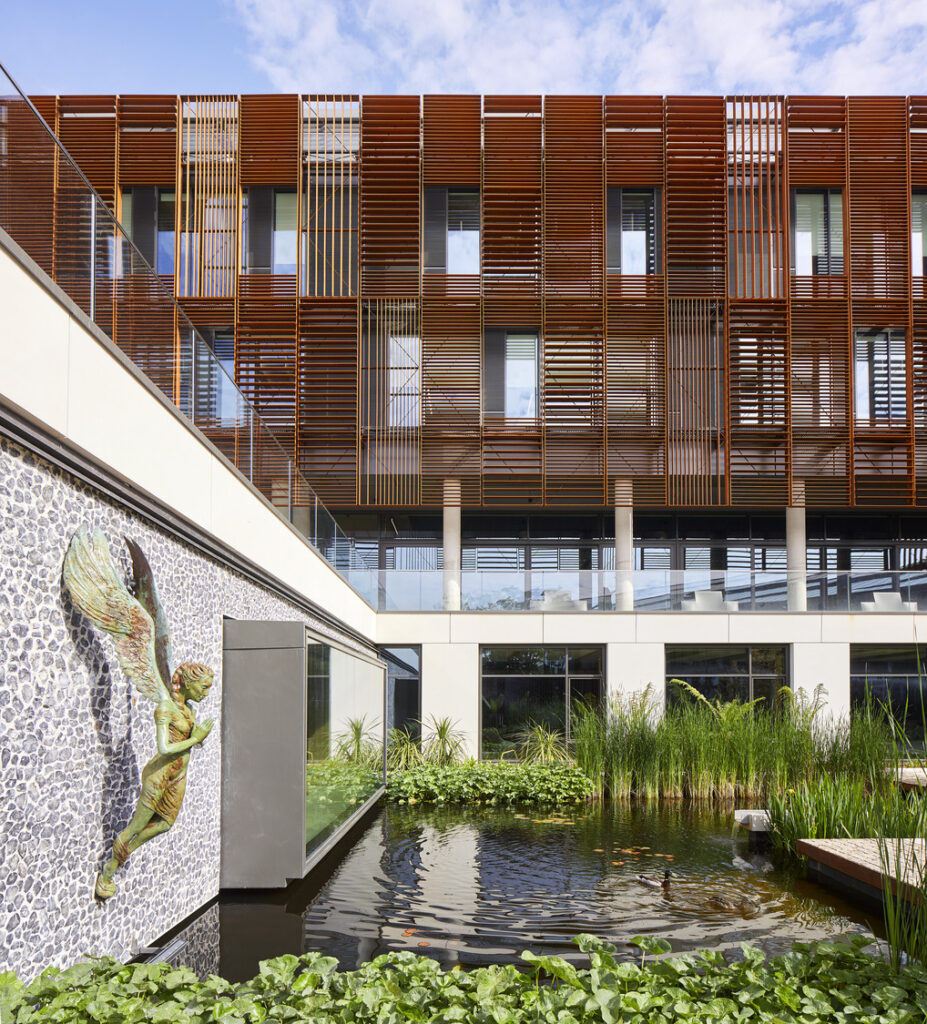
For example at West Downs Centre for University of Winchester, DEA encouraged the potential for civic presence & community use. The building forms create positive outdoor spaces and routes that connect to the city, sensitively set into topography and around mature trees. The building promotes public access. An art gallery, theatre hosting
community events, cafes, and gardens are accessible to all.
We would welcome opportunities to be involved in future projects with independent assessment of social and wider value from the outset, to positively influence processes and provide greater real-world measures of design quality.
3. Do the majority of your projects promote equity in society, and consider all people, not only the building inhabitants? For example, do your projects show due regard for workers within the supply chain and take active steps to avoid modern slavery?
We work to create places for all people.
In wider regard to those involved in constructing places, it is incumbent on all involved in procurement and supply chains to play their part in tackling Modern Slavery and wider fair employment practice in construction. We recognise that we can improve our practice as architects and building professionals: to positively influence the procurement processes that we are involved with.