
Submission by OOBE.
Being a good ancestor
Practice
1. Does the practice have a clearly stated purpose aligned with the planetary emergency? We are looking for a bold ambition here, and a practice culture which recognises the need for long-term thinking. For example, a strong mission, a theory of change, or a sustainability roadmap.
OOBE’s sustainability strategy is anchored by six core pillars: education, health and wellbeing, leadership, consumption, climate, and design. These pillars guide our business and project work toward balancing people and the environment. To support this, we developed our design principles to deliver this promise on every project. Driven by our Environmental, Social, and Governance, we develop these pillars year on year. Education empowers us to live sustainably, protecting people and the environment. Health and well-being succeed in connection with nature. Leadership drives innovation for a sustainable future. We minimise consumption to respect our spaces. Climate resilience is at our core, using nature as our guide. Our designs prioritise people and the planet, creating beautiful, high-quality landscapes.
2. Does the practice have a clear succession plan, which passes on ownership and protects the values and legacy of those who built and contributed to the practice? For example is the practice an employee owned trust.
No.
3. Does the practice share research and knowledge for the benefit of society and the wider world? For example, you regularly carry out post occupancy evaluation and share information with others.
We firmly believe that education is the cornerstone of a more sustainable future. To this end, we host Knowledge Shares to introduce clients and collaborators to key principles such as biophilia, urban greening, biodiversity net gain and sustainable urban drainage (SuDS). By sharing our knowledge, we aim to enthuse others to join us in our mission for a greener, more resilient built environment.
OOBE supports our local universities and is committed to hosting design graduates throughout the year. As part of our social value, we hold talks and workshops at schools to inspire the next generation of designers. Our team speak at events, write articles and blogs and hosts site walks to explain our ethos and project work. We also set an example to others by volunteering at beach litter picking and local tree planting days.
Project
1. Does the practice advocate for long-term thinking at the outset of projects? Do you initiate projects with long-term thinking and challenge the client on design life? Also, can the practice demonstrate that this approach has worked – with a shorter or longer design life, or an innovative approach to financing or payback period?
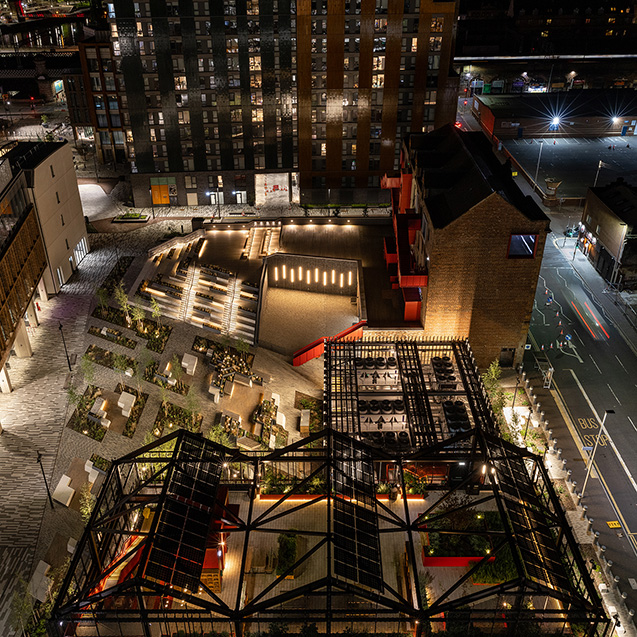
OOBE has demonstrated a strong commitment to sustainability across its projects. The Blindwells Masterplan showcases sustainable design, green and blue infrastructure, wildlife corridors, renewable energy sources, and community engagement. Dragonfly Plot 4 at Barclays Campus prioritises biodiversity, gender-sensitive placemaking and sustainable design & construction. The Spine in Paddington focuses on BREEAM standards, salutogenic and biophilic design. The Biosphere in Newcastle is a flagship project for biodiversity and climate resilience showcasing OOBE’s leadership in sustainable landscape architecture.
2. Do your projects take account of the future climate and the need for resilience? For example, do the projects demonstrate flexibility, design for adaptation, design for disassembly, non-deterministic solutions, or demountable structures.
Yes.
3. Do the majority of your projects go beyond mitigating negatives and towards optimising positives? For example, are they meeting or exceeding the RIBA 2030 Challenge.
Yes, no.
Co-evolving with nature
Practice
1. Does the practice use biophilia within the office or regularly host meetings and retreats in natural settings? For example do you have extensive planting within the office or rely on natural patterns and imagery for stress relief or quiet areas.
We’re firm believers in bringing the outdoors in and actively getting out there ourselves. Our Edinburgh office, for example, is absolutely bursting with greenery – we even grow our own chillies and tomatoes right in the windows! We’ve also ensured our offices are nestled right by nature, with Newcastle just a stone’s throw from the canal and woodlands. In Edinburgh, we actively encourage our team to take lunch breaks and explore the Water of Leith or our lovely local gardens. We’ve also incorporated quiet breakout spaces, perfect for moments of calm. Our last team day perfectly showcased this commitment; we spent it on a stunning Northumberland beach, where we also participated in a beach clean.
2. Can the practice share examples where it has considered nature in decision making? For example by having a nature proxy to encourage eco-centric decision making, using natural systems as inspiration for the company structure, recognising the seasonal nature of people’s capacity and workload or celebrating equinoxes and solstices together.
No.
3. Is the practice supporting nature locally and nationally? For example, does the practice support local gardens, gardeners, planting programmes, rewilding programmes or advocate for changes in legislation to protect nature.
OOBE has made significant investments in the past year to enhance our supply chain management. We have refined our systems and fostered stronger relationships with local suppliers. This investment allows us to work closely with our supply chain, identifying opportunities to reduce our environmental impact, support local economies, and ensure the highest quality materials and services are used in our projects. We also advocate the sourcing of British-grown planting to help with bioresilliance.
Project
1. Can the practice demonstrate projects which strive to match the performance of a mature ecosystem? As a minimum this would mean achieving biodiversity net gain.
OOBE has demonstrated a strong commitment to sustainability across its projects. The Blindwells Masterplan showcases sustainable design, green and blue infrastructure, wildlife corridors, renewable energy sources, and community engagement. Dragonfly Plot 4 at Barclays Campus prioritises biodiversity, gender-sensitive placemaking and sustainable design & construction. The Spine in Paddington focuses on BREEAM standards, salutogenic and biophilic design. The Biosphere in Newcastle is a flagship project for biodiversity and climate resilience showcasing OOBE’s leadership in sustainable landscape architecture.
2. Is the practice working on material stewardship? For example, evidence could be shown through repeated use of low carbon materials, extensive material libraries and research or publications supporting responsible use of materials and elimination of waste.
At OOBE, we actively champion material stewardship. We consistently utilise low-carbon materials such as sustainably sourced UK-grown Douglas Fir and Larch timber, recognising their long lifespan and minimal environmental impact. Our commitment extends to innovative solutions like steel planters, which contain around 80% recycled content and eliminate the need for concrete foundations, significantly reducing embodied carbon.
We actively research and integrate materials that support circular design principles. For example, on Beco Dragonfly Plot 4 the Weinerberger paving can be lifted and reused, directly impacting whole-life carbon emissions. This aligns with our core philosophy of eliminating waste. Our projects contribute to BREEAM Excellent ratings, particularly in the ‘Materials’ category, and align with NPF4 policies on tackling climate change and revitalising brownfield land. Through our BIM-enabled environment, we deliver data-rich, sustainable landscapes that embody responsible material use, creating lasting value for both clients and the community.
3. Do the majority of projects demonstrate the use of biologically-inspired approaches such as Bioregionalism, Biophilia, Biomimicry, Ecomimicry (also referred to as Ecosystems Thinking, Industrial Ecology or Industrial Symbiosis) or BioTRIZ?
Our designs are inspired by nature’s cyclical process – we do more with less. OOBE’ s expertise in masterplanning allows us to integrate sustainability at a larger scale. By focusing on ecological enhancement, habitat restoration and native planting, OOBE designs landscapes that require less maintenance, thus reducing resource consumption over time. We incorporate biophilia principles into our projects. By incorporating natural elements and materials indoors, it fosters a deeper connection with the outdoors, leading to a healthier and happier experience. OOBE has world-class experience with this at The Spine
Recent projects we have been involved in that include such elements are:
- The R&A HQ Project, St Andrews
- Blindwells Masterplan
- University of Salford Health & Society Campus
- Pilgrim Quarter, Newcastle
- South Lanarkshire Parks Masterplan
- Telford Station Quarter
- Rushford Court, Durham University
- Oaklands College, Hertfordshire
- Lincolnshire Lakes
Creating a just space for people
Practice
1. Does the practice have a progressive EDI policy and can you evidence many forms of diversity, which are welcomed and acknowledged, within the practice?
OOBE celebrates the remarkable women integral to our team and the landscapes we create. We are proud that 54.5% of our team (12 out of 22 members) are women, reflecting our commitment to diversity in landscape architecture. It is especially inspiring to see seven women in senior roles, leading complex projects and making significant contributions to our business growth. Their leadership illustrates the immense value women bring to this industry.
OOBE fosters a team culture of social responsibility through active volunteering and fundraising for local charities. Our commitment to quality and environmental management is underscored by the team achieving ISO 9001 and 14001 accreditations.
2. Does the practice operate a no overtime culture, meet the living wage consistently, and stipulate a fair salary ratio between staff of all levels?
We are committed to fostering a supportive and rewarding environment for our team. Our use of CMap software is designed to resource projects effectively, aiming to ensure workloads are manageable and minimise the need for excessive additional hours. We understand the importance of work-life balance and continuously strive to achieve it for our staff.
We are Living Wage accredited, demonstrating our commitment to consistently paying all our employees a wage that genuinely meets the cost of living. This isn’t just a policy; it’s a fundamental aspect of our commitment to our team’s financial well-being. We believe in fair remuneration across all levels. Our salaries are reviewed annually, and we are recognised within the industry for providing high salaries that reflect the skill and dedication of our staff.
We are proud of our diverse team, which underscores our commitment to equitable career advancement and valuing talent at every level.
3. Does the practice support charities, community groups, social enterprises, action groups and others through pro-bono work, charitable giving or in-kind donations?
As an employer, we continually aim to nurture the skills, ambition, and social diversity of aspiring landscape architects. As part of our community engagement, we often raise awareness of landscape architecture and related professions among a wide range of school-age young people.
On projects such as Blindwells (Edinburgh) and Littlehaven, we have commissioned and worked with local artists to produce locally responsive artworks that enrich these sites’ public realm and neighbourhoods.
We have tutored students at local universities in landscape architecture alongside our professional roles; for example, regional director Chris Shiels has tutored at the University of Edinburgh on Landscape Design for Health and Wellbeing. We also provide roles to students pursuing a career in landscape architecture. Following successful site tours with students, we are seeking to deepen our relationship with local universities.
4. Does the practice publicly refuse to work with certain clients, suppliers or organisations on ethical grounds?
No.
Project
1. Do the projects demonstrate deep engagement with local stakeholders and end users? For example, is there evidence that your project engagement goes beyond consultation towards co-design?
Recently, we participated in Auchinairn ‘ Big Build’ (East Dunbartonshire), where we shared our knowledge of landscape architecture with secondary school pupils as part of a collaboration between architects, engineers, and contractor Morgan Sindall. This programme is for students selected because they are interested in future employment in design and construction.
At Faifley Community Campus (West Dunbartonshire), we have recently worked with Morrisons Construction and local primary school’ pupils to help them design an allotment space in their neighbourhood.
As part of delivering social value, we propose that local students interested in working in design and construction should be invited to a site walk during the project to gain a deeper understanding of construction site processes and the roles of the different professionals involved.
2. Do your projects create connected and resilient places which positively contribute to their neighbourhoods and allow equality of access? For example, do your projects create economic opportunity, retain value locally and generate social value?
Our approach to project design involves residents, users, and members of affected communities in active and structured ways. Methods include public consultation and community engagement practices from surveys and interviews to design workshops and feedback sessions.
Evidence and impacts are integrated into the relevant RIBA stage report to inform design development. This approach enables us to deliver places that meet end users’ needs and facilitate community interaction, build local place-based agency and ownership of the scheme, and promote health and well-being.
At an ‘everyday scale’ we seek to minimise disruption and negative impacts on the local community by providing mitigation measures and alternative routes to ensure the welfare of users. We recognise that many of our public engagements are part of the planning process. We are committed to expanding and deepening our engagement practice across all design stages where this offers positive social impact.
3. Do the majority of your projects promote equity in society, and consider all people, not only the building inhabitants? For example, do your projects show due regard for workers within the supply chain and take active steps to avoid modern slavery?
Yes.