
Submission by Orms Designers and Architects.
Being a good ancestor
Practice
1. Does the practice have a clearly stated purpose aligned with the planetary emergency? We are looking for a bold ambition here, and a practice culture which recognises the need for long-term thinking. For example, a strong mission, a theory of change, or a sustainability roadmap.
As a Certified B Corporation, our purpose is to create outstanding buildings that are forever generous and hold genuine resonance; whilst addressing the planetary emergency by designing within planetary boundaries. Orms has amended our Articles of Association to recognise environment and society as key stakeholders, legally embedding our commitment to environmental and social regeneration.
Our practice embraces long-term thinking through:
- Our 2019 “Sum of All Parts” roadmap embedding regenerative mindset questions in everyday practice, alongside a specific carbon reduction roadmap
- Carbon reduction pathway which includes a Commitment to UN Race to Zero with SBTi verified targets and following the Oxford Principles. As well as moving to offices to a fossil fuel free building.
Our Ultra Practice principles of Deep Assignments and Custodianship help shape architecture fit for an accelerated age. Focusing on retrofit and collective action we pioneer circular economy through open-source materials passports, supplier takeback schemes, and forensic analysis of existing structures, reinforced by practice-wide climate literacy initiatives.
2. Does the practice have a clear succession plan, which passes on ownership and protects the values and legacy of those who built and contributed to the practice? For example is the practice an employee owned trust.
Orms is now 40 years old and has always maintained a progressive approach to succession planning. Our transition to an Employee Ownership Trust in 2018 honoured our founders’ vision while creating a more equitable pathway to senior leadership. With 80% of shares held by employees through the EOT as majority shareholder, we’ve ensured the practice’s future is able to continually evolve and remains in the hands of those who contribute to its success.
Our 2024 B Corp certification reflects our ethical culture and represents a natural evolution in our commitment to continual improvement. We distribute annual profit shares to all staff with 12+ months of service through a transparent points system based on tenure and salary. Additionally, our Employee Ownership Council empowers collective decision-making on vital topics including EDI, staff benefits, and office culture, ensuring our values continue to guide our growth while allowing new voices to shape our future.
3. Does the practice share research and knowledge for the benefit of society and the wider world? For example, you regularly carry out post occupancy evaluation and share information with others.
Orms actively contributes to industry knowledge through the Architect’s Mental Wellbeing Forum and participation in cross-practice Sustainability and Technical Leads peer groups. We’ve been actively involved in developing and advocating for the UK Net Zero Building Standard, sponsoring the work, providing a technical project manager and committing four projects to the pilot phase to demonstrate implementation pathways. We lead a hybrid Materials Passports working group for UK and international practitioners, fostering wider adoption through shared approaches. In 2024 we released a white paper with Lancaster University on accelerating material passports. This has led to collaborative projects with developers, institutions and suppliers to demonstrate this research in action, including recent work with the Stone Federation to develop reuse pathways. Knowledge sharing extends through conference presentations, university lectures, and annual volunteering for Open City programmes including Open House and Architecture in Schools, making architectural knowledge accessible to diverse audiences.
Project
1. Does the practice advocate for long-term thinking at the outset of projects? Do you initiate projects with long-term thinking and challenge the client on design life? Also, can the practice demonstrate that this approach has worked – with a shorter or longer design life, or an innovative approach to financing or payback period?
We consistently advocate for long-term thinking at project inception, introducing comprehensive Whole Life Carbon assessments early to quantify impacts beyond practical completion through multiple tenant cycles. This evidence-based approach challenges conventional client thinking by demonstrating how initial decisions affect long-term value.
Our 75 London Wall project exemplifies this approach. By implementing early strip-out strategies, we achieved “significant reuse” of 372 tonnes representing over 85,000 items. This project, described by our client as a “Super Prime offer,” demonstrates how reuse becomes a key factor in investment decisions.
The investment case showed a compelling differential between market average rental returns and Super Prime figures, proving that long-term thinking creates value. Our regenerative mindset balances upfront carbon costs against embodied impacts, circularity potential, and lifecycle performance, resulting in buildings with extended useful lives and improved returns.
2. Do your projects take account of the future climate and the need for resilience? For example, do the projects demonstrate flexibility, design for adaptation, design for disassembly, non-deterministic solutions, or demountable structures.
All our projects undergo our sustainability toolkit process, which tracks sustainability outcomes throughout design stages using a holistic approach built upon RIBA guidance and the climate framework. This process specifically identifies climate resilience and adaptation strategies for each project. We’ve implemented daylighting and overheating software to equip architects with data-driven tools for informed early design decisions.
Our Customs House project exemplifies our resilience approach. After discovering historical evidence of external blinds in archival imagery and identifying remaining blind boxes on-site, we reintroduced this adaptable feature. Beyond preserving historical character (of the grade I listing), these blinds provide critical solar shading, a passive cooling strategy essential for future climate scenarios. Through rigorous testing, we determined that 35-degree angled blinds covering 50% of windows deliver optimal shading without projecting beyond portico columns. This solution demonstrates our commitment to flexible, adaptable designs that respond to both heritage considerations and climate resilience requirements.
3. Do the majority of your projects go beyond mitigating negatives and towards optimising positives? For example, are they meeting or exceeding the RIBA 2030 Challenge.
We consistently push beyond mitigating negatives to optimise positive outcomes across our portfolio. We’re benchmarking all projects against the UK Net Zero Carbon Buildings Standard, with four projects participating in the official pilot testing program to ensure our designs are future-ready. Our supplier engagement has yielded significant circular economy achievements: 32,019 tiles from four projects returned to SAS for reuse, 243 tonnes of high-grade glass recycled with Saint-Gobain, 9,325 light fittings salvaged for reuse, and reclaimed raised access flooring implemented across nearly all projects. To maintain momentum, we’ve established a toolkit process facilitating cross-project knowledge sharing, ensuring successful innovations become standard practice. Each project team identifies and tracks “one big thing” they’re doing differently, embedding continuous improvement into our workflow.
Co-evolving with nature
Practice
1. Does the practice use biophilia within the office or regularly host meetings and retreats in natural settings? For example do you have extensive planting within the office or rely on natural patterns and imagery for stress relief or quiet areas.
Our practice has integrated biophilic principles into our workplace design and operations. Our office features natural materials like timber joinery and strategically placed plants throughout shared spaces, enhancing air quality and wellbeing. Acoustic materials and soft curtains create a gentle, comfortable atmosphere with designated quiet areas for focused work.
We cherish our visual connection to nature through windows overlooking neighbouring parks, positioned just above the tree canopy, allowing us to witness seasonal changes throughout the year. Our outdoor terraces serve as social and working spaces, with plans to enhance them with additional plantings this year.
Our commitment extends to composting systems and encouraging outdoor activities through softball tournaments, football matches, and summer outings like our trip to Norwich, where we enjoyed the Sainsbury Gallery grounds. We’re cultivating a workplace that actively celebrates our connection to nature.
2. Can the practice share examples where it has considered nature in decision making? For example by having a nature proxy to encourage eco-centric decision making, using natural systems as inspiration for the company structure, recognising the seasonal nature of people’s capacity and workload or celebrating equinoxes and solstices together.
Nature guides our practice through multiple integrated approaches. Our climate literacy program embeds regenerative thinking into our everyday culture, influencing how we instinctively make decisions.
We’ve adopted a systems thinking approach that “recognises interconnectedness” understanding that improvements in one area may create co-benefits or require thoughtful trade-offs. This perspective helps us develop solutions that are ambitious, achievable, and actionable.
Our B Corp certification formally designates the planet as a key stakeholder in our decisions, embedded in our articles of association. We call our approach “Ultrapractical architecture,” which guides our design philosophy to be generous and exceed conventional sustainability standards. Our sustainability team participated in a camping retreats in Somerset last year, connecting with nature while exchanging ideas with industry peers. These initiatives create feedback loops that strengthen our collective ecological intelligence, ensuring everyone contributes their unique skills to our practice..
3. Is the practice supporting nature locally and nationally? For example, does the practice support local gardens, gardeners, planting programmes, rewilding programmes or advocate for changes in legislation to protect nature.
No.
Project
1. Can the practice demonstrate projects which strive to match the performance of a mature ecosystem? As a minimum this would mean achieving biodiversity net gain.
The majority of our projects are central London sites with very little biodiversity present in the existing conditions. Our designs strive to significantly improve greenspace on site whilst ensuring that biodiversity is prioritised. Our approach acknowledges the unique challenges of urban environments and aims to create viable ecosystems within these constraints.
At 75 London Wall, an existing building in the City of London which we are retrofitting, there is very little biodiversity on site currently (0.04 habitat units). Our proposals will generate a remarkable 3026% increase in biodiversity, equating to 1.08 habitat units through the addition of extensive biodiverse green roofs, intensive roof gardens, and strategic tree planting. These interventions are carefully designed to create layered habitats that support diverse species.
We incorporate native planting schemes, create microhabitats, and design interconnected green spaces that facilitate wildlife movement through the urban landscape, contributing to broader ecological networks within the city.
2. Is the practice working on material stewardship? For example, evidence could be shown through repeated use of low carbon materials, extensive material libraries and research or publications supporting responsible use of materials and elimination of waste.
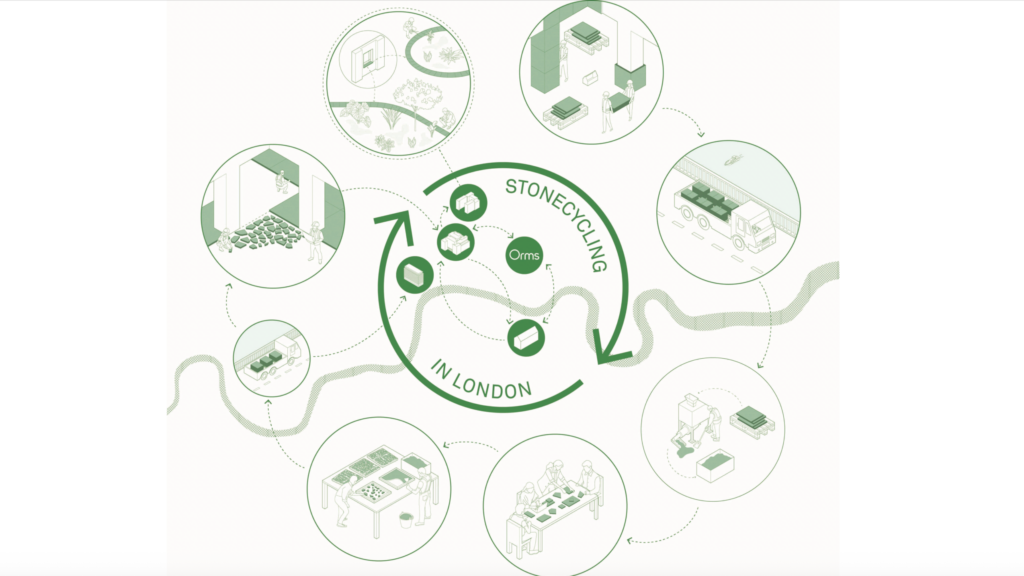
Our practice champions material stewardship through our pioneering Materials Passports initiative, creating a scalable, open-source approach for both existing and new materials. This framework derisks material reuse through comprehensive data collection during design and construction phases. Since publishing our initial methodology in 2021, we’ve established an industry working group and secured UKRI funding in 2023, enabling us to develop a policy paper and expand freely available resources launched in January 2024. Our approach encourages industry transition toward high-quality materials designed for multiple reuse cycles, fundamentally shifting how materials are valued. We actively collaborate with suppliers on practical take-back schemes. Our partnership with SAS established methodologies for ceiling tile reuse, resulting in their formal refurbishment program with new warranties. We’ve returned over 32,000 tiles through this scheme and are developing similar programs for glass, ironmongery, aluminium, and stone reclamation.
3. Do the majority of projects demonstrate the use of biologically-inspired approaches such as Bioregionalism, Biophilia, Biomimicry, Ecomimicry (also referred to as Ecosystems Thinking, Industrial Ecology or Industrial Symbiosis) or BioTRIZ?
No.
Creating a just space for people
Practice
1. Does the practice have a progressive EDI policy and can you evidence many forms of diversity, which are welcomed and acknowledged, within the practice?
Our continuously updated EDI policy is comprehensively introduced during staff inductions, covering equal opportunity statements across age, disability, race, gender, sexual orientation, religion, pregnancy, marriage, ex-offenders, and equal pay. We’ve implemented diverse training for all staff on topics including bias, gender, neurodiversity, and mental health, while senior leadership receives specialized Inclusive Leadership training. As active Architecture Race Forum members, we participate in regular industry discussions.
We’ve improved recruitment diversity by expanding our interviewer pool and agency relationships, offering sponsorship and visa support to international candidates. Our leadership gender balance has significantly improved through targeted development initiatives. We’ve created multiple pathways to architecture through apprenticeships, Part III support, and our Work Experience program specifically targeting students without industry connections. These initiatives collectively support more inclusive access to architectural education and practice, ensuring diverse perspectives inform our design approaches and workplace culture.
2. Does the practice operate a no overtime culture, meet the living wage consistently, and stipulate a fair salary ratio between staff of all levels?
Orms aims to create a positive and healthy working culture for all staff, through active engagement and working with the elected Employee-Owned Council. Presently we have a working hours trial underway, with the key objective to prevent the working of overtime by tackling the upstream causes as a cultural attribute rather than a policy. All staff, team members and leaders are encouraged to discuss workload and working hours, share best practice and to raise issues to mitigate the need for additional working. Where this cannot be avoided, we have specific measures to limit the amount of additional working for a set period and ensure that time off is given following the period.
Orms pays above the London Living wage and has a good fair salary ratio between the highest and lowest paid members of staff.
3. Does the practice support charities, community groups, social enterprises, action groups and others through pro-bono work, charitable giving or in-kind donations?
Our practice supports community engagement through our dedicated internal Giving Back team, which organises fundraising events for organisations including Whitechapel Mission, Felix Project, a Ukrainian School, and Shelter. As foundation donors to the Architects Benevolent Society, we provide sustained financial support alongside additional fundraising initiatives throughout the year. We were founding partners of the London School of Architecture and maintain our commitment through annual financial contributions, student work placements, and design think tank leadership. Through the Designing for the Future programme, we connect with local schools for career talks and educational outreach. We’ve recently implemented an equitable work experience programme to broaden access to architectural careers beyond traditional networks. Our pro-bono contributions extend to leadership roles in community action, with a director volunteering for a temporary accommodation action group in Newham focused on improving user experience for those facing homelessness. This balanced approach combines financial support, knowledge sharing, and direct community involvement.
4. Does the practice publicly refuse to work with certain clients, suppliers or organisations on ethical grounds?
No.
Project
1. Do the projects demonstrate deep engagement with local stakeholders and end users? For example, is there evidence that your project engagement goes beyond consultation towards co-design?
No.
2. Do your projects create connected and resilient places which positively contribute to their neighbourhoods and allow equality of access? For example, do your projects create economic opportunity, retain value locally and generate social value?
No.
3. Do the majority of your projects promote equity in society, and consider all people, not only the building inhabitants? For example, do your projects show due regard for workers within the supply chain and take active steps to avoid modern slavery?
No.