
Submission by ODACE.
Being a good ancestor
Practice
1. Does the practice have a clearly stated purpose aligned with the planetary emergency? We are looking for a bold ambition here, and a practice culture which recognises the need for long-term thinking. For example, a strong mission, a theory of change, or a sustainability roadmap.
We strongly believe that, as structural engineers, we have a critical role to play in developing low-carbon technologies through innovative and efficient design. This principle is central to our business ethos, where our engineers are consistently challenged to deliver highly efficient solutions. In line with this commitment, we invest substantially in research and development of new low-carbon technologies – one such initiative being the Cellular Hybrid Beam, which is currently undergoing testing at the University of Cambridge.
2. Does the practice have a clear succession plan, which passes on ownership and protects the values and legacy of those who built and contributed to the practice? For example is the practice an employee owned trust.
No.
3. Does the practice share research and knowledge for the benefit of society and the wider world? For example, you regularly carry out post occupancy evaluation and share information with others.
As an emerging practice, we dedicate significant resources to the research and development of innovative low-carbon technologies. We are currently collaborating as an industrial partner with the University of Cambridge on the development of a novel long-span timber flooring system, designed to match or exceed the performance of traditional steel and concrete alternatives. Upon completion of the research, we intend to publish the findings in relevant peer-reviewed scientific journals.
Project
1. Does the practice advocate for long-term thinking at the outset of projects? Do you initiate projects with long-term thinking and challenge the client on design life? Also, can the practice demonstrate that this approach has worked – with a shorter or longer design life, or an innovative approach to financing or payback period?
No.
2. Do your projects take account of the future climate and the need for resilience? For example, do the projects demonstrate flexibility, design for adaptation, design for disassembly, non-deterministic solutions, or demountable structures.
We are currently developing an innovative long-span timber floor system designed to be easily dismountable and reusable, offering a sustainable alternative to conventional steel and concrete floor solutions. This system supports a circular economy model and enables the upcycling of reclaimed steel beams, contributing to a more resource-efficient and environmentally responsible construction approach.
3. Do the majority of your projects go beyond mitigating negatives and towards optimising positives? For example, are they meeting or exceeding the RIBA 2030 Challenge.
No.
Co-evolving with nature
Practice
1. Does the practice use biophilia within the office or regularly host meetings and retreats in natural settings? For example do you have extensive planting within the office or rely on natural patterns and imagery for stress relief or quiet areas.
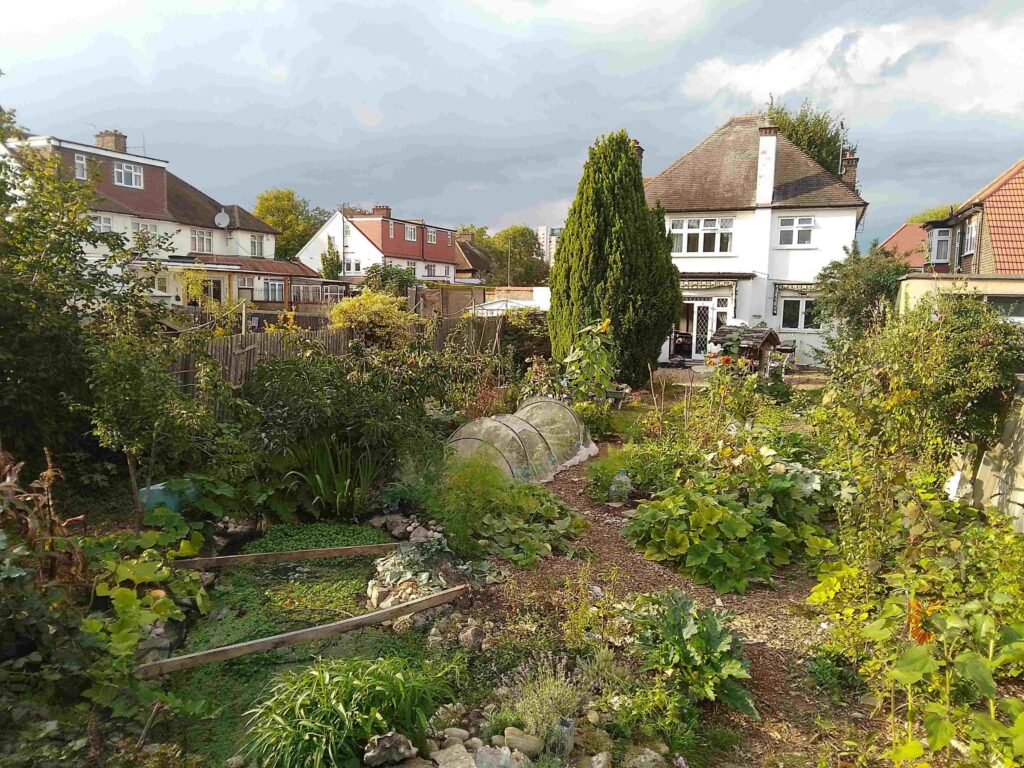
Our home office incorporates a food forest in the back garden. The idea of a food forest is to mimic the different layers of forests and woodlands whilst producing food for human consumption and also for the fauna. We also use this for stress relief.
2. Can the practice share examples where it has considered nature in decision making? For example by having a nature proxy to encourage eco-centric decision making, using natural systems as inspiration for the company structure, recognising the seasonal nature of people’s capacity and workload or celebrating equinoxes and solstices together.
Yes, we use our food forest garden as a demonstrative tool to help clients understand the benefits of growing their own food and to illustrate how microclimates can be cultivated to support the growth of warmth-loving plants such as water melons.
3. Is the practice supporting nature locally and nationally? For example, does the practice support local gardens, gardeners, planting programmes, rewilding programmes or advocate for changes in legislation to protect nature.
We cultivate and propagate fruit trees from our backyard forest garden, which we donate to local schools and neighbors to foster community involvement in food growing and to promote sustainable, locally-based food systems.
Project
1. Can the practice demonstrate projects which strive to match the performance of a mature ecosystem? As a minimum this would mean achieving biodiversity net gain.
Although not a fee-earning project, we transformed our back garden–also home to our office–into a productive forest garden that replicates the layered structure of natural woodland. This space not only yields food for human consumption but also attracts diverse fauna, leading to a significant increase in local biodiversity.
2. Is the practice working on material stewardship? For example, evidence could be shown through repeated use of low carbon materials, extensive material libraries and research or publications supporting responsible use of materials and elimination of waste.
No.
3. Do the majority of projects demonstrate the use of biologically-inspired approaches such as Bioregionalism, Biophilia, Biomimicry, Ecomimicry (also referred to as Ecosystems Thinking, Industrial Ecology or Industrial Symbiosis) or BioTRIZ?
Timber is one of the most frequently specified materials in our structural designs. Where appropriate, we often recommend leaving the timber exposed, both to enhance the biophilic qualities of the space and to reduce the need for additional finishing, offering both aesthetic and cost-saving benefits. Additionally, we offer general guidance on gardening practices and home food cultivation to support sustainable living.
Creating a just space for people
Practice
1. Does the practice have a progressive EDI policy and can you evidence many forms of diversity, which are welcomed and acknowledged, within the practice?
No.
2. Does the practice operate a no overtime culture, meet the living wage consistently, and stipulate a fair salary ratio between staff of all levels?
Yes, we pay over and above the living wage for London.
3. Does the practice support charities, community groups, social enterprises, action groups and others through pro-bono work, charitable giving or in-kind donations?
We have undertaken a number of pro-bono projects for students and other startup firms for the London Festival of Architecture.
4. Does the practice publicly refuse to work with certain clients, suppliers or organisations on ethical grounds?
No.
Project
1. Do the projects demonstrate deep engagement with local stakeholders and end users? For example, is there evidence that your project engagement goes beyond consultation towards co-design?
No.
2. Do your projects create connected and resilient places which positively contribute to their neighbourhoods and allow equality of access? For example, do your projects create economic opportunity, retain value locally and generate social value?
We actively contribute to community-focused projects aimed at enhancing local amenities and improving the quality of the built environment. One such initiative is the Black Barn project in Cambridge – a site that had remained derelict for decades and is now being sensitively developed by a client into a private residence.
Our involvement also includes the refurbishment of the Trinity Theatre in Tunbridge Wells, supporting its long-term economic viability. Currently, we are contributing to the development of a Bird Hide as part of a community project at the Paddock Community and Nature Park.
3. Do the majority of your projects promote equity in society, and consider all people, not only the building inhabitants? For example, do your projects show due regard for workers within the supply chain and take active steps to avoid modern slavery?
Yes, as specifiers we take active steps to reduce risks on site by for instance specifying prefabricated components.