
Submission by Mecanoo International B.V.
Being a good ancestor
Practice
1. Does the practice have a clearly stated purpose aligned with the planetary emergency? We are looking for a bold ambition here, and a practice culture which recognises the need for long-term thinking. For example, a strong mission, a theory of change, or a sustainability roadmap.
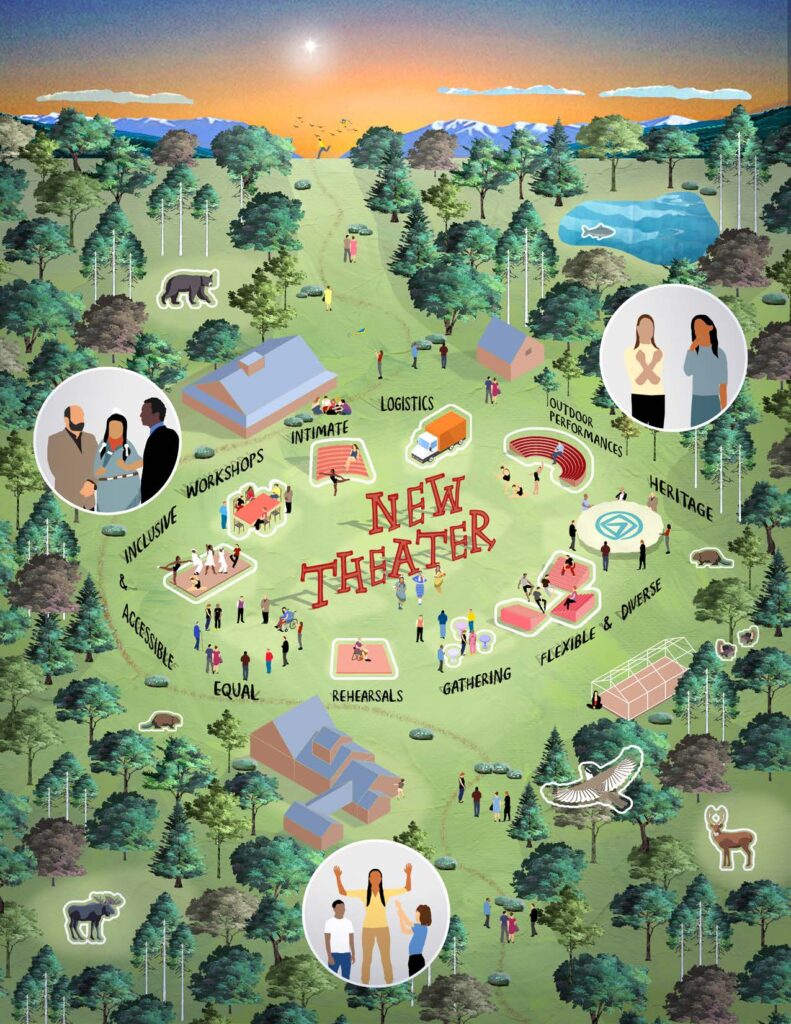
Mecanoo’s mission addresses the planetary emergency through a design philosophy centred on People, Place, Purpose, and Poetry. This holistic approach integrates architecture, landscape, and urbanism to create spaces that are inclusive, regenerative, adaptable, and uplifting. Our long-term sustainability commitment is exemplified by the Doris Duke Theatre at Jacob’s Pillow, which features a mass timber structure, green roof, and rainwater harvesting systems. The design incorporates Indigenous principles – such as a medicinal garden and orientation based on the four directions – fostering a strong connection to land and community. Advanced technologies like spatial audio and infrared tracking support innovative, flexible performances. Mecanoo’s Doughnut framework, inspired by Doughnut Economics, guides our practice by balancing ecological ceilings with social foundations. This model promotes regenerative architecture that supports environmental health, social equity, and future readiness – ensuring our work contributes positively to both people and planet over time.
2. Does the practice have a clear succession plan, which passes on ownership and protects the values and legacy of those who built and contributed to the practice? For example is the practice an employee owned trust.
Mecanoo has proactively implemented a succession plan to ensure the continuity of its values and legacy. In 2022, the firm appointed three new partners – Nuno Fontarra, Rick Splinter, and Arne Lijbers – joining existing partners Francine Houben and Dick van Gameren. This expanded leadership team reflects Mecanoo’s commitment to nurturing internal talent and facilitating a smooth transition of leadership responsibilities.
3. Does the practice share research and knowledge for the benefit of society and the wider world? For example, you regularly carry out post occupancy evaluation and share information with others.
Mecanoo actively shares research and knowledge for the benefit of society and the wider world. Partners regularly lecture internationally, and the office contributes to initiatives such as the Co-Creation Centre and the NoNo House at TU Delft’s Green Village. This living laboratory explores nitrogen-neutral construction using natural materials, nitrogen-absorbing façades, and circular components. Insights from the NoNo House are shared to promote sustainable building and influence policy. Mecanoo also publishes its design philosophy and project experiences through articles, interviews, and monographs, including the a+u publication and the recent publication “People Place Purpose Poetry”. Learning from completed projects is essential to Mecanoo’s approach, with each new project informed by past experiences. Through these efforts, Mecanoo fosters a culture of continuous learning and open knowledge exchange, supporting the evolution of architectural practice and its contribution to societal and environmental wellbeing.
Project
1. Does the practice advocate for long-term thinking at the outset of projects? Do you initiate projects with long-term thinking and challenge the client on design life? Also, can the practice demonstrate that this approach has worked – with a shorter or longer design life, or an innovative approach to financing or payback period?
Mecanoo consistently advocates long-term thinking from the outset of every project. We initiate design conversations by considering not only immediate needs but also how buildings will evolve socially, environmentally, and functionally over time. This approach began early in our practice, notably with the Library at Delft University of Technology (1998). Designed with the digital transition in mind, it continues to meet changing expectations more than two decades later and – featuring a green roof – sparked the transformation of the campus into a park-like setting. Mecanoo has remained engaged, delivering upgrades to learning environments (2008-2011) and office spaces (2015-2016), demonstrating how adaptable design and ongoing collaboration can extend a building’s life and relevance. By integrating energy-efficient systems and low-maintenance materials, we reduce long-term operational costs and environmental impact, ensuring our designs remain both sustainable and economically viable throughout their lifecycle.
2. Do your projects take account of the future climate and the need for resilience? For example, do the projects demonstrate flexibility, design for adaptation, design for disassembly, non-deterministic solutions, or demountable structures.
The Stavros Niarchos Foundation Library (SNFL) in New York is a strong example of Mecanoo’s commitment to climate resilience and adaptability. The project involved the transformation of a 1914 building into a modern, future-ready public library. Key to its design is flexibility – with open, reconfigurable floorplates and demountable furniture systems that allow the space to evolve with changing community needs. The addition of a new rooftop pavilion and terrace not only expands usable space but introduces passive strategies for ventilation and daylight, reducing reliance on mechanical systems. The renovation reused significant portions of the existing structure, aligning with circular principles and reducing embodied carbon. This project demonstrates how adaptive reuse, flexibility, and smart environmental design can deliver a resilient civic space prepared for long-term change – environmentally, socially, and functionally.
3. Do the majority of your projects go beyond mitigating negatives and towards optimising positives? For example, are they meeting or exceeding the RIBA 2030 Challenge.
Mecanoo strives to go beyond mitigating negatives by maximising positive environmental and social outcomes across all projects. The BREEAM Outstanding and WELL Platinum-certified renovation of De Nederlandsche Bank (2025) aligns with the RIBA 2030 Climate Challenge across all four key targets. The project prioritises operational energy efficiency through high-performance insulation, energy-saving systems, and smart controls. By reusing and upgrading the existing structure, it significantly reduces embodied carbon, avoiding emissions from demolition and rebuild. Potable water use is minimised through efficient fixtures and rainwater reuse. The design promotes health and wellbeing with natural light, improved air quality, and accessible green spaces. A new public garden includes lockers for the homeless, while a 6,800 m² public area offers exhibitions to foster education and community connection. This holistic, future-ready approach reflects Mecanoo’s long-term commitment to sustainability and regenerative design.
Co-evolving with nature
Practice
1. Does the practice use biophilia within the office or regularly host meetings and retreats in natural settings? For example do you have extensive planting within the office or rely on natural patterns and imagery for stress relief or quiet areas.
Mecanoo incorporates biophilic design into our daily working environment. Our headquarters in Delft, established by Francine Houben in 1984, is housed in a historic building dating back to 1536. At the heart of the office is an enclosed garden, designed by our in-house landscape architect, which serves as a central biophilic feature. Visible from inside the office, the garden includes a simple pathway, bike shelter, and outdoor furniture where employees can have lunch, hold informal meetings, or participate in activities. This green space provides a natural, calming environment that supports wellbeing and social interaction. It connects directly to our model room, reinforcing the relationship between nature and creativity within our workspace.
2. Can the practice share examples where it has considered nature in decision making? For example by having a nature proxy to encourage eco-centric decision making, using natural systems as inspiration for the company structure, recognising the seasonal nature of people’s capacity and workload or celebrating equinoxes and solstices together.
Nature plays an active role in our decision-making and workplace culture. The enclosed garden at our Delft office provides a natural setting that supports wellbeing, creativity, and informal interaction. When the weather allows, employees use the garden for lunch, casual drinks, or outdoor meetings, reinforcing a seasonal rhythm in how we work and connect. We recognise that creativity doesn’t always happen at a desk – so our workspace encourages movement and flexibility, allowing people to work wherever they feel most inspired, whether in the garden or quieter corners of the office. This informal, eco-aware culture helps us stay connected to natural cycles and fosters a more human, resilient way of working.
3. Is the practice supporting nature locally and nationally? For example, does the practice support local gardens, gardeners, planting programmes, rewilding programmes or advocate for changes in legislation to protect nature.
Mecanoo supports nature both locally and nationally through projects like Habitat Royale. This project demonstrates a deep commitment to regenerative and nature-inclusive design, going beyond sustainability to actively restore ecosystems and increase biodiversity. Located in Amsterdam’s Beatrixpark, Habitat Royale is designed as a biodiversity net gain building. It introduces an abundance of integrated microhabitats, nesting sites, and green corridors that connect with the surrounding landscape, enhancing local ecosystems. Flora and fauna are treated as equal stakeholders in the design process, and the project includes long-term ecological monitoring and natural management strategies to ensure continued biodiversity growth. Mecanoo also uses bio-based materials, green façades, and water recycling systems to support ecological resilience. This holistic approach not only benefits local biodiversity but also serves as a model for nature-inclusive urban development.
Project
1. Can the practice demonstrate projects which strive to match the performance of a mature ecosystem? As a minimum this would mean achieving biodiversity net gain.
Habitat Royale in Amsterdam is a great example. This project is designed to deliver biodiversity net gain, meaning it restores more nature than it displaces. Inspired by mature ecosystems, the building integrates a diverse range of microhabitats, from nesting sites and green façades to water features and varied soil zones that support both flora and fauna throughout all seasons. The design is guided by five ecological principles: connection with the environment, maximum habitat variation, year-round ecological value, learning through monitoring, and natural long-term management. These principles create conditions for complex ecological relationships, echoing the structure and function of natural ecosystems. The project includes ongoing monitoring of flora, fauna, and insect activity, enabling the design to adapt over time. Habitat Royale represents Mecanoo’s commitment to regenerative design that not only reduces impact but actively enhances ecological value.
2. Is the practice working on material stewardship? For example, evidence could be shown through repeated use of low carbon materials, extensive material libraries and research or publications supporting responsible use of materials and elimination of waste.
Mecanoo is deeply committed to material stewardship, embedding circular principles and low-carbon strategies across our projects. For Museum Kaap Skil (2011) on the Island of Texel, we used reclaimed wood for its façades. The recent renovation of De Nederlandsche Bank (DNB), a BREEAM Outstanding-certified project, exemplifies this approach. By preserving and upgrading the existing structure, 70,000 tonnes of building materials were saved, reducing environmental impact by 50% compared to a complete rebuild. Demolition debris was processed into circular concrete and injected with CO2, resulting in CO2 neutral concrete. The renovation has reduced energy consumption and CO2 emissions by more than 80%. Across our practice, we prioritise the use of durable, recyclable, and low-embodied-carbon materials, supported by an evolving internal materials library. Through these efforts, Mecanoo aims to minimise waste and promote regenerative practices, ensuring our designs contribute positively to both the built environment and the planet.
3. Do the majority of projects demonstrate the use of biologically-inspired approaches such as Bioregionalism, Biophilia, Biomimicry, Ecomimicry (also referred to as Ecosystems Thinking, Industrial Ecology or Industrial Symbiosis) or BioTRIZ?
Mecanoo consistently integrates biologically inspired approaches across its projects, drawing from biophilia, bioregionalism, and biomimicry to create regenerative, context-sensitive architecture. Our design philosophy – People, Place, Purpose, Poetry – emphasises the human-nature connection, ecological integration, and long-term adaptability. Our projects often feature green roofs, natural ventilation, and the use of local materials, reflecting principles of bioregionalism and biomimicry. Through these strategies, Mecanoo aims to create environments that not only respect but also enhance the natural world, aligning with the goals of sustainable and regenerative design. An example is The Natural History Museum in Abu Dhabi, which draws inspiration from geological formations, with a design that emulates natural rock strata, fostering a deep connection between visitors and the Earth’s history.
Creating a just space for people
Practice
1. Does the practice have a progressive EDI policy and can you evidence many forms of diversity, which are welcomed and acknowledged, within the practice?
Mecanoo is committed to a progressive Equity, Diversity, and Inclusion (EDI) policy. Our team of 144 people represents 26 nationalities, reflecting the international and inclusive nature of our practice. We currently have 80 male and 64 female employees and are actively working to improve gender balance across all levels.
2. Does the practice operate a no overtime culture, meet the living wage consistently, and stipulate a fair salary ratio between staff of all levels?
Mecanoo is committed to fostering a fair and supportive work environment. We offer competitive salaries, a collective pension plan, and 30 holiday days per year for full-time employees. We prioritise employee well-being and equitable compensation. Our diverse, multidisciplinary team reflects our dedication to inclusivity and fairness across all levels of the organisation. Mecanoo promotes a healthy work-life balance, which is emphasised during the onboarding process. We do not support a culture of regular overtime. While there are occasional instances when overtime is unavoidable, our dedicated project managers and HR team actively encourage employees to take necessary breaks and manage their time well.
3. Does the practice support charities, community groups, social enterprises, action groups and others through pro-bono work, charitable giving or in-kind donations?
Mecanoo actively supports charities, community groups, and social enterprises through pro bono work, charitable giving, and in-kind contributions. Our commitment to social responsibility is integral to our practice. We engage in initiatives that align with our values, offering design expertise and resources to projects that benefit communities and promote inclusivity. By collaborating with various organisations, we aim to create positive social impact and contribute to the well-being of the communities we serve.
4. Does the practice publicly refuse to work with certain clients, suppliers or organisations on ethical grounds?
Mecanoo maintains a strong ethical framework and is committed to responsible practice. We reserve the right to decline work with clients, suppliers, or organisations whose values or operations conflict with our ethical standards – particularly in areas such as human rights, environmental harm, or discriminatory practices.
Project
1. Do the projects demonstrate deep engagement with local stakeholders and end users? For example, is there evidence that your project engagement goes beyond consultation towards co-design?
Mecanoo takes the time to get to know and understand our clients, integrating their expert knowledge at key moments in the process to ensure a well-informed, relevant, and high-quality design. We organise excursions to Mecanoo and other reference projects to share experience and draw meaningful connections with the project, helping to develop a shared spatial reference language. We develop a range of design directions and concepts to respond to specific design parameters, using a variety of media, including models, drawings, and visualisations, to engage the client and stakeholders in meaningful dialogue. Throughout the lifespan of the project, we maintain a continuous exchange of information between the design team, consultants, the client body, and stakeholders.
2. Do your projects create connected and resilient places which positively contribute to their neighbourhoods and allow equality of access? For example, do your projects create economic opportunity, retain value locally and generate social value?
Guided by our philosophy of People, Place, Purpose, and Poetry, Mecanoo designs projects that meet the client’s requirements and the users’ needs (People); respond thoughtfully to the physical context, climate, and culture (Place); and reflect both the current and future potential of a building’s function (Purpose). The outcome is architecture that appeals to all the senses (Poetry), enhances its surroundings, stimulates economic activity, and generates enduring social value.
A good example is Kaohsiung Station in Taiwan (2025), which transforms a transportation hub into a vibrant, inclusive public space. The design introduces a green canopy and sunken plaza, creating year-round gathering areas for the community. Integration with local markets and businesses supports economic resilience and retains value within the neighbourhood. Developed through close collaboration with the local community, the station reflects collective needs and identity, delivering social value that extends far beyond its role in mobility.
3. Do the majority of your projects promote equity in society, and consider all people, not only the building inhabitants? For example, do your projects show due regard for workers within the supply chain and take active steps to avoid modern slavery?
We recognise that architecture does not exist in a vacuum and take our responsibility across the full project chain seriously. While we cannot control every aspect of the supply chain, we actively collaborate with clients, contractors, and partners who share our values of ethical sourcing, fair labour, and sustainability. We promote transparency in procurement and encourage the use of certified materials that meet fair labour standards. We support and comply with policies aimed at eliminating modern slavery and human rights abuses in construction and manufacturing. Where relevant, we work with supply chains aligned with modern slavery legislation and ethical labour practices, and we advocate for these principles in all partnerships. We collaborate with trusted teams and monitor sourcing to ensure materials and processes remain free from exploitation.