
Submission by Leonard Design.
Being a good ancestor
Practice
1. Does the practice have a clearly stated purpose aligned with the planetary emergency? We are looking for a bold ambition here, and a practice culture which recognises the need for long-term thinking. For example, a strong mission, a theory of change, or a sustainability roadmap.
At Leonard Design we have had a sustainability focus group Leonard Green since 2019.
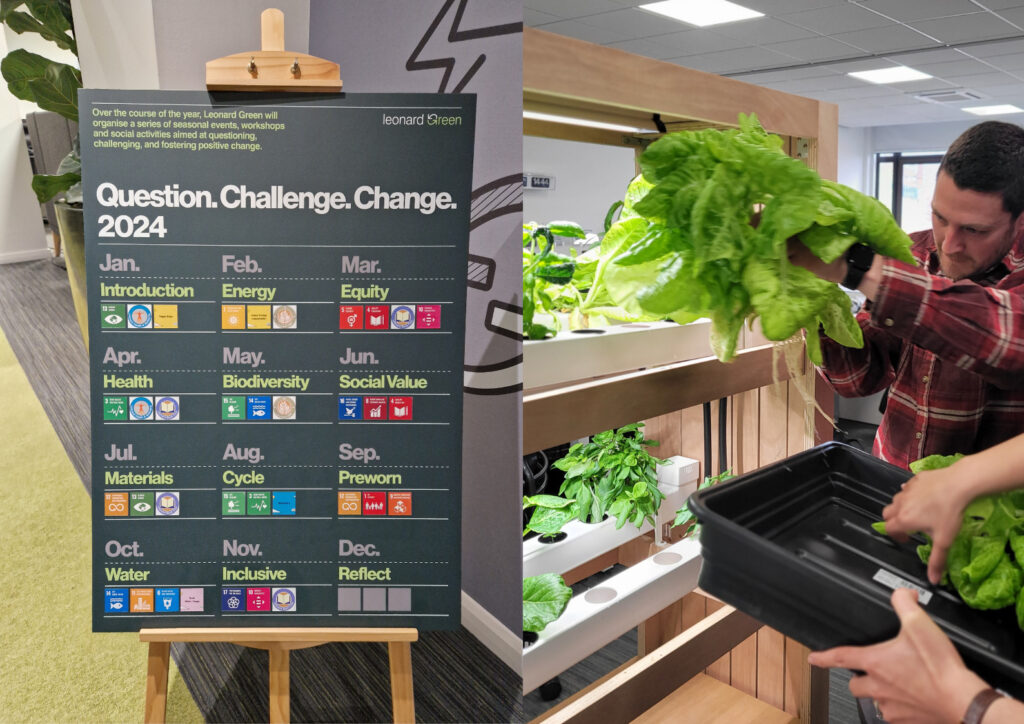
In 2024, Leonard Green started an initiative called Question, Challenge, Change, with regular talks, workshops and events on the topics of sustainability aimed at questioning, challenging and fostering positive change. Using the United Nations Sustainable development goals as a framework Leonard Green create a calendar with seasonal monthly themes linked to energy and carbon, biodiversity and social change. Monthly initiatives are devised to demonstrate our impact as individuals, a company and a design practise.
2. Does the practice have a clear succession plan, which passes on ownership and protects the values and legacy of those who built and contributed to the practice? For example is the practice an employee owned trust.
The company is owned by three directors, each holding between 25% and 50% ownership, giving them significant control.
In the event of a director’s departure due to retirement, resignation, or unforeseen circumstances, the remaining directors will oversee a structured transition process. They will have the first right to acquire the departing director’s shares, maintaining balanced ownership and stability. If no internal buyout occurs, an external candidate or investor may be considered, subject to approval by the remaining directors.
3. Does the practice share research and knowledge for the benefit of society and the wider world? For example, you regularly carry out post occupancy evaluation and share information with others.
Members of Leonard Green played a key role in founding a regional sustainability action group, the East Midlands Sustainability Partnership. As part of the core team, we help organise and host monthly networking events that bring together construction professionals committed to driving positive environmental change. Each month, we pass the baton to a different industry expert or organisation to lead discussions, share insights, and explore the pressing sustainability challenges facing the built environment. This collaborative and evolving platform fosters knowledge exchange and community-led progress across the sector.
To learn more, visit: https://emsustainabilitypartnership.wordpress.com
Project
1. Does the practice advocate for long-term thinking at the outset of projects? Do you initiate projects with long-term thinking and challenge the client on design life? Also, can the practice demonstrate that this approach has worked – with a shorter or longer design life, or an innovative approach to financing or payback period?
Leonard Design is known for its strategic, client-focused approach, embedding long-term thinking from the outset of each project. This may involve exploring temporary or modular solutions in place of immediate construction, or proposing flexible and adaptable buildings designed to last.
On a recent large-scale film and television studio project, we challenged industry norms by advising the client to deliver a turnkey office fit out rather than the usual CAT A shell. Despite the short-term nature of typical tenancies in this sector, we specified robust, hard-wearing finishes to reduce the waste and inefficiency of repeated tenant-led fit outs and reinstatements.
This approach supported both environmental and economic goals and reflects a broader challenge we are also addressing in the retail sector – where frequent interior refurbishments are common. By advocating for adaptable, sustainable solutions, Leonard Design is helping clients reduce waste, increase long-term value, and future-proof their investments.
2. Do your projects take account of the future climate and the need for resilience? For example, do the projects demonstrate flexibility, design for adaptation, design for disassembly, non-deterministic solutions, or demountable structures.
Leonard Design takes climate resilience seriously, embedding flexibility, adaptability, and sustainability strategies into projects. Designs often allow for future adaptation through loose-fit planning, enabling spaces to evolve with changing needs and changing climate conditions. The practice incorporates design for disassembly and circularity, using modular, prefabricated, and durable materials that support reuse and minimise waste. Demountable structures are used where appropriate – particularly in meanwhile uses or dynamic commercial environments – offering versatility in uncertain futures. Leonard Design also explores non-deterministic design solutions, avoiding fixed outcomes and allowing clients to reinterpret spaces over time. Climate-responsive strategies such as passive design, sustainable drainage, and green infrastructure further enhance resilience. Sheffield’s successful grey to green which is part of Leonard Designs Heart of the City 2 is an example of this we are proud of. This holistic approach ensures projects are not only future-proofed but also aligned with environmental goals, offering long-term value and reduced lifecycle impact.
3. Do the majority of your projects go beyond mitigating negatives and towards optimising positives? For example, are they meeting or exceeding the RIBA 2030 Challenge.
No.
Co-evolving with nature
Practice
1. Does the practice use biophilia within the office or regularly host meetings and retreats in natural settings? For example do you have extensive planting within the office or rely on natural patterns and imagery for stress relief or quiet areas.
Both of our offices have beautiful hydroponic planting systems, which members of our team designed, built and now nurture to provide fresh salad and herbs to all staff members. This benefits wellbeing four fold through sensory biophilia, healthy eating, zero food miles and also fantastic organised or impromptu social opportunities.
2. Can the practice share examples where it has considered nature in decision making? For example by having a nature proxy to encourage eco-centric decision making, using natural systems as inspiration for the company structure, recognising the seasonal nature of people’s capacity and workload or celebrating equinoxes and solstices together.
No.
3. Is the practice supporting nature locally and nationally? For example, does the practice support local gardens, gardeners, planting programmes, rewilding programmes or advocate for changes in legislation to protect nature.
The practice actively supports nature through innovative urban greening initiatives and collaborative projects that enhance biodiversity and sustainability. We have run numerous workshops and built community gardens pro-bono for local community organisations.
Parklets Nottingham, an initiative that brought together specialists to design and construct a modular parklet in Nottingham City Centre. By sourcing 100% recycled plastic and selecting hardy plant varieties suited for an urban environment, the project created a valuable community space with minimal environmental impact. One of these community gardens provides fresh ingredients to the kitchen of a college culinary school and highlights a commitment to reducing food miles and fostering sustainability. The concept is highly adaptable and has also been in the Meadows area, where collaboration with Green Meadows and local residents led to the creation of a parklet tailored to a shopping precinct. These efforts reflect our dedication to environmental stewardship, advocating for urban rewilding.
Project
1. Can the practice demonstrate projects which strive to match the performance of a mature ecosystem? As a minimum this would mean achieving biodiversity net gain.
At Leonard Design, we collaborate closely with a network of talented landscape architects and designers to deliver integrated, sustainable environments. As a standard, we aim to exceed 10% biodiversity net gain across all projects, recognising the critical role landscape plays in ecological and community resilience. Notable examples of our collaborative success include the Grey to Green initiative in Sheffield and the Nottingham Parklets project – both of which have contributed meaningfully to the enhancement of regional urban spaces. We are particularly passionate about edible landscapes and actively seek opportunities to work with partners such as Penny from the Nottingham Good Food Partnership to promote community-based, sustainable food systems. Our in-house experimentation with hydroponics has also led to a forward-thinking collaboration with Square Mile Farms, where we designed and coordinated the integration of advanced hydroponic systems into a high-profile global HQ – bringing innovative growing solutions into the heart of the workplace.
2. Is the practice working on material stewardship? For example, evidence could be shown through repeated use of low carbon materials, extensive material libraries and research or publications supporting responsible use of materials and elimination of waste.
Within the Leonard Green group, we have a dedicated team that supports the wider practice by sharing expertise and guiding material selection to enhance sustainability outcomes. This team actively promotes the use of bio-based materials wherever feasible and provides insight into embodied carbon implications to inform early design decisions. Following the evaluation of various embodied carbon assessment methods, we are now focused on developing a Stage 2 materials options matrix. This tool will help project teams compare and propose practical material substitutions aimed at reducing reliance on carbon-intensive products, ensuring that sustainability is embedded from the early stages of design. We would love to collaborate with other local practices and Universities to create a shared materials library, this is something we are investigating through our East Midlands Sustainability Partnership.
3. Do the majority of projects demonstrate the use of biologically-inspired approaches such as Bioregionalism, Biophilia, Biomimicry, Ecomimicry (also referred to as Ecosystems Thinking, Industrial Ecology or Industrial Symbiosis) or BioTRIZ?
No.
Creating a just space for people
Practice
1. Does the practice have a progressive EDI policy and can you evidence many forms of diversity, which are welcomed and acknowledged, within the practice?
Leonard Design fosters an inclusive and progressive workplace through a comprehensive EDI policy that prioritises fairness, transparency, and representation. The practice actively eliminates discrimination while promoting diverse hiring, equitable career progression, and a supportive environment for all staff, clients, and stakeholders.
A dedicated EDI group runs initiatives focused on equal opportunities, unconscious bias, neurodivergence, and gender representation. The team is developing an EDI policy toolkit guiding systemic change within the office and projects, ensuring safe and equitable practices. Monthly meetings enable continuous improvement, shaping policies aligned with the RIBA Inclusion Charter.
Leonard Design welcomes diversity across its workforce, with employees representing 12 nationalities and a gender balance of 60% men and 40% women. The practice also celebrates key religious events, reinforcing its commitment to cultural inclusivity. Through mentorship, staff training, and industry advocacy, Leonard Design embeds EDI principles into every facet of its work and organizational culture.
2. Does the practice operate a no overtime culture, meet the living wage consistently, and stipulate a fair salary ratio between staff of all levels?
We support policies and initiatives that promote a healthy work-life balance, recognising its importance for overall wellbeing and productivity. In a bold stride towards redefining the conventional workplace landscape, Leonard Design initiated a shift in 2016 to the liberating concept of “Open Leave.” Providing empowerment, accountability, and mutual support, our staff embrace the autonomy to manage their leave, aligning it with their workload and professional commitments, with no restriction on the number of holidays taken each year. This takes into consideration the varying commitments and time pressures of our staff, from caring responsibilities to unique personal needs, providing a more inclusive environment for all, no matter their circumstances. Leonard Design pays all our employees above the living wage and salary are benchmarked against RIBA data surveys.
3. Does the practice support charities, community groups, social enterprises, action groups and others through pro-bono work, charitable giving or in-kind donations?
Leonard Design is dedicated to supporting charities, community groups, and social enterprises through pro-bono work, donations, and hands-on involvement. The practice provides work experience placements for young people, offering insight into careers in architecture and design, alongside delivering sustainable design workshops in local schools.
As part of its social initiatives programme, Leonard Design has built strong partnerships with several charities, acting as a community pillar. Collaborations include Switch Up, empowering Nottingham’s youth through mentoring and work experience, and Tara’s Angels/JUNO Women’s Aid, where the team creates banners and support material for the charity that supports survivors of domestic abuse. The firm also supports Half the Story, purchasing biscuits made by those who have experienced homelessness, and provides suits for ex-offenders preparing for job interviews, working closely with the Prison Employment Board.
Through these efforts, Leonard Design continues to strengthen its social impact, fostering inclusive opportunities and meaningful change.
4. Does the practice publicly refuse to work with certain clients, suppliers or organisations on ethical grounds?
No, we do not publicly refuse to work with certain clients, suppliers, organisations; however we do have a vetting / due diligence process where we align ourselves with companies that have the same ethos and values.
Project
1. Do the projects demonstrate deep engagement with local stakeholders and end users? For example, is there evidence that your project engagement goes beyond consultation towards co-design?
Leonard Design is widely recognised for its commitment to meaningful stakeholder and end user engagement, underpinned by a strong foundation in urban design, developer-led projects, and retail asset management. This diverse background enables us to go beyond conventional consultation, embracing co-design principles that actively involve communities and users in shaping outcomes. While our approach is tailored to the specific scale, context, and objectives of each project, our engagement strategy consistently reflects a people-centred ethos – prioritising inclusivity, responsiveness, and long-term value for all stakeholders.
2. Do your projects create connected and resilient places which positively contribute to their neighbourhoods and allow equality of access? For example, do your projects create economic opportunity, retain value locally and generate social value?
Leonard Design is deeply committed to delivering connected, resilient, and inclusive places that make a meaningful contribution to their wider communities. We believe that successful design extends beyond aesthetics and function to encompass enduring social, economic, and environmental value. This ethos underpins our integrated design approach, which draws on expertise in urban regeneration, stakeholder engagement, and place-led strategy. Many of our projects focus on the transformation of underutilised and undervalued assets or neighbourhoods, breathing new life into overlooked spaces through thoughtful, sustainable regeneration that supports long-term community resilience and vitality.
3. Do the majority of your projects promote equity in society, and consider all people, not only the building inhabitants? For example, do your projects show due regard for workers within the supply chain and take active steps to avoid modern slavery?
No.