
Submission by LDA Design
Being a good ancestor
Practice
1. Does the practice have a clearly stated purpose aligned with the planetary emergency? We are looking for a bold ambition here, and a practice culture which recognises the need for long-term thinking. For example, a strong mission, a theory of change, or a sustainability roadmap.
LDA Design is an independent, 100% employee-owned consultancy of urban designers, landscape architects, strategists, and planners with a common purpose to make great places and shape the world around us for the better.
Employee ownership means we all have a say in how the business is run. We are values driven and these values are embedded within Our Charter, a call to action to be courageous in the work that we do. We recognise the close link between climate breakdown, biodiversity loss and social equity, and see landscape as the key building block of place.
We are working to an ambitious new Three-Year Plan, for the first time developed by our employee owners. It focuses our work on the biggest project outcomes and benefits, and the need to evidence impacts.
We undertook a ‘theory of change’ model with senior leadership to develop a consistent outcomes-focussed approach to our projects.
2. Does the practice have a clear succession plan, which passes on ownership and protects the values and legacy of those who built and contributed to the practice? For example is the practice an employee owned trust.
To assure our long-term independence, in 2021 LDA Design became an 100% employee-owned business. This move has protected our 45-year legacy of connecting people and place through landscape and means we can maintain and continue to evolve the first-life approach set out by our former owners.
We have an Employee Ownership Trust with an independent Chair. The Trust holds the shares for the business and promotes and protects our long-term interests. It assesses progress against the commitments held in our Charter.
LDA’s new governance structure is designed to be transparent with everyone able to input. It strengthens lines of communication and cements our One Business culture, which is vital to our creativity and effectiveness.
All our employee-owners helped to shape our new Three-Year Plan, driving the direction of the business toward equity, efficiency, purpose, impact, and resilience
3. Does the practice share research and knowledge for the benefit of society and the wider world? For example, you regularly carry out post occupancy evaluation and share information with others.
We actively share knowledge for wider benefit through research, articles, workshops, tours and thought leadership. We have strong relationships with universities and lecture regularly. We give talks and presentations and are on multiple design review panels
We support industry institutions, including the TCPA, RTPI and Landscape Institute, and we were recently commissioned by the RTPI to carry out original research into two key areas: the importance of design codes, ‘Cracking the Code’ and ‘Net Zero Transport: the role of spatial planning and place-based solutions’.
This year, we partnered with the Developer for a two-day ‘lunch and learn’ on social value. We presented on the social impacts of a flood protection and placemaking scheme in Southsea.
We are currently working with the Quality of Life Foundation exploring how health and wellbeing can be embedded into placemaking. We are working to create a set of measurement indicators to show progress against outcomes.
Project
1. Does the practice advocate for long-term thinking at the outset of projects? Do you initiate projects with long-term thinking and challenge the client on design life? Also, can the practice demonstrate that this approach has worked – with a shorter or longer design life, or an innovative approach to financing or payback period?
Our spatial planning work helps to set out how change in the built and natural environment can be managed effectively over the long term. This might involve planning a new community that will take decades to build out or informing policy for a Local Plan. We advise clients on the data and expertise needed to understand the drivers of change, including economic forecasting, infrastructure delivery planning or natural capital mapping.
We also help plan for innovative models for the long-term financing and stewardship of community assets and infrastructure delivered as part of development, and we work with communities to think up meanwhile uses that can deliver immediate local benefits. For example, in Euston we co-designed with Fitzrovia Youth in Action a new meanwhile garden on a former HS2 construction yard. The playful space reuses and repurposes as much of the site material as possible.
2. Do your projects take account of the future climate and the need for resilience? For example, do the projects demonstrate flexibility, design for adaptation, design for disassembly, non-deterministic solutions, or demountable structures.
We advocate a natural capital approach to spatial planning projects, understanding the ecosystem services provided by existing natural features, and potential improvement through intervention. We analyse impeding climatic impacts, designing and planning for the future, embedding nature-based solutions to drainage where possible to strengthen resilience.
We have long been promoters of renewable energy projects. For this, we plan for adaptation and disassembly, aiming to touch the earth lightly and leave it in better condition.
Our public realm projects all look to provide urban cooling, climate and nature resilience through new planting and SuDS. For the West End Project in Camden, for example, road space was reassigned to create a new park and city square. The project added 2.6km of cycle lanes, at least 8,000 plants, 59 new trees and 3400m2 of water catchment. Air quality has improved with NO2 levels 34% lower on Tottenham Court Road than in 2018.
3. Do the majority of your projects go beyond mitigating negatives and towards optimising positives? For example, are they meeting or exceeding the RIBA 2030 Challenge.
Our ‘outcomes-led’ approach involves engaging delivery partners at the outset to agree what needs to be achieved through change, and how this can be delivered to maximise benefits. This is a shift from planning for an output, such as housing units, and then mitigating the resulting harm. Instead, it involves being clear about the type of place being planned for and finding design solutions that deliver multiple benefits simultaneously. Our spatial planning projects are embedding interventions that meet locally set targets for net zero and environmental net gain into placemaking decisions such as development layout and density.
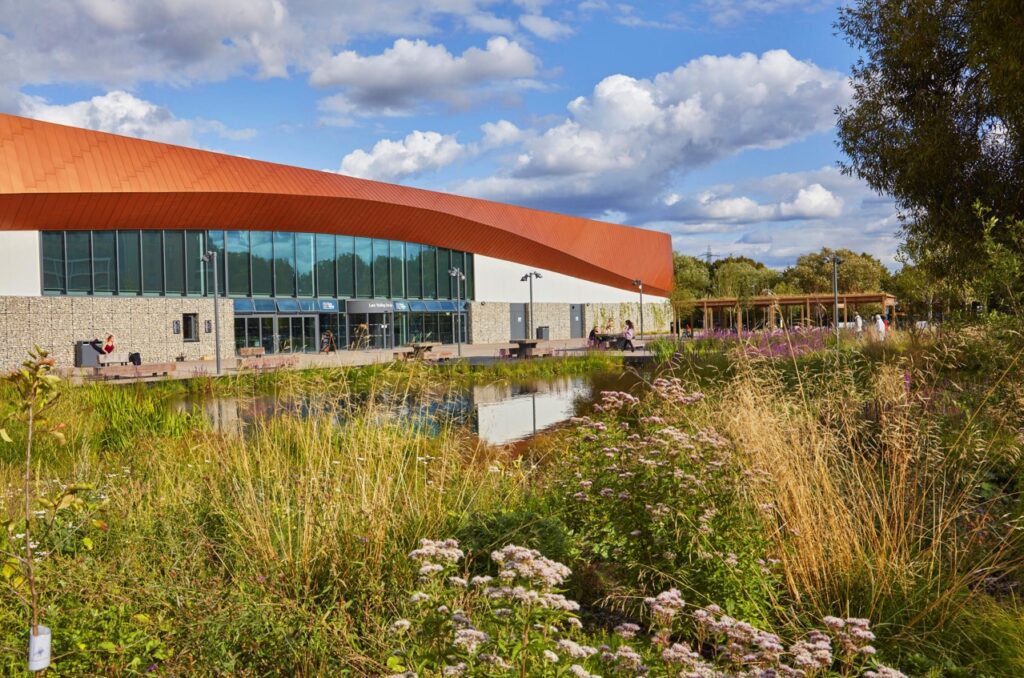
In all our work, we strive for innovative solutions that provide multiple benefits. For London’s new Lee Valley Ice Centre, we challenged the engineers to find a way to reuse ice melt from the rinks. The design will filter the melt through wetlands to oxygenate a stagnant lake nearby. A world first.
Co-evolving with nature
Practice
1. Does the practice use biophilia within the office or regularly host meetings and retreats in natural settings? For example do you have extensive planting within the office or rely on natural patterns and imagery for stress relief or quiet areas.
We understand that when people have closer contact with nature, they feel happier, stress levels reduce, and cognitive function including memory, creativity and mood improves. Biophilic design makes workplaces more productive and can positively affect health.
With this in mind, we ensure our studios are airy, comfortable, welcoming environments, rich in well-looked after plants and with good levels of natural light. We aim for a mix of spaces to accommodate different types of work – from collaborative, long benches for design to spaces for quiet conversation or focussed work.
We arrange group activities including studio tours or lunchtime or after-work walks. Our days are peppered with site visits, but cross-studio collaboration on projects makes outdoor meetings challenging.
We each have an annual volunteering day at our disposal. These are most often used for nature restoration activities. Most recently, our Peterborough studio worked on a new garden for local charities.
2. Can the practice share examples where it has considered nature in decision making? For example by having a nature proxy to encourage eco-centric decision making, using natural systems as inspiration for the company structure, recognising the seasonal nature of people’s capacity and workload or celebrating equinoxes and solstices together.
Our roots lie in the science and art of landscape architecture, and this strengthens all the services we now offer. We believe landscape has the power to transform, to reveal the extraordinary; to connect old and new communities; to create ambitious, sociable, equitable and more sustainable places that work well.
We follow the principles of ‘first life, then spaces, then buildings’, turning traditional masterplanning on its head to shape places that better meet people’s everyday needs, supporting active, healthy lifestyles; well-designed infrastructure; and enabling close contact with nature.
The original meaning of the word landscape is to create a place where people belong. Landscape connects people and place and knowing how people use space gives breadth and depth to our work and the outcomes we can secure. So, for every project we make sure nature has a seat at the table. This is at the heart of who we are.
3. Is the practice supporting nature locally and nationally? For example, does the practice support local gardens, gardeners, planting programmes, rewilding programmes or advocate for changes in legislation to protect nature.
This year, we’re looking to partner with Beyond Zero, an organisation pioneering the use of data and technology to maximise the benefits for nature. We believe we can help Beyond Zero unlock strategic land for nature recovery. Also, by contributing to their nature restoration schemes, we can create opportunities for our employee owners to give back through hands-on eco-restoration.
We see green infrastructure as the means to drive regeneration – our work in Thamesmead is a notable example. We work from the large scale – such as Queen Elizabeth Olympic Park – to community gardens and temporary spaces.
We regularly contribute to local conservation efforts. Recent endeavours include volunteering with Witney Town Council to create dead-wood habitats and giving pro bono advice to local farms on sustainable practices. We have also helped teachers integrate nature into their curriculum.
We advocate for legislative change to protect nature, including in the forthcoming Planning reforms.
Project
1. Can the practice demonstrate projects which strive to match the performance of a mature ecosystem? As a minimum this would mean achieving biodiversity net gain.
We recognise that integrating ecological considerations is critical to successful placemaking. On projects, we look to exceed the mandatory BNG standard of 10% – for example, on Lee Valley Ice Centre in London we achieved a net gain of more than 30%.
We also look to achieve wider benefits for people. This includes creating characterful and attractive places to live, work, and play, with easy access to nature and benefits from natural systems. We aim to build resilience to a changing climate using nature-based solutions.
We have developed an ecosystems approach to masterplanning and design, drawing on a deeper, evidence-based understanding of natural capital assets and opportunities to optimise the ecosystem benefits the landscape can provide.
We believe biodiversity net gain is a progressive step, but we also focus on wider environmental net gain, where possible. Our internally certified Building with Nature assessors push for best practice (beyond BNG).
2. Is the practice working on material stewardship? For example, evidence could be shown through repeated use of low carbon materials, extensive material libraries and research or publications supporting responsible use of materials and elimination of waste.
We have been developing our approach to carbon reduction on projects, utilising the industry-known Climate Positive Design Tool, which extends calculation to natural elements featured in our designs, including soil and vegetation.
Whilst specification has an enormous impact, we want to drive decision making to include site selection and soil disruption through to design and material reuse.
Utilising the Climate Positive Design Tool on London’s Poplar Riverside, we made informed design decisions, including on the specification of natural play surfacing, and lower carbon paving and concrete, bringing down the ‘Years to Net Zero’ by 20 years. For the years beyond this, it would mean the planting would continue to sequester carbon above what was originally emitted to become a climate positive landscape.
We are also working hard to drive industry-wide standards. LDA’s Purpose & Impact Manager is part of the Landscape Institute Steering Group pushing for consistency on accepted measurements.
3. Do the majority of projects demonstrate the use of biologically-inspired approaches such as Bioregionalism, Biophilia, Biomimicry, Ecomimicry (also referred to as Ecosystems Thinking, Industrial Ecology or Industrial Symbiosis) or BioTRIZ?
We understand that we are part of, not separate to, nature and apply biophilic design to create environments rich in natural sensory experiences essential for health, wellbeing, and happiness.
This can happen at all scales, from regional to the most intimate of spaces. Biophilic design is applied as a series of patterns, or design opportunities. The first layer is about shaping space to include opportunities for exploration, discovery, prospect, and refuge. In the second, natural sensory content is introduced, such as beautiful, biodiverse planting. The third layer evokes nature through use of natural materials, so the biomorphic form, colours, shapes, and patterns found in nature can inform design.
With Great Ormond Street Hospital, we are championing biophilic design to create the UK’s first healthy hospital street. It’s a radical model that could set a new international standard. The reimagined street will have gentle curves with seating nestled within lush planting.
Creating a just space for people
Practice
1. Does the practice have a progressive EDI policy and can you evidence many forms of diversity, which are welcomed and acknowledged, within the practice?
The more diverse we are as a business, the more we can understand the communities we work within. Last year, our employee owners made clear they saw EDI as a priority for us
This year, we have been working with an external consultant on best next steps. Our newly formed EDI group is driving more inclusive policies and fresh guidance on language usage, plus shaping our approach to training, recruitment practices and professional development. This work will launch later this year.
Currently, we have a higher diversity of ethnicities compared with our industry. However, comparing our statistics to the cities we are based in revealed we have more to do. We do have a higher diversity of sexual orientation than the general UK statistics, reflecting LDA’s inclusive working environment.
As well as challenging and improving our business, we are also looking at ways to make our industry much more diverse.
2. Does the practice operate a no overtime culture, meet the living wage consistently, and stipulate a fair salary ratio between staff of all levels?
We actively discourage working long hours. Our flex policy builds flexibility into the working day and provides time back when employee owners have worked longer hours due to client deadlines. We track working over hours so can identify when workload may be too high or if there are other concerns.
We meet the real living wage for all our employee owners and our salary bands provide transparency. These are deliberately broad given our different professions, locations, and levels of experience. The bands overlap and recognise those who don’t want to progress but should be fairly rewarded for their skill and experience.
Our senior salaries need to be high enough to attract and retain the necessary skills and experience but not be excessive given our responsibilities to the long-term health of the business and its employee owners. The ratio between the lowest and highest earning person in LDA Design is 7:1.
3. Does the practice support charities, community groups, social enterprises, action groups and others through pro-bono work, charitable giving or in-kind donations?
Our eight studios regularly engage in charitable activities.
Each year, our employee owners vote for days they would like to mark from the UN calendar. This year’s selection included the International Day of Forests, with studios supporting nature restoration projects, including tree planting and pond restoration.
For Earth Day, we held a panel discussion about how energy projects can benefit communities. Next up is the Great Big Green Week, and for this our activities include going into schools to talk about impacts on our water cycle and how we can design for greater climate resilience and better support communities.
We provide an annual bursary to support students facing challenges in pursuing higher education. This year we asked what Regenerative Britain looks like. The standard of entries was high, and we received more than ever before. Three students were awarded a £2,000 bursary each and four weeks’ paid work experience.
4. Does the practice publicly refuse to work with certain clients, suppliers or organisations on ethical grounds?
We have always been keen to work internationally, but we wanted to bring more clarity and transparency around our decision-making process.
So, in 2024, we launched our Ethical Decision-Making Framework. This includes a checklist and a traffic-light system which supports meaningful conversations around the choices we make. We have decided to not accept any new projects based in the countries which the Government identifies as providing particular concern when it comes to human rights issues. Each new prospect goes through this sifting process before we commit.
We continue to review the effectiveness of the Framework to ensure it reflects our purpose and values and we pay close attention to the Government’s list and any changes made to it.
We also listen closely to our employee owners to ensure they feel comfortable with and proud of the work they do and the contribution they make.
Project
1. Do the projects demonstrate deep engagement with local stakeholders and end users? For example, is there evidence that your project engagement goes beyond consultation towards co-design?
We start projects with wanting to hear the widest range of perspectives to understand the outcomes people want and that the planet needs. Listening to local people and harnessing their knowledge and appreciating their lived experiences is key to identifying the challenges and the solutions. It’s these conversations that shape the best outcomes.
Recognising that no one person’s experience is the same ties into our evolving EDI strategy. Diversity within our organisation is also fundamental to appreciating different ways of living.
We have incorporated co-design workshops into our projects, from Aberdeen to Bangor, from Exeter to London. When it comes to developing a placemaking plan, strategising together early on means everyone is invested in the vision, helping to make resulting actions a reality.
As part of our outcomes approach, we are developing a community engagement tool to frame the conversation and to better understand the diversity of priorities and needs.
2. Do your projects create connected and resilient places which positively contribute to their neighbourhoods and allow equality of access? For example, do your projects create economic opportunity, retain value locally and generate social value?
We listen hard to lived experience so that we can positively impact communities, prioritising social equity, inclusivity, and accessibility. We think about the people affected by change and target outreach to those typically excluded. So, community engagement for the masterplan to regenerate east London’s Aberfeldy Estate began with 100 pupils from local schools. A radical departure.
When it came to the restoration of Aberdeen’s Union Terrace Gardens, we went to great lengths to ensure this steep, city-centre valley park was fully accessible for the first time, with two lifts and amphitheatre access. The Chair of the Disability Equality Partnership said it was one of the best examples of inclusive design they had seen.
We see our projects as catalysts for regeneration. For the Carpenters Estate masterplan, we looked to connect the estate to Queen Elizabeth Olympic Park, so that residents can benefit more from this incredible asset on their doorstep.
3. Do the majority of your projects promote equity in society, and consider all people, not only the building inhabitants? For example, do your projects show due regard for workers within the supply chain and take active steps to avoid modern slavery?
Our projects are guided by principles that promote equity and inclusivity, not only for the immediate users of a space but for the broader community and all individuals affected throughout the lifecycle of our projects. We strive to design landscapes, streets and spaces that are accessible, welcoming, and beneficial to people of all ages, abilities, and backgrounds. Our work often engages with under-served communities to ensure that public spaces are inclusive and responsive to diverse social, cultural, and ecological needs.
In terms of ethical sourcing and labour practices, we work with suppliers who share our values and demonstrate compliance with ethical labour standards, including the real Living Wage and modern slavery. We are committed to the principle of equal opportunities in employment, including any agency or sub-contractors.
Through our design processes, community engagement, and procurement practices, we aim to contribute positively to social equity and environmental stewardship.