
Submission byKhadka+Eriksson Furunes.
Being a good ancestor
Practice
1. Does the practice have a clearly stated purpose aligned with the planetary emergency? We are looking for a bold ambition here, and a practice culture which recognises the need for long-term thinking. For example, a strong mission, a theory of change, or a sustainability roadmap.
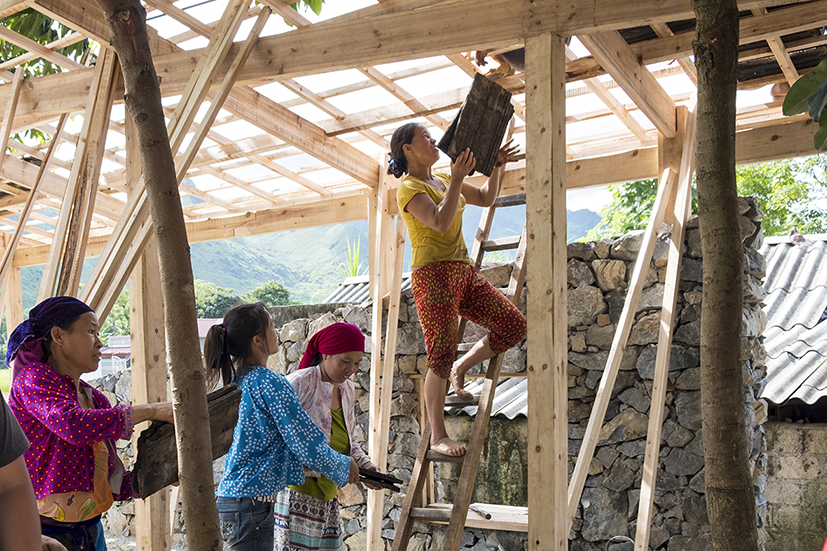
Our work looks at existing traditions of mutual support as an approach to architectural practice. These forms of cooperation are found in many cultures around the world. In Norway, this is called dugnad, and in the Philippines, it’s known as bayanihan. They predate the nation-state as well as market logic, offering a different set of values and relationships between people and their surroundings. Historically, such ways of working together have been used to care for shared land, water, and forests, to build or repair homes, and to cope during times of crisis. Through architecture, we explore how these existing understandings can be mobilized to address the challenges of today.
2. Does the practice have a clear succession plan, which passes on ownership and protects the values and legacy of those who built and contributed to the practice? For example is the practice an employee owned trust.
The practice is a free association of people coming together to work on projects we find important. Often, the project is as much about understanding what we are trying to do as it is about addressing a specific need. Rather than assigning fixed roles, it allows individuals to contribute based on their own interests. Experience and knowledge are passed on through the work of each member involved. A key principle is that everyone works together at the same time, allowing knowledge, skills, and relationships to develop collectively through the process. There are as many perspectives as there are people participating, so the practice evolves in multiple and unpredictable ways.
3. Does the practice share research and knowledge for the benefit of society and the wider world? For example, you regularly carry out post occupancy evaluation and share information with others.
The simultaneous effort of working together is an immediate way of exchanging knowledge and experience. But beyond the act of building, the practice also operates within the art field, collaborating with community partners and participants to find ways of articulating and communicating the process and its findings through publications and exhibitions. Rather than viewing architecture through a pre- or post-construction lens, we see it as something continuously in the making – where every stage of the process is an important part of the building’s life.
Project
1. Does the practice advocate for long-term thinking at the outset of projects? Do you initiate projects with long-term thinking and challenge the client on design life? Also, can the practice demonstrate that this approach has worked – with a shorter or longer design life, or an innovative approach to financing or payback period?
The built environment, seen through the lens of mutual support traditions, is not static. These practices have developed as ways to care for the resources needed by communities to construct architecture – and just as importantly, to maintain it over time. Such structures exist in a dynamic relationship between the availability of resources and the regular exchange of labor required by community members to sustain them. Architecture, in this sense, is an ongoing process. Long-term thinking must be matched by a long-term strategy for caring both for natural resources and the human relationships that support them. These traditions have given rise to buildings and human-nature relationships that have endured for centuries, proving that this way of building is sustainable over the long term. What we now need to understand is how this knowledge and way of working can relate to the way many of us live our lives today.
2. Do your projects take account of the future climate and the need for resilience? For example, do the projects demonstrate flexibility, design for adaptation, design for disassembly, non-deterministic solutions, or demountable structures.
Mutual support is a practice of resilience – both in everyday life and in the aftermath of disasters. Historically, this practice has been as much about building mutual respect among people for the time and effort they invest through their labor, as it has been about nurturing a deep respect for the surrounding landscape, ecology, and nature that provide the materials for building. As such, mutual support has often involved dismantling and reassembling structures, as well as reusing materials from older buildings in new ones. This is not a new idea – but understanding it in the context of today’s crises is crucial. Recognizing that much of the world has been practicing this way of building and living for generations is important, so that more people can feel ownership over the solutions we urgently need to address today’s challenges.
3. Do the majority of your projects go beyond mitigating negatives and towards optimising positives? For example, are they meeting or exceeding the RIBA 2030 Challenge.
The practice is about finding ways to reengage with mutual support in contemporary contexts. The barriers to this often lie in how our construction industry, regulations, and certification processes are primarily geared toward a model of continuous growth, whereas mutual support is a practice rooted in balance.
Because of this, most of our projects remain small in scale and take time to realize. In each case, we explore how to responsibly navigate these contemporary barriers while also optimizing this way of working within the specific context we are engaging with. By linking these different contexts, we aim to develop a transnational approach – one that connects diverse places and experiences through shared values.
In that sense, we do not feel urgency around scaling up. Instead, our focus is on growing horizontally – deepening our engagement with different contexts, cultures, and climates to find ways of addressing the global challenges we all face today.
Co-evolving with nature
Practice
1. Does the practice use biophilia within the office or regularly host meetings and retreats in natural settings? For example do you have extensive planting within the office or rely on natural patterns and imagery for stress relief or quiet areas.
We set up our practice in each site and location where we work. This means the full team of people working together differs from one place to another, and each project is site-bound. Aiming to understand what resources and materials are relevant to each location, we spend a lot of time engaging with the surrounding land and environment. Our practice is therefore not based in a single, static office – it grows out of each project, each collaboration, and each site.
2. Can the practice share examples where it has considered nature in decision making? For example by having a nature proxy to encourage eco-centric decision making, using natural systems as inspiration for the company structure, recognising the seasonal nature of people’s capacity and workload or celebrating equinoxes and solstices together.
A more general answer to this question is that each project is rooted in the existing practice of mutual support in the cultures where we work. This means the seasons are deeply embedded in the way we organise the way we work together, eat together, and live together.
A more specific example is a project we’re currently working on in Venice, where the seasons is framed by international cultural events and extreme tourism. The project is a mutual effort by a group of people from both Venice and elsewhere. The aim is to create a commons within the lagoon from a small vacant island that we have secured trough a 19 year lease. We are collaborating with hunters and fishers to learn about the millennia-old tradition of building with reeds and to learn from this knowledge of reed construction, rooted in local craft and ecology.
3. Is the practice supporting nature locally and nationally? For example, does the practice support local gardens, gardeners, planting programmes, rewilding programmes or advocate for changes in legislation to protect nature.
The practice is increasingly interested in the relationship between common land – whether it’s called almenning in Norway or iriai in Japan – and the traditions of caring for this land, such as dugnad in Norway and yui in Japan. These forms of mutual support are deeply intertwined with nature, and it is this relationship that we want to highlight.
In this sense, our work is about drawing attention to these commons before they are privatised or absorbed into state management – processes that often sever the living relationships people have with the land through mutual care and cooperation.
Project
1. Can the practice demonstrate projects which strive to match the performance of a mature ecosystem? As a minimum this would mean achieving biodiversity net gain.
By learning from mutual support, the project aims to engage with the complexity of each situation we work in. It is as much about articulating the interconnectedness of all things as it is about critically questioning how ecosystems can inform a more sustainable approach to architecture today. While we work closely with people who are deeply committed to the places we engage with, we recognize that we cannot replicate the balance of a mature ecosystem. Instead, the aim is to find ways the project can support or strengthen already existing ecosystems – both social and ecological.
2. Is the practice working on material stewardship? For example, evidence could be shown through repeated use of low carbon materials, extensive material libraries and research or publications supporting responsible use of materials and elimination of waste.
In Venice, we are exploring the use of local reed as a potential roofing material, aiming to bring this traditional knowledge back into public awareness. In Japan, we are learning how materials from vacant houses can be reused in new construction. In Oslo, we are investigating how reclaimed glass and timber can be certified and reintegrated into building practices, in collaboration with initiatives such as the organization Resirqel.
3. Do the majority of projects demonstrate the use of biologically-inspired approaches such as Bioregionalism, Biophilia, Biomimicry, Ecomimicry (also referred to as Ecosystems Thinking, Industrial Ecology or Industrial Symbiosis) or BioTRIZ?
Traditional bioregional practices are often closely linked to mutual support traditions. The ways in which materials are cared for, harvested, and used in construction offer a meaningful starting point for the architectural work we engage in. We aim to learn from and build on this knowledge to create architecture that is rooted in the land and the people where it is built.
Creating a just space for people
Practice
1. Does the practice have a progressive EDI policy and can you evidence many forms of diversity, which are welcomed and acknowledged, within the practice?
Our practice embraces diversity as a strength and actively fosters an inclusive, supportive culture. Though small, our team is composed of professionals from diverse cultural and national backgrounds, whose unique perspectives and experiences are genuinely valued and celebrated. We are also proud to be a female team, contributing to greater gender representation and empowerment within the architecture profession.
Diversity and inclusion are not only reflected in our day-to-day culture but are being formalised through a developing EDI policy, which aims to ensure that equity, inclusion, and representation remain embedded in our practice as we grow.
2. Does the practice operate a no overtime culture, meet the living wage consistently, and stipulate a fair salary ratio between staff of all levels?
The practice is not a commercial endeavor, but it actively works to ensure that funding for projects is distributed in ways that do not undermine the non-commercial values of mutual support. At the same time, it is important to compensate people for the time they contribute during working hours or when they are committing their professional expertise exclusively to the project. Striking a balance between monetary compensation for labor and materials, while honoring non-monetary forms of care and contribution, is a delicate but essential part of the work. The reliance on external funding can pose challenges to the sustainability of projects that lack long-term financial support. In such cases, the expectations and scope of the project must be carefully defined so that it can be maintained and cared for within the limits of the context in which it is built.
3. Does the practice support charities, community groups, social enterprises, action groups and others through pro-bono work, charitable giving or in-kind donations?
Rather than approaching projects as outsiders supporting charities, communities, or social enterprises, the practice seeks to be situated within these initiatives – strengthening the work that is already underway. Existing understandings of mutual support form the starting point from which we explore how we can work together. Each project we take on is rooted in an existing initiative or community-driven effort, which we aim to mobilize and help realize through architecture.
4. Does the practice publicly refuse to work with certain clients, suppliers or organisations on ethical grounds?
Yes, the project does not engage with initiatives that are extractive. A core precondition for involvement is that the initiative is committed to a process rooted in the principles of mutualism – both among people and in relation to the surrounding environment. A clear warning sign, and a reason we have declined to engage with certain projects in the past, is when initiatives aim to provide aid or support to communities without meaningfully involving them in the decision-making and implementation processes. For us, active participation and shared ownership are essential to ensuring that architecture truly serves those it is intended for.
Project
1. Do the projects demonstrate deep engagement with local stakeholders and end users? For example, is there evidence that your project engagement goes beyond consultation towards co-design?
Yes, the projects are rooted in mutual support initiatives and practices, where stakeholders are directly involved in both decision-making and implementation. The process is structured to ensure that participants actively articulate, deliberate, evaluate, and implement their own findings.
The work is a dialogue – within and among people from different walks of life, both inside the community and with us as architects from outside, acting as just one participant among many. We also actively work to help establish organizational structures around what are often informal mutual support practices, so they can be sustained beyond the construction phase – extending into the programming and maintenance of the building.
2. Do your projects create connected and resilient places which positively contribute to their neighbourhoods and allow equality of access? For example, do your projects create economic opportunity, retain value locally and generate social value?
The projects aim to strengthen existing skills and knowledge that can be mobilized through the process of mutual support. Often, this kind of knowledge is not spoken in words but passed down through practice. By facilitating processes where the act of doing and working together is central, we hope to support and amplify such knowledge – knowledge that is often situated and specific to the complexities of the contexts we work within. Where necessary, we also seek ways to formally certify this knowledge, so that those who carry it can transform it into a viable livelihood.
3. Do the majority of your projects promote equity in society, and consider all people, not only the building inhabitants? For example, do your projects show due regard for workers within the supply chain and take active steps to avoid modern slavery?
Mutual support is not based on market logic and therefore does not necessarily operate within conventional systems of supply chains, labor, and materials. Much of our work involves recognizing that large parts of society function through non-monetary systems – through care, reciprocity, and shared effort – while also navigating the realities of working within a global market and industrial context. Many of our projects are grounded in the existing skills and knowledge of the stakeholders themselves. This is one of the reasons why mutual support represents a powerful contribution to both social and environmental sustainability. It is a non-extractive practice, rooted in values of regeneration – where labor and resources are facilitated in ways that avoid depletion and instead become mutually strengthening through the project. This approach also ensures that labor is treated with dignity, and that good, safe working conditions and practices are promoted throughout the process.