
Submission by Hawkins\Brown.
Being a good ancestor
Practice
1. Does the practice have a clearly stated purpose aligned with the planetary emergency? We are looking for a bold ambition here, and a practice culture which recognises the need for long-term thinking. For example, a strong mission, a theory of change, or a sustainability roadmap.
Our response to the climate emergency is Whole Life Design, which aims to reduce, replenish, and heal the planet by reducing carbon emissions through iterative Whole Life Carbon analysis, and enhance communities through social value, engagement, and wellbeing.
Regenerative Design is a natural evolution for HawkinsBrown, a signatory of Architects Declare, the RIBA 2030 Challenge, and End Gas Now. We are a certified B-Corp and have an SBTi-registered carbon reduction plan targeting Scope 1, 2 and 3 emissions. This year, we published three years of embodied carbon emissions from project completions.
For the last year, we have had a regenerative futures specialist in residence, enabling us to upskill the entire practice in regenerative approaches by developing resources. Our yearly Research Week was themed around Regenerative Design with a series of workshops on creating regenerative briefs, integrating social value programmes, and considering project legacies.
2. Does the practice have a clear succession plan, which passes on ownership and protects the values and legacy of those who built and contributed to the practice? For example is the practice an employee owned trust.
HawkinsBrown became an Employee-Owned Trust in 2021. The Founders’ Wishes and the current five-year business plan are shared with every employee when they start. Our clear governance structure includes a Trust Board, the Operations Board, and an elected Employee Council with representatives from across the practice, providing opportunities for staff to develop their business and leadership skills, involving them in decisions, and providing representation to all.
We are updating our five-year business plan and have held office-wide workshops to incorporate all voices in its development. Partners have been divided into several shadow boards to interrogate specific strategic issues across the practice, including design and creativity, operations and culture, and strategic direction. Our Head of Sustainability, Louisa Bowles, is part of the core business plan group to ensure all aspects consider environmental factors. Senior partners play a key role in leading strategic discussions while mentoring the next generation of leaders.
3. Does the practice share research and knowledge for the benefit of society and the wider world? For example, you regularly carry out post occupancy evaluation and share information with others.
Sharing and expanding our knowledge through research and regular POE is essential to our work. In 2025, we:
- Published RIBA overlays and strategies promoting Regenerative, Social Value, Net Zero and Circular design
- Collaborated with the UKGBC systems change research through live case studies and the Recalibrate programme
- Launched a cross-disciplinary Build for Health campaign with health experts and academics
Previously, we:
- Researched topics including Circular Economy and diversity in higher education through our internal bursary.
- Developed a Whole Life Carbon measurement tool, HB:ERT. V1 is freely available, and V2 won the 2020 AJ Best Use of Technology and RIBA Research Award
- Highlighted the value of measuring qualitative design impacts via our Chobham Manor POE, which won the AJ Sustainability Initiative Award 2023.
- Co-authored RICS WLCA Standard 2023 updates and contributed to industry groups including RIBA, RICS, UKGBC, ACAN GLA, NLA and LETI.
Project
1. Does the practice advocate for long-term thinking at the outset of projects? Do you initiate projects with long-term thinking and challenge the client on design life? Also, can the practice demonstrate that this approach has worked – with a shorter or longer design life, or an innovative approach to financing or payback period?
Long-term thinking is key to the Whole Life Design ethos. We use agile, iterative Passive design and Whole Life Carbon analysis to create low-energy, low-carbon buildings, balancing upfront and long-term impacts. Our new consultancy, Foresight, analyses long-term trends to guide strategic outcomes.
This approach shapes long-term partnerships such as:
- University of Oxford Science Area: enhancing the public realm while consolidating fragmented research space into new, purpose-built accommodation
- Central Foundation Boys School: a 12-year phased retrofit delivering state-of-the-art teaching facilities, recently recognised in the 2025 RIBA London Awards
- Lund Quarter: a regeneration project supporting UKGBC systems change research, backed by a 50-year funding programme with LB Newham to promote circularity and long-term thinking
- Gillet Square : an ongoing partnership where a car park has been transformed into a new public space, encouraging local enterprise, culture, and improved health and safety outcomes
2. Do your projects take account of the future climate and the need for resilience? For example, do the projects demonstrate flexibility, design for adaptation, design for disassembly, non-deterministic solutions, or demountable structures.
Resilience is a primary driver of our design approach. Our Environmental Intelligence team integrate Passive design and Whole Life Carbon analysis to advise on overheating risks and life cycle material impacts, while our estates optimisation service drives spatial and operational efficiency, enabling estate managers to make informed decisions around their capital investment plans
Case studies include:
- Oxpens Masterplan: a flood-resilient, mixed-use scheme reconnecting Oxford to the Thames through adaptable public spaces
- Eddington Masterplan: designed with the University of Cambridge Martin Centre, focusing on strategic low-carbon landscape interventions that ensure water neutrality and resident wellbeing
- Estates optimisation for the University of Southampton Masterplan: ensuring 30-year utilities resilience while supporting estate decarbonisation and facilitating specialist teaching provision
- Agar Grove: phased Passivhaus-certified homes to provide robust and resilient social housing for LB Camden
- TEDI HE campus: designed for disassembly and reconstruction, reflecting its short on-site life.
3. Do the majority of your projects go beyond mitigating negatives and towards optimising positives? For example, are they meeting or exceeding the RIBA 2030 Challenge.
We track energy and embodied carbon against the RIBA 2030 challenge; comparing 2024 and 2025 data suggests an improvement. Our most recent data so far on energy (compared to previous year):
Better than RIBA2030: 11% (9%)
Better than RIBA2025: 20% (21%)
Better than RIBA 2020: 40% (27%)
Shy of any targets: 29% (41%)
For embodied carbon (A-C exc B6-B7):
Better than RIBA2030: 24% (38%)
Better than RIBA2025: 12% (23%)
Better than RIBA 2020: 45%
Shy of any targets: 19% (39%)
We have some exemplary projects, including:
- 3 projects taking part in the UK NZCBS pilot
- St Mary’s Catholic Voluntary Academy, where rooftop PV arrays generate more energy on site than is used
- Agar Grove, the UK’s largest Passivhaus development. Other residential projects have achieved ranges of 35-70kWhr/sqm
Co-evolving with nature
Practice
1. Does the practice use biophilia within the office or regularly host meetings and retreats in natural settings? For example do you have extensive planting within the office or rely on natural patterns and imagery for stress relief or quiet areas.
We want everyone to be closer to nature, starting with our own team. We promote initiatives throughout the year to build planetary awareness, including lunch runs, research trips, and reading recommendations that explore the connection between nature and the built environment. Last year, we partnered with UCL for an urban heat island walk using thermal cameras to illustrate nature-based resilience. This year, we plan to integrate nature into our all-staff summer gathering as both a setting and a catalyst for business planning.
Our annual Wellbeing Month features communal activities highlighting the importance of green infrastructure within urban environments. We’ve explored the connection between circadian rhythms, sleep, creativity and productivity, and we’re looking into “forest bathing” as a mindfulness and design tool.
Across our studios, generous planting and biophilic design create connections with nature and calming workspaces, particularly around meeting areas. This is also part of our internal fit-out language
2. Can the practice share examples where it has considered nature in decision making? For example by having a nature proxy to encourage eco-centric decision making, using natural systems as inspiration for the company structure, recognising the seasonal nature of people’s capacity and workload or celebrating equinoxes and solstices together.
HawkinsBrown has made sustainability and regenerative design core to our business plan. The latest five-year plan does not have a dedicated sustainability chapter, as this approach is embedded into all business practices. As part of the core leadership coordinating and implementing the business plan, our Head of Sustainability gives a voice to nature and brings long-term thinking into decision-making.
The move to Employee-Owned Trust was natural, allowing us to involve everyone in the evolution of the practice. There are several examples of this organic, emergent, and self-managing system that relies on empowerment and trust. For instance, the elected Employee Council is not led by senior leadership, who instead mentor them and enable longer-term career development. Voice Groups, including ED&I, Wellbeing, and CSR, feed into the council. We are exploring a revision to our skills matrices to ensure nature and planetary health are considered in decision-making, no matter the role.
3. Is the practice supporting nature locally and nationally? For example, does the practice support local gardens, gardeners, planting programmes, rewilding programmes or advocate for changes in legislation to protect nature.
Our residential-led masterplans reflect a renewed appreciation for the benefits of nature to local communities. At Lund Quarter in Newham, meanwhile-use communal gardens will cultivate social value and education. In Eddington, we are collaborating with the University of Cambridge to research the wellbeing impact of landscape interventions and running growing workshops exploring community interest in different ownership models.
We regularly contribute to industry knowledge and policy development. For example, we are helping to shape the evidence base and recommendations for more ambitious and comprehensive decarbonisation policies in the next London Plan. We also contributed to the 2021 Parliamentary Environmental Audit Committee, leading to the recommendation of WLCA in national policy.
Many of our soft initiatives incorporate natural themes. Our summer gathering is planned for a green setting, and our book group recently read The Nature of Our Cities, followed by a presentation by the author Nadina Galle.
Project
1. Can the practice demonstrate projects which strive to match the performance of a mature ecosystem? As a minimum this would mean achieving biodiversity net gain.
Many of our projects utilise the benefits of nature and ecosystem development and support. For example:
- At biophilic school St Mary’s Catholic Voluntary Academy, the first UK school built to GenZero standards, we retained existing planted boundaries and introduced over 80 new mature trees, species-diverse grassland, swale planting, and green roofs with 47 native species. Seasonal landscaping connects children to nature, and POE indicates improved attainment in core subjects after 12 months. St Mary’s recently received both the RIBA East Midlands Award and Sustainability Award
- At Central Foundation Boys’ School, introducing integrated planters, green roofs, and mature trees to the previously barren site brought an extremely high BNG to the inner city setting and wellbeing benefits to the students
- Similarly, for the Nightingale School, roof gardens and bee hives provide a relief for staff and an educational opportunity for students, even exploring honey production on site
2. Is the practice working on material stewardship? For example, evidence could be shown through repeated use of low carbon materials, extensive material libraries and research or publications supporting responsible use of materials and elimination of waste.
We’ve spent over a decade researching embodied and whole life carbon (WLC). Initiatives include:
- Developing the open-access WLC tool HB:ERT, now evolved into VERT, the Visionary Emission Reduction Tool.
- Co-authoring RICS WLCA Standard updates
- Supporting RIBA, RICS, UKGBC, LETI, NLA, UKNZCBS, GLA and others through guidance and reviews
- Sponsoring the 2023 UKGBC Embodied Carbon Programme and developing material guidance for clients
- Delivering lectures and training on materials and carbon, recently for RIBA and CIBSE
- Sponsoring ReLondon and providing case study information, testing the impact of Circular Economy metrics
We advocate for natural, low-carbon materials where possible. At Clerkenwell Design Week 2025, we argued for wider uptake of stone rather than clay-fired bricks. We frequently specify natural materials, such as local stone, timber cladding, and green roofs at Hayle North Quay, so dwellings positively contribute to the sensitive landscape setting.
3. Do the majority of projects demonstrate the use of biologically-inspired approaches such as Bioregionalism, Biophilia, Biomimicry, Ecomimicry (also referred to as Ecosystems Thinking, Industrial Ecology or Industrial Symbiosis) or BioTRIZ?
Increasingly, our projects integrate nature and natural materials to replenish natural resources and support wellbeing across urban design and individual buildings.
Further examples include:
- Earls Court: a landscape-led masterplan with 50% open space, seeking BNG c.80% and committing to over 1,000 trees
- Begbroke Innovation District: part of the Oxford Nature Recovery Network, with over 3km of native hedgerows to encourage pollinators, a 28% increase in watercourse habitat, and communal gardens, targeting at least 25% BNG.
- St Mary’s Catholic Voluntary Academy: a flagship school showcasing the principles of biophilic design. Each classroom faces out towards nature, and extensive planting, green roofs, and outdoor classrooms stimulate biodiversity
- Here + Now: utilising internal planting and green walls to boost wellbeing and air quality
Creating a just space for people
Practice
1. Does the practice have a progressive EDI policy and can you evidence many forms of diversity, which are welcomed and acknowledged, within the practice?
We want to make HawkinsBrown open and inclusive without exception. We recently ran our second EDI survey, updating our Action Plan to sustain awareness, ensure engagement, and embed inclusivity into our design ethos.
The EDI Voice Group leads the implementation of the Action Plan. Recent achievements include:
- CPDs and knowledge shares on inclusive design, unconscious bias, and social value
- Signing the NLA Diverse Leader’s Pledge, and becoming a Disability Confident employer
- Introducing new HR software to track recruitment data
- Publishing research on inclusive design in HE
- Adding EDI literature to the practice-wide library
- Hosting and promoting staff participation in industry events
Pui Quan Choi, EDI Voice Group Chair, also co-chairs the NLA Diverse Leaders’ Steering Group and is shortlisted for AJ100 Mentor of the Year. Our internal advocacy groups, HB BAME and HB LGBTQ+, provide safe and inclusive spaces for members of staff.
2. Does the practice operate a no overtime culture, meet the living wage consistently, and stipulate a fair salary ratio between staff of all levels?
We are a Living Wage Foundation-accredited employer. We have a published pay policy outlining the approach taken to salary reviews. As part of the process, individuals are grouped into bands of peers ensuring pay parity. Salaries are set using peer practice benchmarks and we pride ourselves on paying market rate or above for all roles.
We have a TOIL policy where any overtime is agreed upon with a partner before implementation. We aim to avoid overtime by reallocating resources and increasing teams aligned with deadlines. If this is not possible, we will allocate TOIL so individuals can take time off to recuperate following intense periods of working. Our HR team actively review time sheets with project leaders to monitor this.
3. Does the practice support charities, community groups, social enterprises, action groups and others through pro-bono work, charitable giving or in-kind donations?
In 2024, we moved to a new London HQ with the ambition to positively impact our local community. Our quarterly “Canteen Conversations” engage with local industry colleagues and independent musicians, with proceeds supporting charities including Migrateful, a charity that supports refugees and migrants to gain independence in the UK through cooking.
For Clerkenwell Design Week 2025, we opened our ground floor to recycled furniture makers Sons of Beasley. At Lund Quarter, we are developing social enterprise connections and recording how these influence design outcomes.
We support charities annually through events, auctions, and sales, benefitting causes like Pieta House and CCHS. Our outreach includes:
- Work experience programmes and workshops (Speakers for Schools)
- Schools outreach (RIBA Ambassador, Fusion Futures)
- Mentoring (Blueprint for All)
- Apprenticeships
Overall, we annually spend 500-600 hours in these social value activities, excluding the knowledge share and talks our partners carry out across disciplines.
4. Does the practice publicly refuse to work with certain clients, suppliers or organisations on ethical grounds?
We are an employee-owned business, and as such, our clients’ values must align with ours. As a certified B Corp, we have adopted B Corp’s Declaration of Independence, which says, “We must be the change we seek in the world”. With this as our guiding principle, we are not interested in only diagnosing problems or making public declarations of what we won’t do or who we won’t work with.
Instead, we think it’s more powerful to use our platform to embody and advocate the positive change we seek. This means actively finding like-minded clients, suppliers and collaborators to deliver exemplary projects that embody the positive changes we believe are needed. That could be a biophilic primary school, a radical retrofit or human-centred affordable housing: projects that actively set and communicate an agenda for positive change.
Project
1. Do the projects demonstrate deep engagement with local stakeholders and end users? For example, is there evidence that your project engagement goes beyond consultation towards co-design?
We know that to design great places, we must continually facilitate a deep understanding of context. This means working with local communities and stakeholders beyond consultation programmes to build knowledge, develop a shared local understanding, promote opportunities to meaningfully influence design, and facilitate opportunities for local people.
We have done this by:
- Hosting a regenerative futures residency to embed regenerative knowledge and methods into our practice
- Developing an in-house Regenerative Design Guide, aligned with the RIBA Plan of Work
- Weaving together social value deliverables with engagement programmes at Lund Quarter, including an internship for a local young person
- Inviting in-house and external environmental intelligence, Passivhaus, circular economy, engagement and social value experts to share best practice, emerging knowledge and actionable ideas in our CPD programme
- Exploring the role of community champions within Timber Square’s co-designed development
- Continually integrating socioeconomic metrics into our site analysis
2. Do your projects create connected and resilient places which positively contribute to their neighbourhoods and allow equality of access? For example, do your projects create economic opportunity, retain value locally and generate social value?
Resilience is crucial for low-carbon, future-proof outcomes. Our masterplans demonstrate the integrated thinking needed to enable this at the neighbourhood and asset level.
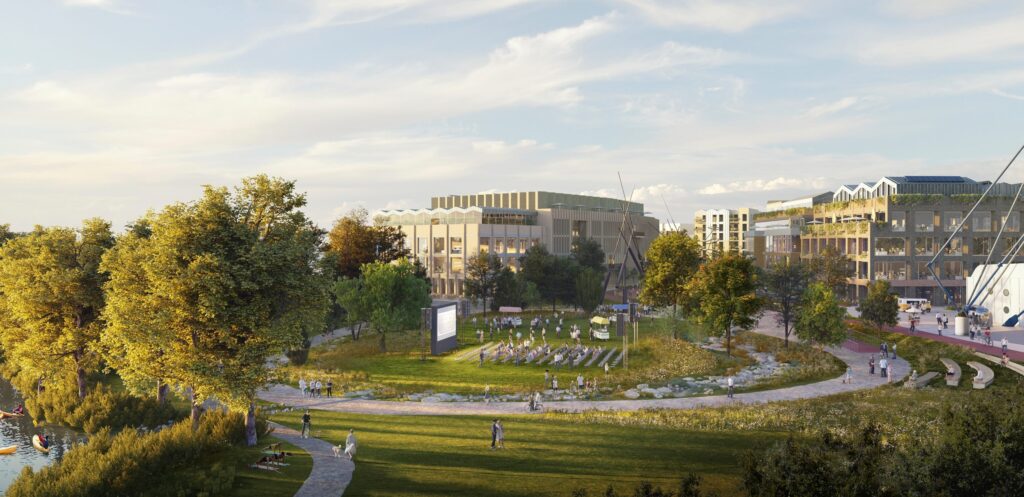
For example, Begbroke Innovation District is inspired by four place principles: restorative landscape, engineering serendipity, car-as-guest, and “opening to Oxfordshire”. Parkland contributes biodiversity to the Oxfordshire Nature Recovery Network, while a community farm, allotments and social landscapes promote healthy living and local domestic produce. Pushing cars to the periphery and relying on nature-based solutions will develop a resilient community and operational processes.
The Oxpens Masterplan focuses on regenerating the poor existing built environment, integrating new development harmoniously with the natural and historical context. The protected riverside landscape respects and enriches local ecology and manages flood resilience via water-accepting features, embracing the dynamic hydrological environment which gives low-lying Oxford so much of its personality. New pedestrian and cycle routes will improve connectivity and contribute to local economic growth.
3. Do the majority of your projects promote equity in society, and consider all people, not only the building inhabitants? For example, do your projects show due regard for workers within the supply chain and take active steps to avoid modern slavery?
People are at the heart of our work. Design and build contracts can distance us from final supply chain choices, but we’re reclaiming authority by rewriting our specification preliminaries to include safeguarding against modern slavery and to reduce supply chain impacts.
We’re increasingly aware of the benefits of localised supply chains. For example, we co-designed SIPS panels for St Mary’s with a local manufacturer, omitting PIR and reducing transport emissions.
Other outcomes include:
- Keeping the community in place during the phased Passivhaus regeneration of Agar Grove, while doubling the number of council-owned homes
- Supporting income generation and local craftsmanship during the renovation of Hackney Town Hall
- Renovating Haringey Civic Centre and Waltham Forest Town Hall with public realm, improved access, and employment opportunities
- Increasing accessibility and community uses of Plumstead Library
- Renovating Crystal Palace Sports Centre with the GLA to support local athletes and sports