
Submission by Hayhurst and Co.
Being a good ancestor
Practice
1. Does the practice have a clearly stated purpose aligned with the planetary emergency? We are looking for a bold ambition here, and a practice culture which recognises the need for long-term thinking. For example, a strong mission, a theory of change, or a sustainability roadmap.
Our practice has a grounding in social sustainability and careful material selection and has been driven by a collective mission to shape spaces that equally serve the users and environment around them. We recognise that the challenges of the climate and ecological crises require bold actions however, and are currently developing a sustainability roadmap for the practice. This will enable us to track and improve our impacts through measurable targets, including:
- we will commit to carrying out carbon calculations on all projects, presenting these to clients at Stages 1, 3, 4 and 6 by end of 2025
- we will carry out POE for operational energy on 75% projects by 2027
- we will achieve or exceed 20% on-site net gain in biodiversity for all new build projects going forwards
- we will carry out material audits and re-use a minimum of 50% reclaimable material for all projects involving demolition by 2027
2. Does the practice have a clear succession plan, which passes on ownership and protects the values and legacy of those who built and contributed to the practice? For example is the practice an employee owned trust.
No.
3. Does the practice share research and knowledge for the benefit of society and the wider world? For example, you regularly carry out post occupancy evaluation and share information with others.
We are a small practice with a high proportion of well published, innovative projects. We share research and lessons learned from these wherever we can. Examples include:
- POE and as built carbon calculations for Green House, which have been widely published following its award as RIBA House of the Year in 2023. We have actively promoted the design as a prototype for a terraced typology suitable for translation elsewhere
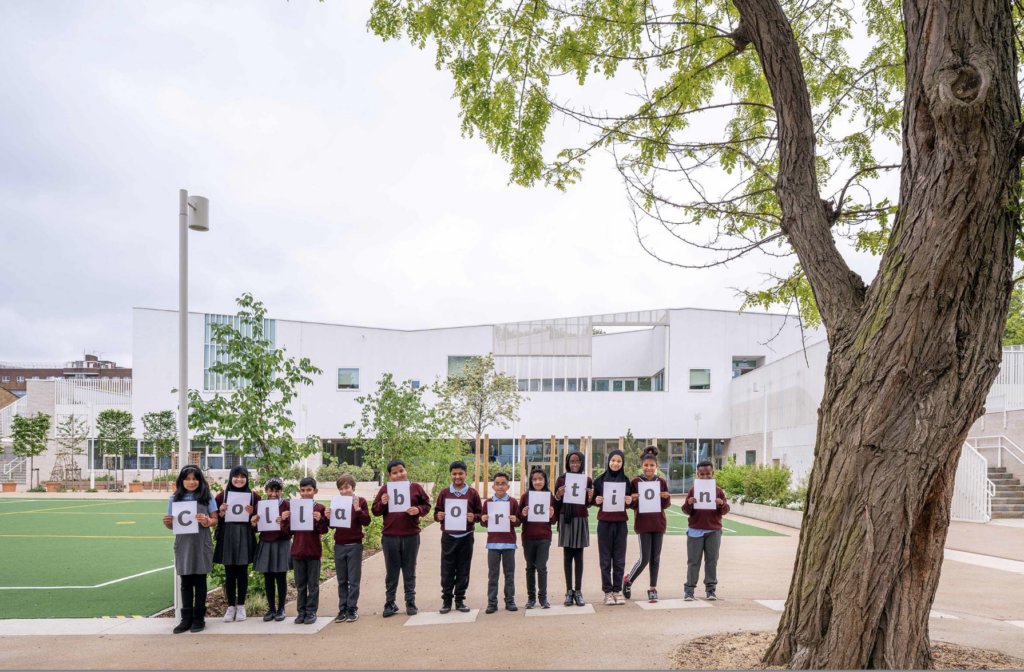
- Edith Neville Primary School, which has received the NLA wellbeing award, as well as the RIBA National Award. The design was developed and promoted to improve learning environments for all pupils, particularly underserved groups
- We are part of the London Practice Forum and regularly share information such as fee scales and salary bands. This has supported secondments, ensuring stability of employment for staff
We are particularly active in education to support access to the profession. We support many of our staff to hold part time roles as tutors and lecturers as well as:
- We are part of Access Aspiration, hosting students from minoritised backgrounds for 1-2 weeks work experience
- We have delivered many workshops for school children, such as RIBA workshops, school consultation workshops.
Project
1. Does the practice advocate for long-term thinking at the outset of projects? Do you initiate projects with long-term thinking and challenge the client on design life? Also, can the practice demonstrate that this approach has worked – with a shorter or longer design life, or an innovative approach to financing or payback period?
We work closely with clients to develop and maintain good relationships over time, often returning to design adaptations and upkeep down the line. We specify and detail materials to ensure a long design life, as well as encouraging clients to future-proof designs for lower carbon energy systems in the future. We also select sub-consultants with specialist expertise to support us to extend design life through low-carbon interventions. We regularly work with energy consultants and M+E engineers to carry out existing heat loss surveys, material audits and advise on low-carbon, low mainten/ace cost energy strategies.
Many of our clients are community or private stakeholders, coming to us with one of their first projects. We introduce long-term thinking from the outset, designing to respond to their brief, but also to build in change in the future.
2. Do your projects take account of the future climate and the need for resilience? For example, do the projects demonstrate flexibility, design for adaptation, design for disassembly, non-deterministic solutions, or demountable structures.
Our work increasingly designs for future climate conditions, building in adaptability. For example we are now regularly designing for 1 in 100 year storm events on the majority of projects, and for 2050 temperatures.
We are also designing with re-use of existing building fabric in more of our projects, and recognise the opportunity to extend this into design for demountability or disassembly. This is something we will increasingly incorporate in future projects.
3. Do the majority of your projects go beyond mitigating negatives and towards optimising positives? For example, are they meeting or exceeding the RIBA 2030 Challenge.
No.
Co-evolving with nature
Practice
1. Does the practice use biophilia within the office or regularly host meetings and retreats in natural settings? For example do you have extensive planting within the office or rely on natural patterns and imagery for stress relief or quiet areas.
Both our London and Bristol studios share a love of green plants. The offices are filled with many climbing, hanging and pot plants, often the first thing visitors comment on when they arrive. Both offices are also at high level with great natural daylighting and views out.
The London office also make use of the adjacent roof terrace, having successfully grown and harvested tomatoes, cucumbers, peppers and strawberries for happy lunchtimes. The roof terrace is also host to many 1:1 detail experiments from previous projects such as the staggered roof structure of garden house and ‘bug homes’ of past workshops. Unwanted samples have been repurposed as small rockeries, now colonised with sedum and wildflower.
2. Can the practice share examples where it has considered nature in decision making? For example by having a nature proxy to encourage eco-centric decision making, using natural systems as inspiration for the company structure, recognising the seasonal nature of people’s capacity and workload or celebrating equinoxes and solstices together.
No.
3. Is the practice supporting nature locally and nationally? For example, does the practice support local gardens, gardeners, planting programmes, rewilding programmes or advocate for changes in legislation to protect nature.
A number of our team are active in charity work to support nature protection and recovery. One of our team is co-ordinator for ACAN Ecology for example which includes support for rewilding programmes and knowledge generation. Recently they are also active in campaigning for tighter legislative rigour for nature under the new planning and infrastructure bill.
We often incorporate nature-based design into projects and design workshops. For example, we recently worked with local community groups to carry out planting exercises and workshops as part of our design work for Filwood Community Centre. These have formed permanent planters that support natural life in the local landscape.
Project
1. Can the practice demonstrate projects which strive to match the performance of a mature ecosystem? As a minimum this would mean achieving biodiversity net gain.
We love to design with planting and many of our design concepts revolve around urban or local greening. This means we were often achieving a high urban greening factor even prior to the recent BNG legislation.
Projects such as garden house and green house forefront urban greening through innovative designs, demonstrating effective and aesthetic ways to integrate ecology into built environments. We hope this also inspires others to design for nature as a priority.
We work alongside arboricultural, ecological and landscape teams wherever feasible to design planting and soft landscaping that serves more-than-human communities.
2. Is the practice working on material stewardship? For example, evidence could be shown through repeated use of low carbon materials, extensive material libraries and research or publications supporting responsible use of materials and elimination of waste.
We have designed with natural materials and timber frame construction as a priority for many years, and are now exploring further ways to reduce material impact such as local stone specifications and materials for healthy indoor environments. This has been a key focus of our CPD programme for the past couple of years.
We are developing our material library to include a tracker of material/supplier credentials to further improve our knowledge and specification in regards to issues such as supply chain impacts, embodied carbon, transport impacts, longevity etc.
3. Do the majority of projects demonstrate the use of biologically-inspired approaches such as Bioregionalism, Biophilia, Biomimicry, Ecomimicry (also referred to as Ecosystems Thinking, Industrial Ecology or Industrial Symbiosis) or BioTRIZ?
No.
Creating a just space for people
Practice
1. Does the practice have a progressive EDI policy and can you evidence many forms of diversity, which are welcomed and acknowledged, within the practice?
The practice maintains an active policy regarding all protected characteristics. The directors have also undergone training on unconscious bias in interviewing and actively encourage applications from minoritised backgrounds. We work regularly with the Re-Set-Go and Access Aspiration programmes to offer work experience opportunities to underserved communities.
We are a registered Equal Opportunities Employer. We have also recently trained a member of staff as a Mental Health first aider, supporting mental wellbeing in the workplace and providing a non-HR/management person to speak to with no questions asked.
2. Does the practice operate a no overtime culture, meet the living wage consistently, and stipulate a fair salary ratio between staff of all levels?
We have been working hard as a practice to change the professions overtime culture, discouraging out of hours work and supporting TOIL where overtime has been required.
All salary bands meet the London Living Wage and the salary ratio between staff is below 3.5 across all staff. Staff are also enabled to work a four day week on an agreed basis to support a better work-life balance.
3. Does the practice support charities, community groups, social enterprises, action groups and others through pro-bono work, charitable giving or in-kind donations?
A number of our colleagues are active members in architectural charities, including the Architect’s Climate Action Network and the Architect’s Benevolent Society. We are now formalising this as part of the practice policy, offering a day a year to each member of the team for voluntary work related to the profession.
As part of our social value commitments on Filwood community centre we have also been working with local charities…
4. Does the practice publicly refuse to work with certain clients, suppliers or organisations on ethical grounds?
Yes, we have regularly turned down commissions from organisations that do not subscribe to our ethics and sustainability policies.
Project
1. Do the projects demonstrate deep engagement with local stakeholders and end users? For example, is there evidence that your project engagement goes beyond consultation towards co-design?
We aim to work closely with local stakeholders and community groups wherever feasible. For example with the RIBA Clore Centre, we developed the designs collaboratively, working with a co-design roadmap to develop effective working relationships between the design team and user group.
We also used co-design techniques during the design development for Edith Neville Primary School for example, building large-scale models that enable interaction and design workshops that shaped the final form and use.
2. Do your projects create connected and resilient places which positively contribute to their neighbourhoods and allow equality of access? For example, do your projects create economic opportunity, retain value locally and generate social value?
We are currently increasing community sector work at a variety of scales and user groups. Many of these projects are funded through government grants for underserved communities, enabling underused or privatised buildings to be (re)accessed by community groups.
We prioritise retrofit wherever possible, to retain existing value and unlock the spaces for community use. For example, Filwood Community Centre forms part of the city which has been critically underserved for a number of years. The project will reactivate both the existing internal spaces and the surrounding public realm, landscaping and local amenity for a wide range of users across the area.
We have also designed a number of education spaces and schools, open to all, which enable local young people to access high quality education environments.
3. Do the majority of your projects promote equity in society, and consider all people, not only the building inhabitants? For example, do your projects show due regard for workers within the supply chain and take active steps to avoid modern slavery?
As a practice, we have had a modern slavery statement in place for many years, however we acknowledge we can go further to consider the wider community and supply chain when specifying materials. We are working on developing a materials and supplier tracker to build a resource library of materials that are regenerative and fair to supply.
Much of our work is in the domestic residential sector with small contractors. In these cases we work directly with the contractor to design construction processes that are safe and healthy for the workers as well as the end user.