
Submission by Coffey Architects.
Being a good ancestor
Practice
1. Does the practice have a clearly stated purpose aligned with the planetary emergency? We are looking for a bold ambition here, and a practice culture which recognises the need for long-term thinking. For example, a strong mission, a theory of change, or a sustainability roadmap.
No.
2. Does the practice have a clear succession plan, which passes on ownership and protects the values and legacy of those who built and contributed to the practice? For example is the practice an employee owned trust.
No.
3. Does the practice share research and knowledge for the benefit of society and the wider world? For example, you regularly carry out post occupancy evaluation and share information with others.
We are part of a growing peer review sustainability group that is set up for knowledge sharing and self-assessment. We host and attend regular sessions to discuss methods and tools for bettering our approach to regenerative design and changing thinking across the sector as a whole. Through this effort we also have begun our own in-house audit of projects, conducting whole life carbon analysis with accessible and understandable One-Click software. This has affected how we approach material choice for structure and cladding on subsequent projects.
Project
1. Does the practice advocate for long-term thinking at the outset of projects? Do you initiate projects with long-term thinking and challenge the client on design life? Also, can the practice demonstrate that this approach has worked with a shorter or longer design life, or an innovative approach to financing or payback period?
No.
2. Do your projects take account of the future climate and the need for resilience? For example, do the projects demonstrate flexibility, design for adaptation, design for disassembly, non-deterministic solutions, or demountable structures.
No.
3. Do the majority of your projects go beyond mitigating negatives and towards optimising positives? For example, are they meeting or exceeding the RIBA 2030 Challenge.
No.
Co-evolving with nature
Practice
1. Does the practice use biophilia within the office or regularly host meetings and retreats in natural settings? For example do you have extensive planting within the office or rely on natural patterns and imagery for stress relief or quiet areas.
In our office we reflect many of the 14 patterns of biophilic design, as the approach informs much of our work.
Over a square floorplan, half the views from our third-floor studio overlook the city. Through the windows we see light track throughout the day, are aware of the weather, and connect with the bustling urban environment below through sound and visual movement. We also have greenery present in potted and hanging plants.
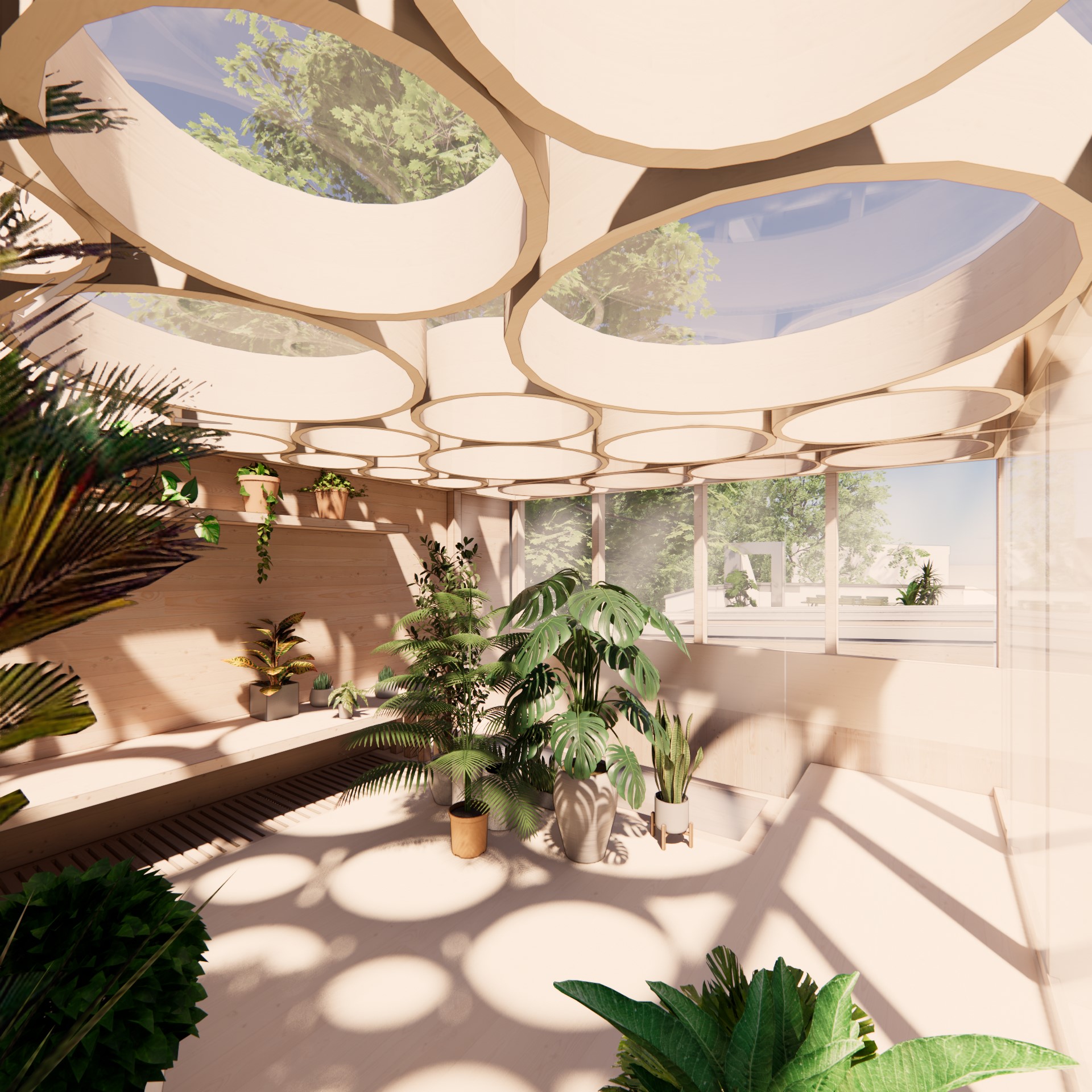
We embrace light from multiple angles in our studio and use 1:1 samples of perforated screens used in our Science Museum Library project to allow diffuse light to create changing shadows reminiscent of dappled light through trees.
We use retrofitted birch plywood for shelving, tables and seating where possible. This materiality used in décor, form and function brings in a warmth and comfort, a tie to nature that is proven to reduce blood pressure and heart rate.
2. Can the practice share examples where it has considered nature in decision making? For example by having a nature proxy to encourage eco-centric decision making, using natural systems as inspiration for the company structure, recognising the seasonal nature of people’s capacity and workload or celebrating equinoxes and solstices together.
No.
3. Is the practice supporting nature locally and nationally? For example, does the practice support local gardens, gardeners, planting programmes, rewilding programmes or advocate for changes in legislation to protect nature.
Our team volunteers at Triangle Site, the sustainable community garden from Global Generation in King’s Cross. We believe that giving back to our local, outdoor community is an essential part of our work. By working together to improve the environment, we can build stronger, more resilient communities and create a better world for everyone.
Project
1. Can the practice demonstrate projects which strive to match the performance of a mature ecosystem? As a minimum this would mean achieving biodiversity net gain.
No.
2. Is the practice working on material stewardship? For example, evidence could be shown through repeated use of low carbon materials, extensive material libraries and research or publications supporting responsible use of materials and elimination of waste.
No.
3. Do the majority of projects demonstrate the use of biologically-inspired approaches such as Bioregionalism, Biophilia, Biomimicry, Ecomimicry (also referred to as Ecosystems Thinking, Industrial Ecology or Industrial Symbiosis) or BioTRIZ?
No.
Creating a just space for people
Practice
1. Does the practice have a progressive EDI policy and can you evidence many forms of diversity, which are welcomed and acknowledged, within the practice?
Our EDI efforts are ongoing and at the forefront of studio conversation and we understand that inclusivity begins at the invitation to apply. We have included consciously inclusive wording for job adverts, removing gendered language and incorporating specific wording around equal opportunity employment. During a particular period of inequality of gender balance, we committed to a practice of interviewing all qualified female applicants for the position at hand. The result led in a 50/50 staff gender split and was highlighted in architectural press as a practical step others make take.
We partner with local educational institutions to invite students for practical, on-the-job experience. We work with Diamond Education Service, the Erasmus exchange programme and Yucan to offer work placement opportunities for students from various geographic and socioeconomic backgrounds, including young carers.
2. Does the practice operate a no overtime culture, meet the living wage consistently, and stipulate a fair salary ratio between staff of all levels?
We implement “no overtime culture” by setting clear boundaries on working hours to prioritize work-life balance and prevent burnout. We achieve this by setting clear goals and deadlines and regularly reviewing our programmes and team capacity to ensure that the workload isn’t overwhelming and that appropriate resources are available.
We ensure that we keep up with “living wage” benchmark for all employees by carrying out regular salary reviews to keep pace with living costs.
Maintaining a fair salary ratio between staff at all levels involves equitable compensation practices where salaries are determined based on factors like experience, qualifications, and job responsibilities rather than hierarchical status. We carry out regular salary reviews to address any disparities.
3. Does the practice support charities, community groups, social enterprises, action groups and others through pro-bono work, charitable giving or in-kind donations?
Our team has experience volunteering their time and resource supporting/preparing job seekers for employment opportunities and in the past year contributed 70 hours to this initiative. We have worked with the following organisation: Blueprint for All (previously the Stephen Lawrence Charitable Trust Building Futures programme) and Built By Us FLUID Diversity Mentoring Programme.
We regularly offer apprenticeships and work experience opportunities at our studio. We have an ongoing relationship with Diamond Education Service, Yucan and the Switch programme to offer work placement for students and young carers.
In 2023 we supported the New Architecture Writers group with unlimited access to our studio and its resources. In 2022 we funded a residency for PATCH Collective to research, write, and curate, all with unlimited access to our studio and its resources.
4. Does the practice publicly refuse to work with certain clients, suppliers or organisations on ethical grounds?
No.
Project
1. Do the projects demonstrate deep engagement with local stakeholders and end users? For example, is there evidence that your project engagement goes beyond consultation towards co-design?
No.
2. Do your projects create connected and resilient places which positively contribute to their neighbourhoods and allow equality of access? For example, do your projects create economic opportunity, retain value locally and generate social value?
No.
3. Do the majority of your projects promote equity in society, and consider all people, not only the building inhabitants? For example, do your projects show due regard for workers within the supply chain and take active steps to avoid modern slavery?
No.