
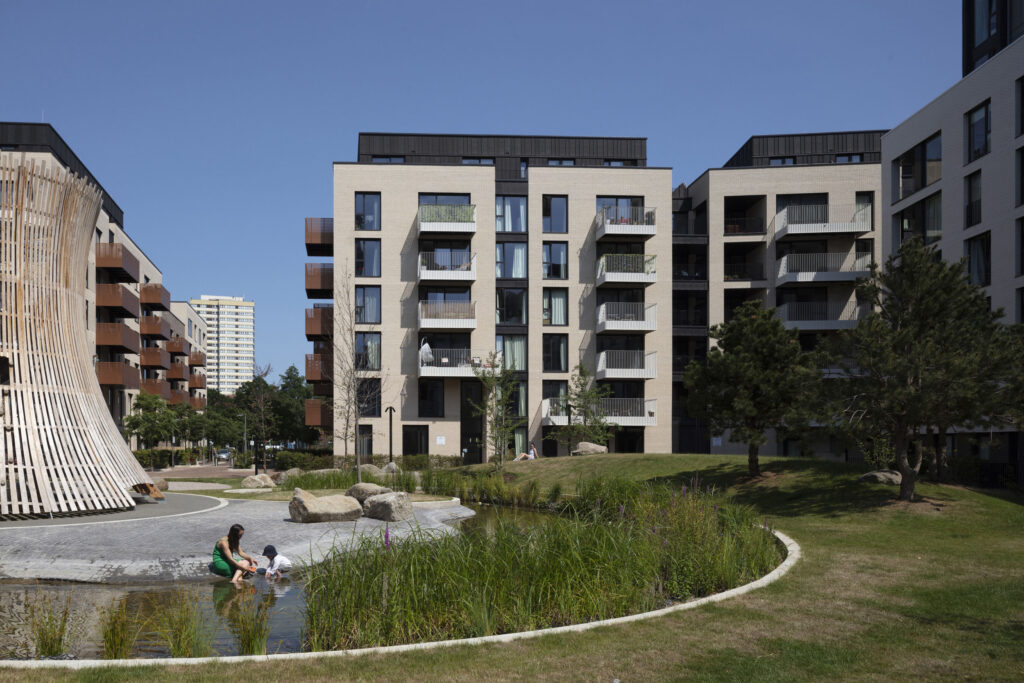
Submission by Churchman Thornhill Finch.
Being a good ancestor
Practice
1. Does the practice have a clearly stated purpose aligned with the planetary emergency? We are looking for a bold ambition here, and a practice culture which recognises the need for long-term thinking. For example, a strong mission, a theory of change, or a sustainability roadmap.
At Churchman Thornhill Finch, our purpose is simple: to make the world a better place. We design landscapes where people and nature thrive. Our aim is to create with care, guided by long-term thinking and a deep sense of responsibility. As a certified B Corp since 2023, we’re committed to systemic chang – balancing people, planet, and profit- embedding this commitment in our Articles of Association.
Our roadmap includes carbon literacy, carbon assessment on projects, and a net zero target by 2030. We embed climate and biodiversity thinking into every stage, from early concept to delivery.
We’re inspired by the belief that the world is something we make – and could just as easily make differently. So, we keep questioning, collaborating, and evolving.
2. Does the practice have a clear succession plan, which passes on ownership and protects the values and legacy of those who built and contributed to the practice? For example is the practice an employee owned trust.
Churchman Thornhill Finch is a B Corporation. We were certified in October 2023 – becoming one of the first UK landscape architecture practices to do so. Becoming a B Corp we amended our Articles to include wording that, in addition to profit, we recognised people and planet as stakeholders in our business decision making. This approach protects our values and legacy.
We underwent a transition on our structure with the retirement of our founding director, Chris Churchman, in November 2025. Since then, the remaining directors, Andrew Thornhill and David Finch, have opened the management to include our associates to form a Leadership Team. Together, we are planning the development of the practice, defining its values and vision. This summer we are sharing these with the practice. We are not yet an EOT – but this is where we are heading.
3. Does the practice share research and knowledge for the benefit of society and the wider world? For example, you regularly carry out post occupancy evaluation and share information with others.
No.
Project
1. Does the practice advocate for long-term thinking at the outset of projects? Do you initiate projects with long-term thinking and challenge the client on design life? Also, can the practice demonstrate that this approach has worked with a shorter or longer design life, or an innovative approach to financing or payback period?
We begin every project by thinking long-term – socially, ecologically, and economically. We focus on how a place will grow, evolve, and adapt over decades. We challenge clients on design life, questioning assumptions and reframing success beyond first-use or visual impact. Landscape, by its nature, demands long-term thinking.
At Silvertown, we’re helping regenerate a post-industrial site by reusing materials and protecting rare Open Mosaic Habitat – an approach rooted in long-term ecological value, not just short-term gain. This has required a commitment fof the client to test seed trials. In Bathampton Meadows, our early community engagement shaped a design that will evolve with local stewardship over time.
We also explore the economics. Our green infrastructure strategies often reduce long-term costs through natural flood management, tree planting, or soft interventions.
For us, longevity isn’t about durability alone – it’s about building places that communities can adapt, own, and care for.
2. Do your projects take account of the future climate and the need for resilience? For example, do the projects demonstrate flexibility, design for adaptation, design for disassembly, non-deterministic solutions, or demountable structures.
Climate resilience is embedded from day one – designing spaces that can accommodate a cloud burst, support drought-tolerant planting, develop layered habitats, shaded and cooler urban streets and parks, and space for wildness in the city. We design for flexibility, knowing the future is unpredictable.
At Silvertown, our work with Open Mosaic Habitat uses recycled substrates and evolves over time. It restores the unique biodiversity on the former industrial site. Many of our schemes include demountable furniture, loose-fit play, and reclaimed materials such as the Welsh timber fenders that were transformed into benches at Elderberry Walk.
We favour nature-based solutions: working with nature for the benefit of all living things. However, resilience isn’t just ecological – it’s social too. By working closely with communities and designing with care, we create places people feel responsible for, places they want to protect.
3. Do the majority of your projects go beyond mitigating negatives and towards optimising positives? For example, are they meeting or exceeding the RIBA 2030 Challenge.
We use the B Impact Assessment to hold up a mirror to our work. It helps us track, test, and improve the environmental impact of our projects – pushing us beyond business as normal toward regeneration. Under the ‘Environment’ pillar, we commit to designing with less: less waste, fewer emissions, lower impact.
We’re not just minimising harm – we’re building in ecological value. From carbon assessments to circular design thinking, we’re learning how to lighted our footprint and build more responsibly.
Our environmental score exceeded benchmarks for our country, sector, and size.
Co-evolving with nature
Practice
1. Does the practice use biophilia within the office or regularly host meetings and retreats in natural settings? For example do you have extensive planting within the office or rely on natural patterns and imagery for stress relief or quiet areas.
We believe nature belongs at the heart of work, not just in our projects, but in our studios too.
Our Bristol studio overlooks the harbour and opens back onto a private garden. In London, we’re tucked down a quiet street, with planting throughout the space and natural light wherever possible. Both studios include quiet corners, open desks, and shared meals and daily coffee breaks to support wellbeing and connection. We use the neighbouring green spaces as settings for catch-up walks with team members.
We take regular time out in nature – studio days out to places like Knepp and team walks on the Downs. Our projects often bring us outside too, from community workshops to on-site design sessions.
We value nature and the benefits that it brings to our people.
2. Can the practice share examples where it has considered nature in decision making? For example by having a nature proxy to encourage eco-centric decision making, using natural systems as inspiration for the company structure, recognising the seasonal nature of people’s capacity and workload or celebrating equinoxes and solstices together.
As a certified B Corporation, we’ve changed our Articles of Association to recognise society and nature as core stakeholders. This commitment shapes how we design and how we work.
We align with natural rhythms, not just in our landscapes, but in our studio culture. Flexible working is standard, with part-time roles, remote working options, and time to break for studio coffee breaks. We believe it’s about creating space for people’s lives, not just their output.
We have a studio gallery that celebrates the changes of the year, inviting the team to observe and share what they notice, such as seasonal flushes of colour and light.
It’s a quiet reminder that we are part of nature, not apart from nature.
3. Is the practice supporting nature locally and nationally? For example, does the practice support local gardens, gardeners, planting programmes, rewilding programmes or advocate for changes in legislation to protect nature.
Nature is at the heart of who we are. We’re a nature-based practice – designing for nature, championing green infrastructure, and supporting community-led greening.
At Bathampton Meadows, we worked with the National Trust on first of their ‘urban green corridors’, reconnecting communities with restored river meadows and wetland habitats. In cities, we bring nature back into everyday life – not just for wildlife, but for people’s health and happiness too.
We support nature through supporting our local communities. Outside our London studio, we helped co-design and plant Charlie’s Patch, a new community garden. In Bristol, we’ve supported Redcatch Community Garden’s next chapter with design and advice.
Wherever we work, we advocate for nature – through our projects, our partnerships, and our presence.
Project
1. Can the practice demonstrate projects which strive to match the performance of a mature ecosystem? As a minimum this would mean achieving biodiversity net gain.
We aim to go beyond biodiversity net gain, designing for ecosystems that thrive.
At the Wellcome Genome Campus, we’re targeting 20% net gain on a complex site. By weaving agroforestry into arable land, layering orchards with crops, we’re creating richer, more resilient habitats.
Outside Bath, our work with the National Trust supports a landscape that is planned to evolve over time. Livestock help manage the meadows, mimicking natural processes to maintain and diversify habitats.
With an in-house Building with Nature assessor, we embed ecological thinking from the outset. The majority of our projects exceed the statutory 10% gain – even where space is tight or conditions are tough.
For us, it’s not about meeting legislation, it’s about making places where life can flourish.
2. Is the practice working on material stewardship? For example, evidence could be shown through repeated use of low carbon materials, extensive material libraries and research or publications supporting responsible use of materials and elimination of waste.
No.
3. Do the majority of projects demonstrate the use of biologically-inspired approaches such as Bioregionalism, Biophilia, Biomimicry, Ecomimicry (also referred to as Ecosystems Thinking, Industrial Ecology or Industrial Symbiosis) or BioTRIZ?
We design with the belief that we are part of nature, not apart from it.
Biophilia runs through our work. At 60 London Wall, we transformed office terraces into green outlooks–planting-rich spaces that offer calm, connection, and a moment to breathe in the heart of the City of London.
Our landscapes reflect the natural systems they sit within. At Hayle North Harbour, the masterplan draws on the area’s layered cultural and natural histories, shaped over time by tides, winds, industry, and community. The result is a place that feels rooted and grown from the area.
We don’t mimic nature, rather we work with it, listen to it, and connect with it.
Creating a just space for people
Practice
1. Does the practice have a progressive EDI policy and can you evidence many forms of diversity, which are welcomed and acknowledged, within the practice?
We have an EDI Plan of Action, which is reviewed and updated on a regular basis. Our plan outlines our commitment to EDI within the practice and the wider industry and details a number of initiatives which we undertake to support this work.
As a certified B Corporation we measure and track data on our equality, diversity, and inclusion – including sex, rave, religion, and disability. We have a working group formed by members of the practice who promote ideas and policies that support members of our team, for example with young families or disabilities.
2. Does the practice operate a no overtime culture, meet the living wage consistently, and stipulate a fair salary ratio between staff of all levels?
We don’t promote the use of overtime or long working hours, however there are occasions where our staff do work extra hours. Our weekly studio meetings at the start of the week aim to identify peak workloads and allocate appropriate resources to avoid overtime and stress for the team members. Our culture is that we are a team, and we work collectively for the benefit of each member.
We are a Living Wage employer and as part of our B Corporation certification, committed to a fair maximum salary ratio across the practice.
3. Does the practice support charities, community groups, social enterprises, action groups and others through pro-bono work, charitable giving or in-kind donations?
We actively support charities, community groups, social enterprises, and others through various means. We have a charity and pro-bono services policy that encourages employees to engage with charitable causes. For example, for six years we have sponsored and supported Design West’s Shape My City programme.
We encourage and enable our employees to be involved in local communities by supporting them to take advantage of 17 hours volunteering allowance and celebrating their achievements. We raise awareness of our community themes among our employees, customer and the wider public, and empower employees to be able to influence the charitable organisations that the company supports.
We work in partnership with organisations where we can use our skills, expertise and reach to drive meaningful change on social issues, such as at Charlie’s Patch community garden Lambeth.
We align our community contributions including cash donations, volunteering time, matched funding with our priority community themes.
4. Does the practice publicly refuse to work with certain clients, suppliers or organisations on ethical grounds?
Within the practice we always review and carefully consider projects we may choose to bid and will decline opportunities where we feel the client, country, regime, project funding or other circumstances are at odds with our ethical principles. We share our decisions with the practice.
Project
1. Do the projects demonstrate deep engagement with local stakeholders and end users? For example, is there evidence that your project engagement goes beyond consultation towards co-design?
We’ve always believed that landscape architecture is most effective when everyone’s voice is heard. That’s why we collaborate widely with residents, community groups, organisations, researchers, charities and other stakeholders to understand fully what their requirements are and inform the brief and the design.
Notable projects where co-design has played a significant role includes our Glencoyne Square housing project in north Bristol for Southmead Development Trust. The project inception, team selection, and development were informed by the community. We worked closely with the residents to develop the design of the new park, public realm, and courtyard gardens.
The Kennington Oval Re-imagined project was co-designed with the community to create a vehicle-free streets for play, walking, and wheeling. This exciting temporary landscape is being monitored over nine months with feedback from the community and other stakeholders shaping the permanent scheme.
2. Do your projects create connected and resilient places which positively contribute to their neighbourhoods and allow equality of access? For example, do your projects create economic opportunity, retain value locally and generate social value?
Our purpose is to create positive change to communities and nature – we look to work on projects that can have a positive impact on local, economic, and social value
We design landscapes that support and promote active, healthy, social and sustainable lifestyles. Through inclusive and meaningful community consultation we create spaces that inspire a feeling of ownership, stewardship, and nurture a lasting positive legacy. We promote local growth through engagement with local manufacturers, sourcing local materials and products where possible.
Our Bath River Line project for Bath and North East Somerset Council created a vision for the proposed 10km linear riverside park through the city. Before any design, we engaged communities to understand their concerns and aspects they cherished. We undertook walking consultation groups to capture the widest views, including WECIL who connected us with Bath-based disability groups to join us.
3. Do the majority of your projects promote equity in society, and consider all people, not only the building inhabitants? For example, do your projects show due regard for workers within the supply chain and take active steps to avoid modern slavery?
As a certified B Corporation we place our social and environmental responsibilities at the heart of our practice. We endeavour to operate ethically in everything we do, from minimising our carbon footprint to supporting charities and sourcing local products as well as supporting our own employees through every stage of their careers
Our Modern Slavery Policy sets out our requirements to identify, assess, and mitigate the areas of risk where slavery or human trafficking may exist in our business or supply chains. This includes consideration in all parts of the world where the practice provides services. We also review and monitor the practice’s suppliers and sub-consultants, and assess the risk that they or their own suppliers and sub-consultants are susceptible to slavery and human trafficking.