
Submission by Broadway Maylan
Being a good ancestor
Practice
1. Does the practice have a clearly stated purpose aligned with the planetary emergency? We are looking for a bold ambition here, and a practice culture which recognises the need for long-term thinking. For example, a strong mission, a theory of change, or a sustainability roadmap.
We recognise the interrelated poly-crises of our times, and have formed a strategy, aligned across studios, to respond to them. BM believe that operating as a global practice carries both opportunity and responsibility in this regard. We are developing a “borderless” approach, which values the exchange of ideas across geographies while honouring the importance of locally grounded solutions. We believe that learning to respond to the complexity of the climate crisis demands a practice philosophy that shapes design & operations as a foundational response to shared planetary challenges and resource boundaries.
By working collaboratively across regions, we seek to address these challenges through design that is globally informed and locally attuned. We hope to see meaningful and measurable impact rising from this intersection of global and local to support long-term ecological and societal resilience.
2. Does the practice have a clear succession plan, which passes on ownership and protects the values and legacy of those who built and contributed to the practice? For example is the practice an employee owned trust.
Broadway Malyan is a majority Employee-Owned organisation, with the trust board representing all regions of the global business, and maintain and manage the interest of all the owner-employees of the practice.
Our long-term governance and profit-sharing model is designed to foster equitable transition from one generation of leadership to the next, upholding core values and creating a resilient platform for future generations. This model has been developed and refined over the past several years, evolving from a conventionally owned structure to one that democratizes decision-making and embeds collective responsibility across the practice. Stakeholder consultation is also central to our strategic planning, with an annual feedback framework informing our long-term business strategy.
These mechanisms not only strengthen institutional memory and adaptability but also ensure that our purpose and impact endure, even amid leadership transitions or external pressures. This model reflects our commitment to sustainable stewardship in a dynamic and evolving industry.
3. Does the practice share research and knowledge for the benefit of society and the wider world? For example, you regularly carry out post occupancy evaluation and share information with others.
No.
Project
1. Does the practice advocate for long-term thinking at the outset of projects? Do you initiate projects with long-term thinking and challenge the client on design life? Also, can the practice demonstrate that this approach has worked with a shorter or longer design life, or an innovative approach to financing or payback period?
Our practice actively advocates for long-term thinking from the outset of projects, particularly in large-scale urban and masterplanning work. We challenge short-term mindsets by promoting resilience – through workshops and visioning exercises, we help stakeholders imagine futures beyond conventional project timeframes, sharing evidence of the social, ecological, and financial benefits of longevity-focused strategies.
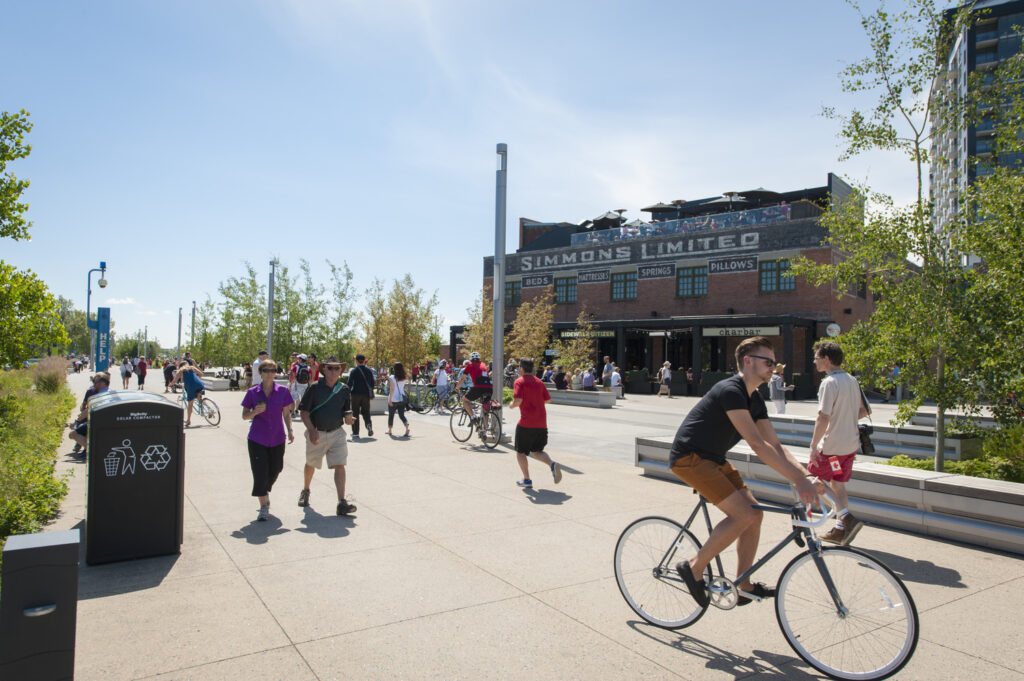
A powerful example is our regeneration masterplan for East Village in Calgary. The site – a flood-prone, underinvested area with a large homeless population – was transformed into a thriving mixed-use cultural district. We shifted the client’s perspective by reframing the project as a long-term civic opportunity. Our approach helped secure Community Revitalisation Levy funding, and enabled investment in flood attenuation, sustainable energy & infrastructure, and high-quality public spaces.
The outcome after 18 years: improved land values, sustainable investment into the community, and a revitalised, walkable urban community now ranked among the world’s most liveable cities.
2. Do your projects take account of the future climate and the need for resilience? For example, do the projects demonstrate flexibility, design for adaptation, design for disassembly, non-deterministic solutions, or demountable structures.
Climate resilience is a fundamental driver in our projects, especially in large-scale masterplans where impacts will unfold over decades. Analysis of regional climate projections and risks such as extreme heat, flooding, water and food scarcity, energy intermittency, and population change allows us to design adaptive strategies for a range of climate scenarios.
Our work on the Greater Muscat Structure Plan exemplifies this. Commissioned to support Oman’s Net Zero 2050 and Vision 2040 goals, the plan integrates resilient urban growth with critical infrastructure upgrades, including enhanced flood attenuation via restored wadis, greywater reuse, and improved coastal profiling to withstand storm surges. The introduction of public transport networks reduces car dependency, supports compact urban forms, and lowers emissions. These measures improve long-term liveability while addressing Muscat’s vulnerability to sea level rise, flash flooding, and extreme heat. This climate-informed approach positions the city, and our client, on a resilient and sustainable path.
3. Do the majority of your projects go beyond mitigating negatives and towards optimising positives? For example, are they meeting or exceeding the RIBA 2030 Challenge.
No.
Co-evolving with nature
Practice
1. Does the practice use biophilia within the office or regularly host meetings and retreats in natural settings? For example do you have extensive planting within the office or rely on natural patterns and imagery for stress relief or quiet areas.
No.
2. Can the practice share examples where it has considered nature in decision making? For example by having a nature proxy to encourage eco-centric decision making, using natural systems as inspiration for the company structure, recognising the seasonal nature of people’s capacity and workload or celebrating equinoxes and solstices together.
No.
3. Is the practice supporting nature locally and nationally? For example, does the practice support local gardens, gardeners, planting programmes, rewilding programmes or advocate for changes in legislation to protect nature.
No.
Project
1. Can the practice demonstrate projects which strive to match the performance of a mature ecosystem? As a minimum this would mean achieving biodiversity net gain.
Urban Green and Blue Infrastructure (UGBI) systems are promoted and supported within our masterplans, enhancing ecological conservation and contributing to community well-being.
These networks create a spatial foundation for a Nature Based Solutions approach, integrating ecosystem enhancing infrastructure for positive environmental impact. Interconnected green and blue ecosystems through corridors and open spaces help the urban fabric adapt to climate change pressures, including flooding, drought, urban heat islands and habitat loss.
Green infrastructure refers to natural and semi-natural systems that provide multiple environmental, social and economic benefits, while blue infrastructure encompasses water bodies and systems, such as ponds, rain gardens, lakes, wetlands and stormwater management features.
When designed optimally, UGBI can provide numerous benefits for coexisting human and non-human ecology; including reduced urban heat island effect, enhanced walkability and bike-ability, improved outdoor comfort, better stormwater management, reduced pollution, increased natural habitats and biodiversity and improved ecosystem services.
2. Is the practice working on material stewardship? For example, evidence could be shown through repeated use of low carbon materials, extensive material libraries and research or publications supporting responsible use of materials and elimination of waste.
No.
3. Do the majority of projects demonstrate the use of biologically-inspired approaches such as Bioregionalism, Biophilia, Biomimicry, Ecomimicry (also referred to as Ecosystems Thinking, Industrial Ecology or Industrial Symbiosis) or BioTRIZ?
Our masterplanning work regularly integrates biologically inspired approaches such as bioregionalism and ecosystem thinking, particularly in climate-vulnerable geographies.
In projects like the Greater Muscat Structure Plan (GMSP), we applied long-term resilience thinking grounded in regional ecology and climate projections. Our strategies accounted for rising sea levels, water scarcity, flood risks, and urban heat island effects, using nature-based solutions to manage stormwater, recharge aquifers, and support biodiversity. We reused greywater for green infrastructure and planned coastal profiling to mimic natural dune and tidal behaviours. These ecologically attuned interventions were coupled with regenerative transit networks, low-impact development, and district-level planning that mirrors the functioning of interconnected ecosystems.
This biologically inspired lens enabled us to propose development that remains functional, adaptive, and low-carbon far into the future. The GMSP has become a national blueprint for sustainable growth, proving the viability of and potential for significant impact through biomimetic and ecosystem-based planning on both socio-economic and environmental outcomes.
Creating a just space for people
Practice
1. Does the practice have a progressive EDI policy and can you evidence many forms of diversity, which are welcomed and acknowledged, within the practice?
Broadway Malyan has a progressive Equality, Diversity, and Inclusion (EDI) policy and fosters an environment where many forms of diversity are not only welcomed but integrated into daily practice.
As a global firm, the practice is inherently more diverse than many equivalent organisations, with a workforce composed of professionals from a wide range of cultural, ethnic, and national backgrounds. This international make-up fosters a healthily diverse environment across studios, strengthened by a strong culture of cross-studio collaboration and international mobility, one we seek to strengthen with our “Borderless” approach.
Diversity of thought is viewed as a strength, and the practice’s EDI commitments are embedded not just in policy, but in lived experience – reflected in team compositions, leadership visibility, inclusive project approaches, and the promotion of international working and our knowledge exchange programme.
2. Does the practice operate a no overtime culture, meet the living wage consistently, and stipulate a fair salary ratio between staff of all levels?
No.
3. Does the practice support charities, community groups, social enterprises, action groups and others through pro-bono work, charitable giving or in-kind donations?
Our studios support a diverse range of charities, community groups, and social initiatives through locally focused pro-bono work, sponsored activities, corporate charitable giving and in-kind contributions. We encourage studios to engage with causes that matter in their regional context – whether by offering design expertise to grassroots organisations, fundraising for local charities, or supporting community events and education initiatives. This decentralised approach ensures that our impact is meaningful, place-based, and responsive to the needs of each community in which we work.
For example, our London studio is actively building relationships with the local BID, We Are Waterloo, with who we are partnering on design workshops as part of the London Festival of Architecture (LFA) which focus on reimagining and redesigning our local area in collaboration with the local community.
4. Does the practice publicly refuse to work with certain clients, suppliers or organisations on ethical grounds?
No.
Project
1. Do the projects demonstrate deep engagement with local stakeholders and end users? For example, is there evidence that your project engagement goes beyond consultation towards co-design?
We prioritise inclusive processes from the outset, using multilingual tools, accessible visuals, and collaborative workshops to ensure meaningful participation – especially for marginalised and underrepresented groups. This approach is illustrated in the Surabaya Urban Transformation project in Indonesia, where we co-developed a regenerative vision for “Dolly”, a former red-light district, in partnership with local government, NGOs, youth, women’s groups, and people with disabilities.
Through sustained engagement, trust and community ownership was built, transforming public perception and supporting capacity-building for local businesses, youth employment, and inclusive urban governance. Pilot projects, low-tech sustainable interventions, and creative place-branding catalysed change, with the community shaping strategies around green infrastructure, mobility, education, and economic development.
The initiative used a tailored tool to integrate UNSDG goals in decision making, implementation and monitoring. It also demonstrates scalability through bottom-up, resilient, and socially inclusive urban regeneration – nicknamed the “Dolly Effect”, it motivated the participation of an additional 180 kampungs (neighbourhoods).
2. Do your projects create connected and resilient places which positively contribute to their neighbourhoods and allow equality of access? For example, do your projects create economic opportunity, retain value locally and generate social value?
We cultivate thriving, interconnected communities by embedding resilience and equity across all levels–from spatial structure to social systems. Our masterplans aim not only to transform physical environments but also to empower people through co-developed strategies that improve access to opportunities and long-term stewardship. Public realm designs prioritise inclusivity, while plans often accommodate informal economies, circular resource flows, and cooperative enterprises.
For instance, our Calgary East Village masterplan transformed a derelict riverside district into a vibrant cultural quarter with public spaces, walkable connections, and high-quality mixed-use development–raising land value, attracting inward investment, and generating long-term civic pride.
Similarly, in Surabaya, Indonesia, we helped regenerate a former red-light district into an inclusive, resilient neighbourhood, using low-tech, participatory urban interventions that empower local economies, celebrate cultural identity, and build long-term community ownership.
3. Do the majority of your projects promote equity in society, and consider all people, not only the building inhabitants? For example, do your projects show due regard for workers within the supply chain and take active steps to avoid modern slavery?
No.