
Submission by Atelier Ten.
Being a good ancestor
Practice
1. Does the practice have a clearly stated purpose aligned with the planetary emergency? We are looking for a bold ambition here, and a practice culture which recognises the need for long-term thinking. For example, a strong mission, a theory of change, or a sustainability roadmap.
Atelier Ten’s mission is to lead the transformation to a regenerative built environment by providing enlightened design, engineering and consulting. We make buildings and places do more with less by challenging conventional thinking. Our purpose is to help our clients and collaborators make informed design decisions, and co-create living spaces that give back to wider environment.
Since 2023, our designs strive to follow the principles of our Absolute Net Zero Carbon roadmap, pushing projects to achieve zero emissions from conception through operation without the use of carbon offsets. But we don’t only focus on carbon. We recognise the intriguing interplay between thriving ecosystems, human well-being and climate resilience to come up with holistic design solutions.
How do we do this? First thinking. Then doing. We develop innovative solutions that go beyond what’s expected, and push our clients (nicely) to focus on long-term value creation for people and planet.
2. Does the practice have a clear succession plan, which passes on ownership and protects the values and legacy of those who built and contributed to the practice? For example is the practice an employee owned trust.
Atelier Ten is currently going through a shift in leadership structure, with our founder Patrick Bellew stepping down for retirement after 35 years of moving the dial in sustainable design. The ‘second generation’ of environmental engineers and designers is now taking over the responsibility of nurturing the Atelier Ten ethos and culture across the wider team. Patrick still serves as a ‘Strategic Adviser’ and comes in regularly for project design critics/reviews – a way to link legacy of decades of expertise to future success.
In 2020, Atelier Ten became part of the Surbana Jurong Group (SJ) – a global urban infrastructure, engineering, architecture and managed services firm headquartered in Singapore. Despite our modest size, our role in this organisation of more than 16,500 international talents is to reinforce and implement regenerative practices across the group, with Patrick Bellew serving as the Chief Sustainability Officer until January 2025.
3. Does the practice share research and knowledge for the benefit of society and the wider world? For example, you regularly carry out post occupancy evaluation and share information with others.
Cutting-edge design solutions rooted in innovation and third horizon thinking require continuous research and curious minds. We cultivate this through our internal Practice Groups (e.g. Materials and Energy practices), and regularly share insights, successes, and challenges through publication of case studies and thought leadership pieces.
- Our team contributes to academia, lecturing at A+A, UCL, and RCA.
- We developed Pathfinder, an open-source, web-based tool for climate-positive landscape design
- We actively engage with the wider industry–we’re founding members of the UKGBC, and sponsor key events such as Footprint+ (where we curated the 2024 Retrofit Agenda stage) and the 2024 CTBUH Conference, where we led a workshop on nature-based solutions and biomimicry
- This year, we’re expanding our outreach through our new NLA Partnership, where we aspire to contribute to expert panels, conferences, seminars and technical symposiums.
- We also provide feedback to industry consultations, including the UK Net Zero Carbon Buildings Standard (NZCBS).
Project
1. Does the practice advocate for long-term thinking at the outset of projects? Do you initiate projects with long-term thinking and challenge the client on design life? Also, can the practice demonstrate that this approach has worked – with a shorter or longer design life, or an innovative approach to financing or payback period?
All our project designs are guided by long-term thinking, as we believe this to be a fundamental prerequisite for shaping regenerative environments. We think we have the responsibility to ensure our designs incorporate longevity, flexibility, adaptability and circularity – essential ingredients for resilience that ultimately extends design life way beyond the ‘expected 60’ to create intergenerational value.
An example of ‘longevity by design’ is our Federation Square project completed in 2002 – an award-winning arts and media development in Australia: The glazed atrium presented a significant challenge to eliminate overheating without using mechanical cooling. Inspired by termite mounds, we proposed an innovative solution in the form of the largest thermal labyrinth in the world – a thermal ‘battery’ that captures night cooling to passively provide temperature reduction on hot summer days. Operational to date, Federation Square proves the powerful concept of integrating nature-inspired design into modern architecture that endure for centuries.
2. Do your projects take account of the future climate and the need for resilience? For example, do the projects demonstrate flexibility, design for adaptation, design for disassembly, non-deterministic solutions, or demountable structures.
As mentioned above – resilience is a core design principle we employ across all our projects. Advocating for climate responsive, flexible and circular design is one of the most important parts of our daily work, as we believe this to be the limiting nutrient in future-proofing our built environment to unlock real holistic value.
We do this by leading workshops on what design for flexibility, adaptability, durability, disassembly and climate resilience really means and looks like, highlighting the benefits for both people and planet. We then do detailed computational analysis to optimise performance and comfort, responding to bioclimatic conditions.
An example of this is our Google Mountain View’s flexible office building in the US, where we through extensive climate analysis and comfort studies shifted the initial glass dome design (subject to severe risk of overheating) to a productive envelope with bespoke PV tiles, without compromising indoor light quality.
3. Do the majority of your projects go beyond mitigating negatives and towards optimising positives? For example, are they meeting or exceeding the RIBA 2030 Challenge.
As stated in our mission, our ambition is to achieve positive and regenerative outcomes in all our designs. We use a comprehensive toolbox, combining quantitative and qualitative analysis, to support this. Ideally, we’re involved from the early stages of a project–where we can have the greatest impact –guiding clients through target setting, pre-redevelopment audits, energy modelling, Whole Life Carbon assessments, material and circularity workshops etc.
Regardless, we benchmark design performance using the RIBA 2030 targets and other industry frameworks, such as the emerging SBTi-aligned asset-level targets. We’re also encouraged by the increased uptake of NABERS certifications, which bridges design intent and actual operational performance.
However, we do believe it’s important not to fixate on a narrow set of specific targets at the expense of systemic sustainability and the broader project vision. Every project is different, and maintaining a holistic perspective allows us to respond to unique challenges and opportunities with meaningful and lasting outcomes.
Co-evolving with nature
Practice
1. Does the practice use biophilia within the office or regularly host meetings and retreats in natural settings? For example do you have extensive planting within the office or rely on natural patterns and imagery for stress relief or quiet areas.
While our London office has room to grow before it could be called a showcase of indoor biophilia, we’re fortunate to share a tranquil courtyard–anchored by a majestic willow tree and lush planting–with fellow creatives at Perseverance Works. We actively encourage staff to use this space for informal meetings, socialising, and taking restorative breaks outdoors.
As part of our annual sustainability week, Regenerate, we hosted a ‘Nature Away Day’ at Hackney Marshes, where Atelier Tenners took part in grounding meditations, nature-based games, and herbal remedy making. The immersive experience was deeply appreciated, and we plan to make it a yearly tradition to nurture well-being and strengthen our connection with nature.
We used to organise cycling trips and dragon boat races–this feels like the perfect prompt to bring them back!
2. Can the practice share examples where it has considered nature in decision making? For example by having a nature proxy to encourage eco-centric decision making, using natural systems as inspiration for the company structure, recognising the seasonal nature of people’s capacity and workload or celebrating equinoxes and solstices together.
Preserving and enhancing nature in our built environment is central in our decision making, both in our designs and operations, as we recognise the interconnection between thriving ecosystems, human well-being and climate resilience – a prerequisite for holistic, regenerative outcomes.
Our annual sustainability week is planned around World Environment Day, where we dedicate a day to ‘Nature’ to reflect on how to ensure nature is always a stakeholder in our work. 2025 themes will be Conservation, Biodiversity, Biophilia and Nature Based Solutions.
Our US office offers a ‘summer schedule’ by working more Monday-Thursday and less on Friday, taking advantage of longer days and allowing opportunity for longer weekend escapes. We used to celebrate ‘Daylight Day’ by switching off lights during the summer solstice – again, great nudge to pick this back up!
In addition, we only use eco-labelled cleaning products, paper from responsibly sourced wood and source for renewable electricity.
3. Is the practice supporting nature locally and nationally? For example, does the practice support local gardens, gardeners, planting programmes, rewilding programmes or advocate for changes in legislation to protect nature.
As part of our annual sustainability week, Regenerate, we invited staff to vote for nature-focused charities to receive a financial contribution. The initiative encouraged active participation and supported our ongoing commitment to environmental stewardship.
The top three charities selected were The Woodland Trust, Trees for Cities, and London Wildlife Trust, each receiving a donation from Atelier Ten.
In celebration of Nature Day, team members were also invited to collect and plant ‘flowers for bees’ seed packets–promoting biodiversity through small but meaningful actions.
Uniquely, the voting was done using old batteries brought in from home. The more batteries placed in a charity’s voting bucket, the greater the contribution it received. This creative approach not only engaged staff in philanthropy, but also raised awareness about the importance of proper battery disposal to prevent harmful toxins from entering our environment.
Project
1. Can the practice demonstrate projects which strive to match the performance of a mature ecosystem? As a minimum this would mean achieving biodiversity net gain.
We consistently aim to maximise Biodiversity Net Gain (BNG) across our projects–but more importantly, we take a holistic approach, considering the functional role of nature in design. This includes identifying key ecosystem services our projects can support, such as air purification, water retention and recycling, and human well-being. In some cases, we even design specifically for plants.
- EDEN, Dundee: Transforms a former industrial site into a self-sustaining, remediating ecosystem.
- Eden, Manchester: Hosts Europe’s largest green façade–350,000 plants that absorb carbon, improve air quality, and harvest rainwater
- Roots in the Sky, London: A 1.4-acre rooftop forest with 100+ trees and thousands of plants–a true ‘tenant of nature’
- Google Kings Cross, London: A ‘landscraper’ topped with habitats for native plants and protected animal species (open lawns, wildflower meadows, large trees)
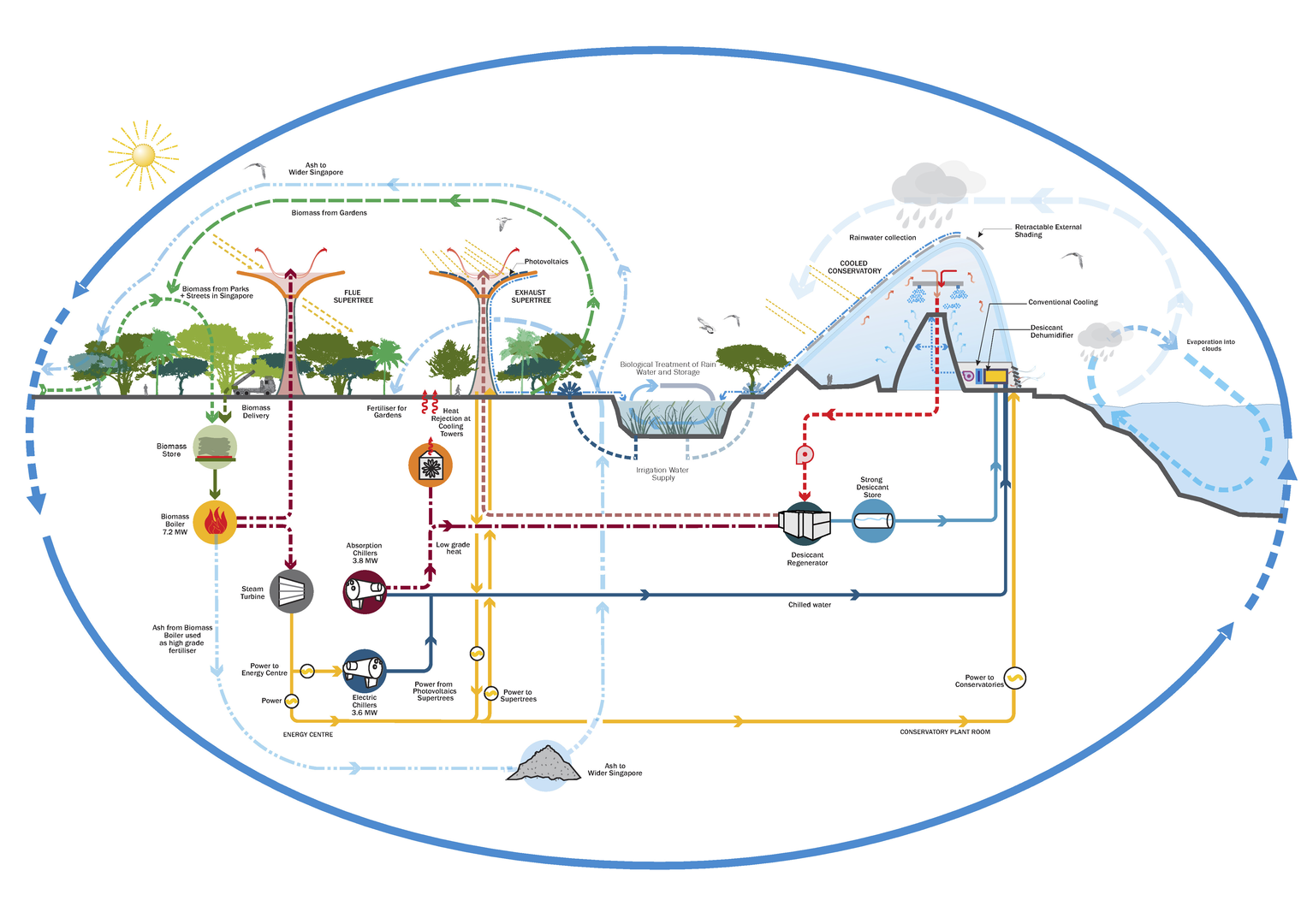
- Projects specifically designed for plants: Gardens by the Bay and Jewel Changi Airport in Singapore, Alpine House in Kew Gardens, Woolbeeding Glasshouse.
2. Is the practice working on material stewardship? For example, evidence could be shown through repeated use of low carbon materials, extensive material libraries and research or publications supporting responsible use of materials and elimination of waste.
Advocating for sustainable resource use is central to our work–starting with lean design as the first priority, followed by the use of circular and low-carbon materials.
In addition to leading material workshops focused on efficiency, durability, and circularity (see above), we translate these discussions into tangible project actions through two key tools:
Circularity Materials & Design Tracker: A bespoke tool developed to ensure that a project’s circularity goals are implemented in practice. It uses pre-demolition audit findings as a ‘design brief’, guiding the team to design in response to identified reuse opportunities. Once agreed with the client, the tracker becomes part of the demolition contractor’s tender package.
Whole Life Carbon Assessments: We present a comprehensive analysis of low-carbon and circular material options, engage with suppliers in the reuse and secondary markets, and produce an interactive waterfall diagram that maps embodied carbon reduction strategies alongside risk and cost considerations.
3. Do the majority of projects demonstrate the use of biologically-inspired approaches such as Bioregionalism, Biophilia, Biomimicry, Ecomimicry (also referred to as Ecosystems Thinking, Industrial Ecology or Industrial Symbiosis) or BioTRIZ?
We recognise that regenerative design principles are rooted in the ingenuity of natural environments. Bio-climatic design is our default approach in all our projects, as the performance of a building (resource use and comfort) is grounded in how well it responds to local climate conditions and surrounding environment. We also draw inspiration from the ingenuity of natural shape, processes and systems (biomimicry) to optimise performance and embed system-thinking in our designs, responding to site specific constrains and opportunities.
Project examples:
- Roosevelt Presidential Library, US: Holistic carbon neutrality through applied systems-thinking (earth-sheltered structure under biodiverse roof protecting from winter winds, restoration of local ecology by grazing agriculture to establish “carbon sink” etc.)
- Bee’ah Headquarters, UAE: Design adapted to local climate patterns and resources to optimize resource use
- Esplanade, Singapore: Shading design inspired by the durian fruit for optimal performance
- Federation Square, Australia: Thermal labyrinth inspired by termite mound passive ventilation mechanisms
Creating a just space for people
Practice
1. Does the practice have a progressive EDI policy and can you evidence many forms of diversity, which are welcomed and acknowledged, within the practice?
As a team of diverse nationalities and backgrounds, our Equity, Diversity, Inclusion, and Belonging (EDIB) group plays an active and influential role within the practice. In London, the EDIB group advises the board on maintaining and enhancing inclusive practices, drawing on insights from regular Diversity and Inclusion surveys to identify areas for improvement.
EDIB resources and activities
- Mental health and well-being platform providing resources on stress management and guidance on dealing with discriminatory behaviour.
- EDIB calendar highlighting religious and non-religious holidays and cultural events, officially shared within the office.
- Culture Days’, held twice a year, where staff are invited to bring food or items that reflect their cultural identity.
- ‘Focus indicators’ for desks to help signal when individuals prefer not to be disturbed.
- Talks and workshops, including topics such as ‘Autism and Neurodiversity in the Workplace’, to foster awareness and inclusion.
2. Does the practice operate a no overtime culture, meet the living wage consistently, and stipulate a fair salary ratio between staff of all levels?
We meet Living Wage requirements and regularly benchmark salaries across all levels against industry standards to support fair and equitable compensation. While we do not encourage overtime as a standard practice, we operate in a deadline driven sector which means that our teams sometimes work longer than their contracted hours in a given week. When that happens, we have Time-Off-In-Lieu policies in place. We monitor all our staff’s time to ensure that nobody is overstretched, and engage in open discussions when issues are raised–ensuring a balanced and supportive working environment.
3. Does the practice support charities, community groups, social enterprises, action groups and others through pro-bono work, charitable giving or in-kind donations?
A few of our initiatives listed below:
- In 2008, we established the Atelier Ten Foundation to channel our skills and influence toward empowering others to improve the built environment globally. We reinvest a portion of our profits into initiatives that allow our people to apply their expertise in ways that help meet humanitarian needs.
- One of the core pillars of our Sustainability Charter is People. As part of our annual sustainability week, Regenerate, we dedicate a day to philanthropy–supporting local businesses and inviting staff to vote for a charity to receive a financial contribution from Atelier Ten.
- To mark Black History Month, we celebrate local Black-owned businesses by supporting Dark Sugars, a female-owned chocolatier based in Brick Lane.
- In 2024, we proudly sponsored the PedElle charity cycle ride for women in real estate, supporting Coram, a charity that champions the rights and welfare of children.
4. Does the practice publicly refuse to work with certain clients, suppliers or organisations on ethical grounds?
We follow a set of ethical principles that help guide the type of work we take on. Where there is uncertainty or concern, we foster a culture of openness where all voices are welcomed and respected.
While we haven’t made formal public statements about declined projects, we are transparent in our decision-making and open to discussing the reasoning behind such choices – dialogue is important to us.
Project
1. Do the projects demonstrate deep engagement with local stakeholders and end users? For example, is there evidence that your project engagement goes beyond consultation towards co-design?
We’re convinced that co-design with local stakeholders is essential to the long-term success of any project. As designers, we must understand the needs and values of the community to foster a sense of belonging, encourage stewardship, and maintain a strong social license to operate.
In our Sustainability Implementation Plan (SIP) processes, we engage with a wide range of stakeholders to ensure that key interests are heard and concerns addressed early. This becomes particularly vital–and often more complex–in regenerative masterplanning, where meaningful collaboration is foundational. A strong example is Project Phoenix in Lewes.
From the outset, our client Human Nature employed an exemplar ‘Circular engagement system’, built on principles of continuous involvement of local residents, interest groups and specialist practitioners. With an emphasis on participatory design, transparent communication, and community activation (festivals, concerts, and exhibitions), Project Phoenix moves beyond traditional consultation–shifting from simply asking questions to actively responding through co-design.
2. Do your projects create connected and resilient places which positively contribute to their neighbourhoods and allow equality of access? For example, do your projects create economic opportunity, retain value locally and generate social value?
We believe that a genuine sense of belonging is essential to fostering community stewardship and long-term resilience–something that grows from inclusive design and meaningful local engagement. This not only delivers social benefits, but also lays the groundwork for creating lasting environmental and economic value within communities.
As sustainability practitioners, we consistently advocate for design solutions that generate social and intergenerational value, even in the most unexpected contexts.
A clear example is Chelsea Barracks, a high-end residential development where we successfully championed public access and permeability–ensuring that the site’s gardens remain open to the wider community. Unlike many nearby private squares that remain gated and exclusive, these green spaces welcome neighbours and visitors alike, helping the development integrate meaningfully into the local urban fabric.
3. Do the majority of your projects promote equity in society, and consider all people, not only the building inhabitants? For example, do your projects show due regard for workers within the supply chain and take active steps to avoid modern slavery?
We’re passionate about championing the health, wellbeing, and opportunity of those building our projects–not just those who occupy them. We actively advocate for construction worker welfare and push for local apprenticeship schemes that create pathways into the industry.
A great example is our Blossom Street project, where we went beyond the standard approach by embedding a dedicated section on worker wellbeing into the Employer’s Sustainability Requirements–ensuring that care for people on site was treated as a core project value, not an afterthought.