
Submission by Assemble.
Being a good ancestor
Practice
1. Does the practice have a clearly stated purpose aligned with the planetary emergency? We are looking for a bold ambition here, and a practice culture which recognises the need for long-term thinking. For example, a strong mission, a theory of change, or a sustainability roadmap.
At the core of Assemble’s mission is a commitment to use design as a tool to respond to the environmental, social and economic challenges we face today. We believe that built examples along with critical reflection are the most effective means to have a positive impact. Responding to ecological crises and climate breakdown requires projects to be grounded in their physical and social locality. We know that lasting ecological, economic and social value can only be achieved through a circular economy approach, integrating local participants and wider stakeholders in the development of a site from the start, putting participation at the heart of delivery. Throughout Assemble’s life-time we have delivered this in a number of ways, from the careful design of buildings, to constructing them ourselves and opening that process up to the public, and creating organisations that will go on to run projects and acting as board members.
2. Does the practice have a clear succession plan, which passes on ownership and protects the values and legacy of those who built and contributed to the practice? For example is the practice an employee owned trust.
Assemble has always operated as a collective. We began as a CIC in 2011. 7 years later we formed a partnership, with the express ambition of all employees having the opportunity to shape the direction of the practice. All employees are given the opportunity to join the partnership as full partners after 2 years FTE working at Assemble. Partners are able to join management teams within Assemble that reflect their area of interest or expertise. Partners meet every quarter to vote on the governance and financial budget of the practice. Today the partnership is a 50/50 split between founding partners and newer partners with everyone having an equal vote. Both new employees and partners are encouraged to bring new projects into the office. The success of Assemble has been for individuals to find their own voice within the collective, through procuring projects that advance their own interests and skillset.
3. Does the practice share research and knowledge for the benefit of society and the wider world? For example, you regularly carry out post occupancy evaluation and share information with others.
Our projects frequently involve the production of research that is publicly produced. Examples include: a published book about the process of designing and building Le Magasin Electrique for Atelier Luma; ‘Raise the Roof’ a publication on building ecological dwellings in Bridport; ‘Make Don’t Make Do’, strategies for public realm interventions around Stratford High Street; and ‘Pitch for a Pitch’, a proposal for supporting grassroots women’s football.
As a practice and as individuals we contribute writing to publications, books and journals about our methods and work. We have collectively written books (Making Ground, ed. Jane Hall, Phaidon, and Common Treasures, ed. James Binning and Giles Smith [forthcoming]), broadcast (Sympathy of Things, Radio 4). We have taught and lectured extensively and internationally, sharing how we work, and our ideas about how to make good work equitably and ecologically. We are currently in our fifth year running a design studio in EPFL, Lausanne.
Project
1. Does the practice advocate for long-term thinking at the outset of projects? Do you initiate projects with long-term thinking and challenge the client on design life? Also, can the practice demonstrate that this approach has worked – with a shorter or longer design life, or an innovative approach to financing or payback period?
We always undertake design for the long term, regardless of the length of the project. In our work in Venice for the Palazzo delle Zattere we developed a strategy for the site that was critical of the short-term-ist way that most cultural activities in Venice are undertaken (La Biennale e.g.) and instead proposed that cultural institutions in Venice needed to take a long-term and local approach to working in the City. Our proposals included a public library, artist residencies and a public garden which was realised as the Laguna Viva project. Our ‘Fleeting Forest’ installation is an example of designing within the context of a short-term installation but for the long-term. The entire installation was designed so that it could biodegrade, be reused or – in the case of the trees – be relocated permanently to a public park in Southwark we are working on.
2. Do your projects take account of the future climate and the need for resilience? For example, do the projects demonstrate flexibility, design for adaptation, design for disassembly, non-deterministic solutions, or demountable structures.
Yardhouse was an affordable workspace building used as a pilot for creative workspace in the Olympic Park. Due to the short-term nature of the site the building was designed to be easily dismantled and rebuilt elsewhere. The timber barn-like structure was simply arranged using off-the-shelf materials, taking an economic approach to construction. Like the London brick of the 19thC, the construction method of OTOProjects was based on using materials readily available on site at little or no material cost; in this case, demolition rubble rather than clay. The earth, rubble and gravel on the site was gathered, sieved, bagged and compressed: transforming waste into giant building blocks. Deep rubble walls were finished with decorative ‘rubbledash’ render and topped with a lightweight timber roof. The project was meant to be temporary; upon demolition, the building returned to the rubble that was found on site. 13 years later it’s still standing.
3. Do the majority of your projects go beyond mitigating negatives and towards optimising positives? For example, are they meeting or exceeding the RIBA 2030 Challenge.
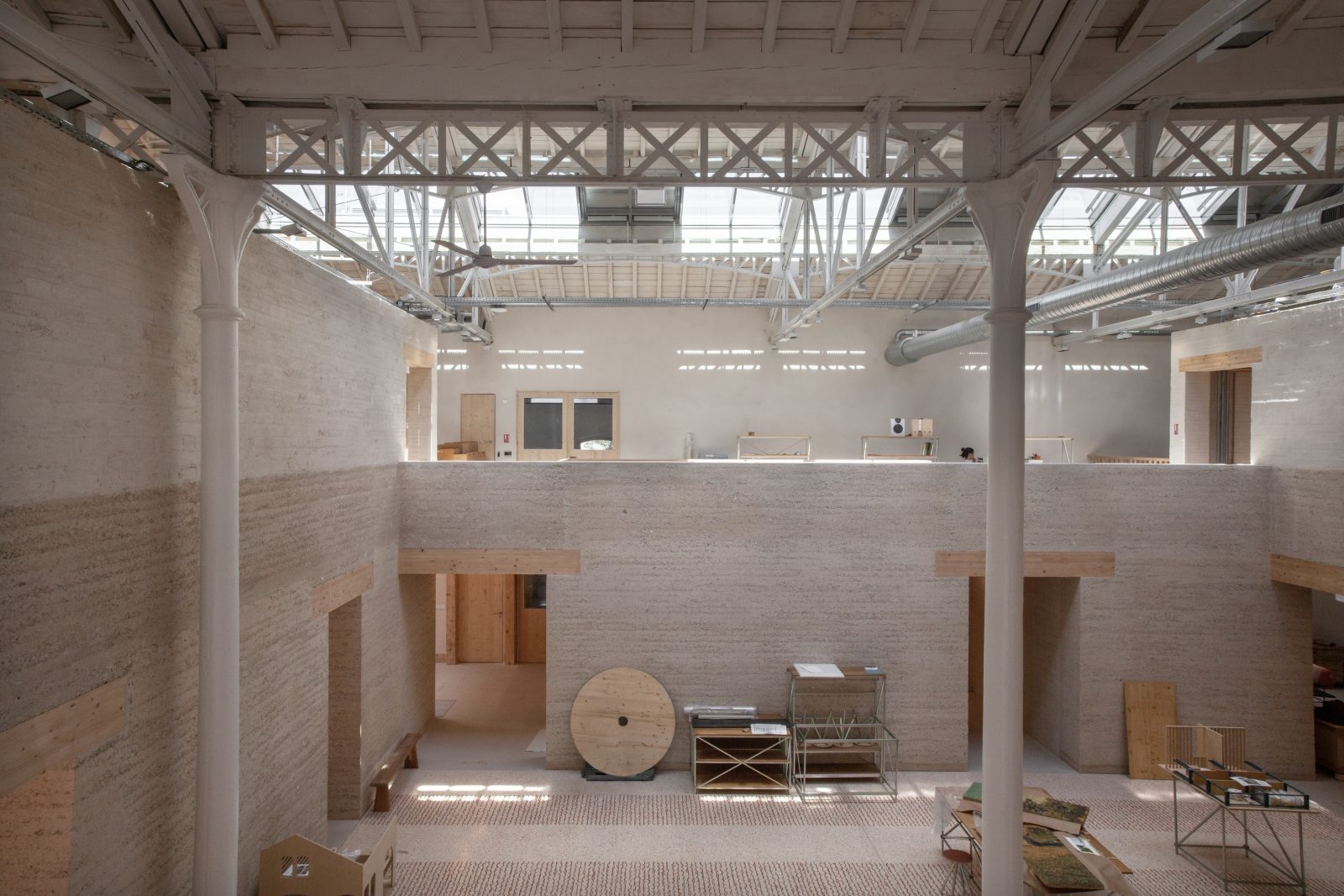
In a number of our projects we’ve recognised that while processes and techniques of building more sustainably and within a circular economy aren’t new, our challenge is to prove these processes so they can be trusted in the mainstream, recognising that this is best achieved through collaboration. A key example of this is Le Magasin Electrique, designed in collaboration with Atelier Luma, and BC architects, where we set out an ambition to create a largescale flagship piece of bioregional design that facilitates, encourages and expands regionally oriented production, using design as a tool to respond to the environmental social and economic challenges we face today. The goal was to create a building as a prototype that would allow for this low-impact bioregional approach to design to be tested at scale.
Co-evolving with nature
Practice
1. Does the practice use biophilia within the office or regularly host meetings and retreats in natural settings? For example do you have extensive planting within the office or rely on natural patterns and imagery for stress relief or quiet areas.
Assemble’s office is part of a large set of studios and workshops it manages in the Lea Valley. The canal and river nearby affords welcome access to natural settings in what is otherwise a tough urban environment. One of our main tenants is Better Food Shed – a not-for-profit organic fruit and veg wholesaler who deliver produce from urban organic farms in and around London, many of which we are working with on projects. We cook lunches for one another every day with produce from Better Food Shed. One founding partner of Assemble is a trained horticulturalist. Assemble hosts an annual summit for all staff at a rural location (in the past this has been Scotland, the Lake District, Suffolk). This is a space for reconnection both with each other and with our environment. It is centred on eating well, walking, visiting exemplary projects in rural locations, and other positive practices.
2. Can the practice share examples where it has considered nature in decision making? For example by having a nature proxy to encourage eco-centric decision making, using natural systems as inspiration for the company structure, recognising the seasonal nature of people’s capacity and workload or celebrating equinoxes and solstices together.
When considering what material palette to use within a project we are always considering both the climate and ecological credentials of a material or construction system. Engaging with how the extraction and processing of raw materials can affect the ecology of the site of processing, is just as important as knowing the carbon credentials. For Atelier Luma, we explored the Camargue region, visiting sites of potential extraction – salt lakes, sunflower fields, algae wetlands, working with local processors and ecologists to determine what construction materials could be identified that wouldn’t negatively impact the local environment. We found that harvesting algae from the wetland area to create a protective paint contributed to the construction project and also supported the local ecosystem by reducing the impact of algae overgrowth on the wetland’s health. This reflects our ongoing effort to work with ecological systems, encouraging regenerative thinking and environmental stewardship in our practice.
3. Is the practice supporting nature locally and nationally? For example, does the practice support local gardens, gardeners, planting programmes, rewilding programmes or advocate for changes in legislation to protect nature.
One of our founding partners is a horticulturalist. We work hard to promote the practice of gardening in our projects. For Bramcote Park, we’ve run gardening workshops as part of the community engagement programme. We’re working with Walworth Gardens, an established community garden, to train local residents in Southwark, to obtain accreditation and a skillset that will enable them to become long term stewards for Bramcote. The contractor is hiring local residents to undertake the initial planting, and contribute to the ongoing stewardship of the park. We have a long working relationship working with Grow in Totteridge, a public agroecological farm on the site of a secondary school that provides opportunities for young people to reconnect with farming, food, and nature. Our project, Broadridge, is a low carbon house on a rewilding site in Devon, part of the rewilding network and built exclusively from bio-based materials sourced from site.
Project
1. Can the practice demonstrate projects which strive to match the performance of a mature ecosystem? As a minimum this would mean achieving biodiversity net gain.
We have close working relationships with horticulturalists and landscape designers. Many of our projects have substantially enriched the biodiversity of the site. Our permanent garden in Venice, Laguna Viva, we worked with local biologist and activist Jane da Mosto to develop a garden that was a miniaturisation of the wider Venetian lagoon within the scale of the garden. Replicating the salt-marsh ecology, the project was an outdoor classroom to educate people on the precarity of Venice’s surrounding natural ecosystem. Our project Bramcote Park will significantly increase the biodiversity of a public park in Southwark. The design creates different landscape character areas to support a wide variety of play. Broadridge sits at the middle of a large-scale rewilding site in Devon. The delivery of that project has aligned itself with the ethos of wilding, sourcing all materials from site and making space for plants to grow in and around it easily.
2. Is the practice working on material stewardship? For example, evidence could be shown through repeated use of low carbon materials, extensive material libraries and research or publications supporting responsible use of materials and elimination of waste.
Assemble has always explored its projects through the lens of the materials they are made from, with its roots in the hands-on-making of its own projects. In early projects this entailed material re-use and DIY methodologies, such as in our first project the Cineroleum. In recent projects such as our Le Magasin Electrique project for Atelier Luma and our project for the Architectural Biennial of Gwangju this has developed into an advanced level of material development with our collaborators to develop locally sourced, bioregional, or transitional materials and products. In Luma this meant that the vast majority of the building materials originated from within 70km of the site.
3. Do the majority of projects demonstrate the use of biologically-inspired approaches such as Bioregionalism, Biophilia, Biomimicry, Ecomimicry (also referred to as Ecosystems Thinking, Industrial Ecology or Industrial Symbiosis) or BioTRIZ?
All our projects look to and respond to nature as a system of which we are part of. For Broadridge Farm, a new-build house in Devon we designed a home to cohabitate with animals as part of Britain’s first rewilding cluster project. The farm house was built nearly completely with natural materials that can bio-degrade and return back to the biosphere. For the foundations we created a base made from gravel, topped with as shallow as possible reinforced concrete and recycled glass. To accommodate wildlife, we installed bat boxes and created crevices in the timber frame for swifts. The structure for Fleeting Forest was built from strawbale walls that captured carbon as they grew and were composted once the installation completed. Nursery trees were selected because they were ‘wonky’ or hard-to-sell. Saplings and groundcover plants were collected during habitat creation works as part of the conservation of Ashdown Forest.
Creating a just space for people
Practice
1. Does the practice have a progressive EDI policy and can you evidence many forms of diversity, which are welcomed and acknowledged, within the practice?
As equal opportunity employers we value diversity in practice; Assemble’s overall recruitment process is set up to actively encourage more women and BAME groups into the architecture profession, in order to address its current imbalance. We partner with a number of platforms to advertise opportunities to work with Assemble with the aim of trying to reach all sections of the community. When applying to work with Assemble we ask applicants to answer a voluntary questionnaire on EDI, with the hope that this information allows us to understand how and who we are reaching in order to feed that back into our recruitment process. Four of our last five appointments were of people with protected characteristics. We have gender parity in the practice and at partner level. We provide enhanced maternity and paternity packages and have several members of staff who we have taken through university and professional exams.
2. Does the practice operate a no overtime culture, meet the living wage consistently, and stipulate a fair salary ratio between staff of all levels?
We work hard to create a working culture that doesn’t encourage overtime and celebrates a healthy work-life balance. All employees are entitled to a 1:1 TOIL policy. Flexible working is encouraged with staff able to work remotely and manage their hours throughout the week at times that suits them best. All staff are paid atleast London Living Wage. The ratio between the lowest paid and the highest paid is 1:2. We are transparent with everyone’s salary. We created an internal payscales working group made up of employees from all levels of the practice. This group researches salaries in relation to industry standards and other metrics and advises the financial team on what pay levels should be each year. We hold two payscale reviews with everyone each year to ask for feedback on their proposed salary level before confirming everyone’s salaries at the end of the financial year.
3. Does the practice support charities, community groups, social enterprises, action groups and others through pro-bono work, charitable giving or in-kind donations?
This is predominantly done through projects where we constantly work to create social impact. We have a dedicated company: Assemble Studio CIC, set up to enable these.
We run a project called House of Annetta in Spitalfields dedicated to social justice and systems change, through this we support a number of community initiatives and campaigns in the Brick Lane area as well as offering space for researchers working in a variety of disciplines working at the intersection of spatial and social justice.
Another example is our Assemble Play project which offers free-to-access loose parts play across London. This supports children and their carers and families in these communities such as the recent Grenfell Play project which ran for a year at the base of Grenfell tower or the current work we are doing at Mudchute City Farm.
4. Does the practice publicly refuse to work with certain clients, suppliers or organisations on ethical grounds?
Whilst we have turned down several projects on ethical grounds and are happy to talk about this publicly, we are careful not to make public claims that could be libellous about organisations and so do not always use our platforms to exclaim these decisions.
Project
1. Do the projects demonstrate deep engagement with local stakeholders and end users? For example, is there evidence that your project engagement goes beyond consultation towards co-design?
Fundamentally we’re interested in addressing the typical disconnection between people and the processes by which places are made. To explore and to challenge who it is that can have agency and effect in this process. How could things be done differently, to make somewhere become more malleable. There are a range of strategies we’ve used, from the design of public spaces and buildings, to building them ourselves and opening that process up to the public, to programming events, testing the activation of sites with different occupations, the development of websites or other digital infrastructure to promote enterprise and support networks of activity. We have also established independent companies as a fundamental part of projects that are not only designed in terms of their physical and material aspects, but also in their organization, the culture they support and the kind of activities they provide for.
2. Do your projects create connected and resilient places which positively contribute to their neighbourhoods and allow equality of access? For example, do your projects create economic opportunity, retain value locally and generate social value?
We have created organisations as key parts of projects to ensure that the social ambition and cultural value of projects can continue after construction. Blackhorse Workshop is an open-access workshop in London. Assemble led on the development of the brief, research and engagement, business planning, recruitment, organisational development, architectural design and construction, and continue to play an active role in the strategic management of the workshop as members of its board. Assemble have worked with the Granby CLT since 2013 on the incremental development of their neighbourhood. This included the refurbishment of a row of terraced houses into social housing, the design of Granby Winter Garden – a community centre and residency space, and the creation of Granby Workshop, an architectural ceramics social enterprise employing people from Granby to make products which furnished houses in Granby and beyond. Assemble works regularly with Granby Workshop via projects and as board members.
3. Do the majority of your projects promote equity in society, and consider all people, not only the building inhabitants? For example, do your projects show due regard for workers within the supply chain and take active steps to avoid modern slavery?
We are concerned not only with the physical stuff of buildings but also how they are made. This is why, with the people of Granby in Liverpool, we set up Granby Workshop. Granby Workshop is now an employee-owned architectural ceramics producer based in Toxteth, Liverpool. Our ongoing collaborations with them on the projects in Liverpool and beyond have enabled an ongoing relationship to build economic resilience and support the production of architectural materials that reinvest into the community that we have been working in.
As well as running an architecture practice we run a workspace business with over 100 tenants over three sites across London. This extensive network of fabricators has enabled us – on many projects – to work with local fabricators and craftspeople who are producing good work for a fair wage.