
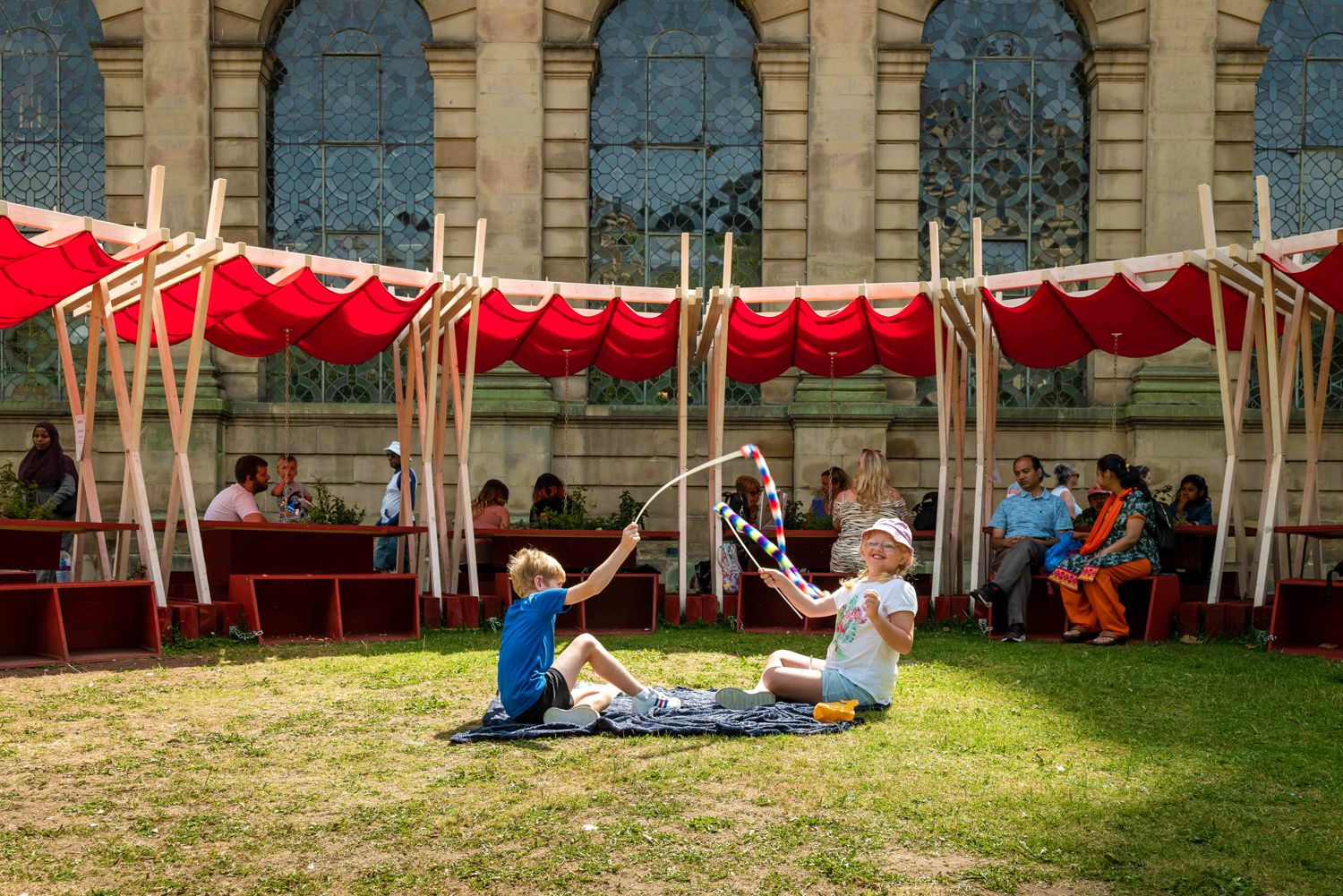
Feilden Clegg Bradley Studios, Assemble, Broadway Maylan and HKS are among the practices committed to creating connected and resilient places, which positively contribute to their neighbourhoods and allow equality of access.
Creating a just space for people
Responses were assessed by Architecture Declare’s Alasdair Ben Dixon, Mandy Franz, Mark Goldthorpe, Tom Greenall and Mitakshi Sirsi, with input from Regenerative Architecture Index ambassador Immy Kaur – social and civil activist, and co-founder and director of CIVIC SQUARE.
Projects Question 2
Do your projects create connected and resilient places which positively contribute to their neighbourhoods and allow equality of access? For example, do your projects create economic opportunity, retain value locally and generate social value?
Front-runner
Feilden Clegg Bradley Studios
We choose to work on projects that can have a positive impact on local, economic and social value.
We design places which support and promote active, social and sustainable lifestyles. Through inclusive and meaningful community consultation we create spaces which inspire a feeling of ownership and leave a lasting positive legacy. We promote local growth through engagement with local consultants and manufacturers, sourcing local materials and products where possible.
Our early-stage work on Our Cultural Heart in Kirklees was designed to engage the community in cultural placemaking, winning the GO Excellence in Public Procurement Awards’ Social Value Award.
The work at Green City Kigali is creating a new mixed-use city typology, taking account of topography and local construction skills to develop integrated drainage swales landscape and accessible circulation. The aim is to enable long-term economic development and densification of housing, alongside workplace, social and retail facilities.
Runner-up
Assemble
We have created organisations as key parts of projects to ensure that the social ambition and cultural value of projects can continue after construction. Blackhorse Workshop is an open-access workshop in London. Assemble led on the development of the brief, research and engagement, business planning, recruitment, organisational development, and architectural design and construction. We continue to play an active role in the strategic management of the workshop as members of its board. Assemble has worked with the Granby CLT since 2013 on the incremental development of its neighbourhood. This included the refurbishment of a row of terraced houses into social housing; the design of Granby Winter Garden – a community centre and residency space; and the creation of Granby Workshop, an architectural ceramics social enterprise employing people from Granby to make products which furnished houses in Granby and beyond. Assemble works regularly with Granby Workshop via projects and as board members.
Ones to watch
Broadway Malyan
We cultivate thriving, interconnected communities by embedding resilience and equity across all levels, from spatial structure to social systems. Our masterplans aim not only to transform physical environments, but also to empower people through co-developed strategies that improve access to opportunities and long-term stewardship. Public realm designs prioritise inclusivity, while plans often accommodate informal economies, circular resource flows, and cooperative enterprises.
For instance, our Calgary East Village masterplan transformed a derelict riverside district into a vibrant cultural quarter with public spaces, walkable connections, and high-quality mixed-use development raising land value, attracting inward investment, and generating long-term civic pride.
Similarly, in Surabaya, Indonesia, we helped regenerate a former red-light district into an inclusive, resilient neighbourhood, using low-tech, participatory urban interventions that empower local economies, celebrate cultural identity, and build long-term community ownership.
HKS
Our projects are designed to create connected, resilient places that positively contribute to their communities, promote equity, and generate lasting social and economic value. Central to this is our Resilience Design Toolkit, a flexible five-step process developed through internal research and inspired by leading industry tools. It guides project teams in embedding resilience-thinking early in the design process, ensuring environments can withstand hazards and recover quickly, while supporting inclusive access and long-term community value.
This approach fosters economic opportunity, sustains local value, and enhances social infrastructure. In 2022, the AIA Resilience & Adaptation Advisory Group recognised the toolkit’s impact, forming a partnership with HKS to share it nationally, and amplifying our commitment to resilient and equitable design on a broader scale.
Intervention Architecture
Our ethos is about equal access to all. Firs and Bromford Park is about giving a deprived community its own, beautiful public space. Our Smithfield scheme is delivering a wellbeing hub that will allow all users of the scheme to meet, mingle, and embed a diverse community. Our community hubs in Erdington and Leamington Spa incorporate adaptable, flexible spaces that can be used by different groups for different purposes. We actively engage in creative and diverse ways to get a real understanding of what a specific community wants and needs – rather than imposing our thoughts – extending this to co-building projects so users have a sense of ownership and pride in their places.
We work closely with inclusive design expert Amy Francis Smith to help us go beyond the criteria in understanding how places are used and interpreted.
LDA Design
We listen hard to lived experience so that we can positively impact communities, prioritising social equity, inclusivity, and accessibility. We think about the people affected by change and target outreach to those typically excluded. Community engagement for the masterplan to regenerate east London’s Aberfeldy Estate began with 100 pupils from local schools – a radical departure.
When it came to the restoration of Aberdeen’s Union Terrace Gardens, we went to great lengths to ensure this steep, city-centre valley park was fully accessible for the first time, with two lifts and amphitheatre access. The Chair of the Disability Equality Partnership said it was one of the best examples of inclusive design they had seen.
We see our projects as catalysts for regeneration. For the Carpenters Estate masterplan, we looked to connect the estate to Queen Elizabeth Olympic Park, so that residents can benefit more from this incredible asset on their doorstep.
Maccreanor Lavington
Our urbanistic work is embedded in the ethos of spatial justice and equitability. In Birkenhead, together with local communities, we used the Doughnut Economics model to develop an implementable vision for a liveable town. In Blackpool, we developed an MHCLG-funded design code that tackles substantial physical and behavioural barriers preventing teenagers from accessing public space. In Bow Goods Yard, Stratford, we co-developed the brief with communities to focus on creating skilled industrial jobs for local people, and maximising safety of use across the site.
Our architectural work implements these objectives on a building scale. All our schemes are ‘tenure-blind’ and built to the same quality irrespective of tenure. Our Aylesbury Estate scheme ensures that outdoor amenity is shared by all. In Royal Albert Wharf we worked with local charities to offer ground-floor units to SMEs and artists, providing a permanent base they would otherwise be unable to afford.
MWD Architects
Our projects are grounded in principles of local engagement, sustainability, and social responsibility. Whether working with housing associations, private clients, or community-led initiatives, we prioritise designs that generate lasting local benefit. Examples include our collaboration with Down to Earth and Coastal Housing on the Pennard housing scheme. This was built with natural materials by members of disadvantaged community groups, creating skills training, healthcare outcomes, and social value in one project. Our One Planet Park Homes and cabins are designed to be affordable, low-carbon dwellings that offer people a route into home ownership, while reducing environmental impact. Many of our clients are small-scale landowners or community members seeking to self-build or restore and enhance the ecological value of their land. In each case, we seek to retain value within the community by using local materials, supporting rural economies, and designing homes that enable people to live lightly and thrive locally.
Scott Whitby Studio
We strive to ensure that every project fosters resilient, interconnected spaces that generate meaningful social and economic value, just as we did at Westminster Chapel. Accessibility drove the project, and we collaborated with our access consultant to design a stair ramp that preserves the original staircase’s essence, while providing accessible entry from the main entrance. Interventions included a public café, a co-working space, and a flexible events area. Consequently, the Chapel now hosts the largest food bank in Westminster, a mother and toddler group, and has a long waiting list for event space hire. Our ultra-low-carbon, light-touch interventions have resulted in a lobby area that is visually and physically more open. The main hall is now clear of impromptu interventions, showcasing a unique and adaptable grand space in London. The café and welcoming area have improved the church’s finances and shown the community that everyone is welcome.