
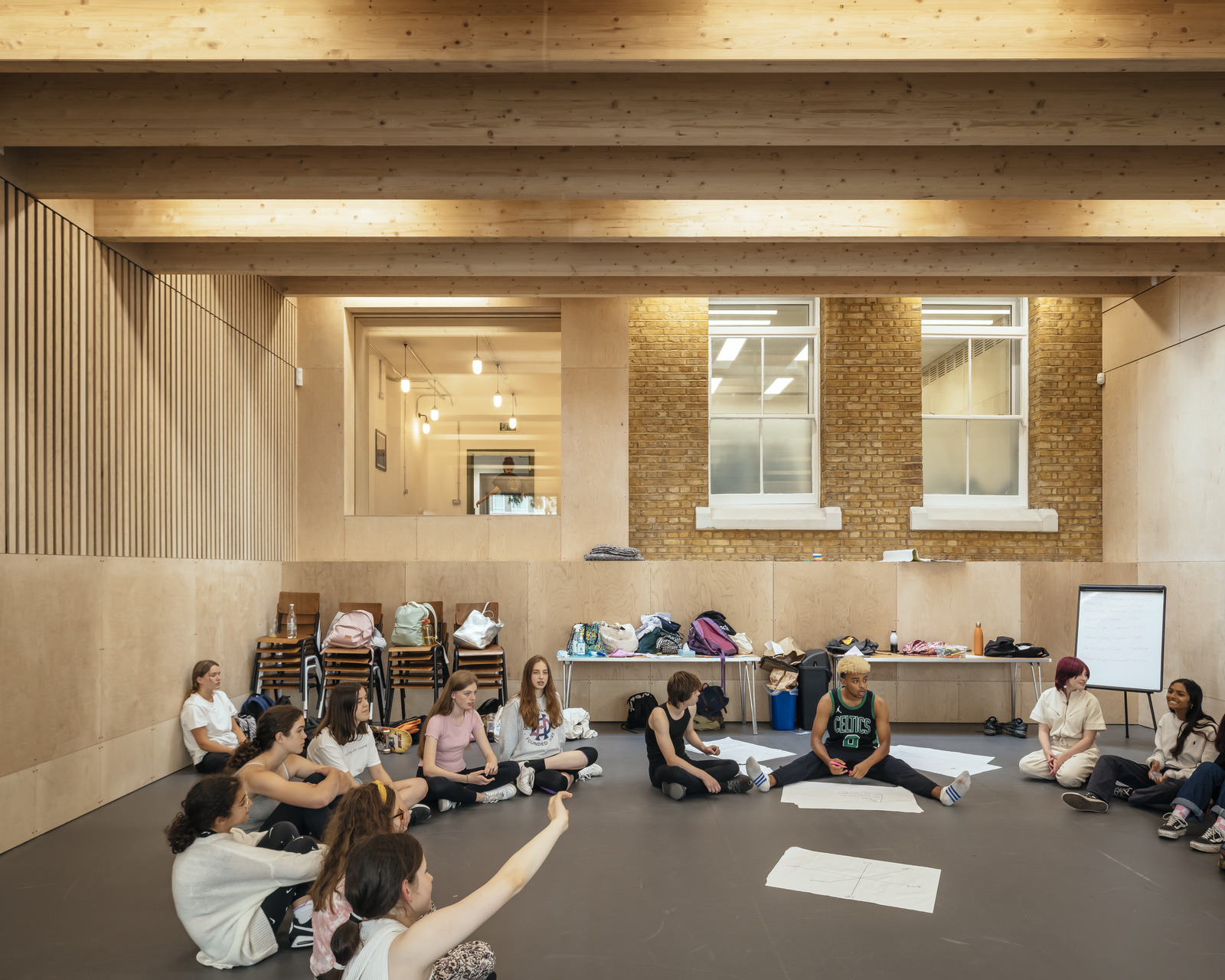
Jan Kattein Architects, DSDHA, Buckley Gray Yeoman, and dRMM, are among the practices whose projects demonstrate deep engagement with local stakeholders and end users.
Creating a just space for people
Responses were assessed by Architecture Declare’s Alasdair Ben Dixon, Mandy Franz, Mark Goldthorpe, Tom Greenall and Mitakshi Sirsi, with input from Regenerative Architecture Index ambassador Immy Kaur – social and civil activist, and co-founder and director of CIVIC SQUARE.
Projects Question 1
Do the projects demonstrate deep engagement with local stakeholders and end users? For example, is there evidence that your project engagement goes beyond consultation towards co-design?
Front-runner
Jan Kattein Architects
At The Paper Garden, we integrated a volunteer-build component, engaging over 3,000 volunteers who became ambassadors for natural building techniques. At the Triangle Site, 409 volunteers learned sustainable construction techniques across 49 events. In Thamesmead, we partnered with Windrush Primary School to create a school garden, collaborating with teachers to align the project with curriculum objectives. This led to garden activities being woven into the school’s STEM curriculum. In Edmonton, our work with St Peter’s and St Paul’s Primary School centred on a teaching programme about sustainability and well-being. Through practical and storytelling sessions with teachers, we developed a strategy for rewilding the street outside the school, directly incorporating children’s imaginative ideas about monster habitats in the completed School Street. Each initiative not only translated co-designed visions into tangible projects, but also demonstrated how hands-on creative approaches can embed sustainability and well-being, making a lasting impact in our environment.
Runner-up
DSDHA
DSDHA is a champion of co-design and recently published Towards Spatial Justice: A Guide for Achieving Meaningful Participation in Co-Design Processes.
This was the outcome of two years of research funded by the RIBA and UCL, and builds on the studio’s nearly 25 years’ experience in pioneering innovative participatory design practice. As part of this, we have launched a website – www.codesigning.space/ – which provides open-source access to a co-design checklist and co-design assessment tool. The research also informed the recently released co-design overlay for the RIBA Plan of Work.
Projects that have utilised co-design include White Horse Square youth space (with Julia King/Make Space for Girls); British Library landscape and public realm (with Global Generation); Euston Tower (with Beyond the Box); and Central Somers Town (with Edit Collective).
These projects demonstrate our ambition to not only engage local communities in co-design, but also to provide opportunities for young practices and SMEs as part of the process.
Ones to watch
Buckley Gray Yeoman
Our projects embrace genuine co-design, moving beyond token consultation to forge lasting partnerships with end users and local communities. For Brixton International House, we ran a series of themed workshops, inviting paid participants drawn from the surrounding neighbourhood to critique plans and elevations, explore precedents, and articulate what aspects resonated or fell short. Their insights didn’t just inform but shaped the final proposals, ensuring the design truly reflects local needs and aspirations.
Similarly, in collaboration with Homes Energy Action Lab, we undertook deep engagement with community groups in Hackney to develop retrofit action plans. Rather than delivering off-the-shelf reports, we conducted in-depth dialogues about how each building is used, mapped pain points, and co-ideated ‘quick wins’ for energy efficiency. This immersive process fostered ownership among stakeholders and ensured that our technical recommendations aligned with on-the-ground realities.
dRMM
dRMM projects consistently demonstrate deep stakeholder engagement that transcends conventional consultation to embrace genuine co-design principles. We develop comprehensive engagement strategies with our clients, beginning with thorough stakeholder mapping to ensure inclusive representation.
Our co-design workshops address topics most relevant to communities, creating meaningful dialogue that directly influences design outcomes. We are particularly committed to engaging hard-to-reach groups through innovative approaches.
At Tustin Estate, we organised a week-long creative workshop series specifically targeting younger community members. These sessions, led by our team alongside local artists, taught design skills while gathering authentic input. The initiative culminated in a design competition with the winner receiving prize money and a paid work experience placement in our studio.
This exemplifies our approach: creating engagement pathways that not only inform our designs but also build skills, create opportunities, and establish lasting relationships with the communities we serve – ensuring their voices genuinely shape project outcomes.
HKS
We demonstrate deep, multi-layered engagement with local stakeholders and end users moving beyond consultation into meaningful co-design.
Our Nature of Place (NoP) framework is central to this approach. It guides design teams in uncovering the unique character, challenges, and opportunities of each location – ranging from the hyper-local neighbourhood to regional scale. This process integrates insights from five key stakeholder groups: the earth, clients and users, investors, the broader community, and the design team itself.
The NoP is more than a checklist, it’s a collaborative discovery tool used before design begins. It fosters informed, inclusive decision making through eco-charrettes and high-performance design workshops, where local voices help shape the vision, goals, and strategies for each project.
By using NoP, HKS ensures that every project is rooted in place, purpose, and shared understanding. This delivers lasting social and environmental value through truly co-created design.
Office S&M
We have a clear and structured approach called Deep Listening, which helps us deliver meaningful engagement for public clients and communities. Our process goes far beyond consultation, working towards genuine co-design by empowering those who will use the spaces to shape their future environment. We have worked with one third of London’s boroughs, helping clients maximise budgets and deliver community benefit with confidence.
We prioritise inclusive engagement, both digital and physical, with a focus on reaching underrepresented groups. We celebrate cultural heritage and local character through initiatives that foster a continued sense of ownership. Our process builds social value by championing community wealth building, diversity, and social sustainability. We believe that the most successful designs are created with the communities who will use them, and we work to ensure their voices shape the outcome from the start.
PRP
PRP is an expert in community partnerships and engagement. Each project, regardless of size, requires a bespoke approach to community engagement to create a truly inclusive design. For our project at High Path Estate, the PRP team used an innovative tool kit of engagement techniques, including co-design to encourage genuine participation and meaningful conversation between varied stakeholders from the very early stages. We encouraged different methods of capturing, recording and presenting feedback. We held co-design and 3D model-making workshops, including a ‘Self Build Play’ workshop, with children aged 8-11 years old, to get them involved in designing for their community. We also hosted ‘Have your Say’ exhibitions for the community, so local stakeholders and residents’ groups could share their thoughts with our team and have an impact on the final design. PRP’s approach is consultative and collaborative, and we will always involve the community where possible in influencing the design development journey.
Studio 8FOLD
We are a process-focused practice, where we engage without a predetermined outcome. A deep engagement with local stakeholders and end-users is fundamental to our design approach.
We worked together with Architekturbüro Lindstedt on a project in Nettlestedt called Dorf im Dorf (Village within a Village), proposing an intergenerational co-living project, deeply embedded in a small town community. We had community-wide workshops and presentations, along with smaller focus-groups, looking at exactly what co-living and intergenerational really meant to them, and understanding both long-term views, budgetary constraints, and greatest concerns. One outcome was a request for a training session on how to do co-living, explaining how the community garden and workshop should be used and engaged with.
Various iterations of the design were presented and shared with not only the client but the whole community, which was crucial in making sure it was accepted by the community and suited future users.
Tonkin Liu
As architects, we want our work to tell stories about nature, people, and place. All projects demonstrate deep and thorough engagement through the Asking Looking Playing Making design process, setting out four scales: individual, community, company, and society. The engagement is through observations of behaviours as well as direct dialogues. The process unearths the expression of certain individuals’ idiosyncrasies, as well as neighbourhood character and issues, while also encompassing broader views, such as the client’s deep-rooted aspirations, and the global responsibilities towards our planet. The co-design should be a co-design with the planet, with a collective value cherishing the planet’s objectives over the short-term objectives of human beings. It is through this process of engagement, which though challenging at times, ultimately reaffirms trust. Every project is an opportunity to build an enduring symbol; a symbol of community trust, pride of place, cohesion, and identity; a symbol of communities wanting their voices to be projected and heard.