
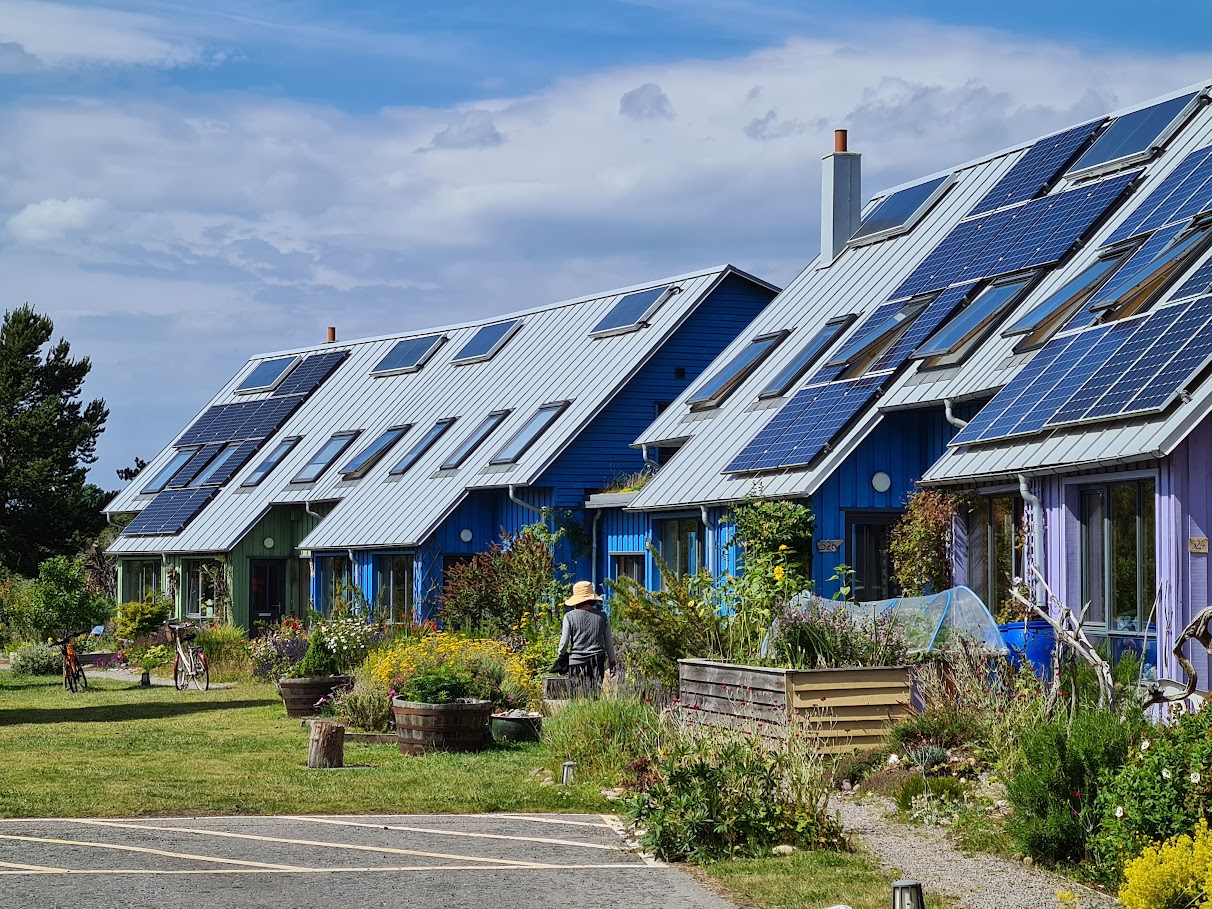
Commonfuture, Feilden Fowles, DSDHA, Feilden Clegg Bradley are among the practices able to demonstrate projects which strive to match the performance of a mature ecosystem.
Co-evolving with nature
Responses to the practice questions were assessed by Architects Declare members Carrie Behar, Laura Baron, Tom Gibson, Kevin Logan, Anna Pamphilon, Kat Scott, and Jacqueline Wheeler, with expert input from RAI ambassador Phoebe Tickell – renegade scientist, systems thinker and social entrepreneur.
Projects Question 1
Can the practice demonstrate projects which strive to match the performance of a mature ecosystem? As a minimum, this would mean achieving biodiversity net gain (BNG).
Front-runner
Commonfuture
We are working with two separate private clients to develop the concept of the ‘smart clachan’ – a way of returning small but dense population clusters to the rural Scottish Highlands where previous small historical townships (clachans) have been evicted by the 19th century clearances. Much of the highlands have since been denuded of biodiversity through the twin factors of monoculture forestry plantations and ‘sporting’ estates. As a means of creating sustainable livelihoods these clachan proposals are seamlessly embedded in permaculture and re-wilding principals, and propose ways in which not only the people but the biodiversity can return to the landscape. Through use of natural and local materials within low-energy constructions and the regenerative forces of food growing, waste composting, and renewable energy we hope to create a replicable model of development that can help to revitalise the biodiversity of rural Scotland.
Runner-up
Feilden Fowles Architects
We recognise that we are part of nature, within integral living systems, not separate from them. Our work actively regenerates ecosystems by learning from and working with natural processes. At the Natural History Museum, we collaborated with scientists to enhance local ecosystems within the museum’s wildlife gardens. Our sensitive transformation safeguarded existing flora and fauna, doubled the area of native habitats, and expanded the pond by 60 per cent, significantly boosting biodiversity across the site. Listening and viewing funnels provide people with a closer connection to nature; hearing water move through tree trunks or beetle larvae feeding on decaying wood. 50 monitoring points support ongoing research by scientists at the adjacent Angela Marmont Centre for UK Nature, who were closely involved throughout the project. Their expertise ensured that biodiversity was not only protected but meaningfully supported and expanded during construction.
Ones to watch
DSDHA
An understanding of local ecologies informs all of our projects. This includes analysis of often hidden or lost ecosystems, which our designs strive to return to the site. At 50 Fenchurch Street, this is leading to the creation of a new fen (wetland) habitat in the heart of the City of London; at Euston Tower, we are creating a ‘mosaic of habitats’ (grassland, moorland, woodland, and wetland) inspired by Hampstead Heath; and at Exchange Square above Liverpool Street Station, we found inspiration in the estuarine landscape of Tollesbury at the end of the trainline. The new park that emerged from this concept has achieved as BNG of 600 per cent. We have recently propagated plants from the Square to be used on the roof terraces of surrounding buildings, including 1 Appold Street on which we are collaborating with Piercy&Company.
The inclusion of a ‘snag’ (a standing dead tree) as part of our wetland at Euston Tower will provide valuable invertebrate habitat and foraging opportunities for local wildlife, imitating conditions found in natural wetlands.
Feilden Clegg Bradley Studios
Biodiversity and collaboration with landscape designers is a key part of our work. We strive to achieve 20 per cent BNG or more on all projects, above regulations.
Researcher Jamie Anderson studied residents at Accordia, and found that living in a neighbourhood with a higher ratio of communal gardens is associated with higher levels of wellbeing and community. Our current work at Brabazon evolves some of these ideas at both masterplan and neighbourhood scale.
We are working with the Eden Project on a regenerative scheme on a former gasworks in Dundee, as a place to explore how we can learn from and reconnect with nature to achieve a regenerative future.
We aim to retain mature trees on our sites. Currently on site, our 1,200 student bed scheme for the University of Sussex, retains more than 50 existing trees between the buildings, and creates a scheme in sympathy with the adjacent South Downs National Park.
Jan Kattein Architects
In Wilderness Street, we temporarily revived landscapes lost to large-scale urbanisation by creating an 80-metre-long living urban landscape on a road surface in Ilford Town Centre. Using the Uphall Camp Beacon, the former Royal Forest of Hainault and the Essex Grazing Marshes as blueprints for plant species and landscape character, we tried to replicate these ancient forests and marshlands on Oakfield Road. The project advocated for the preservation of ancient natural landscapes and their role in maintaining biodiversity and supporting well-being. A series of community events and workshops around the theme of landscape, including planting workshops, were programmed for the duration of the project. The legacy saw all planting given away to community organisations and Ilford residents at the end of the project. Enticing local people to adopt the plants meant that elements of the ancient Essex landscape were reinstated in public places, gardens, planters, and allotments.
Natural Building Studio
Yes, we are deeply guided by the ecosystem of our sites. We design to always improve the habitat offering on a site and integrate it into the architecture as a defining principle at the start of the project, rather than a bolt-on addition. We work closely with ecologists to assess the existing conditions and make informed decisions about how the architecture can improve the ecosystem. For example, in our project with Tiggins Meadow, we applied a number of measures. First, we raised the barn off the ground to provide a sheltered habitat below it. Second, we captured the rainwater from the roof, slowed it down through retention, and then managed its release into a new pond, which supports insect and bird life. Third, we provided a traditional barn owl habitat within the roof volume, on the gable end looking out over hunting ground. It was occupied before construction was finished.