
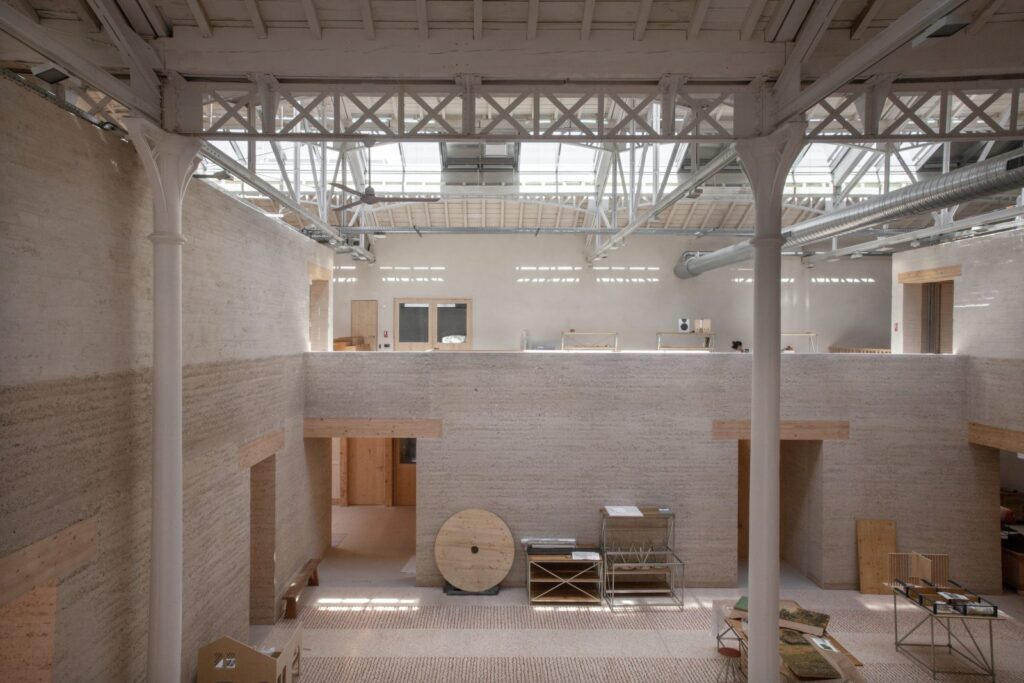
Practices, including Marks Barfield Architects, vHH, BakerBrown Studio and Assemble discuss their approach to material stewardship.
Co-evolving with nature
Responses to the practice questions were assessed by Architects Declare members Carrie Behar, Laura Baron, Tom Gibson, Kevin Logan, Anna Pamphilon, Kat Scott, and Jacqueline Wheeler, with expert input from RAI ambassador Phoebe Tickell – renegade scientist, systems thinker and social entrepreneur.
Projects Question 2
Is the practice working on material stewardship? For example, evidence could be shown through repeated use of low-carbon materials, extensive material libraries, and research or publications supporting responsible use of materials and the elimination of waste.
Front-runner
Marks Barfield Architects
We approach material stewardship as a regenerative practice – mining the Anthropocene, not the Earth. Research includes reuse of secondary timber members into a modular structural framing system, in collaboration with Simpleworks engineers; input into the material passports working group with Orms; developing our own passports for existing materials; material working groups with the ASBP (looking at the reuse of glass partitions); our deconstruction pocketbook (in progress) as an industry guide of tips and tricks to design for deconstruction and mine the Anthropocene effectively; hosting a roundtable with NBS to consider material re-use within standardised specifications; collaborations with fire experts to recertify fire doors; and partnerships with deconstruction contractors to develop material hubs in London. For new materials, we have developed a digital and physical sustainable materials library, which was featured in Architecture Today. Here we consider embodied/sequestered carbon, water use, locality, ethical sourcing, durability, cost, recycled content, and deconstructability.
Runner-up
van Heyningen and Haward
We increasingly specify that things are to be mechanically fixed, avoid composites, and minimise plastics and hydrocarbon-based coatings. We use repurposed timber where possible and from local suppliers where not. At Leicester Cathedral we used a local, underused hardwood (sweet chestnut) to fulfil most of the timber requirement. All the stone used at Leicester was also from UK suppliers, including the tomb. Our demolition specifications state that materials are to be reused. For example, at Leicester Cathedral the parquet flooring was kept and sold, not put in a skip. At the Commissioners House in Chatham (SAM), we have specified that all historic doors are to be kept and used later, and all timber and lead recycled. We use One Click on projects to create life cycle assessments and reduce emissions through quantifiable data. We aim to join a materials forum in the near future and support the circular economy.
Ones to watch
BakerBrown Studio
We have co-authored EU-funded Interreg research projects focussing on issues such as reprocessing agricultural and other waste streams into construction materials. Our Waste House is an ongoing research project in collaboration with students, academia and industry across Europe. It tests the potential of many low-carbon and novel/emerging materials. It is an evolving three-dimensional material library. Continuing research, including collaborations with Rotor DC, Excess Materials Exchange, Local Works Studio, University of Bath and ASBP impacts on our work in practice. It inspires us to author books, such as The Re-Use Atlas and The Pedagogies of Re-Use, and write chapters, for example, on Mycelium, for books such as Materials: an environmental primer. Our team teaches at academic institutions in the UK and Europe. Our founder co-chairs RIBA’s Climate Action Expert Group, and has sat on the Governance Board of the Net Zero Carbon Buildings Standard.
Assemble
Assemble has always explored its projects through the lens of the materials they are made from, with its roots in the hands-on-making of its own schemes. In early projects this entailed material re-use and DIY methodologies, such as in our first building, the Cineroleum. In recent projects, such as our Le Magasin Electrique for Atelier Luma and our scheme for the Architectural Biennial of Gwangju, this has developed into an advanced level of material development with our collaborators to develop locally-sourced, bioregional, or transitional materials and products. In Luma, the vast majority of the building materials originated from within 70 kilometres of the site.
Material Cultures
Material Cultures was founded in 2019 with the explicit aim of taking action to decarbonise the built environment through a fabric-first approach. Our mission has become increasingly interwoven with bioregionalism and landscape regeneration. To this end we have:
• Developed 96 bioregional construction systems.
• Published and co-produced 20 reports and publications about biobased and bioregional materials, landscape regeneration, and the circular economy.
• Carried out four fellowships undertaking research into resilient forestry, agroecology, and wetland restoration and its relationship to the built environment.
• Facilitated the construction of 34 full-scale bioregional construction fragments.
• Written an accessible primer about bioregional design and construction.
• Delivered 514 hours of facilitated learning programmes.
• Given over 100 lectures and seminars.
• Sat on four advisory committees.
• Supported the production of 17 films about bioregional material production.
• Delivered 15 architectural demonstrator projects centring bioregional and biobased materials.
Stride Treglown
We are developing a bitesize guide called, Degenerative to Regenerative. How can we shift to positive impact building materials, in collaboration with the University of Bath’s Centre for Regenerative Design and Engineering for a Net positive World (RENEW). This follows last year’s bitesize guide, Towards a Circular Built Environment. Notable projects which demonstrate excellence in material stewardship include Gwynfaen near Swansea, an ultra-low carbon housing development and LETI pioneer project. It prioritises materials that are low in embodied carbon and locally sourced, including structural timber and cladding sourced exclusively from Welsh forests. Timber cassettes are fabricated just 13 miles from the site and use biobased wood-fibre and cellulose insulations. We have since launched a Welsh Tai ar y Cyd pattern book promoting timber-frame construction with Welsh-grown, sustainably-sourced timber, bio-based insulation, and airtight detailing to reduce embodied and operational carbon.
Studio Bark
We prioritise natural materials like timber, earth, cork and wool, and focus on repair, reuse and sourcing locally. For instance, Land House in Oxfordshire uses rammed stone from local quarry waste, and Thatch House incorporates locally-sourced straw insulation. Our carbon tool, SmallCarbon, integrates an extensive material library, aiding comparisons at early design stages, and encouraging deeper consideration among users. We developed U-Build to eliminate construction waste and promote circularity, encouraging the reuse of components at the end of a project’s life. This year, we obtained an EPD for the U-Build system. Our ‘Library of Boxes’ for lending to shorter-term community-use and events, further supports circular practice. We also engage the public in material stewardship. For Leeds City of Culture 2023, we collaborated with artist Michael Pinsky on Making A Stand, an immersive artwork addressing timber sourcing, accompanied by digital storytelling.