
Practices, including Gale & Snowden, Orms, Studio Bark and dRMM explain how they share research and knowledge for the benefit of society and the wider world.
Being a good ancestor
Responses in this section were assessed by Architects Declare’s Alasdair Ben Dixon, Tom Gibson, Deepthi Ravi, Zoe Watson and Jacqueline Wheeler, with expert insight from Regenerative Architecture Index ambassador, social philosopher and author Roman Krznaric.
Practice Question 3
Does the practice share research and knowledge for the benefit of society and the wider world? For example, do you regularly carry out post occupancy evaluation and share information with others?
Front-runner
Gale & Snowden
We partake in research and development work, such as the Technology Strategy Board climate change adaptation of buildings programme. The practice undertook three projects under this initiative becoming experts in future climate resilience in buildings – modelling buildings with future weather files (Prometheus files 2030, 2050 and 2080) using IES building physics software. From this research, David Gale became a member of the expert panel and contributed to the IPCC AR5 synthesis report and IPCC AR6 Working Group II and III.
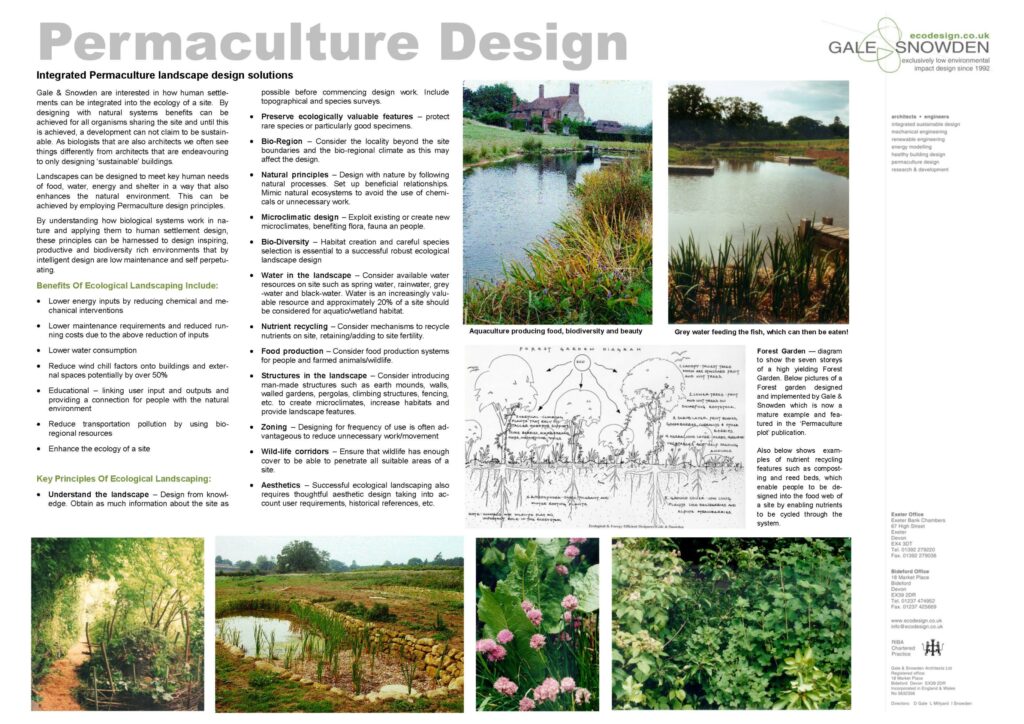
The practice undertakes numerous presentations on integrated and regenerative design, including Passivhaus, building biology, and future climate resilience design under the practice ethos of Permaculture Design. The practice has been involved in the dissemination of publications, such as the BRE/Carbon Trust Good Practice Guide 293 for external wall insulation, as well as refurbishment guides for Westminster City Council and others.
We regularly monitor our buildings, including with the Passivhaus Institute (Germany), and have undertaken post occupancy monitoring research projects with TSB on a number of our Passivhaus flats as part of addressing the performance gap. Our practice holds a CPD design course on permaculture, building biology and Passivhaus for our staff and clients. This has allowed us, for example, to help change the culture of local authorities so that they commission Passivhaus/building biology and future climate-resilient buildings.
Over the years we have attended green building fairs, self-build exhibitions, and other construction exhibitions promoting ecological design (EDA) and healthy building. In 2014, the practice set up the Building Biology Association – a not-for-profit organisation promoting education, design, construction and the maintenance of healthy buildings.
Runner up
Orms
The practice actively contributes to industry knowledge through the Architects’ Mental Wellbeing Forum, and participation in cross-practice sustainability and technical leads peer groups. We’ve been actively involved in developing and advocating for the UK Net Zero Building Standard, sponsoring the work, providing a technical project manager, and committing four projects to the pilot phase to demonstrate implementation pathways.
We lead a hybrid materials passports working group for UK and international practitioners, fostering wider adoption through shared approaches. In 2024, we released a white paper with Lancaster University on accelerating material passports. This has led to collaborative projects with developers, institutions and suppliers to demonstrate the research in action, including recent work with the Stone Federation to develop reuse pathways. Knowledge-sharing extends through conference presentations, university lectures, and annual volunteering for Open City programmes, including Open House and Architecture in Schools, making architectural knowledge accessible to diverse audiences.
Ones to Watch
Studio Bark
Sharing our research and knowledge is central to our way of operating. We regularly engage the public through exhibitions, such as Barricade and Beacon (V&A), events (Open City), press features, and publications, including Protest Architecture (RIBA). Beyond this, we have a number of open-access initiatives at varying stages of development:
- SmallCarbon: A user-friendly, affordable, whole-life carbon tool for SMEs, aiming at making carbon-informed design more accessible.
- Our live build education programmes look at diversity and climate literacy gaps, offering students hands-on experience of low-impact construction.
- Materials research: On live projects, we experiment with natural materials – for example, structural uses for waste timber, rammed stone and earth – to broaden industry understanding.
- Open-source planning research: we share our expertise in rural planning to support others in realising environmental homes that enhance the landscape and ecology.
dRMM
dRMM actively shares research and knowledge to benefit society and advance industry practices. Our published research, Measuring Mass Timber, developed with Edinburgh Napier University and the Quality of Life Foundation, established a methodology for assessing whole-life carbon and quality of life impacts in timber construction.
We conduct post-occupancy evaluations on completed projects. Our Workstack scheme features comprehensive assessment of in-use performance and occupant satisfaction, while Coate Street currently participates in the Net Zero Carbon Building Standard pilot, contributing performance data to help evolve industry guidance.
As founding signatories of Architects Declare, we volunteer with organisations like LETI and ACAN to disseminate sustainability best practices. We’ve contributed to multiple LETI publications and helped develop our local BID’s Green Charter. Furthermore, members of our senior design team frequently present at industry events and universities, as well as participate in discussion panels and working groups to disseminate knowledge.
Elliott Wood
We researched, wrote and published Structural Carbon Tool, a design tool for assessing embodied carbon. This was donated to IStructE for free, and has been downloaded by businesses and individuals more than 10,000 times and adopted for use in other countries. Revisions of the tool continued to be developed and shared with the industry.
A member of staff was the lead author of the IStructE publication Circular economy and reuse: guidance for designers. We have contributed significant staff time to the UK Net Zero Carbon Building Standard initiative. We are also currently leading a consortium of technical and design experts, insurance experts, and most of the UK’s largest commercial developers to produce a technical guidebook that fosters cross-sector industry alignment and ensures the widespread adoption of large-scale mass timber offices.
Elliott Wood has also developed The Building Archives, an open-to-all sharing platform for detailed information on existing buildings. This is continuing to grow and now holds three different archive collections, enabling a central platform for the industry to use.
Atelier Ten
Cutting-edge design solutions rooted in innovation and third horizon thinking require continuous research and curious minds. We cultivate this through our internal Practice Groups, and regularly share insights, successes and challenges through publication of case studies and thought-leadership pieces. Furthermore:
- Our team contributes to academia, lecturing at the A+A, UCL, and RCA.
- We developed Pathfinder, an open-source, web-based tool for climate-positive landscape design.
- We actively engage with the wider industry. Atelier Ten is a founding member of the UKGBC, and sponsors key events, such as Footprint+ where we curated the 2024 Retrofit Agenda stage; and the 2024 CTBUH Conference, where we led a workshop on nature-based solutions and biomimicry.
- This year, we’re expanding our outreach through our new NLA partnership, and are aspiring to contribute to expert panels, conferences, seminars and technical symposiums.
- We provide feedback to industry consultations, including the UK Net Zero Carbon Buildings Standard (NZCBS).
Hawkins\Brown
Sharing and expanding our knowledge through research and regular POE is essential to our work. In 2025, we:
- Published RIBA overlays and strategies promoting regenerative, social value, net zero and circular design.
- We collaborated with the UKGBC systems change research through live case studies and the Recalibrate programme.
- We launched a cross-disciplinary Build for Health campaign with health experts and academics.
Previously: - We researched topics including the circular economy and diversity in higher education through our internal bursary.
- We developed a whole life carbon measurement tool, HB:ERT. Version one is freely available, and version two won the 2020 AJ Best Use of Technology and RIBA Research Award.
- We highlighted the value of measuring qualitative design impacts via our Chobham Manor POE, which won the AJ Sustainability Initiative Award 2023. We co-authored RICS WLCA Standard 2023 updates and contributed to industry groups, including RIBA, RICS, UKGBC, ACAN, GLA, NLA and LETI.