
Practices, including BakerBrown Studio, Haworth Tompkins, PLP and Useful Simple Trust, explain how they advocate for long-term thinking at the outset of their projects.
Being a good ancestor
Responses in this section were assessed by Architects Declare’s Alasdair Ben Dixon, Tom Gibson, Deepthi Ravi, Zoe Watson and Jacqueline Wheeler, with expert insight from Regenerative Architecture Index ambassador, social philosopher and author Roman Krznaric.
Projects Question 1
Does the practice advocate for long-term thinking at the outset of projects? Do you initiate projects with long-term thinking and challenge the client on design life? Also, can the practice demonstrate that this approach has worked – with a shorter or longer design life, or an innovative approach to financing or payback period?
Front-runner
BakerBrown Studio
In 2001, we designed the Romney Warren Visitor’s Centre, the UK’s first public building made from straw harvested from fields to the north of the site. This building was designed as a ‘material bank’ for future buildings, or as we said at the time, “designed for deconstruction.”
It also avoided the use of concrete; coming out of the ground with compressed shingle foundations brought to site from Dungeness nearby. Ground-floor insulation was formed from compressed Perlite clay beads. Plastic was eliminated, and one day, if required, all materials, including the aggregates forming the ground floor, could be removed from site and reused in other buildings.
We deliberately specify materials where the management processes actively enhance the natural environment, and have been doing this for 30 years. We are now at the point where some of the sweet chestnut coppices that have supplied our projects with timber have been harvested on two rotations. This process creates a greater level of biodiversity than if the woodland is left alone. These are examples of the long-term thinking that inspires the design of our buildings.
Runner-up
Haworth Tompkins
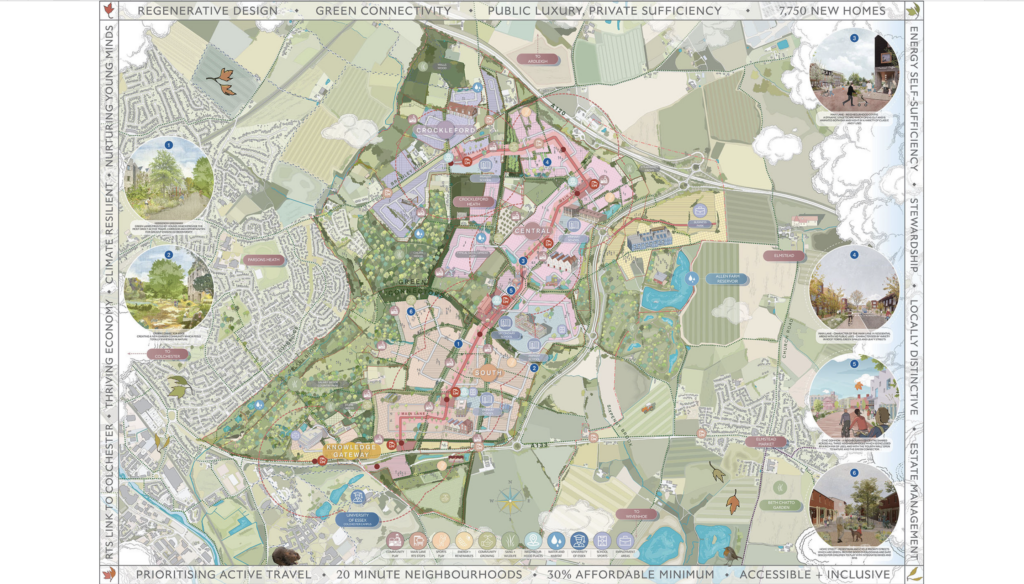
We support our clients in considering what it means to be a good ancestor through early-stage workshops incorporating generational practices, such as ‘human layers’, helping to imaginatively connect with past and future generations. On our strategic masterplans for the Centre for Alternative Technology and the Colchester Garden Community, workshops were fundamental in establishing core design principles that will allow interspecies habitats to develop, evolve and thrive within and alongside the developments.
We deliberately work at both extremes of a spectrum spanning from short to long-project design life. Our approach to the new and refurbished buildings for Pembroke College Cambridge was driven by longevity, climate resilience and adaptability – building on a 675-year legacy of institutional and onsite continuity. By contrast, our nomadic performance venue for Troubadour Theatres has a design life of just seven years and is designed to be fully demountable and transportable for re-assembly.
Ones to watch
PLP Architecture
Long-term thinking is embedded in our design ethos. From the outset, we attempt to advocate and collaborate with clients for future-proof, flexible, and circular solutions, challenging conventional cost models and design life assumptions. At concept stage, we promote longer-life, loose-fit strategies, and collaborate with clients to embed adaptability and performance resilience in the final scheme. Circularity is a constant lens; beyond longevity, we consider how material reuse can transform value, and are therefore well adapted to meet the upcoming legislative requirements.
We hosted ‘Scaling Circularity’, a public event exploring circularity from product to city scale, featuring colleagues in-house who are innovators in mycelium and regenerative masterplanning. Our own office fit-out demonstrates that we practice what we preach, achieving 92 per cent material reuse and 72 per cent cost savings, proving circularity is both feasible and economical.
In South Korea’s National Meteorological Centre, we demonstrated how long-term gains in health, wellbeing, carbon taxation and performance outweighed a tripled initial cost, leading the client to rethink traditional financial analysis.
Useful Simple Trust
This year, we launched our ‘Project Handprint’ process to assess projects on a scale from degenerative to regenerative. It evaluates energy, carbon, biodiversity, social equity, and resource use. Assessments are conducted at the start of projects, to identify regenerative opportunities, and again at the end to reflect on outcomes and capture lessons learned.
The process builds on a regenerative design tool we use with clients and design teams to shift the conversation from “doing less harm” to creating positive impact. It promotes whole-life costing over CapEx-only approaches, targets net carbon positive outcomes, supports biodiversity net gain, and prioritises adaptive reuse over demolition and new construction.
A standout example is the adaptive reuse of the 1950s Marks & Spencer HQ on Baker Street. By successfully advocating for refurbishment instead of demolition, we avoided 35,000 tonnes of CO2 emissions, demonstrating the tangible benefits of regenerative thinking in practice.
DaeWha Kang Design
In our standard design process, before putting pen to paper, we begin by agreeing design principles with our clients. These conversations focus on the deeper meaning and potential behind the projects and the brief. We always discuss the legacy of the design and how the project might positively benefit our grandchildren. See the ‘Letters to Grandchild’ section of our website for some hints of this philosophy.
In all of our projects, we prioritise authentic materials that age well and are built to last. In the Communique Project in Korea, we discovered that because of the supply chain available in that region, a stone facade was cheaper than the hybrid aluminium plastic sandwich panel that the client had originally been considering. After this project won the Ministry of Land award for best adaptive reuse in the country, we continued developing more stone buildings.
Marks Barfield Architects
We use the regenerative primer framework to help clients establish their deep purpose and consider future scenarios. At project inception, we interrogate the site and question any need for new construction, prioritising retrofit and reuse. For example, as masterplanners for a UK government project we reviewed the proposed demolition, calculated the embodied carbon and suggested structures and buildings which could be saved, resulting in the reuse of several buildings which were set to be demolished. Our work is grounded in ‘seven-generation thinking’, the best example of this being our speculative West Somerset Tidal Lagoon, which will provide renewable energy for 200-plus years. We are using circular economy principles to both minimise waste and save costs – crucial for wider spread adoption. On an office fit-out we were able to save 577 tonnes of CO2e and £1.65m through material reuse, enabled by close coordination with client, contractor and industry specialists.