
Submission by Root And Erect.
Being a good ancestor
Practice
1. Do you have a clearly stated purpose aligned with the planetary emergency? We’re looking for a bold ambition here, and a culture which recognises the need for long-term thinking.
Nothing must be done to harm the children. This principle – drawn from our 23-year specialism in child-centred design and intergenerational urbanism, and from indigenous traditions of intergenerational responsibility – is our deepest orientation toward the planetary emergency.
People and Planet is one of six values co-produced by the whole team. Our directors have trained in Regenesis Group’s Regenerative Practitioner and Storying Place courses, grounding our practice in living-systems thinking. Five team-led working groups – in ecological stewardship, equity and inclusion, quality and learning, digital tools, and communications – embed this thinking in our daily culture through bottom-up learning and development. Our quality plan maps regenerative design principles to RIBA work stages. We are building an internal best practice co-design and engagement compendium, codifying what we know so it belongs to the whole practice.
2. Do you have a clearly stated purpose aligned with the planetary emergency? We’re looking for a bold ambition here, and a culture which recognises the need for long-term thinking.
What we pass on is not only ownership but a living culture: our co-produced values, team-led working groups, co-design methodology, and policies built around care for the team. These are practice assets, not personal ones. Annual accounts and a live profitability record are shared with the whole team; salary decisions involve a rotating working group of three staff members including one director.
Our aspiration is to formalise this through employee ownership – passing the practice to those who have shaped it rather than selling or dissolving it. As a nine-person practice we have begun that process and found it genuinely difficult: any financial settlement for the founding directors must not leave the practice under-resourced. We have not yet resolved how to honour both, but the cultural foundation for such a transition is already in place.
3. Do you share research and knowledge for the benefit of society and the wider world?
We contributed to Making London Child Friendly, a Mayor’s Good Growth publication, and contributed case studies to the GLA’s Shaping Neighbourhoods: Play and Informal Recreation SPG. We are currently writing a Play Strategy for the London Legacy Development Corporation – whose reach across the sector gives this work significant influence. We lecture regularly, most recently at Central Saint Martins. We volunteered at Studio in the Woods, running construction workshops experimenting with timber, and co-ran a think-tank on intergenerational urbanism at the London School of Architecture. Play Your Part, our co-design card game developed in collaboration with Feilden Clegg Bradley, was submitted to the Davidson Prize and is publicly available through that entry.
Our co-design methodology is itself an act of dissemination – we aspire for communities to leave each process with tools, language, and agency that outlast our involvement.
Project
1. Do you advocate for long-term thinking at the outset of work? Do you initiate work with long-term thinking and challenge clients? Also, can the organisation demonstrate that this approach has worked?
We initiate projects by reading place deeply: at Connecting Hoxton, local history was shared at public engagement workshops, a project strand celebrates the Women of Hoxton, and these and other stories of place have become design narratives – embedding the work in local identity and strengthening belonging. We co-developed the social infrastructure and public realm strategy with the community from the ground up and are now in the midst of messy implementation, repeatedly advocating for positive outcomes for community, nature, and biodiversity.
We challenge clients to invest in maintenance: to fund gardeners rather than granite, to divert capital budgets toward the operational stewardship that allows landscapes to grow beyond their establishment period. This is long-term thinking made financial.
We wish to steward rather than deliver and depart. One day we will be gone and these may be pointed to and said, ‘that’s how you do it’.
2. Does your work take account of the future climate and the need for resilience?
In our public realm and landscape projects we specify resilient plants, incorporating projected climate conditions and establishment maintenance from the outset. Surface water is managed above ground as a visible, precious resource rather than concealed underground. Working with collaborators who share our ethos – Robert Bray Associates and Civic Engineers – we advocate for diverting roof rainfall into planted retention basins and implement raingardens, swales, and wetlands. Vauxhall Missing Link was among London’s first raingardens; Holland Park Playground was highly commended in the Real Play City Challenge: Places where Play Supports Climate Action.
For people we design for shade, advocate for drinking water fountains, and support organisations in designing social lobbies and public realm without payment – refuge during extreme weather.
In community architecture, we prioritise reclaim and reuse. Borde Hill Learning Centre is designed for demountability; site-felled oaks are drying for green oak construction on the same site.
3. Does the majority of your work go beyond mitigating negatives and towards optimising positives?
Optimising positives is a commitment across our work – in methodology, advocacy, and design – not only in individual projects.
In engagement we work from asset rather than deficit. At Connecting Hoxton we asked residents what they loved about their neighbourhood and how it could better care for its young and older people. Play Your Part, developed with Feilden Clegg Bradley, is designed to reconnect participants with their own playfulness and creativity – generating forward-looking vision rather than cataloguing problems.
Our advocacy consistently pushes toward positives: funding gardeners rather than granite, investing in establishment maintenance, celebrating surface water rather than concealing it. Camden Active Spaces, delivered with NHS funding and monitored by UCL, produced measurable community wellbeing gains.
At policy scale, our contribution to Making London Child Friendly and our LLDC Play Strategy advocate for positive outcomes for children and communities across London.
Co-evolving with nature
Practice
1. Do you use biophilia within your premises and/or do you regularly gather in natural settings?
Our Hackney studio is full of plants and is located near Victoria Park and London Fields, which we use for lunchtime walks, team lunches, picnics, and celebrations. Our long access deck overlooks Regent Canal – we use it for stretching, true to our play ethos, occasional roller skating and daily walks up to the seventh floor to enjoy the view.
Team trips take us to habitat case study sites: urban parks, nature reserves, and sites of outstanding natural beauty, reconnecting us with the places and processes we design for. We host CPDs from ecologists, soil scientists, and arboriculturists, keeping our ecological knowledge current.
We are particularly drawn to traditional methods of nature recovery. A recent alumni CPD explored traditional ecological knowledge, and we hosted the site manager of Bethnal Green Nature Reserve – bringing local ecological expertise directly into the practice.
2. Can you share examples of where you have considered nature in decision making?
Our Storying Place practice – reading each site through geological, hydrological, biological, cultural, and spiritual lenses – places nature as a key to understanding place.
This thinking is evolving into our engagement work. Our latest development of our engagement game Play Your Part introduces non-human beings as personas in an opening warm-up round, inviting participants to consider the needs and perspectives of other species sharing the space. Nature as a voice in co-design.
This love for ecology is celebrated in the decision to add the verb ‘root’ to our name, reflecting our wish to be rooted in the neighbourhoods we serve. On projects we seek to exceed biodiversity net gain and urban greening factor requirements, introducing community gardens and wildlife areas across housing estates. Locally felled oak from Borde Hill will be used in construction on site; a visit to Tipping Point East has informed our material sourcing approach.
3. Are you supporting nature locally and nationally?
Locally, our commitment to nature is lived as well as designed. Our director volunteers with Core Landscapes, helping establish a new community garden, and has worked with neighbours to plant a fifteen-metre mixed species hedge and is creating a 6x6m patch of native woodland on her housing estate. Watering young street trees and tending new public realm planting beds are regular occupations. The practice helped establish a wildflower meadow behind our office block.
Nationally, we contribute to Making London Child Friendly and are currently writing a Play Strategy for the London Legacy Development Corporation – both advocate for nature connection at policy scale and with sector-wide reach. We are members of the UK Green Building Council and Architects Declare signatories. Our national ambition exceeds our current reach: we would welcome opportunities to contribute to nature recovery policy and guidance, and are actively seeking pathways to do so
Project
1. Can you demonstrate work that strives to match the performance of a mature ecosystem?
We work with ecologists from the outset of every project to understand ecological opportunities holistically and to design with rather than against nature.
At the Queen Elizabeth Olympic Park, co-designed with LUC, ecological succession shaped the design: character areas span from meadow grassland through coppiced willow and hazel to climatic woodland with oaks and pines. At Borde Hill Gardens our playground aims to expand Dinosaur Woods, an existing mature woodland, extending its complexity rather than creating habitat from scratch.
At St Paul’s Waldorf School and Carpenter Primary School, mature TPO trees anchor sites where compacted ground is being rehabilitated and understory planting introduced. The Carpenter Primary School project, including adjacent proposed housing, is projected to achieve an 11.36% uplift in area habitat units and a 3,963% uplift in hedgerow units.
Across all projects we work with existing ecological assets and design toward greater complexity over time.
2. Are you working on material stewardship?
Our approach begins before design: we categorise site elements for preservation, refurbishment, or repurposing, producing colour-coded analysis drawings rather than standard demolition plans. At Riverside Gardens we kept demolition waste on site: bricks repaired the Thames flood wall facing; concrete pavers repaired other areas or were crushed for subbase. At Borde Hill, site-felled oaks are drying for green oak construction on the same site. At Chilton Playsquare, a play structure was built from reclaimed steel, gravel foundations avoided concrete, and safety surfacing came from waste cork.
Our LLDC Play Strategy advocates for loose safety surfacing – sand and bark – and Tigermulch from recycled tyres where bound surfacing is required.
Our Sustainability working group is building a practice-specific embodied carbon library and visited Tipping Point East to research increased use of reclaimed materials.
3. Does the majority of your work demonstrate the use of biologically-inspired approaches such as Bioregionalism, Biophilia or Biomimicry?
Biophilia underpins the majority of our landscape and public realm work: designing spaces that foster genuine connection between people and nature is the philosophical foundation of our play and public realm practice. Bioregionalism shapes our approach to every project – reading place through geological, hydrological, biological, and cultural lenses, selecting species and materials rooted in local ecology, and situating each project within its wider green infrastructure network.
Biomimicry appears in our work, though not consistently. At Kilburn Grange Park the learning centre structure mimics a tree canopy, a natural tree trunk column supporting radiating structural beams. At Tumbling Bay the main play structure mimics mature trees from natural trunks and branches, while the sand and water play area traces the course of the River Lea from source to industrial estuary. At Chilton Square the play structure is inspired by the DNA double helix – a reference to the nearby Francis Crick Institute.
Creating a just space for people
Practice
1. Do you have a progressive EDI policy and can you evidence many forms of diversity, which are welcomed and acknowledged, within your company/organisation?
Root And Erect is female-founded and female-led: two directors, an associate, and five women across a nine-person team spanning four nationalities, four languages, and three ethnicities. We hold the London Living Wage and the Mayor’s Good Work Standard, with equal pay across genders. Our directors are Part W and WATT members.
Our policies go beyond statutory minimums: miscarriage leave, enhanced maternity pay, and four weeks’ full-pay paternity leave from day one, all without return-to-work conditions. Our EDI policy explicitly covers LGBTQ+ inclusion and neurodiversity. Flexible working is available from the end of probation.
Seven children across nine people is evidence that these policies are genuinely lived. We are honest that our broader diversity does not yet reflect Hackney. Our EDI working group attends job fairs for underrepresented groups and offers targeted portfolio reviews.
2. Do you operate a no overtime culture, meet the living wage consistently, and stipulate a fair salary ratio between staff of all levels?
Overtime is actively discouraged. Where additional hours are worked they are compensated through time off in lieu or paid at the standard rate. Staff self-record hours and may carry a surplus or deficit of up to sixteen hours across months, with excess taken as additional flexi-leave. We hold the Mayor’s Good Work Standard.
We are a London Living Wage employer with equal pay across genders. Salaries are set transparently each year using RIBA benchmarking and a role-specific skills matrix, reviewed by a rotating working group of three staff members including one director, with cost-of-living uplifts applied wherever possible.
Our salary ratio between director and entry-level is approximately 1.8:1 – significantly below the industry benchmark of around 3:1, and a deliberate commitment to fair distribution. Annual accounts are shared with the whole team; a live profitability record is reviewed by everyone fortnightly.
3. Do you support charities, community groups, social enterprises, action groups and others through pro-bono work, charitable giving or in-kind donations?
We have undertaken pro-bono design work for London Wildlife Trust. We volunteered as tutors at Studio in the Woods, running design and construction workshops, and co-ran a think-tank on intergenerational urbanism at the London School of Architecture. We participate in Open House London, offering guided tours through completed projects.
In addition to our social value contributions we offer at least one work experience placement per year, typically to Part 0 students at the London School of Architecture, and attend careers fairs for underrepresented groups. We supported the formation of a local inclusion group, creating a professional opportunity as disability advocate for a community member. Young people from Voyage Youth and local colleges have participated as paid community researchers in our design processes.
A director volunteers with Core Landscapes, helping establish a community garden, and with neighbours on habitat creation on her housing estate.
4. Do you use an ethical framework to assess opportunities and/or supply chain partners and is them team consulted on these decisions?
Our choice to work predominantly with public sector clients, charities, and ethically-minded developers is a deliberate ethical position, not circumstantial. We actively seek commissions that serve the common good and decline those that conflict with our values.
The team is consulted on significant decisions through our weekly office meeting; ethical questions are discussed collectively before acceptance. We have declined commissions involving excessive international air travel and reconsidered a project in Saudi Arabia on grounds of human rights, health, and safety standards, cross-referencing FCDO country guidance – a unanimous team decision.
We prioritise consultants and contractors with aligned values and are developing a formal supply chain assessment process. We do not yet have a publicly stated ethical framework but are developing one through our working groups, with the intention of publishing it.
Project
1. Does your work demonstrate deep engagement with local stakeholders and end users?
Deep engagement is not a phase in our process but its foundation – we design with communities rather than for them.
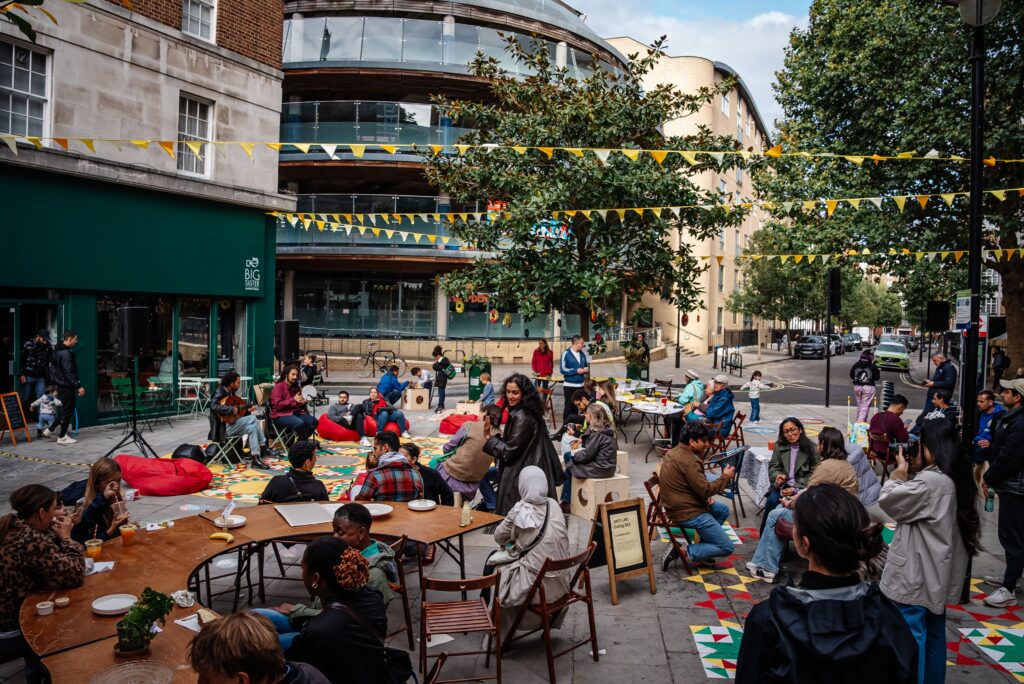
At Connecting Hoxton we engaged over 170 participants across a remunerated programme, removing financial barriers to participation. We asked residents what they loved about their neighbourhood and how Hoxton could better care for its young and older people – generating forward-looking responses that conventional consultation rarely produces. We helped establish a local inclusion group, creating a disability advocate role for a community member. Young people from Voyage Youth, local colleges, and the London School of Architecture participated as paid community researchers.
On the Burnt Oak spatial framework we included local organisations directly in the design team: Unitas and Inclusion Barnet were partners in improving the local high street. Play Your Part, our co-design card game developed with Feilden Clegg Bradley, was designed to reconnect participants with their creativity and agency.
2. Does your work create connected and resilient communities which positively contribute to neighbourhoods and allow equality of access?
Social connectivity is something we measure as well as design for. Before beginning work at Connecting Hoxton we mapped connections between local community organisations; we will map them again on completion, with the explicit intention of creating a denser weave of community relationships – not only improved spaces but a stronger social fabric.
Timber Lodge and Tumbling Bay at the Queen Elizabeth Olympic Park won the national Selwyn Goldsmith Award for Universal Design – described by judges as “an exemplar in accessibility and universal design.” Camden Active Spaces, monitored by UCL, produced measurable wellbeing gains for London primary school pupils.
Connecting Hoxton will create four jobs and safeguard 34. We embed economic opportunity through community researcher roles, disability advocacy positions, and investment in local plant maintenance. Community gardens on housing estates create persistent focal points for neighbourhood life.
3. Does the majority of your work promote equity in society, and consider all people, not only building inhabitants
Our work is inherently outward-facing: public realm, parks, playgrounds, and streets that serve entire neighbourhoods and the full spectrum of their residents. Where we design buildings, these are predominantly community and learning centres.
Our equity commitment extends to those whose voices are least heard: children, elderly people, people with disabilities, and communities excluded from conventional consultation. Intergenerational design – connecting the youngest and oldest residents in shared outdoor space – is a longstanding specialism. We supported the formation of a local inclusion group, creating a professional opportunity as disability advocate for a community member. We work with young people from Voyage Youth, local colleges, and the London School of Architecture as community researchers.
Our emerging material library considers working practices in countries of origin, travel distances, and EPDs. Our contribution to Making London Child Friendly and our LLDC Play Strategy extend equity principles to city-wide guidance.