
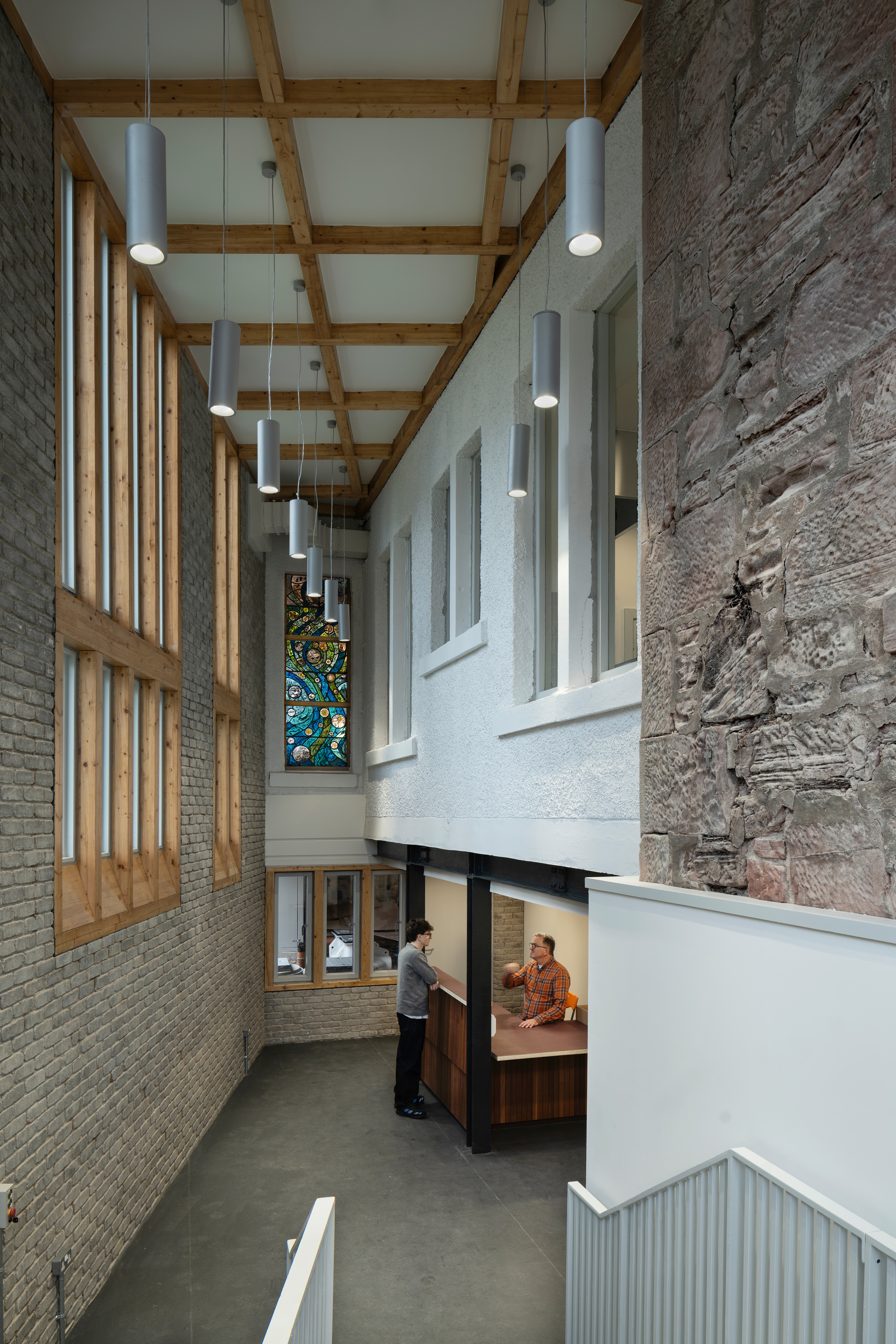
Submission by O’DonnellBrown.
Being a good ancestor
Practice
1. Do you have a clearly stated purpose aligned with the planetary emergency? We’re looking for a bold ambition here, and a culture which recognises the need for long-term thinking.
We have a clear purpose that is shaped by the planetary emergency to extend the life of buildings and places, and to demonstrate the value of working with what already exists. Our work is centred on retrofit, regeneration and repair, treating existing fabric, embodied carbon and community memory as assets rather than liabilities. This informs both our projects and culture. We apply conservation principles (repairing before replacing, minimal intervention and longer term adaptability) while working closely with communities to secure social as well as environmental value. This position is visible across recent work, from the defurbishment of a former Salvation Army Hall, to the revival of an island community town hall, to the low energy transformation of a former community centre, and the stewardship led regeneration of an A listed riverside industrial site.
2. Do you have a clearly stated purpose aligned with the planetary emergency? We’re looking for a bold ambition here, and a culture which recognises the need for long-term thinking.
To note I had to tick ‘yes’ to give some explanation, however the answer is work in progress:
Not yet, in a formalised sense, but this is an active area of work. As the practice has grown, there has been increasing focus on how ownership, responsibility and values can be carried forward in a way that supports continuity. Discussions are underway to develop a clear succession structure that protects the ethos of the practice while empowering the wider team to help shape its future. This is understood not simply as a question of governance, but as part of building a resilient long term practice culture, a culture that recognises contribution, supports shared responsibility, and creates the conditions for our work and its values to continue.
3. Do you share research and knowledge for the benefit of society and the wider world?
Sharing knowledge is central to how the practice works. Built work, self initiated projects, teaching and writing all contribute to a wider conversation about retrofit, stewardship and socially responsible design. Public facing project material openly documents the thinking behind work including a restored town hall, a low energy community centre retrofit, a carefully adapted former assembly building and a long term riverside regeneration project. The studio also maintains strong links with architecture schools through tutoring, crits and mentoring, alongside mentorship programmes for young architects and women in mid career. Self initiated research is another way that we share, by testing ideas in public, building new partnerships and generating knowledge that can transfer into practice, policy and education. We think that research is most valuable when it is outward looking, practical and capable of benefiting communities.
Project
1. Do you advocate for long-term thinking at the outset of work? Do you initiate work with long-term thinking and challenge clients? Also, can the organisation demonstrate that this approach has worked?
We advocate for long term thinking by challenging the assumption that replacement is the default. At project outset we ask what can be retained, repaired and adapted, and what social, material and cultural value is already present. This approach has shaped work across different contexts. Examples include a careful repair and extension strategy which brought a vacant town hall back into use while creating income generating flats as part of the retrofit to support its future. On a post industrial riverside site, longterm community led work helped to establish a vision that protects heritage while reopening the site to the city. In each case, long term thinking has led to lower embodied carbon, stronger continuity, improved access and greater resilience.
2. Does your work take account of the future climate and the need for resilience?
Our work addresses future climate and resilience through reuse, fabric first retrofit, adaptable planning and long term stewardship. Examples include a former community centre which was transformed from a damp, inefficient 1970s building, into an energy efficient performing arts and community hub, reducing energy use from 265 kWh per square metre to 82 kWh per square metre while securing the future of a youth organisation. Another retrofit of an existing assembly building achieved EPC A with a primary energy indicator of 55 kWh per square metre per year while improving natural light, ventilation and accessibility. Elsewhere, repair, extension and environmental upgrades have secured the future of an island community’s town hall, supported by a revenue model that strengthens long term viability. Self initiated courtyard research extends this thinking to the scale of the city, exploring how shared urban backcourts can support drainage, biodiversity, heat resilience and everyday community life.
3. Does the majority of your work go beyond mitigating negatives and towards optimising positives?
We aim to go beyond reducing harm and create work that generates social, environmental and civic value. Our retrofit work extends the life of existing buildings, reducing waste and embodied carbon while improving accessibility, comfort and usefulness. And across our work generally, we strive for outcomes that are both social and enviornmental.
Co-evolving with nature
Practice
1. Do you use biophilia within your premises and/or do you regularly gather in natural settings?
We are based in a city, but have always placed importance on connection to nature as an important part of our culture. An early studio was a Victorian conservatory in a garden setting, and we really benefited from being so connected to nature with opportunities for our studio expanding into the garden setting. Our work increasingly looks at how architecture can support stronger connections between people, place and ecology and as a team we try to get into nature when we can, whether it is a team trip up a munro in the Scottish highlands, or walking Clemie, our studio dog.
2. Can you share examples of where you have considered nature in decision making?
We are based in a city, but have always placed importance on connection to nature as an important part of our culture. An early studio was a Victorian conservatory in a garden setting, and we really benefited from being so connected to nature with opportunities for our studio expanding into the garden setting. Our work increasingly looks at how architecture can support stronger connections between people, place and ecology and as a team we try to get into nature when we can, whether it is a team trip up a munro in the Scottish highlands, or walking Clemie, our studio dog.
3. Are you supporting nature locally and nationally?
We are based in a city, but have always placed importance on connection to nature as an important part of our culture. An early studio was a Victorian conservatory in a garden setting, and we really benefited from being so connected to nature with opportunities for our studio expanding into the garden setting. Our work increasingly looks at how architecture can support stronger connections between people, place and ecology and as a team we try to get into nature when we can, whether it is a team trip up a munro in the Scottish highlands, or walking Clemie, our studio dog.
Project
1. Can you demonstrate work that strives to match the performance of a mature ecosystem?
Yes, in that in our work we try to create conditions that are adaptable, resource aware, interconnected and supportive over time. The clearest examples are our self initiated courtyard studies, exploring how shared backcourts can evolve into multifunctional spaces that support climate resilience, biodiversity, water management and stronger community use, alongside an off grid learning facility designed as part of a wider learning landscape where light touch construction, renewable energy and woodland engagement work together.
2. Are you working on material stewardship?
Yes. Material stewardship is increasingly integral to our work, from retaining existing structures to planning for reuse from the outset. On a recent retrofit of a former warehouse to aparthotel, a pre demolition audit was undertaken to identify and assess existing materials before strip out began. Elements with reuse potential were included in the contract to prevent unnecessary waste. This builds on an earlier example, where retained fabric was prioritised and materials reused across different buildings, including timber floorboards reused as joinery elements. We are still developing this area of the practice, but continue to improve year on year.
3. Does the majority of your work demonstrate the use of biologically-inspired approaches such as Bioregionalism, Biophilia or Biomimicry?
Our work is aligned with this type of thinking, even where it is not explicitly framed in those terms. Across our practice we begin with local context including climate, material traditions, existing fabric, community knowledge and landscape conditions. This is evident in our conservation led retrofit work, the use of robust natural materials, and projects shaped by passive environmental design and minimal ground disturbance. A competition winning retrofit of a former laundry building in the Scottish Borders was developed around the idea of being inn and of the landscape, using locally sourced materials including earth from site to create a strong connection to place. The proposal combined circular design and low carbon principles as part of a highly collaborative process, demonstrating an approach where buildings, landscape and people are understood as part of the same system.
Creating a just space for people
Practice
1. Do you have a progressive EDI policy and can you evidence many forms of diversity, which are welcomed and acknowledged, within your company/organisation?
We have an EDI policy in place and see this as part of a wider commitment to building a practice culture that is fair, supportive and open to different experiences and perspectives. As a growing studio, we recognise that this is ongoing work rather than a fixed achievement, and we are committed to continually improving representation and inclusion within our workplace over time. This approach also shapes the way we design. We prioritise accessibility, community voice and the creation of spaces that work for a broad range of people, not only the most visible or well represented users. Internally, we aim to create an environment where team members can contribute meaningfully to the direction of the practice, while externally we work with clients, communities and collaborators in ways that respect different perspectives.
2. Do you operate a no overtime culture, meet the living wage consistently, and stipulate a fair salary ratio between staff of all levels?
Yes. We are committed to fair and sustainable working conditions within the practice and aim to avoid overtime wherever possible – thoughtful design work depends on manageable workloads and respect for people’s time outside the studio. On occassion, where additional time is needed to meet project deadlines, this is discussed and agreed in advance. We offer time off in lieu, with paid overtime agreed for more significant periods of additional work. We meet the living wage and maintain a fair and transparent approach to pay across the team, recognising that this is an important part of building trust within a practice of our size. The way the practice is run reflects the values we aim to bring to our projects, including fairness, clarity, collaboration and long term sustainability.
3. Do you support charities, community groups, social enterprises, action groups and others through pro-bono work, charitable giving or in-kind donations?
Supporting charities, community groups, and social enterprises features in both our project work and studio culture. The majority of our projects involve values led organisations, where design work contributes directly to wider social and civic benefit. The practice also supports organisations through contributions in kind, and staff volunteering. We each have an annual volunteering day, which has been used for activities such as preparing drawings for a non profit cultural organisation, and participating in tree planting and environmental work with partner organisations. These commitments connect the practice to wider social infrastructure, beyond our commissioned work.
4. Do you use an ethical framework to assess opportunities and/or supply chain partners and is them team consulted on these decisions?
We do not currently have a formal written ethical framework. However, decisions around opportunities and collaborations are guided by practice values including environmental impact and social value. These considerations form part of early project and procurement discussions and inform how we assess collaborators, consultants and suppliers. In a ten person studio context, decisions are discussed collectively, particularly during project setup and team formation. We prioritise working with local suppliers and partners whose approach is in alignment with our own. We are working to further develop and formalise this approach as the practice grows.
Project
1. Does your work demonstrate deep engagement with local stakeholders and end users?
Genuine engagement with communities and local stakeholders is central to our process. On a derelict post industrial riverside site, rather than beginning with a fixed architectural proposal, our work as masterplan architect started by listening, bringing together community voices, the client, the local authority and heritage bodies to build a shared vision. Our work on this project has been a multi year process involving conversations, workshops, presentations, site visits, and different forms of participation designed to hear a wide range of voices. For the public park element of the masterplan, engagement was structured to create space for groups including women and girls, older residents and the wider public, helping balance competing priorities around heritage, ecology, recreation and development generally. The result is a project shaped through iterative public input, with the first phase, a new riverside park, opening up the site physically and socially to the city earlier this year.
2. Does your work create connected and resilient communities which positively contribute to neighbourhoods and allow equality of access?
Our work aims to strengthen neighbourhoods by creating places that are useful, resilient and accessible. Our recent completion of a town hall retrofit for an island community strongly illustrates this. The project brings a vacant public building back into active community use, restoring spaces for gathering, performance and local activity, while carefully retaining identity and memory. The addition of three homes has created a rental income that is supporting the long term sustainability of the building and its charity client, contributing to resilience rather than one off renewal. The design also improves access through upgraded facilities including a lift, and a clearer organisation of spaces.
3. Does the majority of your work promote equity in society, and consider all people, not only building inhabitants
A lot of our work is focussed on buildings, organisations and places that serve the wider public, over and above the people who use the building itself. We often work with charities, trusts, community groups, and public interest clients, and try to understand projects in terms of the neighbourhoods and networks they support. In a recently completed community centre retrofit, this meant securing the future of a youth and community organisation through a building transformation that improved environmental performance alongside everyday usefulness. In our recently completed town hall retrofit, this meant re-establishing shared infrastructure for community life. In a long term riverside regeneration project, it meant shaping development through years of engagement so that heritage, public access, ecology and new homes are considered together.