
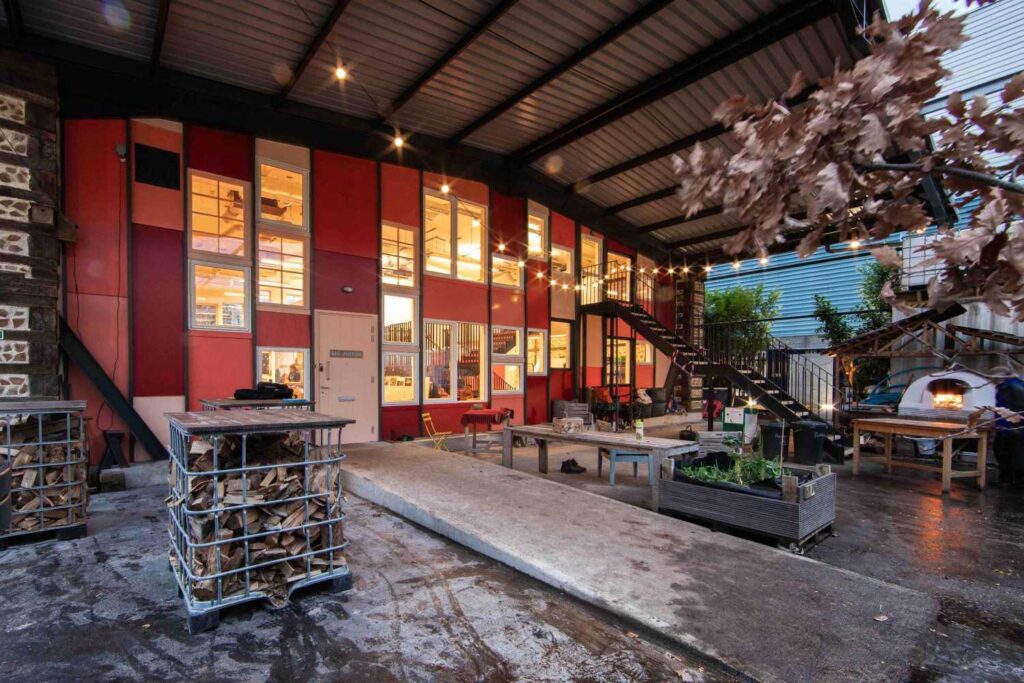
Submission by Jan Kattein Architects.
Being a good ancestor
Practice
1. Does the practice have a clearly stated purpose aligned with the planetary emergency? We are looking for a bold ambition here, and a practice culture which recognises the need for long-term thinking. For example, a strong mission, a theory of change, or a sustainability roadmap.
Our practice is built around the understanding and recognition that architecture is a holistic concern that has to do with people, places and the environment. Our design philosophy emphasises collaborative and open design processes, sustainability and circularity, community engagement and adaptive reuse.
Throughout design, procurement and delivery, we look for opportunities to re-activate existing spaces, use reclaimed or surplus materials, and tap into local networks.
We work closely with our clients to create innovative and inclusive construction methods often by re-designing entire construction processes and we re-invent vernacular construction methods to respond to contemporary environmental and social challenges.
We believe that to build a building with the help of more than 3000 volunteers, using more than 60% reclaimed materials is not only possible, but can result in an ‘A’ Energy Rating. We achieved this in the Paper Garden and are applying the insights we gained to our ongoing projects.
2. Does the practice have a clear succession plan, which passes on ownership and protects the values and legacy of those who built and contributed to the practice? For example is the practice an employee owned trust.
As a collaborative team, we have always given careful consideration to futureproofing our company, while taking steps to protect the values, culture, and integrity that have shaped the practice over the years.
We maintain a manageable team of 20, which allows us to adapt quickly to the company’s needs. While we are not an employee-owned trust, we work collectively to promote transparent decision-making, shared stewardship, and mentorship opportunities across all levels of the team. We are actively refining our succession plans to align with the regenerative principles we aim to embody in both our practice and our projects. In 2024, four employees were promoted to Associate Director, with these values and goals as a guiding priority.
3. Does the practice share research and knowledge for the benefit of society and the wider world? For example, you regularly carry out post occupancy evaluation and share information with others.
For 15 years our work has helped to redefine how social and environmental policy is implemented.
- We have prepared four planning policy guidance documents and spoken directly to more than 10,000 people in connection with our work
- We are committed to helping promote best practice in inclusive and collaborative design by participating and organising knowledge-sharing events.
- 50% of our team is involved in teaching and lecturing at institutions across the UK.
- We regularly upskill local people in construction techniques through our community co-build and co-design projects.
- We deliver additional outputs through our projects including construction skills training
- Jan Kattein has published two books, ‘The Architecture Chronicle; Diary of an Architectural Practice’ & ‘Londoners making London’ and remains a thought leader on grass roots processes, community led regeneration, participatory design processes, placemaking and community wealth building.
Project
1. Does the practice advocate for long-term thinking at the outset of projects? Do you initiate projects with long-term thinking and challenge the client on design life? Also, can the practice demonstrate that this approach has worked – with a shorter or longer design life, or an innovative approach to financing or payback period?
The initial brief at Carpenters Estate was to demolish the existing structures on site and to build new buildings. Instead, we worked with the client and design team to devise a strategy that allowed us to retain all structures by repairing and extending to suit their new purpose.
JKA developed a bespoke Embodied Carbon Calculator which tracks the embodied & operational carbon that covers the pre-construction & post-life of our design. Our Whole Life Carbon Assessment acts as a useful tool to progress the conversation around material choices and their impact around Carbon Footprint, which is particularly important in meanwhile projects.
To overcome some of the challenges we encountered in the Paper Garden, our client Populo set up a Circular Economy Hub on site to manage reclaimed material flows and we are currently achieving well below LETI ‘A’ Rating for Upfront Embodied Carbon A1-A5 and the London Plan Guidance benchmarks.
2. Do your projects take account of the future climate and the need for resilience? For example, do the projects demonstrate flexibility, design for adaptation, design for disassembly, non-deterministic solutions, or demountable structures.
We design for flexibility and future change by using demountable and re-deployable structures with in-built latent capacity.
Throughout the design process, we incorporate solutions for demounting and re-assembly in future locations and in different configurations, which are important parameters in all our meanwhile projects. At Ebury Edge and Sayer Street, we used timber framing techniques by carefully combining a series of standard elements to design lightweight structures that allow for dis-assembly and re-erection elsewhere.
Their construction is based on pre-fabricated timber cassettes and roof trusses and was conceived to make innovative use of accessible elements common in house-building which allowed us to create complex forms using standard components.
We have just brokered a deal where our kitchen & office building from the Story Garden, once dismantled to make way for permanent development, will be moved and to our Carpenter’s Estate meanwhile project later in 2025.
3. Do the majority of your projects go beyond mitigating negatives and towards optimising positives? For example, are they meeting or exceeding the RIBA 2030 Challenge.
We are conscious of the need to drastically reduce the carbon footprint of construction at all stages of the process and constantly strive towards optimising positives in all our projects. The innovative construction materials and methods that we use means that we are often unable to certify many of our projects under existing formalised frameworks. However, there are instances where we are able to use our own internal benchmarking to compare like-for-like with these systems. For example, exceeding the LETI 2030 target through a 60% (by volume) for reusing materials on the Paper Garden or benchmarking against the London Plan and LETI Carbon Calculation targets.
We embrace the United Nations’ 17 Sustainable Development Goals, that consider environmental and social goals as a set of interlinked priorities. Our commitment is reflected in projects such as The Wandsworth Food Bus, a mobile, affordable supermarket serving communities across South London.
Co-evolving with nature
Practice
1. Does the practice use biophilia within the office or regularly host meetings and retreats in natural settings? For example do you have extensive planting within the office or rely on natural patterns and imagery for stress relief or quiet areas.
Our studio occupies a converted former off-licence on New North Road in Islington. While this is not a quiet or leafy location, we’ve created two outdoor spaces; one at ground level and another on the first floor that are set back from the busy street, offering a peaceful retreat whenever needed.
Our roof terrace is planted with bee-loving plants and is spacious enough for the entire team to enjoy summer lunches together. Right now, we’re experimenting with ‘Tuesday Team Lunches,’ where team members take turns preparing food and using the courtyard for outdoor cooking.
Large windows offer views onto both the terrace and courtyard, and every workstation is close to an operable window or door leading outside.
Our ongoing partnership with the environmental charity Global Generation means that we regularly join together as a team to volunteer on build days, or participate in community planting events.
2. Can the practice share examples where it has considered nature in decision making? For example by having a nature proxy to encourage eco-centric decision making, using natural systems as inspiration for the company structure, recognising the seasonal nature of people’s capacity and workload or celebrating equinoxes and solstices together.
No.
3. Is the practice supporting nature locally and nationally? For example, does the practice support local gardens, gardeners, planting programmes, rewilding programmes or advocate for changes in legislation to protect nature.
For us, sustainability is simultaneously a social and environmental challenge, and one which demands multi-generational strategies to continually support and build capacity in our most vulnerable communities. We have partnered with the environmental charity Global Generation since 2015, co-creating four temporary gardens throughout London. These gardens enable Global Generation to deliver a multitude of educational and environmental programmes that include practical hands-on gardening experience as well as employment pathways for people that are often from disadvantaged backgrounds, giving them the social, emotional and practical skills to make a difference in the world.
We have a landscape architect on our team who helps us integrate a holistic approach to ecology in all our projects. To us, ecology encompasses both people and the natural world, and our aim is to shape a new narrative that focuses on developing healthy ecological and social systems in challenging locations.
Project
1. Can the practice demonstrate projects which strive to match the performance of a mature ecosystem? As a minimum this would mean achieving biodiversity net gain.
In Wilderness Street, we temporarily revived landscapes lost to large-scale urbanisation by creating an 80m long living urban landscape on a road surface in Ilford Town Centre. Using the Uphall Camp Beacon, the former Royal Forest of Hainault and the Essex Grazing Marshes as blueprints for plant species and landscape character, we tried to replicate these ancient forests and marshlands on Oakfield Road.
The project advocated for the preservation of ancient natural landscapes and their role in maintaining biodiversity and supporting well-being. A series of community events and workshops around the theme of landscape including planting workshops were programmed for the duration of the project.
The legacy saw all planting given away to community organisations and Ilford residents at the end of the project. Enticing local people to adopt the plants, meant that elements of the ancient Essex landscape were re-instated in public places, gardens, planters and allotments.
2. Is the practice working on material stewardship? For example, evidence could be shown through repeated use of low carbon materials, extensive material libraries and research or publications supporting responsible use of materials and elimination of waste.
Material stewardship is so intertwined with our philosophy that it’s hard to pin-point when it began. Recently, we repurposed a gramophone horn left over from one of Jan’s 1:1 Diploma project models in 2003 in our steam-punk toilet refurbishment at the Discover Children’s Story Centre. Material re-use is about these stories too.
We’ve built cordwood walls using Epping Forest logs, repurposed railway sleepers, built with CobBauge using Kings Cross earth, hundreds of volunteers made handmade bricks and shakes from local clay and timber, pushing technical boundaries along the way. Reusing sanitary ware, doors, windows, flooring, steel, and furniture is standard practice in our projects.
In collaboration with Global Generation, we are organizing Build Fest UK, set to take place on July 19th at the Story Garden behind the British Library. The event will feature lectures, discussion sessions, and hands-on workshops focused on sustainable building, and sustainable communities.
3. Do the majority of projects demonstrate the use of biologically-inspired approaches such as Bioregionalism, Biophilia, Biomimicry, Ecomimicry (also referred to as Ecosystems Thinking, Industrial Ecology or Industrial Symbiosis) or BioTRIZ?
No.
Creating a just space for people
Practice
1. Does the practice have a progressive EDI policy and can you evidence many forms of diversity, which are welcomed and acknowledged, within the practice?
We prioritise EDI in all aspects of our operation and we have comprehensive EDI policies that are reviewed and audited yearly as art of as part of our UKAS ISO 9001 and Constructionline Gold Accreditations. With the vast majority of our projects located in London and in areas with high indexes of deprivation, the diversity of our team is essential to understand and respond to the challenges faced by the communities we work with.
Our team brings together various skills and perspectives, leading to holistic and impactful and appropriate architectural solutions. Our team of 11 speak the following languages: German, Malaysian, Mandarin, French, Cantonese, Romanian, Greek and Gujarati. 60% of our team identify as women and 25% of our team are from a global majority background.
2. Does the practice operate a no overtime culture, meet the living wage consistently, and stipulate a fair salary ratio between staff of all levels?
We prioritise the wellbeing of our people and the majority of our team work a four-day week. We actively support members of our team in any additional roles, creative pursuits or responsibilities and offer flexible working and enhanced sick leave, maternity and paternity leave and pay, additional annual leave and paid overtime or time off in lieu. We are a London Living Wage Employer and we regularly benchmark our salaries to the RIBA salary survey. We do not accept that anyone should be working for free and do not take unpaid interns.
3. Does the practice support charities, community groups, social enterprises, action groups and others through pro-bono work, charitable giving or in-kind donations?
Our purpose is to build community through design and we support a number of charities and other like-minded organisations with a combination of pro-bono work, in-kind donations and charitable giving.
4. Does the practice publicly refuse to work with certain clients, suppliers or organisations on ethical grounds?
Our Corporate Social Responsibility Policy and our Ethical Policy inform our decision-making at every level; from selecting who we bank with to determining the types of commissions we accept. In practice, this means we may earn lower financial returns by choosing banks that do not support arms dealing, or that we must decline opportunities such as competitions funded by petroleum companies, or projects that conflict with our values. Some might argue this approach is detrimental to business, but we view it as essential for maintaining our integrity.
Our commitment to ethical practice shapes our relationships with clients, partners, and the broader community. We actively seek out collaborations and initiatives that align with our principles of sustainability, fairness, and social responsibility, guiding us to support initiatives that promote positive social change and decline to support those who, in our view, promote the opposite.
Project
1. Do the projects demonstrate deep engagement with local stakeholders and end users? For example, is there evidence that your project engagement goes beyond consultation towards co-design?
At The Paper Garden, we integrated a volunteer-build component, engaging over 3,000 volunteers who became ambassadors for natural building techniques. At the Triangle Site, 409 volunteers have learned sustainable construction techniques across 49 events. In Thamesmead, we partnered with Windrush Primary School to create a school garden, collaborating with teachers to align the project with curriculum objectives; this led to garden activities being woven into the school’s STEM curriculum. In Edmonton, our work with St Peter’s and St Paul’s Primary School centred on a teaching programme about sustainability and well-being. Through practical and storytelling sessions with teachers, we developed a strategy for re-wilding the street outside the school, directly incorporating children’s imaginative ideas about monster habitats in the completed School Street. Each initiative not only translated co-designed visions into tangible projects, but also demonstrated how hands-on, creative approaches can embed sustainability and well-being making a lasting impact in our environment.
2. Do your projects create connected and resilient places which positively contribute to their neighbourhoods and allow equality of access? For example, do your projects create economic opportunity, retain value locally and generate social value?
The concept of resilient places deeply ingrained in our approach. At Blue House Yard, we prioritised local employment by hiring apprentices and carpenters from the area, assisted by volunteers and future tenants, which retained the economic benefits of the project within the community and supported local economic growth.
In Enfield we worked with the Council and, through conversations with local residents businesses and artists, devised a strategy to identify and address urgent challenges in the immediate term, while strengthening long-term resilience. Our collective vision enabled Enfield Council secure £2 million from the Mayor’s Good Growth Fund to deliver a four-pronged strategy, including Fore Street Living Room Library, Angel Yard, a new School Street and public artworks. We further supported the Council by developing a local procurement plan, which led to the works being implemented exclusively by local contractors.
3. Do the majority of your projects promote equity in society, and consider all people, not only the building inhabitants? For example, do your projects show due regard for workers within the supply chain and take active steps to avoid modern slavery?
Most of our work is in the public domain. Much of it is publicly funded. And some of it is politically sensitive. During the last 15 years we have worked with more than 10,000 stakeholders who were affected by our projects that include residents, businesses and business organisations, children and young people, town centre teams, senior citizens and religious groups. This cross-section of society includes manifold diversities and we reject any form of discrimination.
We are constantly striving for social and environmental good in our projects, and our dedication is reflected in the positive impact of our initiatives. This commitment has been recognized through several prestigious awards, including a Commendation for a Lifetime of Architecture for the Common Good (RIBAJ MacEwen Awards 2024), the Climate Change Winner title (2024 TET Inspire Future Generations Award), and the distinction of Social Value Architect of the Year (AYA 2023).