
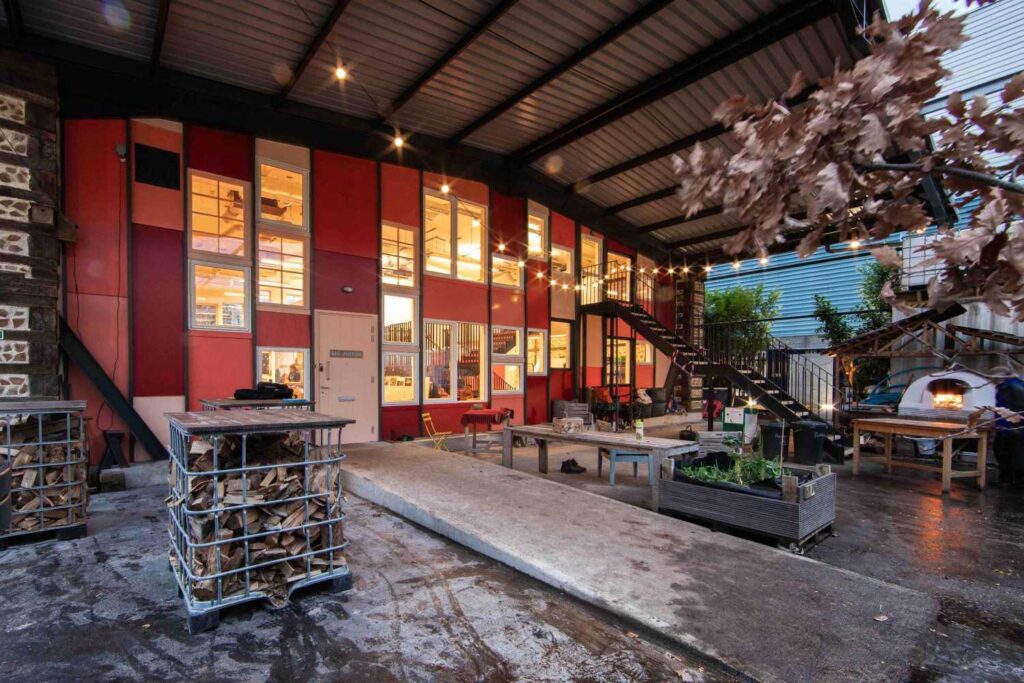
Submission by Jan Kattein Architects.
Being a good ancestor
Practice
1. Do you have a clearly stated purpose aligned with the planetary emergency? We’re looking for a bold ambition here, and a culture which recognises the need for long-term thinking.
We are an internationally recognised leader in civic practice, researching and nurturing collective action for positive change. We understand architecture as a holistic practice, connecting people, places and environments. For 25 years we have been developing and advocating for open, creative design methods to give agency to communities traditionally excluded from planning and regeneration processes. Since 2015, our work has focused on opening pathways for individuals and young people to meaningfully contribute to climate action.
We critically engage with our profession to interrogate architecture’s responsibility in response to accelerating societal and environmental challenges, while developing aspirational buildings and spaces that showcase what can be achieved when a truly regenerative mindset is applied to design practice. We collaborate interdisciplinarily to re-design out-dated procedures and risk perception and linear thought processes.
Independent external verification in connection with our ISO 14001 environmental accreditation compels us to review and improve our performance annually.
2. Do you have a clearly stated purpose aligned with the planetary emergency? We’re looking for a bold ambition here, and a culture which recognises the need for long-term thinking.
In progress/being developed.
3. Do you share research and knowledge for the benefit of society and the wider world?
For 20 years our work has helped redefine how social and environmental policy is implemented. As leaders in grass-roots processes, community-led design regeneration, participatory design processes and community wealth building, we:
- use pioneering participatory methodologies that have meaningfully engaged over 20k members of the public, including young people and individuals with protected characteristics.
- have given 50+ industry and academic lectures worldwide, on experimental, participatory and sustainable urbanism
- organise public events such as ‘Earth Build Day’ and ‘The Green Handprint at Work’ book launch
- regularly deliver CPD and knowledge exchange to local authority teams, architects and engineers
- are regularly involved in teaching and lecturing
- deliver additional value to communities through school work placements, mentoring and systematic capacity building
- publish articles and books that disseminate our methodologies incl. The Architecture Chronicle (2014), High Street Regeneration (2021), Londoners Making London (2023) and Architecture for Good (2028)
Project
1. Do you advocate for long-term thinking at the outset of work? Do you initiate work with long-term thinking and challenge clients? Also, can the organisation demonstrate that this approach has worked?
For 2 decades, we have been challenging design life expectancy and advocating for retention, flexibility and repairability through campaigning, strategizing and monitoring.
- Advocating for retention to limit embodied carbon, we have convinced clients in Enfield, Newham and Doncaster to abandon demolition and embrace retrofit/reuse
- Developing actionable legacy strategies, we have recently seen one meanwhile project relocated and given a permanent site.
- To demonstrate the value of reclaimed materials, we developed our own carbon calculator for temporary and meanwhile structures
- phased implementation strategies that facilitates iterative learning and development to allow spaces and uses to become better integrated
- materials and construction techniques that can be repaired, changed and de-mounted. At Ebury Edge, both structure and finishes feature detailing that reveals fixings and junctions
- monitoring our own successes (and failures) by building long term relationships with users and occupants of our buildings for learning and feed-back.
2. Does your work take account of the future climate and the need for resilience?
No.
3. Does the majority of your work go beyond mitigating negatives and towards optimising positives?
Our mission is to push boundaries and raise the bar on what can be achieved through circular and low-impact construction. We make a meaningful contribution to climate mitigation through:
- delivering teaching and training through our projects to give others the skills, knowledge and confidence to build with natural or reclaimed materials. For example, at Paper Garden and the Triangle Site we enabled 4500+ volunteers to build using 60% reclaimed and natural materials (by volume) – far exceeding current industry targets.
- developing innovative and replicable methods and systems. Notably these have compelled a housing association in Newham to innovate towards circular construction.
- creating new design languages for retrofit and reclaimed materials such as at Aberfeldy Street, where we drew on locally relevant traditions to re-invent existing high street terraces
- campaigning for solutions that do not involve any construction such as the Wandsworth Food Bus
Co-evolving with nature
Practice
1. Do you use biophilia within your premises and/or do you regularly gather in natural settings?
We use our studio environment to practice what we believe in. Our workspace occupies a former high street off-license shop where we have created indoor and outdoor workspaces across 3 floors using natural and reclaimed materials. Most workspaces are within 1m from a window and none are further than 3m from a window. Our two outside spaces, a courtyard and a roof terrace are densely planted with pollinator-friendly species and scented plants including jasmine, rosemary and wisteria, offering immersive greenspace for work and recreation. Team lunches are cooked weekly in our outdoor kitchen and during the summer served on our roof terrace.
Many of our projects involve volunteer action such as planting and gardening and we encourage team members to participate. Our ongoing partnership with the environmental charity Global Generation means that we regularly join force to volunteer building gardens together.
2. Can you share examples of where you have considered nature in decision making?
No.
3. Are you supporting nature locally and nationally?
For us, the nature emergency is simultaneously a social and environmental challenge, and one which demands multi-generational strategies to build support and capacity in our most vulnerable communities. We have partnered with environmental charity Global Generation since 2015, co-creating four temporary gardens in London. These enable the delivery of educational and environmental programmes including hands-on nature experiences, creating employment pathways for people from disadvantaged backgrounds, providing the social, emotional and practical skills to make a difference in the world.
We support the Woodland Trust. Our support of local resident initiatives has led to the creation of two pocket parks on our street. Many of our projects engage volunteers such as in Thamesmead where we planted an orchard with local residents, in Leytonstone where school children were involved in urban planting, and in Stratford and Southgate where we supported an initiative to create an urban garden with secondary school children
Project
1. Can you demonstrate work that strives to match the performance of a mature ecosystem?
Our projects enhance urban ecosystems through sustainable water management, biodiversity enhancements, education initiatives linked to long-term stewardship.
At the British Library, Canada Water and in King’s Cross, we built biodiverse gardens on sealed industrial sites with no previous biodiversity. Sustainable rainwater capture and management helps to transform sites formerly hostile to nature into fertile natural gardens all year around. In Redbridge, we transformed a street into an 80m long living urban landscape, re-creating ancient natural landscapes. In Edmonton, we created a school street with 3 biodiverse habitat areas. In Southgate, we turned car parking spaces into natural green spaces and in Hammersmith, we are de-paving a play area to introduce biodiverse nature play. In Thamesmead, we worked with a primary school to turn a lawn into a biodiverse educational garden and worked with Peabody’s grounds maintenance team to change mowing patterns and timetables to support pollinators.
2. Are you working on material stewardship?
Material stewardship is central to all our thinking, for both environmental and cultural reasons. Materials have embedded cultural value and re-using them yields powerful placemaking outcomes, enhancing people’s sense of belonging and civic pride.
In recent projects we have built cordwood walls using logs arising from forest management in Epping Forest; built with King’s Cross clay excavated close to our site; re-used windows destined for landfill; used UK grown and sawn wood in structural applications, re-used doors, kitchens, lights, insulation and plywood in our buildings.
We want to normalise the use of natural and re-claimed materials in construction and use our projects to create exemplars to inspire others and train a new generation of construction professionals, making natural and re-used materials the default solution.
We co-organised Build Fest UK, a conference exclusively about regenerative living and building to include practical, hands-on workshops focussed on the use of natural materials.
3. Does the majority of your work demonstrate the use of biologically-inspired approaches such as Bioregionalism, Biophilia or Biomimicry?
No.
Creating a just space for people
Practice
1. Do you have a progressive EDI policy and can you evidence many forms of diversity, which are welcomed and acknowledged, within your company/organisation?
We think that cultural, ethnic, sexual and religious diversity essentially contribute to London’s vibrancy and we cherish the creative opportunities that this brings to our work. London’s heterogeneity is reflected in our workforce. Our comprehensive EDI policies are reviewed and audited yearly as art of as part of our UKAS ISO 9001 and Constructionline Gold Accreditations. With the vast majority of our projects located in areas with high levels of deprivation, the diversity of our team is essential to understand and appropriately respond to the challenges faced by the communities we work with. Our team brings together diverse skills and perspectives, leading to caring, holistic and impactful design responses.
To nurture a diverse workforce, we explicitly encourage individuals from under-represented groups to apply to any job opportunities. Through thoughtful and collaborative allocation of responsibilities, support and training, we support professional and personal development of everyone in the team.
2. Do you operate a no overtime culture, meet the living wage consistently, and stipulate a fair salary ratio between staff of all levels?
We prioritise the wellbeing of our people and the majority of our team work a four-day week. We actively support members of our team in any additional roles, creative pursuits or responsibilities and offer flexible working and enhanced sick leave, maternity and paternity leave and pay and additional annual leave. Where out of hour working is unavoidable such as for attendance of planning committee meetings, events or public consultations, we have put in place a simple process granting time off in lieu. We have been an accredited London Living Wage Employer since 2018 and we regularly benchmark our salaries to the RIBA salary survey incl. senior positions. We do not accept that anyone should be working for free and do not take unpaid interns.
3. Do you support charities, community groups, social enterprises, action groups and others through pro-bono work, charitable giving or in-kind donations?
We support charities and community organisations through financial donations, social value commitments and discounted or pro-bono work. Our community give back pledge has to date delivered well over £100k in design work for free, helping to get many innovative and transformational projects off the ground that support some of the most vulnerable communities in the UK, including the Wandsworth Food Bus, the Beacon Homeless project, the Thornhill Primary School Dream Library Project and the Skip-, Story- and Paper Gardens.
In addition, we regularly leverage social value through our supply chain, compelling partners, sub-contractors and works contractors to commit to community wealth building initiatives in the places where we work.
4. Do you use an ethical framework to assess opportunities and/or supply chain partners and is them team consulted on these decisions?
Our Corporate Social Responsibility Policy and Ethical Policy inform decision-making at every level.
We actively seek collaborations that pursue sustainability, fairness, and social responsibility, guiding us to support initiatives that promote positive social change and decline to support those who promote the opposite. This includes who we sub-contract, who we bank with, who we travel with, where we buy office supplies and who we buy our energy from.
We do not knowingly work on projects or promote our work through channels that are funded, promoted or commissioned by organisations linked to fossil fuel extraction, ethically questionable practices including worker exploitation or projects that displace or cause harm to communities.
We do not knowingly specify products derived through unethical, anti-social, fraudulent or environmentally harmful practice or produced by companies implicated by such practice, including those connected to Grenfell and actively promote alternatives to our clients even if there are cost implications.
Project
1. Does your work demonstrate deep engagement with local stakeholders and end users?
We value genuine trust and long-term collaboration, from collaborative briefing to participatory design and co-building.
- At The Paper Garden and Triangle Site, we integrated volunteer-building, engaging 4,500+ people who became ambassadors for natural building techniques.
- In Thamesmead, we partnered with teachers to create a garden that aligned with curriculum objectives; this facilitated the school’s STEM curriculum being delivered in nature.
- Through practical and storytelling sessions, we engaged children in re-wilding a school street in Edmonton, establishing long-term stewardship by adopting their ideas.
- At Thornhill Primary School, we worked with pupils who made 400 miniature models of dream libraries to re-define what a library is.
- And at Lupus Street, we hosted public play sessions to formulate visions for a new play space.
We build community through design. That means creating spaces that foster social interaction, while opening design processes to bring people together and build community.
2. Does your work create connected and resilient communities which positively contribute to neighbourhoods and allow equality of access?
Supporting the development of resilient places is deeply ingrained in our approach. In Enfield and Newham, we developed local procurement strategies that saw works delivered by contractors within a 5 mile radius, retaining public spend locally and building contractor capacity to bid for future public sector work.
We regularly support local apprenticeship and (paid) trainee programmes to create jobs including at Blue House Yard and the King’s Cross Triangle.
Our affordable workspace projects have created or safeguarded over 500 jobs during the last 10 years and often in areas subject to deprivation and hardship. Affordable rents and flexible terms allow entrepreneurs to innovate and take risks. We have found that creating a space where start-ups can innovate and fail inconsequentially actually increases their chance of success.
Our workspaces favour social impact organisations and have generated significant social value for local people through job creation, support, stewardship, education and culture.
3. Does the majority of your work promote equity in society, and consider all people, not only building inhabitants
We practice to Jane Jacob’s leitmotif: ‘ Cities have the capability of providing something for everybody, only because, and only when, they are created by everybody.’
The fact that most of our work is in the public domain, much of it is publicly funded, and some of it is politically sensitive makes us accountable for the changes that we promote and deliver. During the last 15 years we have worked with over 10,000 stakeholders who were directly or indirectly affected by our projects.
We exist to strive for social and environmental good. Our dedication to this cause is reflected in the positive impact of our projects. This commitment has been recognized through several prestigious awards, including a Commendation for a Lifetime of Architecture for the Common Good, the Climate Change Winner title, and being selected Social Value Architect of the Year.