
Submission by Hawkins\Brown.
Being a good ancestor
Practice
1. Do you have a clearly stated purpose aligned with the planetary emergency? We’re looking for a bold ambition here, and a culture which recognises the need for long-term thinking.
Increasingly, regenerative principles inform how we work and operate. As a response to the planetary emergency, we’ve committed to becoming a fully regenerative practice in our 2026-2030 business plan. The plan’s “ten commandments” include regenerative approaches alongside our core purpose: to be serious about society and human about architecture. Our new Design Manifesto is complemented by design overlays and templates to embed this culture throughout our studios.
We practice “Whole Life Design”, aiming to replenish and heal the planet by reducing carbon emissions, creating social value, and increasing connections to nature. We’re SBTi-registered and annually publish our carbon footprint; in 2024-2025, we recorded our first overall reduction in Scope 1, 2, and 3 emissions. We achieved this by thoroughly reviewing internal operations to ensure consistency between operation and design outputs.
In March 2026, we published our first annual impact report since B Corp certification, setting goals for the next year.
2. Do you have a clearly stated purpose aligned with the planetary emergency? We’re looking for a bold ambition here, and a culture which recognises the need for long-term thinking.
We’ve been an Employee-Owned Trust since 2021, ensuring the business is held and managed for the long-term benefit of employees. The founders’ values are a core, continuous part of how we operate. Our 2026-2030 business plan was co-created with all staff, ensuring equal representation of voices. We launched it with simultaneous events in all studios; everyone wrote commitments on wooden blocks, which became a tower of promise. In this way, the next generation of practice leadership feels agency over the legacy.
Our Design Manifesto enshrines three core tenets into a lasting framework for decision making: creating with spirit; transforming places; and designing with purpose. These principles anchor our work in long-term social and environmental value, ensuring that the next generation continues to uphold the founding ethos while evolving our practice in response to future challenges. All employees receive a copy of the Founders’ Wishes and the current five-year business plan.
3. Do you share research and knowledge for the benefit of society and the wider world?
Research-led design is a key part of our identity, which we often freely publish.
Recent examples:
- “Nourishing neighbourhoods” with the University of Cambridge and Max Fordham
- Key takeaways from our work with the Natural History Museum on a permanent exhibition, published via our website and shared at Footprint+ and via Museums 2030 network
- GLA technical evidence base to safeguard emissions reduction and resilience with Etude, Levitt-Bernstein and Currie & Brown
- Second phase of POE for Chobham Manor, due to be published by the LLDC
- Our Build Lean campaign, advocating for material efficiency and the strategic reuse of existing assets to lower costs and embodied carbon
- LCA training, RIBA Climate Emergency Core CPD led by our Environmental Intelligence team; coordinating ACAN and the Heads of Sustainability Network.
We’re also running an extensive programme internally, including lectures and interactive workshops on creating regenerative briefs.
Project
1. Do you advocate for long-term thinking at the outset of work? Do you initiate work with long-term thinking and challenge clients? Also, can the organisation demonstrate that this approach has worked?
Long-term thinking is central. From project inception, we challenge clients to consider outcomes beyond immediate financial and programme constraints, using iterative passive design and Whole Life Carbon analysis. Our Foresight consultancy further supports this by analysing long-term trends, helping clients take a systems-based view beyond traditional industry siloes.
This approach delivers lasting impact. Our twenty-year relationship with the University of Oxford helped them consolidate research space into adaptable, future-ready facilities designed around improved public realm. At Central Foundation Boys’ School, a 12-year phased retrofit has delivered high-quality teaching spaces, recognised for both Architecture and Sustainability in the 2025 RIBA London Awards and winning Creative Retrofit of the Year at the 2026 Pineapples, two years after its completion. We’ve worked extensively with Manchester Metropolitan University, focusing on efficiency, retrofit, and building lifecycle optimisation, while at Norwich City Hall, our analysis drove a window refurbishment strategy saving time, money and carbon.
2. Does your work take account of the future climate and the need for resilience?
Our Resilience Design toolkit embeds climate projections, rainfall analysis, passive design, and overheating risk into early design strategies. Our estates optimisation work supports long-term, data-led investment decisions that ensure growth projections are supported by resilience plans.
Our work on the Norwich Research Park masterplan reduced reliance on engineered solutions through green and blue infrastructure. Modelling higher and lower energy outcomes showed the additional renewables investment needed for energy security.
We’re advocating for the introduction of flood-resilient public space as part of waterfront regeneration projects in Glasgow, Cork, and Oxford, after successfully introducing them to central London through our work on the Thames Tideway public realm. Eddington in Cambridge achieves water neutrality through SUDs and demand minimisation; the landscape-led approach also supports social cohesion and stewardship. Recent work on Oxford Street and St Pancras addresses how to adapt sensitive city infrastructure to rising temperatures and increased storm events within existing constraints.
3. Does the majority of your work go beyond mitigating negatives and towards optimising positives?
2026 project performance data shows continued progress. For operational energy, 11% of projects outperform RIBA 2030 targets (up from 9%), with those missing all targets reduced to 29% (from 41%). Embodied carbon shows mixed results: 24% exceed RIBA 2030 targets, down from 38%, while projects missing targets have decreased significantly to 19% (from 39%).
While developing planning proposals for Lund Quarter, one of the team joined the Regenerative Design Lab and the project was linked with the UKGBC Systems Change programme to optimise regenerative outcomes. A regenerative brief was developed for an agri‑tech masterplan at Norwich Research Park, organising buildings around biodiversity corridors and blue infrastructure for nature-based water management, supported by performance KPIs. Through a focus on efficiency, the TSH Fountainbridge project is projected to outperform NZCBS operational energy, has future resilience built in, and increases local social value.
Co-evolving with nature
Practice
1. Do you use biophilia within your premises and/or do you regularly gather in natural settings?
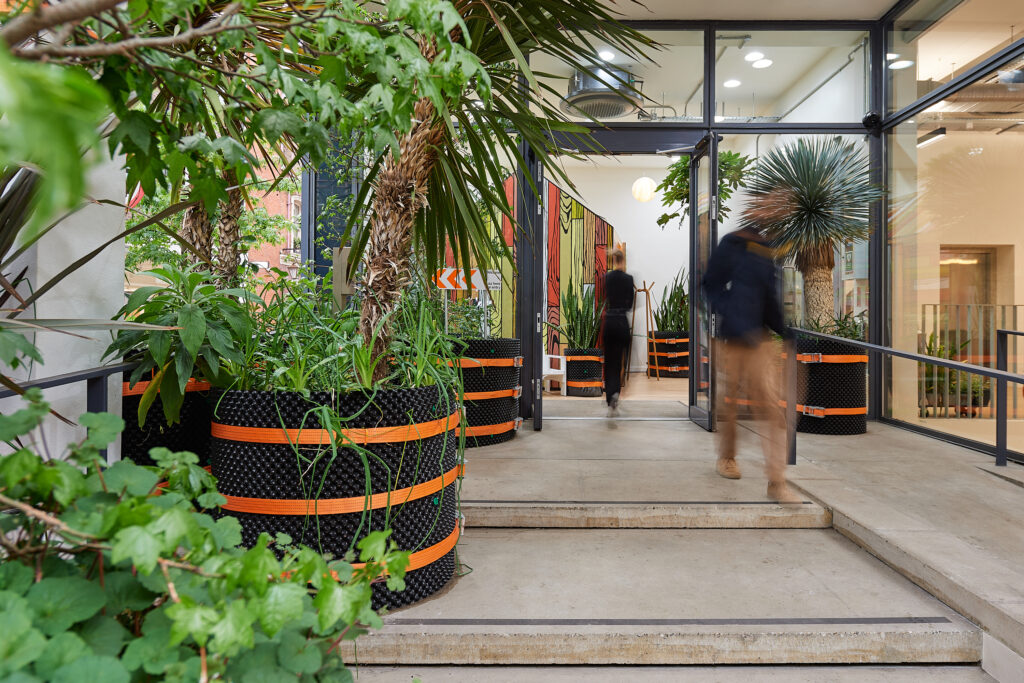
All our five locations utilise planting and biophilia at varying scales to create connections with nature and a calm working environment. We welcome visitors to our London studio through a pavement pocket paradise, known as the Wild, which we designed in collaboration with landscape designers James Fox and Michael Halifax and horticulturalist Lyndon Osborne. Since its installation in 2024, we’ve actively managed the mix of different species of trees, shrubs, and seasonal bulbs to adapt to the immediate environment and urban context. The perforated airpot planters are made of repurposed construction materials. Each root is guided towards an airhole, which dehydrates the tip, prunes it and stimulates root branching. The process repeats until there is a mass of healthy fibrous root.
Across our studios, generous planting and biophilic design create connections with nature and calming workspaces, particularly around meeting areas. This is also part of our internal fit-out language.
2. Can you share examples of where you have considered nature in decision making?
We consider nature within decision‑making by treating sustainability and regenerative design as integral to our business. As part of the core leadership coordinating and implementing the business plan, our Head of Sustainability gives a voice to nature and brings long-term thinking into decision-making.
As an Employee-Owned Trust, we share responsibility and collective stewardship of environmental outcomes. There are several examples of this organic, emergent, and self-managing system that relies on empowerment and trust. For instance, the elected Employee Council is not led by senior leadership, who instead act as mentors to the next generation. Voice Groups, including ED&I, Wellbeing, and CSR, feed into the council. We are exploring a revision to our skills matrices to ensure nature and planetary health are considered in decision-making.
3. Are you supporting nature locally and nationally?
Our residential-led masterplans reflect a renewed appreciation for the benefits of nature to local communities. Earlier this year, we published a research project titled “Nourishing Neighbourhoods,” in collaboration with Max Fordham and the University of Cambridge Behaviour and Building Performance Group, which advocates for the integration of high-quality natural landscape and community gardens as a way of improving neighbourhood health and wellbeing. This research formed a core part of the design strategy for Eddington, North West Cambridge.
We regularly contribute to industry knowledge and policy development. For example, we are helping to shape the evidence base and recommendations for more ambitious and comprehensive decarbonisation policies in the next London Plan. We also contributed to the 2021 Parliamentary Environmental Audit Committee, leading to the recommendation of WLCA in national policy.
Project
1. Can you demonstrate work that strives to match the performance of a mature ecosystem?
Many of our projects utilise the benefits of nature and ecosystem development and support.
We are currently working on several landscape-led projects that prioritise resilience in the face of climate change, biodiversity, and sustainable water management. One example is Custom House Quay and Carlton Place in Glasgow, where we are creating a new biodiverse park on the Clyde waterfront alongside flood defence works. Construction will be paused during the salmon season so as to avoid interfering with their migration patterns, and we are proposing red lighting to minimise the impact of the scheme on nocturnal species such as bats and moths.
2. Are you working on material stewardship?
Building on over a decade of embodied‑carbon research, including the development of H\B:ERT and its successor, VERT, we continue to explore regenerative, low‑impact materials and scalable circular practices.
We focus on reducing the need for virgin material. Our Build Lean research examines procurement and embedded WLC analysis aligned with cost to drive material efficiency, while our Industrial Rehab campaign argues for the repurposing of post-industrial assets. Our advocacy enabled multiple public realm projects to reuse hard landscaping, including the Smithfield market redevelopment. We regularly partner with others, including Material Index and Saint Gobain, to maximise re-use, ensuring material remains in the value chain and financial value can be recouped.
For this year’s London Festival of Architecture, we’re collaborating with Loughborough University and the Hiroshima Institute of Technology to create a seaweed pavilion as part of ongoing research into bio-materials in construction.
3. Does the majority of your work demonstrate the use of biologically-inspired approaches such as Bioregionalism, Biophilia or Biomimicry?
Biophilic design is embedded across our education projects, including the St Paul’s School interior palette, where colours, textures and tonal gradients drawn from natural environments were used to calm students, support cognitive focus and create a restorative atmosphere. Bioregional principles guide major infrastructure and regeneration work. For example, Thames Tideway public realm integrates river‑edge ecologies, tidal processes and material cues from the Thames foreshore and London’s lost rivers. Similarly, our work on Cork Docklands responds directly to the estuarine landscape, local microclimate and long-standing maritime material culture.
At the masterplanning scale, the nature‑led Norwich Research Park framework is structured around hydrology, habitat networks and landscape character, using ecological processes to shape movement, development parcels and long‑term resilience. These approaches ensure that projects are rooted in the ecological and cultural identity of place rather than imposed design language.
Creating a just space for people
Practice
1. Do you have a progressive EDI policy and can you evidence many forms of diversity, which are welcomed and acknowledged, within your company/organisation?
As a 100% employee‑owned B Corp, a meaningful approach to EDI is key to our practice. Our team spans 28 nationalities, is 51% women, 25% people of diverse ethnic heritage, and includes 34% parents/carers. Employees are empowered through the Employee Council and Employee Voice Groups (EDI and CSR). We also have three internal advocacy groups, REACH (Race, Ethnicity, and Cultural Heritage), LGBTQ+, and Women in Progress, which provide an informal support network and a safe space.
We are signatories to the NLA Diverse Leaders Pledge, RIBA Inclusion Charter and Disability Confident. These initiatives, together with the BCorp framework, inform our EDI Employee Voice Group action plan.
The EDI Employee Voice Group ensures that EDI is a key consideration across design, recruitment, training, development and leadership. We provide a comprehensive training programme for all staff, with enhanced mandatory training for those in positions with responsibility for recruitment and progression.
2. Do you operate a no overtime culture, meet the living wage consistently, and stipulate a fair salary ratio between staff of all levels?
We are accredited by the Living Wage Foundation and have a published pay policy that sets out how salary reviews are carried out. Staff are placed into peer bands to support pay parity, and salaries are benchmarked against comparable practices. We aim to pay at or above market rate across all roles.
We operate a TOIL policy: any overtime must be agreed with a partner in advance. We try to prevent overtime by reassigning resources and scaling teams to meet deadlines; where this isn’t possible, TOIL is provided so people can take time to recover after intensive periods. HR reviews timesheets with project leaders to monitor hours and spot issues early.
3. Do you support charities, community groups, social enterprises, action groups and others through pro-bono work, charitable giving or in-kind donations?
Our CSR Voice Group, known as “&everyone”, coordinates charity work, volunteering, mentoring, and wider CSR. Each year, we vote for a company charity local to one of our offices: in 2025/2026, we’re working with Coffee4Craig and Rainbow Hub in Manchester. Our supper club series, which hosts discussions on the built environment, has a longstanding partnership with Clerkenwell-based charity Migrateful, whose alumni chefs cater the events and to which we donate ticket sales.
We run an extensive mentoring and schools outreach programme. In the last year, we’ve collaborated with Built by Us, Open City Accelerate, Blueprint for All, Arts Emergency, POC in Architecture CIC, Build the Way and Narrative Practice, delivering events, pairing students with qualified architects, and hosting work experience. Later this year, we’re working with a local school to run workshops on climate change and resilience in partnership with Climate Change for All.
4. Do you use an ethical framework to assess opportunities and/or supply chain partners and is them team consulted on these decisions?
We are an employee-owned business, and as such, our clients’ values must align with ours. As part of our B Corp certification, we do not work with clients in industries acting against B Lab’s Theory of Change, such as tobacco, gambling, or defence. New opportunities, particularly those overseas, are evaluated using a framework based on the Freedom House Index and the project’s social value.
Project
1. Does your work demonstrate deep engagement with local stakeholders and end users?
We know that to design great places, we must continually facilitate a deep understanding of context. This means working with local communities and stakeholders beyond consultation programmes to build knowledge, develop a shared local understanding, promote opportunities to meaningfully influence design, and facilitate opportunities for local people.
At the Northumberland Park Estate, we worked with Haringey Council to form a Community Voice Group, which engaged throughout the design process alongside wider public events to understand resident priorities and needs. We collaborated with The Glass-House Community Led Design, a national charity, which hosted workshops and acted as an independent voice to empower the community. The result was a variety of engagement tools that allowed a wide cross-section of the community to be involved meaningfully.
2. Does your work create connected and resilient communities which positively contribute to neighbourhoods and allow equality of access?
When working on large-scale residential schemes, we are actively trying to “design out” loneliness and create connected, resilient communities. On the Carpenter’s Estate in Newham, where residents have experienced decades of proposed regeneration, our design process needed to bring people together to build resilience in the face of change and embed co‑design principles so that local voices meaningfully influenced the emerging proposals. Consequently, we adopted a “we’ll come to you” approach, using The Dovetail Community Centre at the heart of the estate as our base. To reach a wider cross‑section of the community, we complemented our sessions with volunteering at local food banks and schools, and by inviting local classes to our studio for insight days. This allowed us to meet people where they already were, build relationships beyond formal consultation, and demonstrate that our commitment to a healthy, thriving neighbourhood extends far beyond the design proposals themselves.
3. Does the majority of your work promote equity in society, and consider all people, not only building inhabitants
Our design approach is built on an in-depth understanding of the contexts within which we work and an aspiration to create a more inclusive and equitable society. This approach regularly takes us beyond the red line boundary, where we consider the wider impact of our projects.
We actively promote equity and inclusion by developing strategies to engage thoughtfully and respectfully with local communities, working with accessibility experts, and seeking opportunities for co-design. Our commitment to EDI supports and strengthens our design approach, and by partnering with local organisations to support a varied supply chain, we can deliver measurable and impactful social value.
Our Environmental Intelligence team has been reviewing our supply chain practices and helping to shape industry guidance through the UKGBC Supply Chain taskforce, promoting practical guidance for embedding sustainability and social value in the procurement process, and encouraging inclusive engagement with suppliers of all sizes, including SMEs.