
Submission by Gale & Snowden Architects Ltd.
Being a good ancestor
Practice
1. Does the practice have a clearly stated purpose aligned with the planetary emergency? We are looking for a bold ambition here, and a practice culture which recognises the need for long-term thinking. For example, a strong mission, a theory of change, or a sustainability roadmap.
Our Practice is informed by an approach that recognises that people are part of nature and that by understanding and working with nature and natural systems we can regenerate our environment
We can provide all the things that we need; food, water, energy, shelter & community in a healthy, robust and ecologically sustainable manner whilst creating beautiful places to live work and play
Understanding the science of how the natural world works gives us the tools to produce elegant and efficient design solutions. We deploy rigorous physics and biology to create buildings and integrated landscapes that need little energy and enhance our health and invigorate us, whilst improving the environment and supporting our communities
This approach is known as Permaculture, which involves whole systems thinking and strives to integrate people into designed productive ecosystems – this is the ethos that underpins our practise, the work that we do and how we live.
2. Does the practice have a clear succession plan, which passes on ownership and protects the values and legacy of those who built and contributed to the practice? For example is the practice an employee owned trust.
Gale & Snowden have been specialising and at the forefront of Ecological and healthy design for over 32 years. The practice is in the process of transferring a EOT (Employee Ownership Trust). This Trust will embody the mission statement and purpose – Gale & Snowden Architects www.ecodesign.co.uk – ‘it is Gale & Snowden’s mission to create healthy, beautiful buildings and landscapes that regenerate the environment around us and connect people to their location, to nature and to each other. Gale & Snowden aspires to change the world for the better and we look forward to doing this with you’.
3. Does the practice share research and knowledge for the benefit of society and the wider world? For example, you regularly carry out post occupancy evaluation and share information with others.
Gale & Snowden partake in Research & Development work such as the Technology Strategy Board Climate Change Adaptation of buildings programme – Gale & Snowden undertook 3x projects under this programme becoming experts in future climate resilience in buildings modelling buildings with future weather files (Prometheus files 2030, 2050 and 2080) using IES building physics software. From this research David Gale became a member of the Expert Panel and contributed to the IPCC AR5 synthesis report and IPCC AR6 Working Group II and III. The practice undertakes numerous presentations on integrated and regenerative design including Passivhaus, Building Biology and Future Climate Resilience design under the practice ethos of Permaculture Design. The practice has been involved in other dissemination of publications such as the BRE/Carbon Trust Good practice Guide 293 for External Wall Insulation as well as refurbishment guides for Westminster City and others.
We regularly monitor our buildings including with the Passivhaus Institute (Germany) and have undertaken post occupancy monitoring research projects with TSB a number of our Passivhaus flats as part of addressing the performance gap. Our practice holds CPD design course on Permaculture, Bulding Biology and Passivhaus for our staff and clients. This has allowed us for example help change the culture of local authorities so that they commission Passivhaus / Building Biology and Future Climate Resilient Buildings eg Exeter City Council.
Please also see https://www.ecodesign.co.uk/expertise/in-voluptate-velit-esse-cillum-6/
Over the years we have attended green building fayres, self build exhibitions and other construction exhibitions promoting ecological design (EDA) and healthy Bulding (BBA – Building Biology Association). The practice set up the Building Biology Association in 2014 a not-for-profit organisation to promote education, design, construction and maintenance of healthy buildings.
Project
1. Does the practice advocate for long-term thinking at the outset of projects? Do you initiate projects with long-term thinking and challenge the client on design life? Also, can the practice demonstrate that this approach has worked – with a shorter or longer design life, or an innovative approach to financing or payback period?
The practice advocates for long term thinking for all projects and is at the heart of the practices ethos. We provide clear guidance on low environmental impact, healthy building and a low energy approach based on sound building physics. We provide an integrated design service to our clients in order to achieve these aims. Our integrated design service includes Architects, M&E Engineers, Building Physicists and Biologists and Landscape Designers. We often provide payback period analyses for our clients such as for the Passivhaus Certified Leisure Centres we have been involved with in order to help the clients approve a Passivhaus approach.
The practice has over the years developed solutions to challenges eg designed and patented a thermal bridge free timber twin-frame system (for building used in schools and housing), green oak cladding system allowing use of UK wood with least amount of processing, triple glazed windows and doors manufactured in the UK using UK hardwood and natural finishes
2. Do your projects take account of the future climate and the need for resilience? For example, do the projects demonstrate flexibility, design for adaptation, design for disassembly, non-deterministic solutions, or demountable structures.
We are recognised experts in future climate resilience having undertaken 3 research projects funded by the TSB (Technology Strategy Board – now Innovate UK) and we offer this services as part of our integrated design approach to clients. We are able to model buildings with IES and PHPP software using future climate data (2030, 2050 and 2080 Prometheus project weather files). We have written Climate Adaptation strategies for our designs and built resilience into our designs with this knowledge so that our buildings can perform into the future as intended.
3. Do the majority of your projects go beyond mitigating negatives and towards optimising positives? For example, are they meeting or exceeding the RIBA 2030 Challenge.
Gale & Snowden Architects tend to only take on projects that will be beneficial to the environment and improve the health of building occupants. We recognise that as a small practice we can only undertake a certain amount of projects a year and therefore the ones we work on we wish to ensure they make a positive contribution to addressing the environmental crisis and climate chaos. We do this by employing good science such as adopting the Passivhaus standards (the majority of our building projects are Passivhaus Certified), Building Biology (we are Certified Building Biology Consultants through the Building Biology Institute IBN in Germany) and the practice has an underlying ethos based on Permaculture regenerative design where we have Certified Permaculture Designers at the core of our practice.
Co-evolving with nature
Practice
1. Does the practice use biophilia within the office or regularly host meetings and retreats in natural settings? For example do you have extensive planting within the office or rely on natural patterns and imagery for stress relief or quiet areas.
We use natural building materials in both our offices, eg. our Bideford office has oak and slate flooring, earth plaster on the walls – it also has a wild garden. Our Exeter office is more compact being in a city and there are less opportunities. However, both offices have natural light autonomy, ie. they have good levels of full spectrum natural light. We are introducing relaxation space in these including sofas and coffee table and will be considering planting in these areas with plants that can help condition the internal air.
2. Can the practice share examples where it has considered nature in decision making? For example by having a nature proxy to encourage eco-centric decision making, using natural systems as inspiration for the company structure, recognising the seasonal nature of people’s capacity and workload or celebrating equinoxes and solstices together.
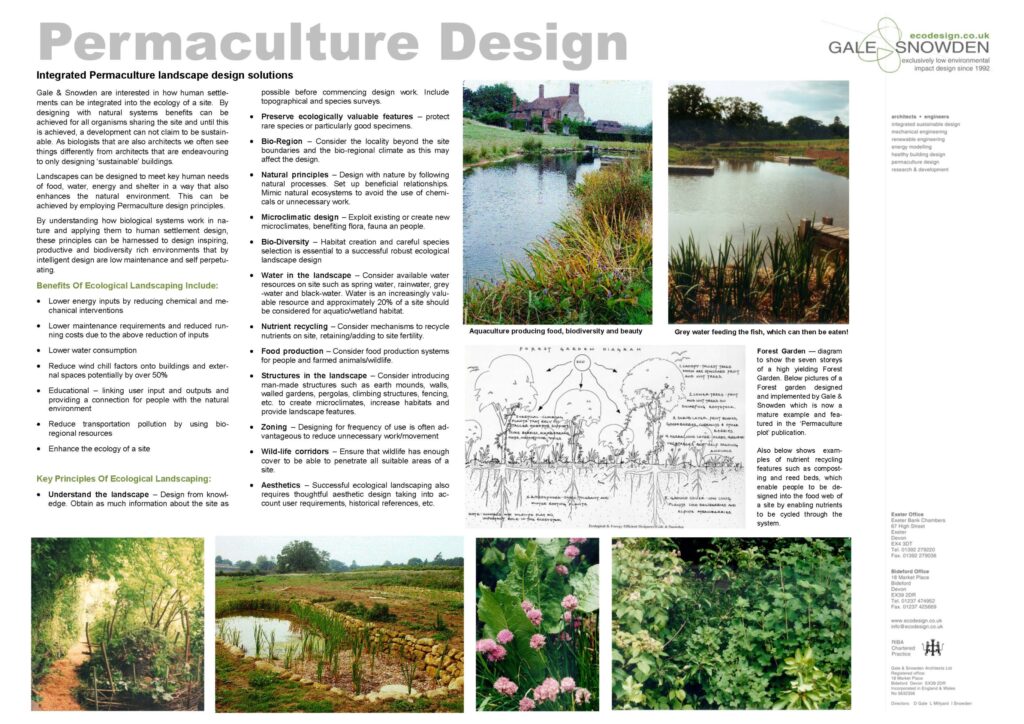
Gale & Snowden’s design work and services are informed by the ethos of Permaculture. The emphasis of Permaculture is on a design strategy based on integrated natural systems. The aim is to work with nature to obtain what we need, to guide it, and to make the most of what it has to offer.
Permaculture informs our design work so that we integrate people into designed, productive ecosystems that provide key human needs of food, water, energy and shelter in a way that also enhances nature and ecologically regenerates our environment. By applying ‘living systems understanding’ to human settlement design, we can harness nature to design inspiring, productive and biodiverse-rich environments that are low-maintenance and self-perpetuating; where humans can intentionally participate as part of nature, actively co-evolving the whole system.
The practice has numerous examples of working with nature and designing productive ecosystems – please see www.ecodesign.co.uk
3. Is the practice supporting nature locally and nationally? For example, does the practice support local gardens, gardeners, planting programmes, rewilding programmes or advocate for changes in legislation to protect nature.
We are long term members of the AECB, Permaculture Association and Building Biology Institute IBN who all support nature. We support the local Bideford Sustainability Group who undertake sustainability projects including natural planting in the local area. The practice has set up the Building Biology Association UK (BBA) in Association a not-for-profit organastio0n that has connections with the highly regarded Bulding Biology Institute IBN Germany. The practice runs the BBA on voluntary basis.
Project
1. Can the practice demonstrate projects which strive to match the performance of a mature ecosystem? As a minimum this would mean achieving biodiversity net gain.
Gale & Snowden have over 30 years’ experience in designing and implementing Permaculture design. Our work has been featured in publications such as ‘The Permaculture Plot’ and in architectural and environmental publications and magazines collaborating with a team of specialists including species, horticultural, and aquaculture consultants, we provide a full Permaculture design service that ranges in scale from private gardens to public parks and from forest gardens to whole working farms.
We can demonstrate projects where we have designed to increased bioactivity to that of a mature ecosystem or better.
2. Is the practice working on material stewardship? For example, evidence could be shown through repeated use of low carbon materials, extensive material libraries and research or publications supporting responsible use of materials and elimination of waste.
The practice tends to use locally sources, natural building materials that are non-toxic and least processed such as timber frame, timber cladding (eg green oak), wood fibre, earth plaster, stone, perforated solid clay blocks, organic paints, stains and waxes, mineral paints. We have a practice library and publications that we have collected over the 30+ years we have been in practice.
3. Do the majority of projects demonstrate the use of biologically-inspired approaches such as Bioregionalism, Biophilia, Biomimicry, Ecomimicry (also referred to as Ecosystems Thinking, Industrial Ecology or Industrial Symbiosis) or BioTRIZ?
The practice has a Permaculture ethos that runs through all the work that we do. The founding directors started his career as a Biologist and later became an Architect and who is a Certified Bulding Biologist registered with the Bulding Biology Institute IBN in German and our work has been recognised and featured in various publications including the book ‘Bulding Biology – Criteria and Architectural design by Nurgul Ece.
Creating a just space for people
Practice
1. Does the practice have a progressive EDI policy and can you evidence many forms of diversity, which are welcomed and acknowledged, within the practice?
Our practice adopts a friendly family approach to running the business and working together in a collaborative and supportive manner. The Practice are signatories of the RIBA Inclusion Charter. In accordance with Chartered RIBA practice, the practiced has an EDI policy. The practice can evidence many forms of diversity within the context of being a small practice.
2. Does the practice operate a no overtime culture, meet the living wage consistently, and stipulate a fair salary ratio between staff of all levels?
For the last 12 months the practice tested a change from a 5 day working week to a 4 day working week with no change to pay or working hours in the day. This was to done to create a better work life balance. After this 12 month test it has been decided by the practice to now operate a 34 hour week with flexibility for staff how they wish to work. The practice does not encourage an overtime culture. Staff wages are as per the RIBA guidelines for salaries. The Practice is moving towards becoming an EOT (Employee Ownership Trust).
3. Does the practice support charities, community groups, social enterprises, action groups and others through pro-bono work, charitable giving or in-kind donations?
The practice has limited funds but supports organisations that we believe are making a difference towards a more sustainable future eg AECB UK, Permaculture Association UK, Bulding Biology Institute IBN Germany, Sonnenhaus German (Solar Institute), Passivhaus Trust UK.
4. Does the practice publicly refuse to work with certain clients, suppliers or organisations on ethical grounds?
The practice tends to only take on projects that align with our Passivhaus, Building Biology and Permaculture values – this means we have turned work away on occasions. The practice’s clients tend to be community projects, local authority projects, schools and individual clients.
We do not and have never work on projects we think will degrade the environment or people’s health. The practice does not take on defence or prison projects.
Project
1. Do the projects demonstrate deep engagement with local stakeholders and end users? For example, is there evidence that your project engagement goes beyond consultation towards co-design?
The reason clients come to us is became we have specialised in integrated ecological design for over 30 years. Our project briefing always includes ecological design, including Permaculture, Passivhaus, Building Biology (healthy building) and renewable energy. Depending on the project, we often hold exhibitions and open days to engage with stakeholders. Over the years we have attended green building fayres, self build exhibitions and other construction exhibitions promoting ecological design (Ecological Design Association) and healthy Building (BBA – Bulding Biology Association UK).
2. Do your projects create connected and resilient places which positively contribute to their neighbourhoods and allow equality of access? For example, do your projects create economic opportunity, retain value locally and generate social value?
We would like to think so but we do not collate data to assess if they do. We design for equality of access. We do undertake post occupancy feedback and often return to past projects time and again to see how the buildings are performing and hear from occupants about their further feedback so that we can learn and make better buildings and landscapes. There is more we can do to more academically asses the projects contribution in the local economy and understand better the generation of social value.
However, for one of our community projects, Woolsery Sports and Community Hall, we are part of the community because some of us live in the parish – so we have seen first hand over 25 years the benefits to the local economy and enhanced social value that the project has helped bring to the local area.
We can evidence that the designs we produce retain their value locally because of high quality components used and high levels of quality control eg that come with adopting Passivhaus Certification and Building Biology principles.
3. Do the majority of your projects promote equity in society, and consider all people, not only the building inhabitants? For example, do your projects show due regard for workers within the supply chain and take active steps to avoid modern slavery?
We do consider more than the occupants of our buildings. A healthy building approach has regard to the health of the people manufacturing the materials and during construction as well as in occupation but also in maintenance of the building. This is why strategies such as use of natural, non-toxic materials and dust free sites are advocated by our practice. The choice of materials that can be easily cleaned and do not attract dust mites so that, for example, natural soap flakes can be used to clean surfaces properly rather than needing to use toxic cleaning agents.
Our practice promotes sustainable worthwhile jobs that lead to good heath outcomes by, for example, specifying the use of natural materials that are grown outside in polycultures. We wish to avoid condemning people to working in factories. We also do not promote the use of some recycled products such as those from car tyres because we do not wish to promote this industry but also car tyres contain toxic substances. It is better to promote health bio-based materials and products that can build a better more sustainable and positive world and at the same time nurture human skills and meaningful jobs for people. For these reasons, and ensuring locality is designed into buildings, we favour locally based labour/skills and local/time tested detailing over prefabricated modular building solutions.