
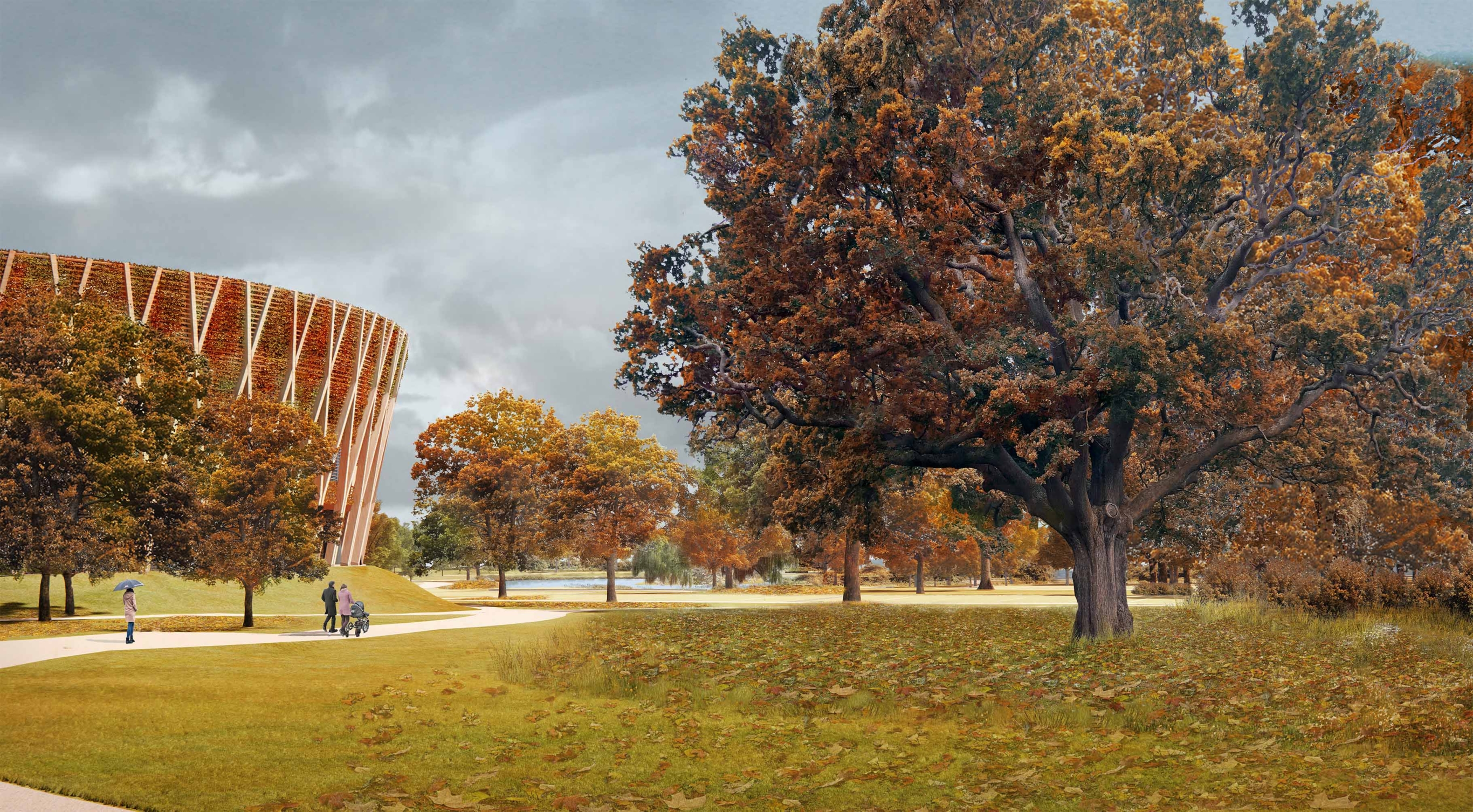
Submission by Allies and Morrison.
Being a good ancestor
Practice
1. Does the practice have a clearly stated purpose aligned with the planetary emergency? We are looking for a bold ambition here, and a practice culture which recognises the need for long-term thinking. For example, a strong mission, a theory of change, or a sustainability roadmap.
Extensive industry benchmarking, client interviews, and in-depth internal consultation has recently enabled us to refine our practice response to the planetary emergency by identifying our most impactful contribution:
Building on our deep understanding of urban placemaking we’ve established a responsive three-year roadmap, with clear priorities and enablers, to further refine ‘a unique and impactful expertise on sustainability at the neighbourhood scale’. Crucially, this scale allows us to identify where environmental and social benefits align with economic opportunity, to help our clients scale viable, high-impact solutions to benefit future generations. We are committed to long-term thinking and systems-based design, recognising that our response requires both bold ambition and pragmatism, values that sit at the heart of our practice.
This expertise is reinforced with a focus on the evolution of our portfolio of built projects to deliver regenerative and resilient solutions, and a commitment to lead by example through our practice operations.
2. Does the practice have a clear succession plan, which passes on ownership and protects the values and legacy of those who built and contributed to the practice? For example is the practice an employee owned trust.
For Allies and Morrison succession is non-transactional: equity is not bought or sold, but passed on through stewardship in alignment with our collective culture and mission. New partners are appointed to our Limited Liability Partnership (LLP), with a clear mandate of collegiate decision-making and long-term guardianship, prioritising the ethos of the practice over short-term gain. A formal succession covenant, embedded in our partnership agreement, ensures transparency and consistency across generations to safeguard the continuity of our culture and values which include a commitment to creatively address our planetary challenges. This has enabled the appointment of eleven new partners in the past decade. Profit distribution also extends beyond the partnership, reinforcing our belief in shared success and collective value creation. This structure allows us to honour the legacy of those who built the practice, while cultivating space for emerging leaders to shape its future with integrity, purpose, and continuity.
3. Does the practice share research and knowledge for the benefit of society and the wider world? For example, you regularly carry out post occupancy evaluation and share information with others.
Knowledge-sharing is central to our practice. Our annual ‘Citymakers’ conference brings together industry leaders to explore environmental and social challenges at the urban scale. We collaborate with universities through teaching, research, and via peer-reviewed publications like the Journal of Planning and Environmental Law. We also partner with public bodies such as Historic England on award-winning research like Complex City, the MHCLG on its review of the National Model Design Code and facilitate pro-bono capacity-building workshops for Local Planning Authorities on sustainable urban development.
We show our commitment to accountability by conducting Post Occupancy Evaluations (POEs) on all completed projects using the BUS Methodology, self-financed when necessary. In the past ten months, we’ve completed five POEs, with two underway and six planned. Findings are shared with clients, peers, and through Arup’s public data platform, reflecting our belief that shared knowledge helps raise the bar for design, performance, and environmental responsibility industry-wide.
Project
1. Does the practice advocate for long-term thinking at the outset of projects? Do you initiate projects with long-term thinking and challenge the client on design life? Also, can the practice demonstrate that this approach has worked with a shorter or longer design life, or an innovative approach to financing or payback period?
We begin every project by broadening its physical and temporal boundaries to consider both its immediate context and long-term legacy. Our analysis includes environmental, social, and historical dimensions, allowing us to anticipate change and embed resilience from the outset. This discipline is a hallmark of our work that translates into pragmatic design strategies, especially critical on our masterplans where extended timescales make long-term thinking more feasible and impactful.
Examples include:
- Ecological regeneration of a Capability Brown landscape from a private golf-course to a public park and tennis stadia for the Wimbledon championship
- Pioneering low carbon Passivhaus developments with ‘100yr design life’ for academic institutions enabled by in-depth lifetime cost assessments
- Reuse-led regeneration of Al Balad, Jeddah, reversing the harmful impact of vehicular infrastructure and re-establishing a vernacular urban grain with passive cooling. This enhances the Old Town, regenerating tourism to ease the transition from a petrochemical-based economy.
2. Do your projects take account of the future climate and the need for resilience? For example, do the projects demonstrate flexibility, design for adaptation, design for disassembly, non-deterministic solutions, or demountable structures.
Future climate resilience is an increasingly integral part of our design approach. It is now common for us to explore multiple climate scenarios with our clients, particularly those who are long-term natural asset holders and therefore most attuned to the risks and responsibilities of future-proofing. This mindset has led to the inclusion of future retrofit feasibility studies within our built projects and the integration of climate shelters, storm-water management systems, and resilient public realm strategies in our masterplans. We routinely explore non-deterministic solutions, such as flexible structural grids and demountable elements, to enable adaptation over time. In several projects, we are testing the limits of off-grid resilience, designing systems that anticipate potential water and energy shortages while maintaining comfort and usability. These efforts reflect our belief that climate resilience is not a constraint, but a design opportunity–enabling more robust, adaptable, and ultimately longer-lasting environments for people and communities.
3. Do the majority of your projects go beyond mitigating negatives and towards optimising positives? For example, are they meeting or exceeding the RIBA 2030 Challenge.
We actively manage a live project tracker across our portfolio, assessing each project’s sustainability potential using a clear framework that ranges from ‘business as usual’ to ‘exemplar’. This tool enables us to calibrate ambition, track progress, and hold ourselves accountable. Our sustainability strategy includes an annual target to shift our portfolio mix toward a majority of impact-driven pioneering projects, aligned with the RIBA 2030 Challenge and beyond. While it would be simpler to focus solely on working with already progressive clients, we believe greater impact lies in advocating for change, bringing more conventional briefs toward ambitious environmental and social outcomes. We’ve found this client-focused approach highly effective, particularly when we align sustainability measures with long-term commercial benefits such as lifecycle savings, operational efficiency, and enhanced asset value. This proactive strategy not only raises the performance of individual projects but also drives broader, systemic improvement across our practice and industry.
Co-evolving with nature
Practice
1. Does the practice use biophilia within the office or regularly host meetings and retreats in natural settings? For example do you have extensive planting within the office or rely on natural patterns and imagery for stress relief or quiet areas.
N/A.
2. Can the practice share examples where it has considered nature in decision making? For example by having a nature proxy to encourage eco-centric decision making, using natural systems as inspiration for the company structure, recognising the seasonal nature of people’s capacity and workload or celebrating equinoxes and solstices together.
N/A.
3. Is the practice supporting nature locally and nationally? For example, does the practice support local gardens, gardeners, planting programmes, rewilding programmes or advocate for changes in legislation to protect nature.
N/A.
Project
1. Can the practice demonstrate projects which strive to match the performance of a mature ecosystem? As a minimum this would mean achieving biodiversity net gain.
N/A.
2. Is the practice working on material stewardship? For example, evidence could be shown through repeated use of low carbon materials, extensive material libraries and research or publications supporting responsible use of materials and elimination of waste.
N/A.
3. Do the majority of projects demonstrate the use of biologically-inspired approaches such as Bioregionalism, Biophilia, Biomimicry, Ecomimicry (also referred to as Ecosystems Thinking, Industrial Ecology or Industrial Symbiosis) or BioTRIZ?
N/A.
Creating a just space for people
Practice
1. Does the practice have a progressive EDI policy and can you evidence many forms of diversity, which are welcomed and acknowledged, within the practice?
N/A.
2. Does the practice operate a no overtime culture, meet the living wage consistently, and stipulate a fair salary ratio between staff of all levels?
N/A.
3. Does the practice support charities, community groups, social enterprises, action groups and others through pro-bono work, charitable giving or in-kind donations?
N/A.
4. Does the practice publicly refuse to work with certain clients, suppliers or organisations on ethical grounds?
N/A.
Project
1. Do the projects demonstrate deep engagement with local stakeholders and end users? For example, is there evidence that your project engagement goes beyond consultation towards co-design?
N/A.
2. Do your projects create connected and resilient places which positively contribute to their neighbourhoods and allow equality of access? For example, do your projects create economic opportunity, retain value locally and generate social value?
N/A.
3. Do the majority of your projects promote equity in society, and consider all people, not only the building inhabitants? For example, do your projects show due regard for workers within the supply chain and take active steps to avoid modern slavery?
N/A.