
Submission by AEW Architects.
Being a good ancestor
Practice
1. Does the practice have a clearly stated purpose aligned with the planetary emergency? We are looking for a bold ambition here, and a practice culture which recognises the need for long-term thinking. For example, a strong mission, a theory of change, or a sustainability roadmap.
“We’re a collaborative placemaking practice with our communities, clients and environment at the heart of our thinking.”
Our differences:
“We bring diverse expertise and a broad perspective to all projects. We’re focused on creating places for the future. We’re inspired by our people and our communities.”
Environmental Policy Extract:
“We recognise the climate and biodiversity emergencies and believe that our activities should have a positive effect on the environment and society. To this end we commit to protecting the environment, including the prevention of pollution. Our activities must respect planetary boundaries and the ecological ceiling whilst ensuring a just social foundation for all. We seek to achieve positive outcomes for our clients and business partners, the community, and our employees. We embrace the UN Sustainable Development Goals and are continually working to increase our understanding and position in a truly sustainable world.” https://www.aewarchitects.com/our-approach/sustainability
2. Does the practice have a clear succession plan, which passes on ownership and protects the values and legacy of those who built and contributed to the practice? For example is the practice an employee owned trust.
No.
3. Does the practice share research and knowledge for the benefit of society and the wider world? For example, you regularly carry out post occupancy evaluation and share information with others.
We also have a Knowledge Share external CPD programme we are using to upskill Clients on Net Zero Carbon, Passivhaus and Retrofit to share our project experience and analysis to help influence future projects to have higher aspirations and move beyond minimizing harm towards having a positive environmental impact. We also help to upskill and educate tomorrow’s industry professionals through our support of Design Engineer Construct! at a local school. Where we have contributed 62 volunteer hours to support 170 student learning hours. We have also supported 14 works experience students and are currently mentoring 2 apprentices. Our team sits on CIATs Climate Society and UK Net Zero Carbon Building Standard working groups. We are also members of Manchester Climate Change Partnership.
Project
1. Does the practice advocate for long-term thinking at the outset of projects? Do you initiate projects with long-term thinking and challenge the client on design life? Also, can the practice demonstrate that this approach has worked – with a shorter or longer design life, or an innovative approach to finacing or payback period?
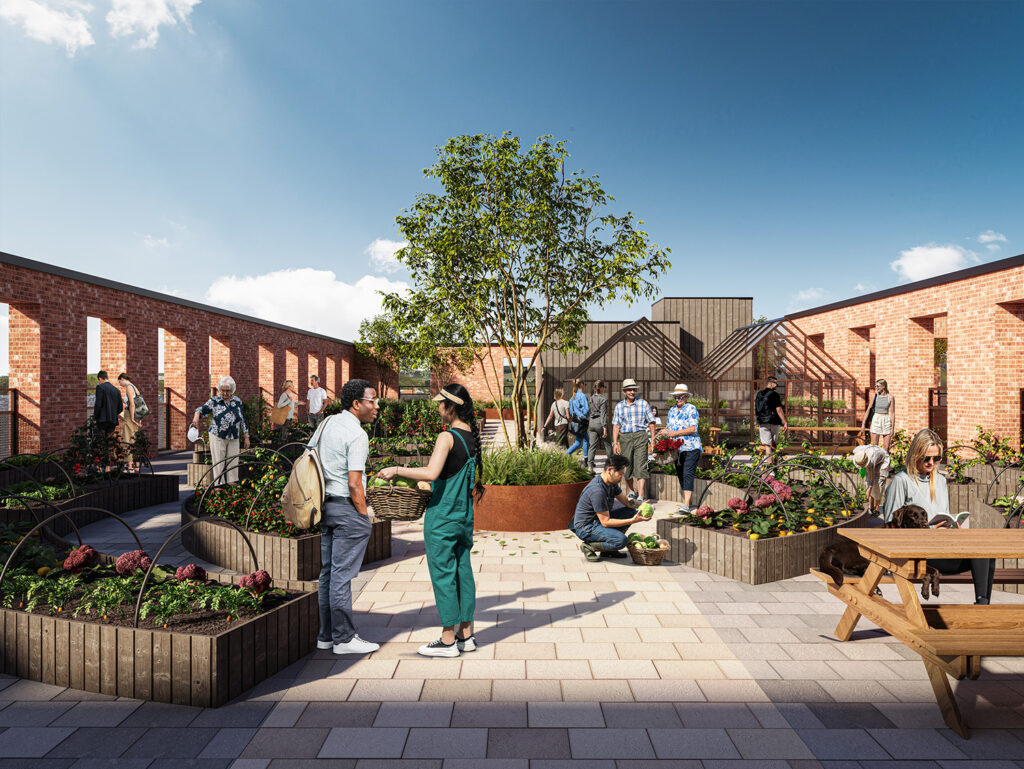
Our work to promote Passivhaus Standards to our Clients is an example of our advocacy for encouraging clients to invest in a project that shall deliver long term savings and benefits. Some notable examples include Parkmount, Manchester a low rise development of 24 socially rented homes that is currently onsite. We also have Fletcher Street, Stockport a 245 home scheme currently in planning which is targeting the Passivhaus Institute Low Energy Standard. Also of note for this project is its commitment to age friendly design providing resilience to an aging population within its unit mix and level of accessibility rather than focusing on short term profitability. The project also features a shared laundry facility and rooftop community allotment.
https://www.aewarchitects.com/projects/parkmount-and-princedom/
https://www.aewarchitects.com/journal/plans-submitted-for-70m-passivhaus-low-energy-scheme-in-stockport/
2. Do your projects take account of the future climate and the need for resilience? For example, do the projects demonstrate flexibility, design for adaptation, design for disassembly, non-deterministic solutions, or demountable structures.
Many of our non-domestic projects have a design for disassembly and end of life study, and a climate adaptability study carried out at RIBA stage 2. A notable project example where we pioneered an enhanced consideration of design for disassembly and reuse is the Co-Op at Steeple Claydon, this project was off the back of a two year conceptual project with a key brief requirement for disassembly and circular economy principals. The scheme utilised screw-pile foundations and a hybrid timber frame such that at least 80% of the foundations, superstructure, glazing, cladding and insulation are fully demountable.
https://www.aewarchitects.com/projects/co-op-steeple-claydon/
3. Do the majority of your projects go beyond mitigating negatives and towards optimising positives? For example, are they meeting or exceeding the RIBA 2030 Challenge.
No.
Co-evolving with nature
Practice
1. Does the practice use biophilia within the office or regularly host meetings and retreats in natural settings? For example do you have extensive planting within the office or rely on natural patterns and imagery for stress relief or quiet areas.
One of the key design features for our office, designed by our interior design team, was to embed biophilic design throughout to enhance user wellbeing. This ranges from plants on desks to greenery fringing the meeting rooms and communal kitchen/breakout space. We also have access to a large outdoor terrace, so even though we are in central Manchester there is the opportunity to have meetings outside when weather permits. Our team are using the balcony for a mini allotment, helping the team to reconnect to nature on breaks from work.
https://www.aewarchitects.com/projects/trinity-manchester/
2. Can the practice share examples where it has considered nature in decision making? For example by having a nature proxy to encourage eco-centric decision making, using natural systems as inspiration for the company structure, recognising the seasonal nature of people’s capacity and workload or celebrating equinoxes and solstices together.
No.
3. Is the practice supporting nature locally and nationally? For example, does the practice support local gardens, gardeners, planting programmes, rewilding programmes or advocate for changes in legislation to protect nature.
Everyone at the practice has a volunteer day and we make sure to share opportunities where people can choose to spend this supporting nature locally. We regularly share volunteer opportunities with City of Trees both planting new woodlands and helping to maintain existing green areas within the region.
In addition to our time we also invest in offsetting our emissions, we know this is no substitution for long term reductions but we double up on any international offsets we purchase to match this investment in supporting reforestry and nature conservation within the UK.
Project
1. Can the practice demonstrate projects which strive to match the performance of a mature ecosystem? As a minimum this would mean achieving biodiversity net gain.
On Moneypenny’s 2019 office development in Wrexham we worked to ensure that we were sensitive to, and respected, the environmental requirements of this site to create an ecologically robust landscape that responds to surface water drainage and ecology in a way that is sustainable for future generations. Slight adverse impacts of the development in the short/medium term were expected to have a residual positive biodiversity impact following enhancements. The scheme involved creation of meadows, orchard and wetland across the 10 acre site. Former arable areas surrounding the new office and car park were improved to match the ecology of adjacent grassland, wetland and woodland habitats. The new wetland provided functional SUDs, habitat creation for Otters linking existing wetland features and opportunities for building users to connect with nature.
https://www.aewarchitects.com/projects/moneypenny-wrexham/
2. Is the practice working on material stewardship? For example, evidence could be shown through repeated use of low carbon materials, extensive material libraries and research or publications supporting responsible use of materials and elimination of waste.
We present low carbon materials of the month both in terms of more sustainable interior design and architectural construction materials to help to raise awareness and collective knowledge. We have a Sustainable Outcomes Toolkit which helps to drive best practice to reduce embodied carbon through design and specification, we also apply Life Cycle Assessment to a number of our projects to quantify embodied carbon, inform decision making and make the case for natural and low carbon materials. On many projects we also have a Materials Efficiency Strategy to help to empower the whole design and construction team to reduce waste. We have been expanding on this by sharing research into embodied ecological and social justice impacts rather than just focusing on carbon.
3. Do the majority of projects demonstrate the use of biologically-inspired approaches such as Bioregionalism, Biophilia, Biomimicry, Ecomimicry (also referred to as Ecosystems Thinking, Industrial Ecology or Industrial Symbiosis) or BioTRIZ?
No.
Creating a just space for people
Practice
1. Does the practice have a progressive EDI policy and can you evidence many forms of diversity, which are welcomed and acknowledged, within the practice?
We have an EDI policy to ensure that all forms of diversity are welcomed and acknowledged within the practice.
We are signatories of the RIBA Inclusion Charter and have established a dedicated Team to push our EDI agenda. They mark occasions like Black History Month and Pride with CPDs and events to highlight issues and broaden understanding. The EDI team have collaborated on a number of call in & call out events this year to help drive best practice in the industry. We provide a multi-faith space in the office, are a Disability Confident Committed Employer and publish our gender pay gap.
In 2024 we were highly commended in The Times Best Places to Work as one of the Best Places to work for LGBTQIA+ employees and we were also shortlisted for AJ Employer of the Year in 2024.
2. Does the practice operate a no overtime culture, meet the living wage consistently, and stipulate a fair salary ratio between staff of all levels?
In the first instance, we aim to avoid our team working overtime. We monitor and review timesheets monthly to identify those working overtime and speak with individuals to identify any issues and implement training, alter resourcing arrangements or organise recruitment as required. We also operate highly flexible hybrid and flexible working arrangements, enabling our team to better balance their time against workloads and deadlines and take time off in lieu. We relaxed our core hours in 2023 to add even more flexibility for staff.
We are a living wage employer and member of the Living Wage Foundation and Greater Manchester Good Employment Charter. We publish salary bandings and benchmarks annually to be transparent about salaries between staff at all levels.
3. Does the practice support charities, community groups, social enterprises, action groups and others through pro-bono work, charitable giving or in-kind donations?
Our Social Value and Wellbeing Group continue to lead events throughout the year, raising money for charities towards our target for 2% of profits to be donated to charitable causes. This year we supported Canopy Housing in Leeds with 20 volunteer days to help support retrofit of empty homes to benefit those at risk of homelessness with a home that they have helped created and learn new skills. We also supported Canopy with a bake off and raffle to raise funds for their work. Alongside our volunteering and fundraising we are also working pro bono to support the delivery of Embassy Village in Manchester, a pioneering community of 40 homes providing short and medium term accommodations to homeless men.
4. Does the practice publicly refuse to work with certain clients, suppliers or organisations on ethical grounds?
We have a stringent Sub Consultant on boarding process where suppliers and organisations we work with must demonstrate and evidence their finacial, professional, health and safety, people, environmental and quality management processes. If suppliers and organisations cannot meet these requirements then we will not work with them.
Where we have new Clients we carry out due diligence to ensure that they are aligned with our B Corp commitments in terms of companies engaged in controversial issues with potential for negative impacts.
Our current strategy is to engage with our clients and supply chain to improve their sustainability and ethical performance wherever possible.
Project
1. Do the projects demonstrate deep engagement with local stakeholders and end users? For example, is there evidence that your project engagement goes beyond consultation towards co-design?
Particularly in our large scale retrofit work, where we are working to enhance housing estates with residents in-situ we go beyond resident consultation into a co-design approach. Around 12% of our our turnover is on such projects, including notable examples at Lancaster West Estate, London and in North Manchester at Newton Heath. On these projects we have undertaken extensive collaborative co-design between design team, residents, stakeholders and client where many major decisions are jointly decided.
https://www.aewarchitects.com/projects/morland-house-talbot-grove-house-london/
https://www.aewarchitects.com/projects/croydon-drive-newton-heath/
2. Do your projects create connected and resilient places which positively contribute to their neighbourhoods and allow equality of access? For example, do your projects create economic opportunity, retain value locally and generate social value?
Sale West, is a 43ha housing estate regeneration to provide 263 new homes and a range of estate improvements for the benefit of the community. Connectivity is improved to design out social value problems and to improve accessibility for all.
We have a comprehensive social value plan in place, including the three year “adoption” of Ashton on Mersey School using Class Of Your Own’s ‘Design Engineer Construct!’ training to inspire local children to discover unique pathways into the construction industry. We have established an architecture club, led site visits and hosted a number of candidates for work experience.
The success of the social value activities has led to the following awards:
- Regeneration of the Year (Northern Housing Awards), Winner
- Neighbourhood Transformation Award (Affordable Housing Awards), Finalist
- Social Impact Award (Insider NW Residential Property Awards), Winner
- Regeneration of the Year (Inside Housing Development Awards), Winner
3. Do the majority of your projects promote equity in society, and consider all people, not only the building inhabitants? For example, do your projects show due regard for workers within the supply chain and take active steps to avoid modern slavery?
Our EDI team helps to promote equitable design in our projects.
We are committed to acting ethically and with integrity in all our business relationships and taking reasonable steps to ensure slavery and human trafficking are not taking place in any business or organisation that has any sort of a business relationship with our Company. We have a Modern Slavery Policy which includes a whistleblowing process, and all staff under went mandatory training this year.
We have carried out research and delivered training into embodied social justice impacts, to help raise awareness of our team on potential hidden equity and wellbeing impacts in the supply chain from their design and specification decisions.